Product image supplied by the brand
In this guide
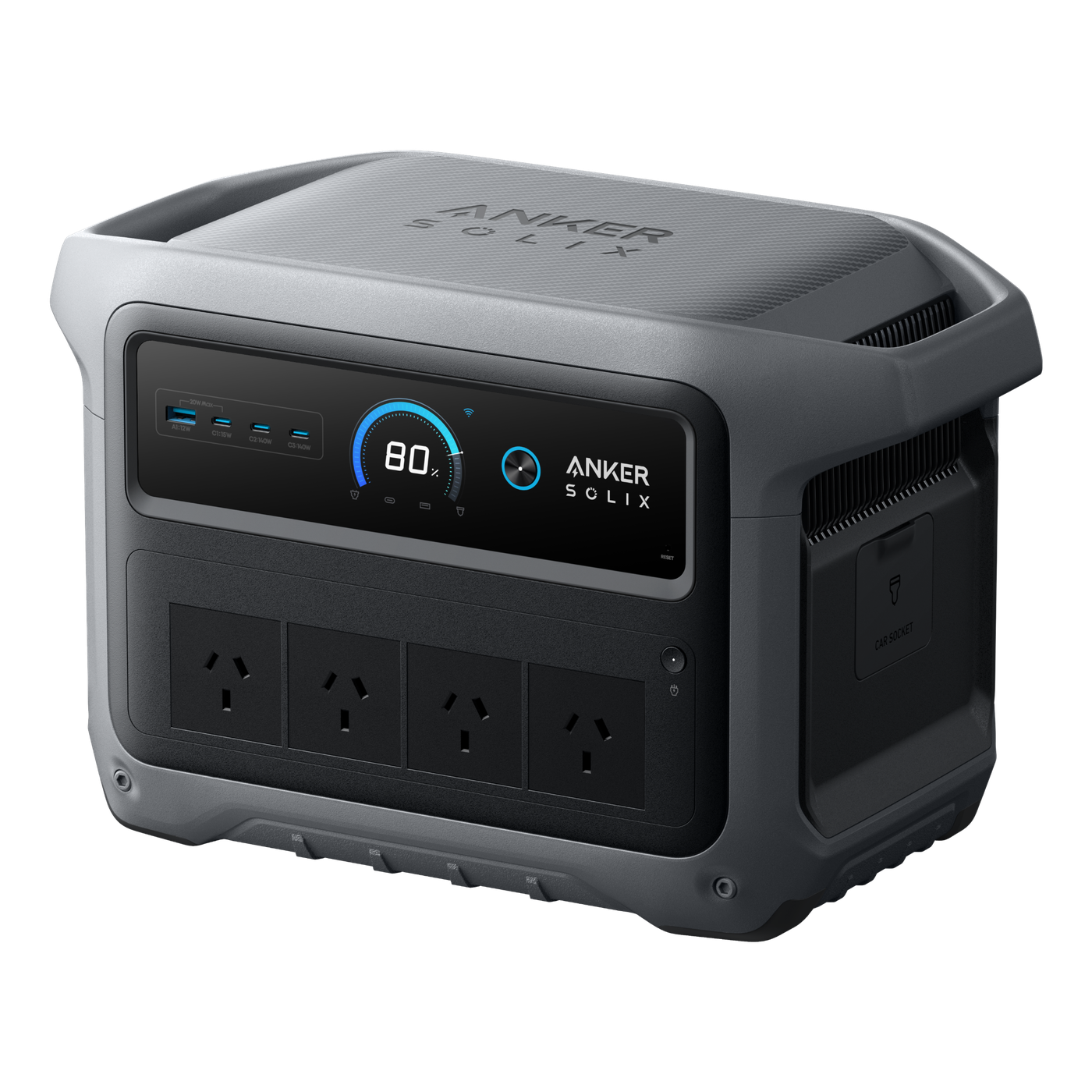
The SOLIX C1000 Gen 2, model A1763, stores 1,024Wh in LiFePO4 cells and puts out 2,000W continuous. The version Anker sells in Australia differs from the American one where it matters at the wall: its front panel carries four Australian three-pin sockets, Anker counts nine ports in all against ten in the US, and its maximum bypass is 2,250W against 1,800W.
On 5 November 2026 Amazon Australia listed it at A$1,099, shipped and sold by AnkerDirect AU. Anker's own Australian store printed A$1,599 for the same station and brought it down with automatic codes that expire, so A$1,099 is the steadier figure to compare against.
What the money buys is speed from a wall socket, an LCD and a case Anker puts at 11.3 kg. What it gives up is any way to add capacity later, which Anker states plainly on the Gen 2's own FAQ.
Our verdict
Buy the Australian C1000 Gen 2 for a fast wall-socket refill in an 11.3 kg case; if a second battery may ever join the setup, Anker itself points to the C1000 instead.
- A good fit for
- A household that wants about 1 kWh on a shelf for a CPAP, a modem and a fridge during an outage, refilled from a 230 V wall socket between blackouts.
- We would skip it if
- Skip it if you may add a second battery, need more than four AC sockets at once, or want a station you can send back after delivery: Amazon lists it as non-returnable.
Reasons to consider it
- Anker's Australian page rates it at 2,000W continuous and 3,000W peak from 1,024Wh of LiFePO4 kept above 80 percent after 4,000 cycles
- UltraFast lifts AC input to 1,600W from the standard 1,200W, and the 10 ms UPS switchover covers a CPAP or a modem when the grid drops
- Anker's Australian family page states a five-year warranty, and the station weighs 11.3 kg at 384 x 208 x 244 mm
The compromises
- No expansion battery: Anker's FAQ says the Gen 2 leaves expansion out to save weight and size and recommends the C1000 for expandable capacity
- The 49-minute refill needs UltraFast switched on in the Anker app and a battery above 20 °C, and unplugging the AC cable switches it off again
- The Australian version has four AC sockets and nine ports in all, where the American model has five outlets and ten ports
What we have not verified: Open: Anker's Australian product page and the Amazon listing still print the American 120 V / 60 Hz input line beside photos of Australian sockets, the Australian user guide prints no voltage, and box contents differ between the guide and Amazon.
The things in this guide
A closer look at the products, who they may suit, and what to check before buying.
SOLIX C1000 Gen 2 Portable Power Station · A1763
A$1,099 from AnkerDirect AU on Amazon: 1,024Wh of LiFePO4 rated for 4,000 cycles to 80 percent, 2,000W continuous across four Australian sockets, a 1,600W UltraFast refill and a 10 ms UPS switchover in an 11.3 kg case.
Before you buy: Anker's FAQ rules out an expansion battery, the 49-minute refill needs the app and a warm battery, and Amazon Australia will not take the station back after delivery because it ships as hazardous goods.
Price checked 5 November 2026. Retailer prices can change.Four Australian sockets, nine ports, 2,250W of bypass
Anker's Australian specification block for the C1000 Gen 2 lists four AC outputs, a 2,250W maximum bypass and the same 2,000W rated, 3,000W peak output as elsewhere. Add four USB ports and a car socket and the count is nine ports, which is what both Amazon Australia and Anker's Australian page say. The listing photos match: four three-pin sockets in a row under the display.
For a blackout plan that means four mains plugs at once, so a power board goes on the list if a fridge, a CPAP, a modem and a lamp all need to stay on. The USB side is generous: two USB-C ports at up to 140W each, a 15W USB-C and a 12W USB-A, the last two sharing 20W.
One line on the local pages does not fit. Anker's Australian product page and the Amazon listing both still print the American input line, 120 V at 60 Hz, beside photos of Australian sockets, and the Australian user guide prints no voltage at all. Ask AnkerDirect AU to confirm the rating plate before ordering.
The 49 minutes is a mode you switch on, not the default
Out of the box the station charges from the wall at up to 1,200W. The 1,600W figure behind the 49-minute claim is UltraFast, which the Australian user guide says is switched on in the Anker app, recommends only when necessary to protect the battery, and turns itself off every time the AC charging cable comes out. It also cannot run while the app's time-of-use mode is active.
Temperature is the second condition. Anker's FAQ says UltraFast only activates with the battery above 20 °C and that charging between 0 and 20 °C significantly reduces the speed. A garage in a Canberra July or a car boot overnight will not see 49 minutes; plan on the standard 1,200W rate and a longer wait unless the station lives indoors.
No second battery, and the C1000 Anker recommends instead is sold out locally
Anker's Australian FAQ answers the expansion question directly: to improve portability the Gen 2 has no expansion feature, and the original C1000 is recommended for anyone who needs expandable capacity. The comparison table on the same page puts the trade in numbers: the Gen 2 holds 1,024Wh against 1,056Wh, refills in 49 minutes against 58 on 1,600W of AC input against 1,300W, switches its UPS in 10 ms against 20 ms, and cannot be expanded where the C1000 can.
In Australia that alternative is hard to buy. Anker's Australian C1000 page showed the station sold out at A$699 on 5 November 2026. So the choice for most buyers is this station as it stands, about 1 kWh for good, or a bigger station from the start if 1,024Wh is already marginal for the appliances on the list.
A$1,099 on Amazon, a higher printed price at Anker, and no change-of-mind return
Amazon Australia listed the station at A$1,099, shipped and sold by AnkerDirect AU, with dispatch in two to three days. Anker's Australian store printed A$1,599 and lowered it with automatic codes, one of them expiring on 8 November, so its checkout price moves with promotions; compare the two on the day.
The returns differ by channel. Amazon marks the station 'Non-returnable due to hazmat safety reasons', while Anker's store advertises a 30-day money-back guarantee. Either way the five-year warranty on Anker's Australian family page applies, and Anker notes that its limited warranty does not affect statutory rights, which in Australia means the consumer guarantees under the Australian Consumer Law.
Box contents are listed two ways. Amazon names the station, an AC charging cable, a car charging cable, a quick start guide and a warranty card; the Australian user guide shows only the station, the AC cable and documents. Count on the AC cable and treat the car cable as a bonus if it arrives.
Who should buy it, and the setup details that matter before an outage
Take the Gen 2 when the station will sit on a shelf, be carried at 11.3 kg and refill from a wall socket, where its 1,600W UltraFast input does its work. Look elsewhere when the setup may grow, when four AC sockets are too few without a power board, or when a 600W solar input is too small for the panels already on the roof rack.
For backup the user guide sets the conditions: plug the station into a wall outlet with the supplied AC cable and press the AC output button, and the UPS takes over in 10 ms. SurgePad lets heating appliances draw up to 2,400W, but not while the station passes grid power through. Solar panels go in parallel with open-circuit voltage within 60V.
How we put this together
Built from the product pages and listings below, without test scores or results we have not measured. Specifications and prices change, so check the original page for the exact model, current price, delivery, and returns.
- Amazon Australia: Anker SOLIX C1000 Gen 2 Portable Power Station (ASIN B0FN7MSY4L) (opens in a new tab)
- Anker SOLIX Australia: C1000 Gen 2 Portable Power Station product page (opens in a new tab)
- Anker SOLIX Australia: C1000 Gen 2 and C2000 Gen 2 family page (opens in a new tab)
- Anker SOLIX: C1000 Gen 2 user guide, Australian edition (A1763_AU_UG_V1, 2026-02-09, PDF) (opens in a new tab)