Product image supplied by the brand
In this guide
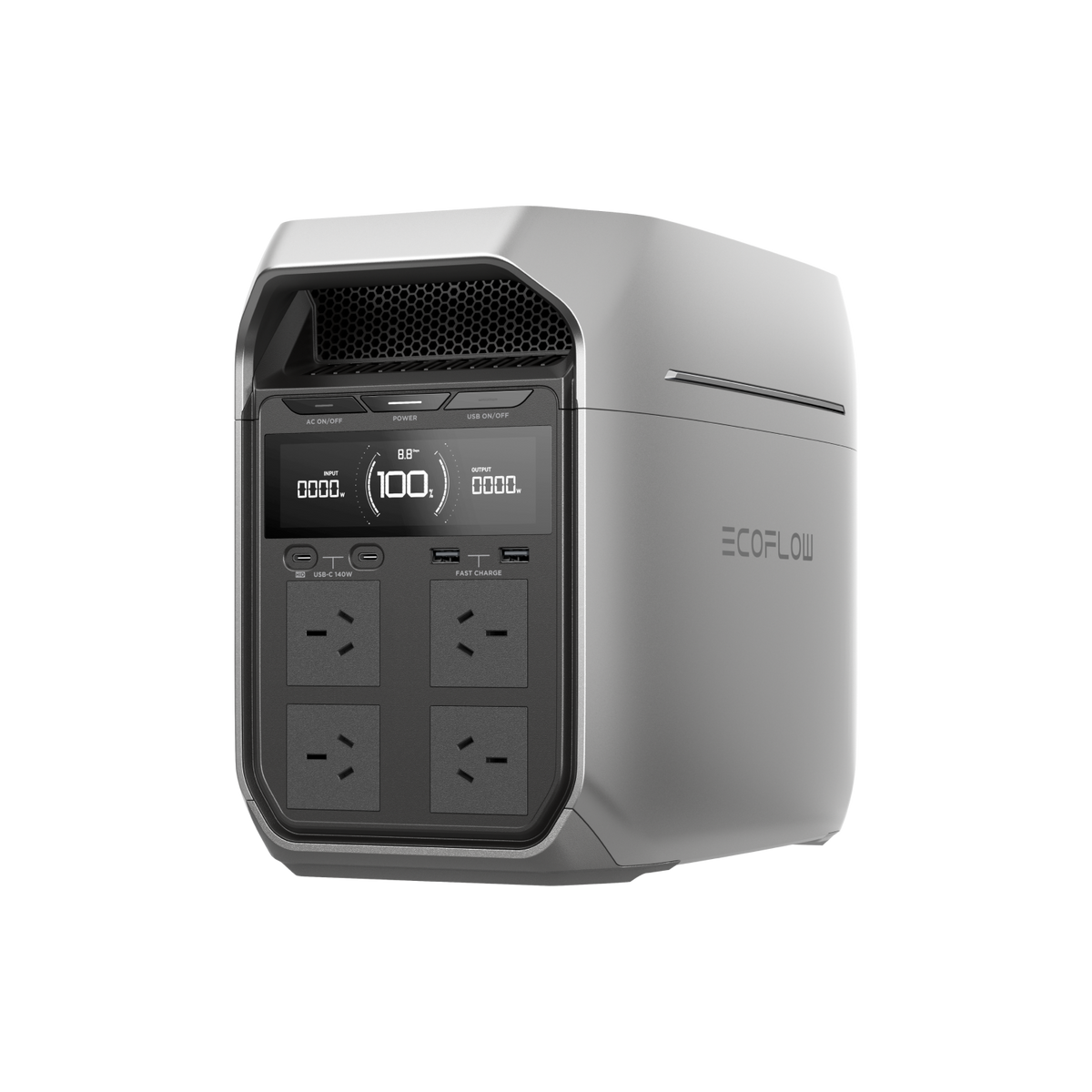
The DELTA 3 Plus sold in Australia is a different chassis from the one in the American review, and that difference shapes everything below. This is the 230V/50Hz model, SKU EFDELTA3P-AU: four AC outlets rather than six, 11 output ports rather than 13, an X-Boost ceiling of 2,400W rather than the 2,200W or 2,600W printed in two places on the US page, and a mass stated in kilograms — up to 12.5 kg, in a 398 by 202 by 284 mm case. Capacity and inverter are unchanged: 1,024Wh of LiFePO4, 1,800W across those four sockets with a 3,600W surge, and A$1,599 at EcoFlow's Australian store on 5 November 2026.
What A$1,599 buys that Anker's cheaper station does not is a port. EcoFlow's DELTA 3 Series Extra Battery, A$1,399 here, plugs into the station's Extra Battery port and takes capacity to 2,048Wh; the station and one battery sold together were A$2,699 against a A$2,999 comparison price. The catch is the arithmetic a buyer here faces: the battery costs A$200 less than the station it doubles, where in the United States it costs about half the station's price.
Our verdict
Buy the DELTA 3 Plus at A$1,599 for its second solar input, its 140W USB-C, or the A$2,699 bundle with a second battery. For 1kWh on its own, Anker's C1000 Gen 2 is A$999 and EcoFlow's DELTA 3 is A$1,499.
- A good fit for
- A household that wants 2kWh through the A$2,699 bundle, or that buys 1kWh now and will charge from up to 1,000W of solar or run 140W USB-C laptops.
- We would skip it if
- The station will live plugged in as a UPS, where X-Boost cuts out, or no battery will be added and 500W of solar is enough: the A$1,499 DELTA 3 has the same inverter.
Reasons to consider it
- A$2,699 for the station and one battery against A$2,998 bought separately, a A$299 saving that the American listing does not offer
- X-Boost reaches 2,400W on the 230V model, enough for EcoFlow's own examples of a 2,150W oven and 1,800W hair dryer, with a 3,600W surge underneath
- Five years of warranty in EcoFlow's Australian table, an LFP pack rated for 4,000 cycles to 80 percent, and a UPS transfer under 10 ms
The compromises
- Four AC outlets, not the six the US model carries, and 11 ports in total against 13 — the 230V panel is smaller
- The A$1,399 battery is 88 percent of the station's price, so doubling capacity costs A$2,699 rather than the roughly 1.5 stations an American buyer pays
- X-Boost is off while the station charges or passes grid power through, and EcoFlow warns it lowers voltage enough to stop devices that protect against low voltage
What we have not verified: EcoFlow's Australian page states the X-Boost ceiling twice and not the same way: the specification block and the headline bullet say 2,400W, while a paragraph further down claims it handles appliances 'over 2600W'. The 2,400W figure matches the 230V row of EcoFlow's own manual, which gives 2,200W at 220V and 2,600W at 120V, so 2,400W is the number used here. The page also carries the same pre-order sentence under the buy box that EcoFlow's other stores print as a template, while its product data marks the SKU in stock, and it prints no load-to-runtime table, no output voltage in the specification block and no end date for the bundle price. Anker's Australian page gives the C1000 Gen 2 2,000W with a 3,000W peak and no SurgePad figure, and the Australian page does not say in so many words whether the DELTA 3 takes the extra battery; EcoFlow's battery pages in other markets sell the same EFDELTA3P-EB pack for both models.
The things in this guide
A closer look at the products, who they may suit, and what to check before buying.
DELTA 3 Plus Portable Power Station · EFDELTA3P-US
A$1,599 at EcoFlow's Australian store buys 1,024Wh of LFP rated for 4,000 cycles, 1,800W across four AC outlets with a 3,600W surge, 2,400W of X-Boost headroom on 230V, and a battery port that reaches 2,048Wh with the A$2,699 bundle.
Before you buy: Anker's C1000 Gen 2 is A$999 at Anker's own store and A$1,099 on Amazon for the same 1,024Wh and 2,000W continuous with no battery port at all, and EcoFlow's own DELTA 3 is A$1,499 in the same store.
Four sockets, not six
Start with the panel, because the American review of this station describes a machine that is not on sale here. The Australian model carries four AC outlets where the US one carries six, and 11 output ports where the US one carries 13: two USB-C at 140W, two USB-A at 36W, two DC5521 at 12.6V and 3A, plus the four AC sockets sharing 1,800W with a 3,600W surge. The case is 398 by 202 by 284 mm and weighs up to 12.5 kg.
The ceiling moves with the voltage. EcoFlow's specification block gives 2,400W as the maximum device power with X-Boost, and its own manual puts that figure on the 230V row, against 2,200W at 220V and 2,600W at 120V. The examples in the page's copy — a 2,150W oven, an 1,800W hair dryer, a 1,200W kettle — are all comfortably inside 2,400W; the same page's other paragraph, which claims appliances over 2,600W, is not.
The second battery costs almost as much as the station
The A$1,399 extra battery is the reason to choose this station and the reason to hesitate in Australia. Per watt-hour the station is A$1.56, the battery A$1.37 and the pair A$1.32; in the United States the pack is roughly half the station's price, so the doubling argument is stronger there than here. Bought separately the two come to A$2,998, which makes the A$2,699 bundle the cheaper way to reach 2,048Wh by A$299.
Whether 2,048Wh is enough is a separate sum, and EcoFlow publishes no load-to-runtime table. On the label, 1,024Wh against a 100W average draw runs a little past ten hours before inverter losses, and 2,048Wh a little past twenty. A fridge, router and three lamps averaging 100W across a day use 2.4kWh, which neither configuration covers.
X-Boost on 230V, and the three conditions
X-Boost is how a 1,800W inverter feeds an appliance labelled above that rating: EcoFlow's explanation is that it marginally reduces voltage so a smaller inverter can carry a bigger load. The conditions decide whether it works at all. It is switched on in the EcoFlow app, and the manual says it ships disabled while EcoFlow's global X-Boost page says enabled by default; it is unavailable whenever the station is charging or passing grid power through, so a unit left plugged in as a UPS never reaches the 2,400W ceiling; and the manual warns that devices with voltage protection, precision instruments among them, may stop working under the reduced voltage.
The practical version for an Australian buyer is a kettle or a hair dryer on a power board in a blackout, not a fixed appliance. Anything that runs from the wall every day is better served by the wall.
Against A$1,099 of Anker, and EcoFlow's own cheaper stations
Anker's SOLIX C1000 Gen 2 was A$999 on Anker's own Australian store on 6 November 2026, in stock, and A$1,099 from AnkerDirect AU on Amazon, which marks it non-returnable for hazmat reasons: 1,024Wh, 2,000W continuous with a 3,000W peak, and a 49-minute charge. That is A$600 less at Anker's store for the same capacity, 200W more continuous output and a faster wall charge, and Anker's own comparison table marks it not expandable.
EcoFlow undercuts itself twice in the same store. The DELTA 3 is A$1,499, A$100 less, with the same 1,024Wh, four outlets, 1,800W inverter and 2,400W X-Boost, but one 500W solar input instead of two, USB-C at 100W instead of 140W and USB-A at 18W instead of 36W; the DELTA 3 Classic is A$1,299. EcoFlow's battery pages elsewhere sell the same pack for the DELTA 3, but the Australian store bundles it only with the Plus: A$2,699 for 2,048Wh, against A$2,898 for a DELTA 3 plus the A$1,399 battery bought separately. That bundle is where the Plus earns its price here.
What is in stock, and what the page will not settle
EcoFlow's Australian page puts the station at A$1,599 with the same figure struck through, so there is no discount to expire, while the buy box carries EcoFlow's template pre-order sentence and the page's own product data marks the SKU in stock on 5 and 6 November 2026. The station-only Amazon listing showed no buy box on either day; what Amazon Australia did have was the station with a 160W panel at A$1,959 and the extra battery at A$1,399, both sold by EcoFlow-AU, and the panel bundle is marked non-returnable for hazmat reasons.
The box is the other unsettled item. EcoFlow's Australian page carries a What's in the box block that did not render its list when read, and the global manual lists the station, one AC charging cable and the paperwork, with no solar or car cable. Anyone buying for a car or a panel should price the cable separately rather than assume it ships.
Five years, 30 days, and A$85 to send it back
EcoFlow's Australian warranty table puts the DELTA 3 Plus at five years from the date the buyer receives it. The return policy is separate and narrower: 30 days, unused, in the original packaging, with refurbished units excluded, a refund inside 24 hours of ordering, and a 2.6 percent card or 3.6 percent PayPal fee if a cancellation comes after that window and before delivery.
Return postage is on the buyer, and the policy's own table lists A$85 for DELTA-class units. Underneath both sits the Australian Consumer Law: the consumer guarantees cannot be excluded, and a 30-day change-of-mind window is a store promise rather than the legal floor. A station that fails to do what a power station should do is a guarantee question whenever it happens, not a 30-day one.
How we put this together
Built from the product pages and listings below, without test scores or results we have not measured. Specifications and prices change, so check the original page for the exact model, current price, delivery, and returns.
- EcoFlow Australia: DELTA 3 Plus Portable Power Station (opens in a new tab)
- EcoFlow Australia: Warranty Policy (opens in a new tab)
- EcoFlow Australia: Return & Refund Policy (opens in a new tab)
- EcoFlow: DELTA 3 Plus user manual (model EF-DL-H10-4, global edition) (opens in a new tab)
- Amazon Australia: EF ECOFLOW DELTA 3 Plus, 1024Wh, station only (B0DV3HZBSL) (opens in a new tab)
- Amazon Australia: Anker SOLIX C1000 Gen 2 (B0FN7MSY4L) (opens in a new tab)
- ACCC: Consumer rights and guarantees (opens in a new tab)
- Anker SOLIX Australia: C1000 Gen 2 product page (opens in a new tab)