Product image supplied by the brand
In this guide
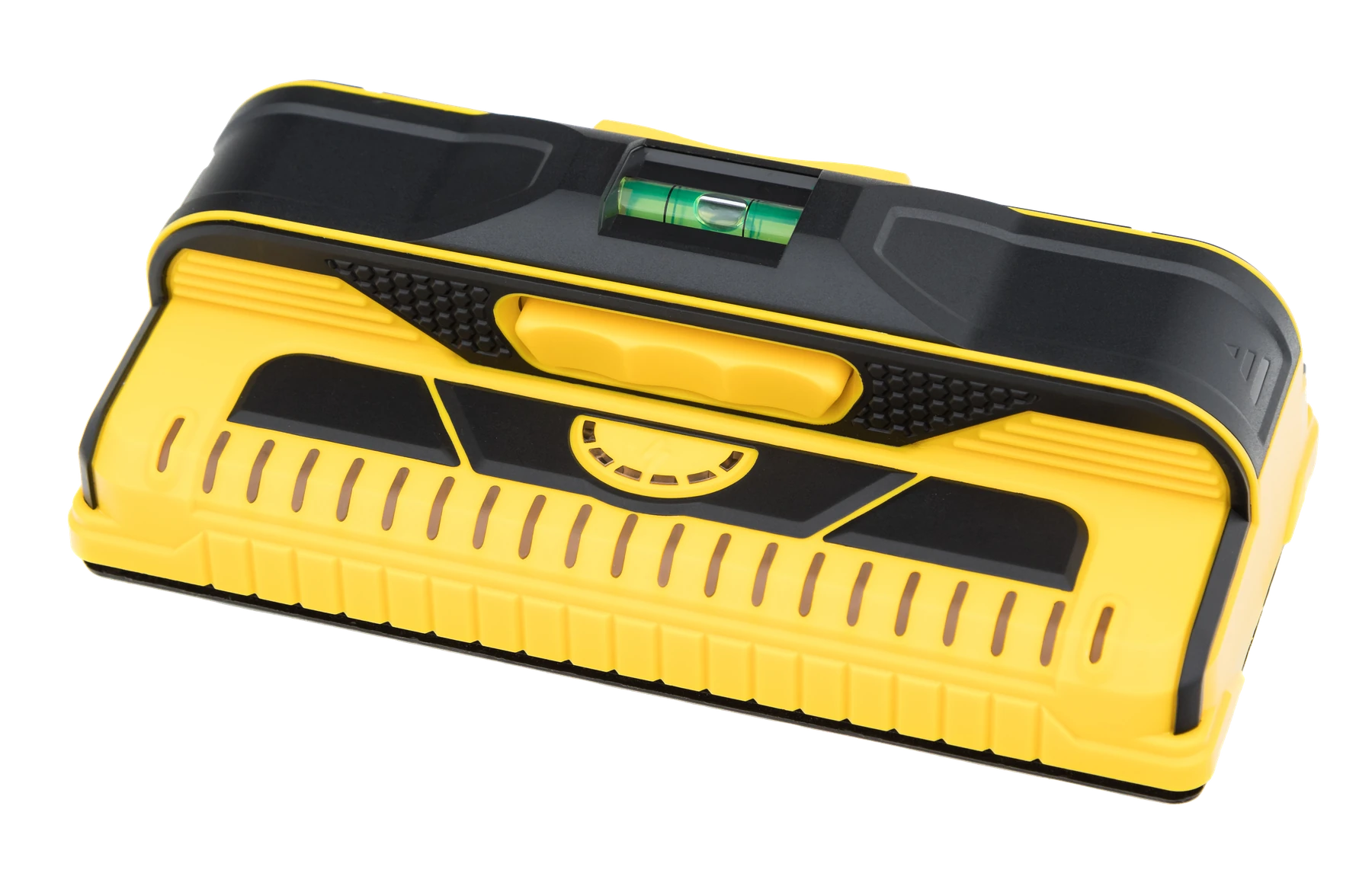
Amazon Australia sells the ProSensor M210 at A$119.00, shipped by Amazon and sold by Franklin Sensors Australia, with a typical price of A$124.97 printed beside it on 5 November 2026. It is the same US-made model (ASIN B0917VXLDK) that Franklin calls its top-of-the-line stud finder: thirteen sensors behind a 21-LED strip, a bubble level, a pencil caddy and a Live Wire Meter. It runs on two AA batteries, which the listing says are not included.
Plasterboard over a timber or steel frame is the wall it is built for. The listing claims a 4.3 cm read through plasterboard and both timber and steel studs, while Franklin's own FAQ says its finders are designed for interior surfaces and are not designed for exterior walls, roofs or tile. The cheaper option from the same seller is Franklin's nine-sensor M150 at A$89.97.
Our verdict
Buy the A$119 M210 for a plasterboard wall where you want a stud's full width and a live-wire check in one pass; the A$89.97 M150 finds the stud for one shelf with fewer sensors and no level.
- A good fit for
- Someone hanging a TV, cabinet or shelf run on plasterboard over timber or steel framing who wants edges, centre and a wire warning before drilling.
- We would skip it if
- Brick or block walls, tiled splashbacks, foil-backed insulation or metallic wallpaper, or a single light shelf the M150 can handle for less.
Reasons to consider it
- Thirteen sensors and 21 LEDs show a stud's edges and centre at once, with no calibration and a stated 1.7 in, about 4.3 cm, of depth
- Bubble level, pencil caddy and Live Wire Meter built in; the Australian listing claims both timber and steel studs
- Sold by Franklin Sensors Australia and shipped by Amazon AU, with Franklin's Limited Lifetime Warranty on defects
The compromises
- A$119 against A$89.97 for Franklin's nine-sensor M150 from the same seller
- Franklin's sheet says foil-backed insulation, metallic wallpaper, tile and metal-mesh plaster can defeat the scan
- Two AA batteries are not included, and there is no published weight, battery life or accuracy test
What we have not verified: Franklin publishes no accuracy test, weight or battery-life figure, and its sheet gives no mains voltage for the Live Wire Meter, which it says is optimised for wires on or near studs. Warranty contact details on the sheet are in Meridian, Idaho; no Australian service address is printed.
The things in this guide
A closer look at the products, who they may suit, and what to check before buying.
ProSensor M210 Stud Finder · M210
Thirteen sensors light a stud's edges and centre in one pass with no calibration, the bubble level and pencil caddy sit on the body, and the Live Wire Meter grades the signal before you drill. Amazon AU ships it and Franklin Sensors Australia sells it.
Before you buy: About A$29 more than the M150; foil-backed insulation, metallic wallpaper, tile and metal-mesh plaster can defeat it, and Franklin publishes no accuracy test, weight or battery life.
Price checked 5 November 2026. Retailer prices can change.A$119 from Franklin's Australian seller
Amazon Australia listed the M210 at A$119.00 on 5 November 2026, in stock, shipped by Amazon and sold by Franklin Sensors Australia, with a typical price of A$124.97 printed beside it. The listing says the unit was made in the USA and needs two AA batteries that are not in the box, so budget for a pair.
Franklin's nine-sensor M150 sat on Amazon AU at A$89.97 the same day from the same seller. The A$29 between them pays for four more sensors, a deeper rated read, a graded wire meter and the level and pencil caddy, covered section by section below.
What thirteen sensors put on the strip
The M210 reads with 13 sensors and reports through 21 LEDs. The strip shows the full width of a stud rather than one point, so edges and centre appear together, and the middle LED turns green at the centre. Franklin's sheet gives the depth as 1.7 inches; the Australian listing states it as 4.3 cm through plasterboard.
There is no calibration step. Hold the button, keep your fingers on the handle and the LEDs flow to the centre to show the unit has power. The Live Wire Meter runs while the button is held, its yellow LEDs lighting in sequence as the field strengthens, and Franklin says it is optimised for wires on or near studs.
The bubble level sits in the top grip and the pencil caddy in the housing. When the second LED from the right flashes, the two AA cells need replacing, and the sheet asks you not to mix old and new cells.
Plasterboard yes, brick and tile not promised
Franklin's FAQ says its finders are designed for interior surfaces, particularly sheetrock, which is what Australians call plasterboard, and are not designed for exterior walls, roofs or tile. The Amazon AU listing adds that the M210 finds both timber and steel studs, so an internal plasterboard wall on either frame is the job it is made for.
Solid brick, an external wall scanned from outside or a tiled splashback sits outside that promise. For tile, the FAQ suggests scanning from the other side of the wall or from an untiled patch above or below. Older lath and plaster is covered up to 1.7 inches, but plaster with metal mesh reinforcement may go undetected.
Foil-backed insulation can cause inconsistent readings 'with all electronic stud finders, including the ProSensor', and wallpaper with metallic content can block the signal. Texture and pipes light the LEDs too: scan up and down, and a stud stays steady while an irregularity flickers. Keep the unit 7 cm from trim, power points and switches.
The nine-sensor M150 for A$29 less
The M150 reads with nine sensors through 15 LEDs at a stated 1.5-inch depth, against the M210's 13 sensors, 21 LEDs and 1.7 inches. Its manual lists two AAA batteries and a Live Electrical Warning that lights one yellow lightning-bolt symbol, where the M210's meter lights its LEDs in sequence as the signal strengthens. Neither the M150's page nor its parts list mentions a bubble level or pencil caddy.
For one floating shelf or a curtain rail on plain plasterboard, the M150 still shows where the stud sits. The extra A$29 buys the wider strip, a little more depth, the graded meter and a level you do not have to carry separately.
The lifetime warranty and the missing numbers
Franklin's sheet carries a Limited Lifetime Warranty: defects in materials and workmanship are covered for the life of the product, Franklin decides whether to repair or replace, and incidental or consequential damage is excluded. The same sheet states that 'the function of the products is not guaranteed', and its contact address is in Meridian, Idaho.
Bought from Amazon AU, the unit also comes with Amazon's 30-day change-of-mind returns for items it fulfils and your rights under the Australian Consumer Law, which the listing says that policy does not affect. Franklin publishes no accuracy test, weight or battery-life figure, and the sheet gives no mains voltage for the Live Wire Meter.
How we put this together
Built from the product pages and listings below, without test scores or results we have not measured. Specifications and prices change, so check the original page for the exact model, current price, delivery, and returns.
- Amazon Australia: Franklin Sensors ProSensor M210 (ASIN B0917VXLDK) (opens in a new tab)
- Franklin Sensors: ProSensor M210 product page (opens in a new tab)
- Franklin Sensors: ProSensor X2100 & M210 operating/safety instructions (X2100_M210.E, 10/25) (opens in a new tab)
- Franklin Sensors: Frequently asked questions (opens in a new tab)
- Amazon Australia: Franklin Sensors ProSensor M150 (ASIN B0917TH83L) (opens in a new tab)
- Franklin Sensors: ProSensor M150 page and M90/M92/M150/X990 instructions (opens in a new tab)