Product image supplied by the brand
In this guide
EcoFlow's Canadian store has a DELTA 3 Plus page of its own, priced in Canadian dollars: C$799.00 against a C$1,099.00 comparison price, a C$300 saving printed beside it, and a Sold out button where the Add to Cart would be. Every configuration on the page carries the same status — the station alone, the station with a 160W panel, with a 220W panel, with the alternator charger, with the smart generator, with the extra battery, with a 65W charger, with the magnetic power bank — and a line under the buy box says the station is temporarily out of stock and expected back early next year, suggesting the DELTA 2 to anyone who needs one sooner.
The other official channel is emptier still. Amazon.ca carries the DELTA 3 Plus under the same ASIN as the American listing and shows it as currently unavailable, with no price and no seller offer on the page. So on 5 November 2026 there is no Canadian channel that will take C$799 for this station: one lists it and cannot ship it, the other will not quote it.
What a Canadian can buy is the model underneath. The DELTA 3 — same 1,024Wh headline, 1,800W, no Plus on the name — reads C$749.00 against a C$849.00 list, in stock and sold by EcoFlow Inc-CA on Amazon.ca. Above it, the DELTA 3 Max Plus is C$1,399 and the DELTA 3 Ultra Plus C$1,999. The rest of this review is therefore about what the C$799 figure buys when the stock returns, and whether waiting for it beats taking the C$749 station today.
Our verdict
You cannot buy it in Canada today: EcoFlow Canada lists C$799 and is sold out until early next year. The in-stock C$749 DELTA 3 takes the same extra battery, so wait only if 1,000W of solar or 140W USB-C matter.
- A good fit for
- A Canadian household that can wait for the restock and will charge from up to 1,000W of solar or run 140W USB-C devices, on top of the 1,024Wh and the extra-battery port.
- We would skip it if
- Anyone who needs backup power this month or charges mostly from the wall: the C$749 DELTA 3 is in stock, has the same inverter and takes the same extra battery.
Reasons to consider it
- C$799.00 on EcoFlow's Canadian store against a C$1,099.00 comparison price with a C$300 saving shown, and a five-year warranty printed in the same specification block
- 1,024Wh of LFP rated 4,000 cycles to 80 percent, six AC outlets sharing 1,800W with a 3,600W surge, thirteen outputs and 12.5 kg in a 400 x 211 x 281 mm case
- The DELTA 3 Series Smart Extra Battery lists at C$499 against C$699 on its own Canadian page, and the station-plus-battery bundle at C$1,298: 2,048Wh on EcoFlow's Canadian prices, all sold out on 2026-11-06
The compromises
- Both official Canadian channels are empty on 2026-11-05: sold out at ca.ecoflow.com with a notice pointing at early next year, and 'Currently unavailable' on Amazon.ca with no price at all
- X-Boost is written as 2,200W in the page's bullet and 2,600W in its own specification table on the Canadian page, and it is unavailable whenever the station is charging or passing grid power through
- A change-of-mind return costs a transaction fee plus shipping — 2.6 percent on a card, 3.6 percent through PayPal — and an order cannot be cancelled after 30 days
What we have not verified: The stock position is the whole story and it can change without notice: EcoFlow Canada says early next year, and nothing on either Canadian page says whether the restock arrives at C$799 or back at the C$1,099 comparison price. The Canadian page prints two X-Boost ceilings, 2,200W in a bullet and 2,600W in the specification table, and does not reconcile them. EcoFlow publishes no load-to-runtime table, so every hour figure here would come from the label rather than a rating. The DELTA 3's solar and USB figures come from EcoFlow's US specification table and its Amazon.ca title, because its Canadian product page was not compared line by line, and the C$749 DELTA 3 price is a reading from 2026-11-05 and 2026-11-06.
The things in this guide
A closer look at the products, who they may suit, and what to check before buying.
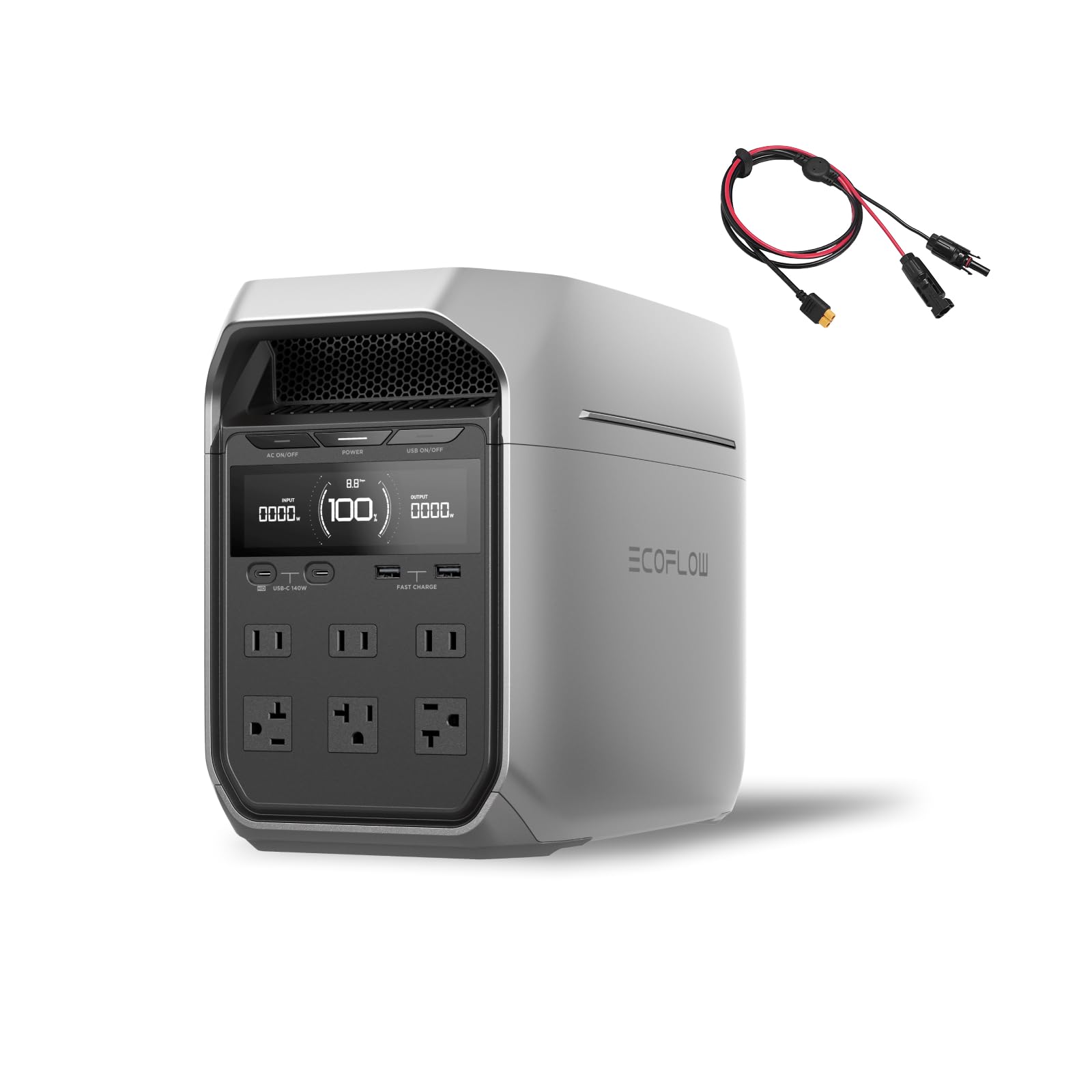
DELTA 3 Plus Portable Power Station · EFDELTA3P-US
C$799.00 at EcoFlow Canada against a C$1,099 comparison price buys 1,024Wh of LFP rated 4,000 cycles to 80 percent, 1,800W across six outlets with a 3,600W surge, thirteen outputs and a five-year warranty, in a 12.5 kg case.
Before you buy: Neither Canadian channel has it: the maker's store is sold out until early next year and Amazon.ca calls it unavailable, so the money cannot be spent today, and X-Boost is off whenever the station is plugged in.
Price checked November 6, 2026. Retailer prices can change.Two official channels, no stock in either
Start with what a Canadian cannot do. EcoFlow's own Canadian store lists the DELTA 3 Plus at C$799.00 and puts Sold out where Add to Cart belongs, with the same status on all eight configurations. The line under the buy box is unambiguous about timing: temporarily out of stock, expected back early next year, with the DELTA 2 offered as the alternative for anyone who needs one sooner.
Amazon.ca is the second official channel and it is worse, because it will not even quote a price. The ASIN is the same one the American listing uses, the title is the same, and the buy box reads currently unavailable with no seller attached. A reader who searched the model in Canada would find the page and no way to order from it.
That combination is unusual enough to be worth stating plainly: this is not a station with a thin discount or a long delivery estimate, it is a product with no Canadian stock and no second retail channel to fall back on. Everything below describes what the C$799 will buy when it returns, and what the alternative is in the meantime.
What C$799 is listed for
The figure is C$799.00 against a C$1,099.00 comparison price, with C$300 of saving printed beside it and no end date anywhere on the page. Canadian mains is 120 V at 60 Hz, the same as the American grid, so nothing about the station's input changes on this side of the border and no step-down transformer enters the purchase.
The specification block is metric first: 400 x 211 x 281 mm, net weight 12.5 kg or less, 1,024Wh of LiFePO4 rated for 4,000 cycles to 80 percent, six AC outlets sharing 1,800W with a 3,600W surge, two 140W USB-C ports, two 36W USB-A ports, a 126W car socket and two DC5521 outputs — thirteen in all. AC charging is rated 1,500W, solar comes in through two ports, and a car can refill it at 800W in 1.3 hours. The battery pack is rated IP65, the UPS transfer is under 10 ms, and the warranty line reads five years.
The X-Boost ceiling is printed twice on the same page and does not agree with itself. The bullet above the buy box says 1,800W of AC output, 2,200W with X-Boost and a 3,600W surge; the specification table two screens down says 'Max Device(s) Power (with X-Boost) 2600W'. A Canadian buyer planning around a specific appliance — a kettle, a hair dryer, a space heater — has to read the number that matches the load rather than the one in the marketing bullet.
C$499 for the second battery, by subtraction
The extra-battery route is what this station is usually bought for, and in Canada it is priced both ways. The DELTA 3 Series Smart Extra Battery has its own page on the Canadian store at C$499.00 against a C$699.00 comparison price, and the station plus that battery is listed at C$1,298.00 against C$1,798.00. With the station alone at C$799.00, the bundle and the separate purchase come to the same C$1,298 for a 2,048Wh total.
Neither route can be ordered: on 2026-11-06 the battery's own page marked it sold out, as it did the bundle with the Plus and the bundle with the plain DELTA 3 at C$1,239.00. That last listing matters more than the price. EcoFlow sells the same pack for the cheaper DELTA 3, so the battery port is not what separates the two stations, and the question of which one to wait for comes down to the specification differences in the next section.
EcoFlow's own footnote describes how the packs connect: the DELTA 3, DELTA 2, DELTA 2 Max and DELTA Pro 3 extra batteries all reach the station through an Alternator Charger XT150 Output Cable, and the page puts the expansion range at 1 to 5kWh without saying which pack reaches the top of it. Two of EcoFlow's own documents describe that connection differently — the American product page routes four battery models through the cable, while the battery's own page describes no setup at all. Neither reading was verifiable from the Canadian store on the day.
What is actually on the Canadian shelf
The DELTA 3 is the station a Canadian can order today: C$749.00 against a C$849.00 list, In Stock, sold by EcoFlow Inc-CA rather than a marketplace seller, with an Amazon.ca title giving 1,024Wh, 1,800W AC and 100W USB-C. Against the Plus it is C$50 cheaper on the listed price, with the same capacity and inverter rating, and EcoFlow's battery page sells it the same extra battery. What the extra C$50 buys, on EcoFlow's US specification tables for the two models, is a second 500W solar input, 1,000W in all against 500W, and USB-C at 140W against 100W, with USB-A at 36W against 18W.
Above it the range is continuous. The DELTA 3 Max Plus reads C$1,399 for 2,048Wh and 3,000W, the DELTA 3 Ultra Plus C$1,999 for 3,072Wh and 3,600W, and the Delta Pro 3 C$2,999 against a C$4,499 list for 4,096Wh. A refurbished DELTA 3 at C$549 against a C$749 list is also in stock from the same seller, which is worth knowing before paying C$749 for a new one.
The gap that matters for a buyer who wants 1kWh now is therefore C$50, not C$300, and it buys solar and USB headroom rather than expandability. The C$1,099 comparison price on the Plus is a discount on a product nobody can order; the C$749 on the DELTA 3 is a price someone can pay today, from the maker's own Amazon.ca storefront.
The Canadian warranty and the return fee
The warranty is five years, printed in EcoFlow's Canadian specification block rather than in a separate policy page, which is the same term the American listing states. Nothing on the Canadian page says who performs the repair or where the unit goes, so the five years is a term rather than a process.
Returns are where Canada differs most from the American store's summary. An order cancelled within 24 hours is refunded in full; cancelled after 24 hours and before delivery, it carries a transaction fee of 2.6 percent on a credit card or 3.6 percent through PayPal; after 30 days it cannot be cancelled at all. A return needs the package in hand first and an RMA from EcoFlow's support address, and a change-of-mind return has the transaction fee plus shipping deducted, while a quality issue gets a full refund or a one-time free replacement. The refund itself lands within 14 business days of the warehouse receiving the unit.
For a C$799 purchase the fee is not trivial. Cancelling on a card a week after ordering costs about C$21 before anything ships, and a change-of-mind return costs that again plus freight on a 12.5 kg parcel. Anyone ordering at the restock should decide inside the first day, when the cancellation is free.
The floor under the five years
Under EcoFlow's five years sits a layer the manufacturer does not write and cannot price: the statutory warranty a consumer sale carries in the province whose law governs it. Quebec's Consumer Protection Act, as the province's Office de la protection du consommateur sets it out, entitles a buyer to demand that goods are usable for the purpose for which they are ordinarily used, that they have reasonable durability judged against the price paid and the terms and conditions of use, that they are free of hidden defects present before the sale, and that they match their description in the contract, in advertising and in what the seller's representative said.
A 1,024Wh station bought as backup power is the ordinary-purpose test in practice, and the five-year card does not answer it on its own.
The remedy is not the manufacturer's to choose alone. The Office's own account is that the buyer may deal with the merchant, the manufacturer, or both, that a merchant cannot insist the buyer go to the manufacturer instead, and that the party answering may repair the unit at no charge, exchange it or reimburse, with compensation where the defective unit caused damage.
None of that replaces the contract terms described above — the 24-hour cancellation window, the transaction fee and the return freight are EcoFlow's policy, while the statutory warranty is a floor the policy cannot lower. Buyers outside Quebec have their own provincial version of that floor, in different words and with different procedures, so the text to check is the one for the province the unit is delivered to.
Whether to wait for the restock
Wait for the Plus only if the solar input is the plan. A household that will charge from more than 500W of panels, or run a 140W laptop from USB-C, gets something from the second input and the faster ports that the DELTA 3 does not offer. A household that wants a second battery later does not need to wait for that reason: the same C$499 pack is sold for the DELTA 3, and the inverter, outlets and capacity are the same on both.
Do not wait if the station is for this winter. EcoFlow's own notice says early next year, which is a statement about a shipping schedule rather than a date, and the C$749 DELTA 3 is in stock from the same maker this week. For a household that wants a fridge and a router carried through an outage, the C$50 saved and a station in hand this week beat an unbounded wait.
One behaviour is worth checking on whichever station arrives. X-Boost, the mode that lets the inverter carry an appliance rated above 1,800W by trimming voltage, is unavailable while the station is charging or passing grid power through — so a unit kept plugged in as a UPS never uses it. A buyer whose plan is a permanently plugged-in backup is paying for a mode that stays off, and one whose plan is a cordless station at a campsite is buying exactly the mode it was designed for.
How we put this together
Built from the product pages and listings below, without test scores or results we have not measured. Specifications and prices change, so check the original page for the exact model, current price, delivery, and returns.
- EcoFlow Canada: DELTA 3 Plus Portable Power Station product page (opens in a new tab)
- EcoFlow Canada: Return & Refund Policy (opens in a new tab)
- Amazon.ca: EF ECOFLOW Portable Power Station DELTA 3 Plus, 1024Wh (B0DCC2BVFW) (opens in a new tab)
- Amazon.ca: EF ECOFLOW Delta 3 Portable Power Station, 1024Wh 1800W (B0DCJTSB1N) (opens in a new tab)
- Amazon.ca: EF ECOFLOW DELTA 3 Max Plus, 2048Wh, 3000W (B0FRDJZNB8) (opens in a new tab)
- Amazon.ca: EF ECOFLOW DELTA 3 Ultra Plus, 3072Wh, 3600W (B0FRDWMTPS) (opens in a new tab)
- Amazon.ca: EF ECOFLOW Delta Pro 3, 4096Wh (B0D14FMFZD) (opens in a new tab)
- Amazon.ca: EcoFlow DELTA 3 Portable Power Station, 1024Wh (Renewed) (B0HJQX1D9B) (opens in a new tab)
- Office de la protection du consommateur (Quebec): How to Have Legal Warranties Applied (opens in a new tab)
- EcoFlow Canada: DELTA 3 Series Smart Extra Battery product page (opens in a new tab)
- EcoFlow US: DELTA 3 and DELTA 3 Plus specification tables (comparison reference) (opens in a new tab)