Product image supplied by the brand
In this guide
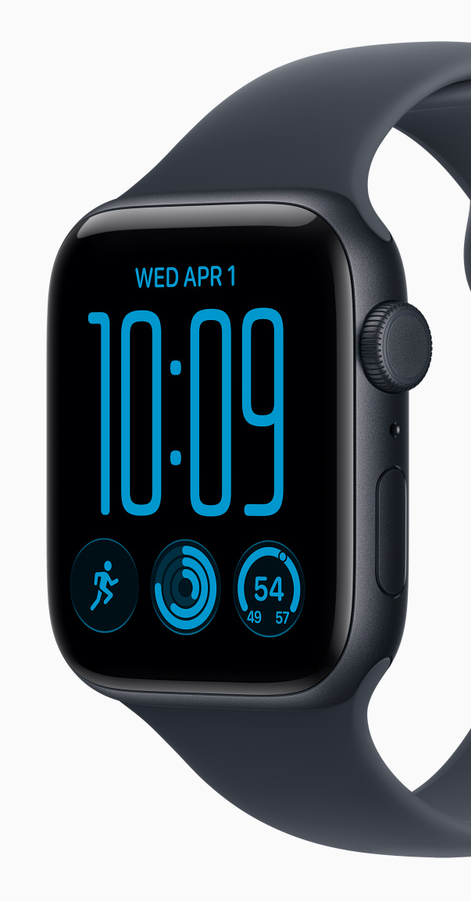
Apple Watch SE 3 is the aluminum-only model in a current line of three, at $329 in Canadian dollars for the 40mm GPS version, $369 for 44mm and $70 more to add cellular, in Midnight or Starlight. It runs the S10 chip with a 64-bit dual-core processor and 64GB of storage, and keeps an Always-On Retina display — OLED on an LTPO backplane, under Ion-X glass Apple rates 4x more crack resistant than the SE 2's. Water resistance is rated to 50 m. The spec page's compatibility line names iPhone 11 or later on iOS 27 or later, and no Android phone.
What the $329 leaves out is one family of hardware, and it cannot be added later. The SE 3 has a second-generation optical heart sensor instead of an electrical one, and no blood-oxygen sensor. Apple's spec pages and comparison table put the electrical sensor and the blood-oxygen sensor on Series 12, which starts at $549, so the $220 step is worth paying only if the ECG app or blood-oxygen readings are why you want a watch.
Our verdict
Buy the $329 Apple Watch SE 3 for notifications, sleep tracking and heart-rate trends on an iPhone; pay $220 more for Series 12 only if an ECG or blood-oxygen readings are why you want a watch.
- A good fit for
- A buyer new to smartwatches, on an iPhone, who wants notifications, sleep and heart-rate trends, and does not have a heart condition their doctor is monitoring.
- We would skip it if
- If you need the ECG app or blood-oxygen readings, skip it; so should anyone on Android, and owners of a watch that already records an ECG, since the SE 3 would take that away.
Reasons to consider it
- An Always-On Retina display with OLED and LTPO, Ion-X glass rated 4x more crack resistant than the SE 2, and a 50 m water-resistance rating
- Sleep apnea notifications, sleep stages, sleep score, temperature sensing and advanced cycle tracking, for $329
- 18 hours of normal use, 32 hours in Low Power Mode with sleep tracking, and fast charging rated at 15 minutes for 8 hours of use
The compromises
- No electrical heart sensor, so no ECG app — Apple's own footnote says the app excludes Apple Watch SE models
- No blood-oxygen sensor, so no Blood Oxygen app; Apple's comparison table marks both as absent on the SE 3
- Aluminum is the only case material, and cellular adds $70 on top of $329 rather than being included
What we have not verified: Apple publishes no capacity-retention curve for the battery, so a second-year owner cannot tell how long the watch will still run, and the sleep apnea feature is worded as detecting signs rather than diagnosing a condition.
The things in this guide
A closer look at the products, who they may suit, and what to check before buying.
Apple Watch SE 3
At $329 the 40mm SE 3 keeps the Always-On Retina display, the S10 chip, 64GB of storage, 50 m water resistance and the full sleep set — stages, score and sleep apnea notifications — plus temperature sensing and advanced cycle tracking. Fast charging is rated at 15 minutes for 8 hours of normal use, and AppleCare+ costs $2.99 a month or $29.99 a year with accidental damage at $89.
Before you buy: No electrical heart sensor means no ECG app, which Apple's own footnote excludes from Apple Watch SE models; the Blood Oxygen app is missing too, and cellular costs another $70.
Price checked October 15, 2026. Retailer prices can change.What $329 buys: the screen, the chip and the waterproofing
The SE 3 comes in two case sizes and one material. The 44mm case fits wrists from 140 to 245 mm at 32.9 g, or 33.0 g with cellular; the 40mm takes 130 to 200 mm at 26.3 g. The 44mm adds $40, 6.6 g and a larger display, 977 sq mm against 759. Both run the S10 chip with a 4-core Neural Engine and 64GB of storage.
The display is Always-On Retina with OLED and LTPO, peaking at 1,000 nits, under Ion-X glass Apple rates 4x more crack resistant than the SE 2's. Water resistance is rated to 50 m for pool and open-water swimming. The controls include the Digital Crown with haptic feedback plus single tap, double tap and wrist-flick gestures, and the watch carries Emergency SOS, Fall Detection and Crash Detection.
The two sensors that stay on Series 12
Apple's SE 3 specification page lists a second-generation optical heart sensor and then stops. There is no electrical heart sensor, and the consequence is spelled out in Apple's own footnote on the Series 12 page: the ECG app is available on Series 4 and later, excluding Apple Watch SE models, and is meant for people 22 and over. Without that sensor, no software update can add the ECG app to the SE 3. The SE 3 does keep high and low heart rate notifications and irregular rhythm notifications.
The SE 3 also has no blood-oxygen sensor, so no Blood Oxygen app, which Apple labels wellness-only. Series 12 starts at $549 in 46mm and 42mm, Ultra 4 at $1,099 in 49mm titanium. The $220 between the SE 3 and Series 12 also buys a brighter display, up to 2,000 nits against 1,000, and an S11 chip, but the two sensor-based apps are the part with no substitute. Apple's Canadian buy and spec pages do not list hypertension notifications for any model, and its watchOS feature-availability page names Canada but warns the feature may not be available on Series 12 or Ultra 4 while regulatory clearances are in process.
Sleep apnea notifications, sleep score and cycle tracking
Apple's footnote states sleep apnea notifications are available on Apple Watch Series 9 and later, Ultra 2 and later, and SE 3, and that the feature is meant to detect signs of moderate to severe sleep apnea in adults 18 and up who have never had a diagnosis. It flags signs rather than diagnosing anything, which makes it a prompt to see a doctor rather than an answer.
Alongside it the SE 3 logs sleep stages and a sleep score, and carries a temperature sensor, which feeds cycle tracking. The advanced cycle-tracking app adds fertile-window estimates, retrospective ovulation estimates and perimenopause and menopause support; Apple's own footnote limits cycle-deviation notifications including perimenopause to people 40 and older, and states the app should not be used for birth control or to diagnose a condition.
18 hours, 32 in low-power mode, and what the charging claim measures
Apple rates the SE 3 at up to 18 hours of normal use, up to 32 hours in Low Power Mode including sleep tracking, and up to 7 hours of outdoor workout. The 18-hour figure comes with a published protocol: 300 time checks, 90 notifications, 15 minutes of app use, and a 60-minute workout with music played from the watch over Bluetooth. The low-power figure uses a more demanding protocol over 32 hours — 430 time checks, 130 notifications, 20 minutes of app use, a 60-minute workout and six hours of sleep tracking. Series 12 is rated up to 24 hours and up to 38 in Low Power Mode.
Fast charging is quoted in three ways: about 45 minutes to reach 80%, 15 minutes for up to 8 hours of normal use, and 8 minutes for up to 8 hours of sleep tracking. The last two are the arithmetic behind wearing it overnight and topping it up while you shower. Apple measured them with its Magnetic Fast Charger to USB-C cable and a 20W USB-C power adapter, and notes that charge time varies with the adapter.
The $70 cellular question, and what it unlocks
Cellular is a $70 add-on at either size, taking the 40mm from $329 to $399 and the 44mm from $369 to $439. Apple's connectivity block spells out the trade: with GPS you make calls and send texts with your iPhone nearby, and with GPS + Cellular you can do it with just the watch. It is also the only way to use Apple Watch For Your Kids, which Apple says needs a GPS + Cellular model and lets a parent set up a child's watch from their own iPhone.
For an adult who carries a phone everywhere, the GPS model covers the usual jobs; the spec page lists the same L1 GPS with GLONASS, Galileo, QZSS and BeiDou under All Models, so cellular adds connectivity, not location. It needs a wireless plan, and Apple's carrier chart names Bell, Freedom, Koodo Mobile, Rogers, SaskTel, Telus, Videotron and Virgin Plus for Canada, with eligibility decided by each carrier. Both models are limited to 2.4GHz Wi-Fi networks.
Returns, the one-year warranty and the $89 repair
Apple takes an undamaged SE 3 back within 15 days of delivery, with its accessories, packaging and receipt; Best Buy Canada, which sells the Midnight 40mm GPS model itself at $329.99, allows 30 days to return or exchange. Apple Canada's one-year warranty covers the watch and the accessories in the box against defects in materials and workmanship. Batteries that wear down over time, cosmetic damage and accidents sit outside it, and Quebec residents are governed by that province's consumer protection law. Repaired parts carry 90 days or the rest of that first year, whichever is longer.
The SE 3's AppleCare+ plan is $2.99 a month or $29.99 a year, and an accidental-damage repair under AppleCare costs $89 — $99 for Ultra and Hermès models. AppleCare also replaces the battery at no extra charge when its capacity drops below 80%, which is the coverage the base warranty leaves out.
How we put this together
Built from the product pages and listings below, without test scores or results we have not measured. Specifications and prices change, so check the original page for the exact model, current price, delivery, and returns.
- Apple Canada: Buy Apple Watch SE 3 (opens in a new tab)
- Apple Canada: Apple Watch SE 3 technical specifications (opens in a new tab)
- Apple Canada: Apple Watch Series 12 technical specifications (opens in a new tab)
- Apple Canada: Apple Watch cellular carriers (opens in a new tab)
- Apple: Apple One (1) Year Limited Warranty, Canada (English) (opens in a new tab)
- Apple Canada: Canadian retail sales policies (opens in a new tab)
- Apple Canada: AppleCare (opens in a new tab)
- Apple Canada: AppleCare service fees, excesses and deductibles (opens in a new tab)
- Best Buy Canada: Apple Watch SE 3 (GPS) 40mm Midnight with Midnight Sport Band (opens in a new tab)
- Apple Canada: watchOS 27 feature availability (opens in a new tab)