Product image supplied by the brand
In this guide
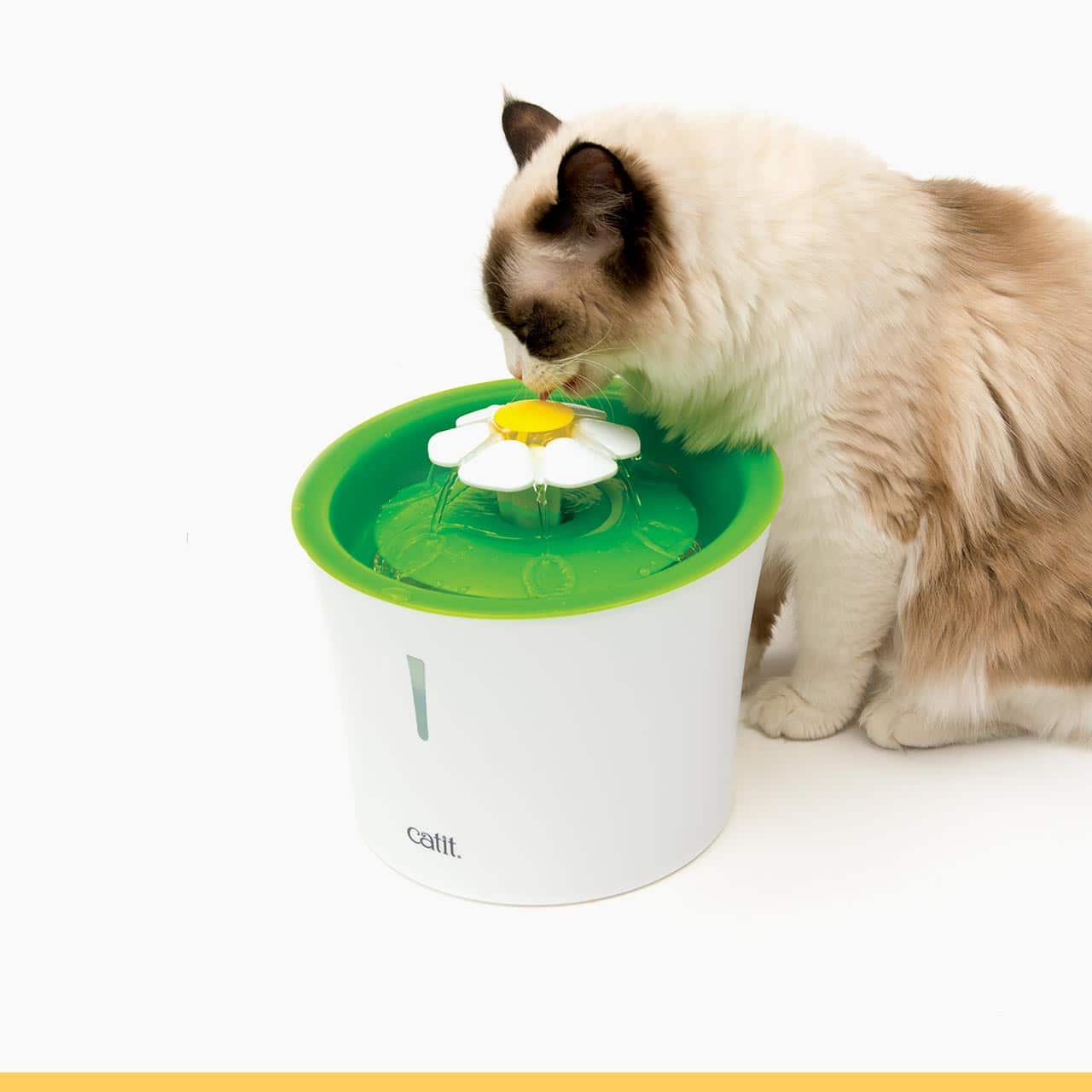
Catit UK sells the Flower Fountain (product #43742) for £31 including tax, with a 3 L reservoir, a 21 x 21 x 20 cm body and a listed weight of 835 g. The UK page gives the power rating as 230-240 V, 50 Hz, 12 VA, 300 mA, and says it is made from BPA-free materials with a Triple Action filter and a quiet pump. The page lists the same product ID as Catit's global spec pages.
This is a desk-research comparison built from Catit's UK store and Catit's own help pages; nobody here handled the fountain. The question worth asking is what it costs to keep running: a filter pad Catit says to replace every 30 days, plus a pump teardown on a two-week cycle. Those two chores decide whether it suits your house.
Our verdict
A sensible fountain for a household that will fit a £7.20 or £15.80 filter pack into the budget and take the pump apart every two to four weeks. If that sounds unlikely, a bowl rinsed daily is the better choice.
- A good fit for
- Single- or two-cat homes with a hard, level floor and someone who already keeps a recurring chore on the calendar
- We would skip it if
- You expect to run it unattended for months, want a stated noise figure, or need a wattage number to compare running costs
Reasons to consider it
- 3 L reservoir with a water level window, so you can see when it needs topping up without lifting the top
- Three adjustable flow settings, which give a fussy cat more than one way to drink
- Replacement pads are priced on the same site: £7.20 for two, £15.80 for six, so the running cost can be worked out before you buy
The compromises
- Catit says to replace the Triple Action pad every 30 days or when saturated, which makes twelve pads a year, about £31.60 as two six-packs
- The cleaning guide says to disassemble the pump every two weeks, while the Q&A says monthly; either is more upkeep than a bowl
- Catit UK lists no decibel figure, no wattage and no cord length, and its page does not state the plug type
What we have not verified: Catit UK lists 835 g and a 20 cm height, while Catit's global pages give 590 g and 18.5 cm for the same #43742, and nothing explains the gap. No noise rating, wattage, cord length, plug type or warranty period appears on the pages read. The urinary-health wording is the manufacturer's and is not verified here.
The things in this guide
A closer look at the products, who they may suit, and what to check before buying.
Flower Fountain
£31 for a 3 L fountain with three flow settings and a water level window, plus pads sold in 2-packs and 6-packs on the same site so the monthly swap is easy to stock.
Before you buy: No noise figure, wattage or cord length from Catit UK; pads are a permanent monthly expense; Catit's help pages disagree on how often the pump needs cleaning.
Price checked 17 October 2026. Retailer prices can change.What the spec sheet says, and what it leaves out
Catit UK lists a 3 L reservoir in a 21 x 21 x 20 cm body, 835 g, at £31 with tax included. For a single cat that capacity means several days between top-ups, which is the main reason to pick a fountain over a bowl if you are away for a weekend. With two cats the interval shrinks, though the water level window shows how much is left without lifting the top. The call: capacity for the footprint is good for this class. The limit is that Catit does not say how low the water can fall before the pump runs dry; the fill mark is a wavy line moulded into the rim.
The UK page gives 230-240 V, 50 Hz, 12 VA and 300 mA. The 12 VA figure is an apparent-power rating, not a measured draw, so it caps the running cost without telling you the real wattage. It does not name the plug type or the cord length, and there is no decibel rating or dishwasher guidance. The weight is also odd: Catit's global pages give 590 g and 18.5 cm for the same product number, and the UK page 835 g and 20 cm. The call: treat running cost as small and unknown, and check the plug before you order.
The filter pad is a monthly subscription in everything but name
The Triple Action pad has a cotton mesh outer layer for hair and debris, activated carbon for odour, and an ion exchange resin for calcium and magnesium. Catit says to replace it every 30 days or when visibly saturated, which means twelve a year. Catit UK sells 2 for £7.20 and 6 for £15.80, so a pad costs £3.60 in the small pack and about £2.63 in the large one. Twelve pads cost £31.60 as two six-packs, against £43.20 as six two-packs. That is our arithmetic, and it puts a year of pads level with the price of the fountain. The call: buy the 6-pack if you buy at all.
The fountain alone, at £31, sits under the £40 free-UK-shipping banner; adding one 6-pack brings the basket to £46.80. The pad also needs preparation: the setup page says to shake and tap the dry filter, rinse it and submerge it, pressing the mesh so it stops floating, and every replacement repeats that. A pad left above the waterline can grow mould, so the fountain has to stay filled to the wavy line. The call: the filter works as described only if it stays wet and gets swapped on schedule. The 30-day interval is a manufacturer figure, not a measured saturation point, and long-haired cats may clog it sooner.
Cleaning: what Catit asks of you every two weeks
Catit's cleaning guide says every component can be washed in warm water with a soft sponge and dishwashing soap, and that aggressive detergents and abrasive sponges are off limits. The top parts need regular cleaning so scale does not settle, which matters most in hard-water areas. In a soft-water area the scale note is minor. The call: plan on a sink session, not a wipe-down. Neither page says whether any part is dishwasher safe, so assume hand washing.
The pump is the part that decides whether you keep the fountain. The cleaning guide says to remove and disassemble it every two weeks, rinsing each part separately; the Q&A says to clean the pump each month. Both pages agree on the failure mode: a pump clogged with cat hair loses flow, and the fix is to take it apart. So the real interval sits between two and four weeks depending on how much your cat sheds, and a long-haired breed points to the shorter end. The call: biweekly is the safer schedule. Only older units have a flow slider; if yours does, Catit says to set it to + for full flow.
The urinary-health claim, kept at arm's length
Catit UK's product page says fresh, flowing water supports kidney health and helps prevent urinary tract issues, and the filter page says the resin softens tap water to help prevent urinary tract disease, then adds that the product is not designed to cure any disease or illness. Catit's global filter page explains the idea: removing excess calcium and magnesium that could build up in the lower urinary tract. These are manufacturer claims, and nothing here verifies them. A buyer can reasonably expect softer-tasting water and less scale. The call: buy it for hydration convenience, not as a treatment. This is not veterinary advice; if your cat has a urinary history, ask a vet what water, diet or fountain to use.
The design also matters: Catit describes a pump that draws water through the pad, so the cat drinks what has passed through the filter. If that is right, the pad's condition sets the water quality at the bowl, which is why the 30-day swap carries weight. Kept on schedule, the claim holds up mechanically; with a pad left in for three months, the same mechanism pushes water through a saturated filter. Catit publishes no filtration performance data, so 'filtered' describes a path through the pad and nothing more quantitative.
When to skip it
Skip it if the placement will be a countertop or a wooden floor and you are sensitive to hum. Catit's Q&A says the fountain runs quieter on a sturdy, fully level surface, that it belongs on the floor rather than a table, and that a wooden floor is naturally noisier than concrete or tile. The UK page calls the pump quiet but gives no decibel figure, so a flat with a bedroom next to the kitchen has nothing to judge by. The call: treat noise as unknown and put it on tile or vinyl if you can. Filling to the wavy line and cleaning the pump also affect noise.
Skip it too if the recurring cost has no place in your budget. Over a year the fountain and twelve pads come to £62.60 at Catit UK, plus the occasional flower accessory (#44820, sold separately); a cat that drinks happily from a bowl gains mostly a chore. On the buying side, standard delivery takes 3-5 days after up to 2 business days of processing, and a change-of-mind return is allowed if the goods have been held no more than 14 working days, with the original delivery cost not normally refunded. The call: if you cannot picture yourself disassembling a small pump every two weeks, the bowl wins.
How we put this together
Built from the product pages and listings below, without test scores or results we have not measured. Specifications and prices change, so check the original page for the exact model, current price, delivery, and returns.
- Catit UK: Catit Flower Fountain (43742) (opens in a new tab)
- Catit UK: Catit Flower Fountain Replacement Filters (opens in a new tab)
- Catit UK: shipping and refund policies (opens in a new tab)
- Catit: Flower Fountain cleaning guide (opens in a new tab)
- Catit: Flower Fountain Q&A (opens in a new tab)
- Catit: Flower Fountain getting started (opens in a new tab)
- Catit: Flower Fountain Triple Action Filter Pad (opens in a new tab)
- Catit: Flower Fountain (global product page, #43742) (opens in a new tab)