Product image supplied by the brand
In this guide
The DELTA 3 Plus sold in Britain is not the American unit. It is the 230V model: four AC sockets instead of six, eleven outputs instead of thirteen, and an X-Boost ceiling of 2,400W in place of the 120V figures. EcoFlow's UK store lists it inside its DELTA 3 Series page at £699.00, SKU EFDELTA3P-UK, and on 6 November 2026 marked every DELTA 3 Plus configuration sold out while the card still read 'Pre-order now. Estimated shipping: Second week of December 2026'. A DELTA 3 Smart Extra Battery is £549 and the pair bundled at £1,123 against a £1,248 comparison price.
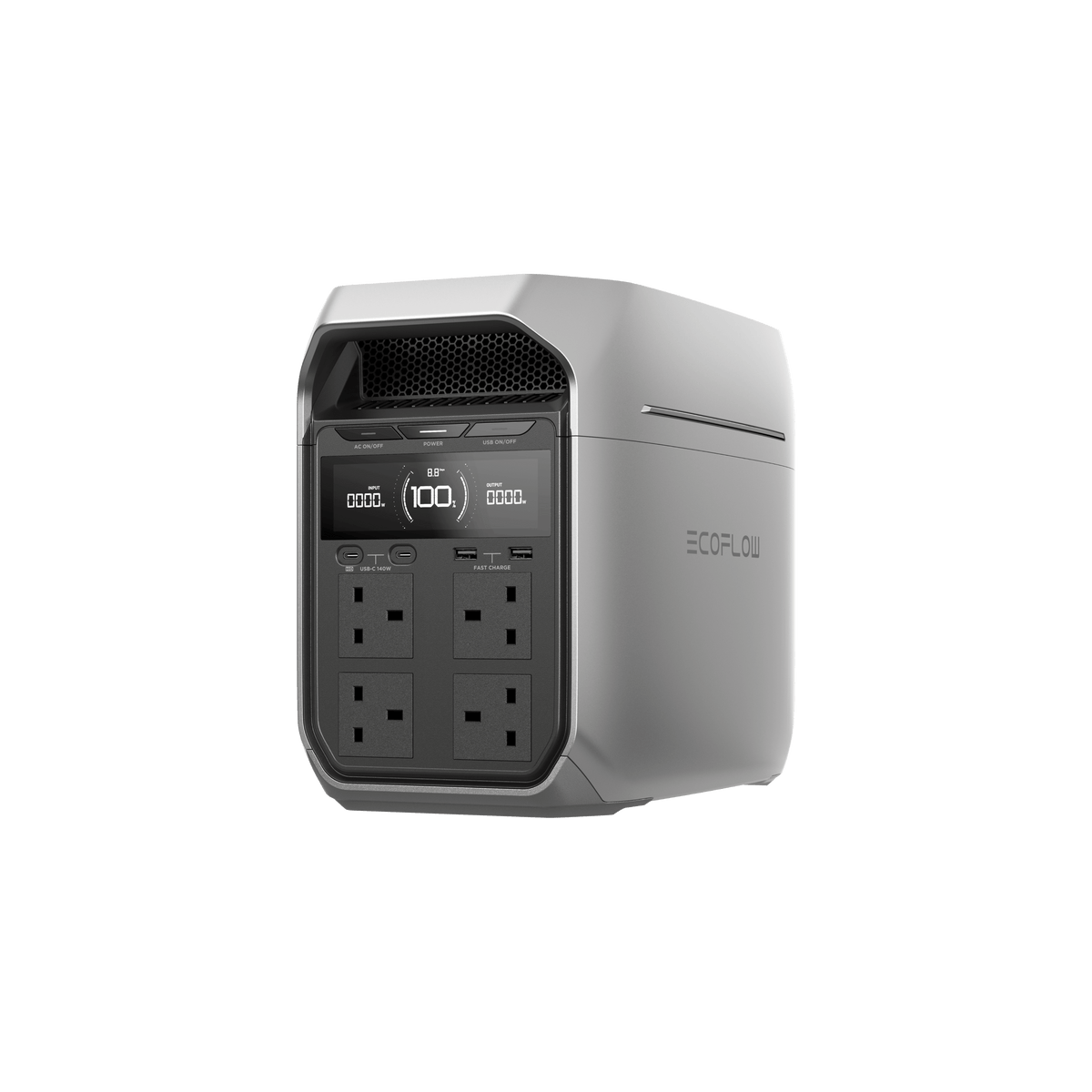
The hardware is 1,024Wh of LiFePO4 in a 12.5 kg case measuring 398 × 200 × 284 mm, with a 1,800W inverter and a 3,600W surge. Charging is the part EcoFlow leads with: 1,500W from the mains for a 56-minute fill, two 500W solar inputs for 70 minutes, or 800W from a car in 1.3 hours. The battery pack is rated IP65, the inverter switches to battery in under 10 ms, and the warranty runs five years.
Against the other two 1 kWh stations in the UK the price reads differently from the American review. Anker's SOLIX C1000 Gen 2 was £599 on 6 November, from AnkerDirect UK on Amazon and on Anker's own UK store; Jackery's Explorer 1000 v2 was £449 from Jackery UK. So the DELTA 3 Plus costs £100 more than the Anker and £250 more than the Jackery. The battery port it adds is not unique, though: EcoFlow's own DELTA 3, £649 and orderable on the same page, takes the same pack.
Our verdict
Buy the DELTA 3 Plus at £699 only for its second solar input and 140W USB-C: EcoFlow's £649 DELTA 3 takes the same £549 battery and was in stock. With no battery plan, Anker's C1000 Gen 2 is £599.
- A good fit for
- A household that wants 1 kWh now with room to double it, and that will charge from up to 1,000W of solar or run 140W USB-C laptops.
- We would skip it if
- No battery will ever be added, where Anker's £599 C1000 Gen 2 is cheaper, or 500W of solar is enough: EcoFlow's £649 DELTA 3 takes the same battery and was in stock on 6 November.
Reasons to consider it
- An Extra Battery port that takes the £549 DELTA 3 battery and reaches 2,048Wh; the pair bundled listed at £1,123 against £1,248 separately, though the bundle could not be ordered on 6 November 2026
- 2,400W with X-Boost in the 230V model, above the 1,800W rating, with EcoFlow's own examples running to a 2,150W oven and hair dryers to 2,500W
- Eleven outputs in a 12.5 kg case: four AC sockets sharing 1,800W with a 3,600W surge, two 140W USB-C, two 36W USB-A, a 126W car socket and two DC5521, with an LFP pack rated 4,000 cycles and a five-year warranty
The compromises
- £699 against £599 for Anker's C1000 Gen 2 and £449 for Jackery's Explorer 1000 v2, neither of which takes a battery pack, and £649 for EcoFlow's own DELTA 3, which takes the same one
- X-Boost is off while the station charges or passes mains power through, the manual says it ships disabled while EcoFlow's X-Boost page says enabled, and it works by lowering voltage
- The UK store's 30-day return is not free: an unwanted DELTA 3 Plus comes back at a 2.6 per cent card fee plus £30 shipping, and only a faulty one returns at EcoFlow's cost
- No UK stock on 6 November 2026: every DELTA 3 Plus configuration on EcoFlow's UK store read Sold out while the card still estimated the second week of December, and Amazon quoted 2 to 3 December
What we have not verified: EcoFlow publishes no table of loads against run times, so every hour figure here is arithmetic on the 1,024Wh label. The X-Boost ceiling is written as 2,400W on the UK page and in the manual's 230V row, while the same page's marketing copy lists a 3,000W kettle, which is above that ceiling. Anker's UK page gives the C1000 Gen 2 2,000W with a 3,000W peak but no SurgePad figure; its European pages put SurgePad at 2,400W. Nothing states when the £549 battery price ends, and on 6 November 2026 the UK store marked the station sold out while its card still read 'Estimated shipping: Second week of December 2026', a date nothing on the page binds EcoFlow to.
The things in this guide
A closer look at the products, who they may suit, and what to check before buying.
DELTA 3 Plus Portable Power Station · EFDELTA3P-US
£699 at EcoFlow's UK store buys 1,024Wh of LFP rated to 4,000 cycles, four AC sockets at 1,800W with a 3,600W surge, a 2,400W X-Boost ceiling, eleven outputs and a port that reaches 2,048Wh with a £549 battery.
Before you buy: EcoFlow's £649 DELTA 3 takes the same battery, so the extra £50 buys the second solar input and faster USB; a returned unit costs a card fee plus £30 to send back, and Anker sells the same capacity for £100 less without the port.
The British unit is a different machine
Start with what changed for this market. The UK version runs on 230V mains and carries four AC sockets where the American model has six, which brings the total to eleven outputs rather than thirteen. Its X-Boost ceiling is 2,400W, the figure in both the UK specification table and the manual's 230V row. The same manual puts 2,600W against 120V and 2,200W against 220V, and the American product page prints 2,200W in its spec block while its copy claims 'over 2600W' — three numbers for one feature, two of them about a voltage this unit does not use. Weight and footprint are the same either way: 12.5 kg and 398 × 200 × 284 mm.
Four sockets is fewer than it sounds until you count what is plugged in at once. A fridge, a router and a lamp use three; a fourth device means unplugging something. The two 140W USB-C ports and two 36W USB-A ports cover the phones and a laptop, and a 126W car socket plus two DC5521 outputs sit at the back for 12V kit.
The rest of the specification is unchanged and good: LFP cells rated 4,000 cycles to 80 per cent, an IP65 battery pack, under 30 dB at 600W, a 10 ms transfer to battery, and a five-year warranty. EcoFlow also states 1,500W of mains charging for a 56-minute fill; Anker quotes 49 minutes for the C1000 Gen 2.
What £549 buys, in watt-hours and in pence
A DELTA 3 Smart Extra Battery is £549 and adds 1,024Wh on the same chemistry, taking the pair to 2,048Wh. EcoFlow's own copy extends the idea further: the series accepts DELTA 3, DELTA Pro 3, DELTA 2 Max and DELTA 2 packs, up to 5kWh, though the page does not say which combination reaches five. The port is not what separates the Plus from the cheaper DELTA 3: the battery page sells the same pack with the DELTA 3, bundled at £1,006 against £1,123 with the Plus.
Per watt-hour the battery is the cheaper half. £549 for 1,024Wh is 54p a watt-hour; the station alone is 68p; the pair at £1,248 is 61p. Bought as a bundle the two come to £1,123, which saves £125 over buying separately, but that bundle read Sold out on 6 November, while the DELTA 3 bundle at £1,006, 49p a watt-hour, could be ordered.
Whether the capacity is worth having is a separate sum, because EcoFlow publishes no table of loads against hours. On the label alone, 1,024Wh against a steady 100W load is a little over ten hours before inverter losses, and 2,048Wh is a little over twenty. A fridge cycling on and off plus a router and two lamps fits inside one battery for an evening; a heating appliance does not fit inside either.
X-Boost at 230V, and the kettle problem
The inverter is rated 1,800W with a 3,600W surge. X-Boost is how the station feeds something rated above that, by trimming the voltage so a smaller inverter can carry a bigger load. In the UK unit the ceiling is 2,400W. EcoFlow's own examples are a 2,150W oven and hair dryers between 1,800W and 2,500W — and then kettles from 1,200W to 3,000W, which is a range whose top end sits above the ceiling the same page states.
That matters in a British kitchen more than an American one, because a full-size electric kettle here is usually 3kW. A 3,000W kettle is not something this station will run continuously, whatever the copy says. A 2,000W travel kettle, a 1,600W hairdryer or a 2,150W fan oven are inside the ceiling, and those are the realistic loads.
Three conditions come with it. X-Boost is switched on in the EcoFlow app, and the DELTA 3 Plus manual says it ships disabled while EcoFlow's X-Boost page says it is on by default — check the screen before relying on it. It is unavailable whenever the station is charging or passing mains power through, so a unit kept plugged in as a UPS cannot use it. And because it works by lowering voltage, devices that protect themselves against low voltage can simply stop.
£100 more than Anker, £250 more than Jackery
The UK price comparison is less flattering than the American one. Anker's SOLIX C1000 Gen 2 was £599 on 6 November 2026, from AnkerDirect UK on Amazon and on Anker's own UK store, for the same 1,024Wh and a 2,000W output. Jackery's Explorer 1000 v2 was £449 from Jackery UK, with 1,070Wh and 1,500W. The DELTA 3 Plus at £699 with no discount therefore costs £100 more than the Anker and £250 more than the Jackery.
Neither rival takes a battery pack, which is the structural difference. The second half of the American argument, X-Boost's extra 200W over Anker's SurgePad, does not survive the crossing: Anker's European pages put SurgePad at 2,400W, the same figure as X-Boost on a 230V unit, and Anker's UK page gives 2,000W with a 3,000W peak without a SurgePad figure. On the published numbers, the EcoFlow has no ceiling to sell over the Anker in Britain.
The honest reading is that the port carries the price against those two, and EcoFlow sells the same port for less. The DELTA 3 at £649 has the same 1,024Wh, four sockets, 1,800W inverter and 2,400W X-Boost, and differs in one 500W solar input instead of two, USB-C at 100W instead of 140W and USB-A at 18W instead of 36W. Someone who will add the battery and charges from the mains is better served by the DELTA 3; someone who will not add one is better served by the Anker.
Where to buy, and what a return costs
Both channels asked £699 on 6 November 2026, and neither had one to ship this month. EcoFlow's UK store marked every DELTA 3 Plus configuration sold out while the card still read 'DELTA 3 Plus: Pre-order now. Estimated shipping: Second week of December 2026.' Amazon's listing, sent and sold by EcoFlow Germany GmbH, quoted delivery on 2 to 3 December. Neither date is a promise, and the one shown at checkout is the one that counts.
The same page shows where the stock is. Every DELTA 3 configuration but one could be ordered, from the £649 station alone to the £1,006 bundle with the extra battery, and the £549 extra battery on its own page could be ordered too. A buyer who needs a station before December, and who can live with one solar input, can have the DELTA 3 and the same battery now.
The return terms are where the UK store departs from what shoppers expect. EcoFlow offers 30 days, but an unwanted unit is an unconditional return, and those carry a transaction fee — 2.6 per cent on a card, 3.6 per cent through PayPal — plus the shipping, which the policy's table puts at £30 for a DELTA 3 Plus. On £699 that is about £48 to change your mind. A faulty unit comes back at EcoFlow's cost and is refunded or replaced. Cancelling within 24 hours of ordering is free; after that, before delivery, a fee applies.
UK consumer law sits underneath all of this and is more generous in one specific way: an online order can be cancelled within 14 days of delivery for any reason, with the refund due within 14 days of the goods arriving back, and a fault reported within six months must be repaired or replaced regardless of the warranty. The 30-day window is longer than the 14-day right; the fee is the part that is not.
The warranty is five years on the station and on the battery. What arrives is the station, one AC charging cable and the paperwork; solar panels and the extra battery are separate purchases.
What EcoFlow still leaves open
There is no load-to-runtime table anywhere in EcoFlow's UK material, so the hours in this review are arithmetic on 1,024Wh and nothing more. There is no published figure for how long the £549 battery price lasts, and no end date on the £125 bundle saving. The X-Boost default is described two ways by the same company, and the copy's 3,000W kettle contradicts the 2,400W ceiling on the same page.
Stock is the last open question, and it moved since the American review was written. The US store was taking pre-orders with a late-November label; the UK store on 6 November 2026 marked the station sold out with a card estimating the second week of December, while Amazon quoted 2 to 3 December. Anyone buying the battery later is relying on the model staying on sale for another year, which is the usual assumption in this category and still an assumption.
None of that changes the verdict, but it changes the first ten minutes of ownership: open the app, find the X-Boost switch, and confirm it is where you want it before the first power cut rather than during one.
How we put this together
Built from the product pages and listings below, without test scores or results we have not measured. Specifications and prices change, so check the original page for the exact model, current price, delivery, and returns.
- EcoFlow UK: DELTA 3 Series Portable Power Station product page (opens in a new tab)
- EcoFlow UK: DELTA 3 Series Smart Extra Battery product page (opens in a new tab)
- Amazon UK: EF ECOFLOW Portable Power Station DELTA 3 Plus, 1024Wh (B0DFPW2Y2C) (opens in a new tab)
- EcoFlow UK: refund policy (opens in a new tab)
- GOV.UK: Accepting returns and giving refunds, the law (opens in a new tab)
- Amazon UK: Anker SOLIX C1000 Gen 2, 2000W 1024Wh (B0FN7MSY4L) (opens in a new tab)
- Amazon UK: Jackery Explorer 1000 v2, 1500W 1070Wh (B0DB1T34X5) (opens in a new tab)
- EcoFlow DELTA 3 Plus user manual, model EF-DL-H10-4 (PDF, mirrored by a UK retailer) (opens in a new tab)
- Anker SOLIX Europe: C1000 Gen 2 product page (opens in a new tab)