Product image supplied by the brand
In this guide
Prices here are in pounds sterling. Garmin UK still sells the Forerunner 165 at £199.99 in Black/Slate grey, with an Add to Cart button, but the watch's own page now runs Sports & Fitness > Running > Previous Models. The replacement in that slot, the Forerunner 70, costs £219.99, so in Britain the older watch is the cheaper one, and the question becomes whether £20 plus a different spec sheet tips the choice.
The 165 answers the phone-free part of the question directly. It has satellites of its own, a 43 mm case at 39 g, and a spec sheet that keeps the barometric altimeter, compass, thermometer and Garmin Pay that the Forerunner 70 does not list. The manual then draws a second line: Wi-Fi and Bluetooth sensors belong to the music model only, so everything that moves between this watch and the internet moves through a phone.
Our verdict
Buy it at Garmin's £199.99 if you want the altimeter, wrist payments and 4 GB, because it costs £20 less than the Forerunner 70. Skip it if Training Readiness and the 70's longer battery matter more.
- A good fit for
- Runners and cyclists who leave the phone at home and want pace, distance, elevation and floors from the watch itself, plus wrist payments on the way back.
- We would skip it if
- You want Training Readiness, Training Status and the 23-hour GPS-only figure the Forerunner 70 lists, or you only need notifications and sleep.
Reasons to consider it
- GPS, GLONASS and Galileo sit on the sensor list, and Garmin rates the watch at up to 19 hours in GPS-only mode and up to 17 hours with all systems on
- The 165 sheet carries a barometric altimeter, compass, thermometer and Garmin Pay, none of which appear on the Forerunner 70 sheet, and 4 GB of storage against the 70's 512 MB, for £20 less
- Garmin UK's warranty runs two years from purchase, with 20 mm industry-standard quick-release bands and a 5 ATM rating
The compromises
- The manual restricts Wi-Fi and Bluetooth sensors to the music model, so this watch uploads and updates through a paired phone or a USB cable into Garmin Express, and external sensors must speak ANT+
- Garmin UK files it under Running > Previous Models and lists shipping in four to seven business days, against one to three for the 70, 170, 265 and 570
- Charging runs on a Garmin proprietary plug, you pay transportation for warranty service, and the warranty excludes damage from cables Garmin did not supply
What we have not verified: The 11-day smartwatch figure assumes activity tracking, phone notifications and wrist heart rate all running, with no published figure for what an always-on AMOLED takes off that. Garmin publishes no support horizon for a watch it has moved into Previous Models, which is the main thing a buyer cannot check. The Wi-Fi entry in the page source belongs to the Forerunner 165 Music variants listed beside this watch, so the manual's music-model restriction applies to the plain 165. No retailer was read, so the £199.99 is Garmin's own price and not a market range. Garmin UK has listed the watch under Previous Models, so stock, colours and the £199.99 price may change as remaining units clear.
The things in this guide
A closer look at the products, who they may suit, and what to check before buying.
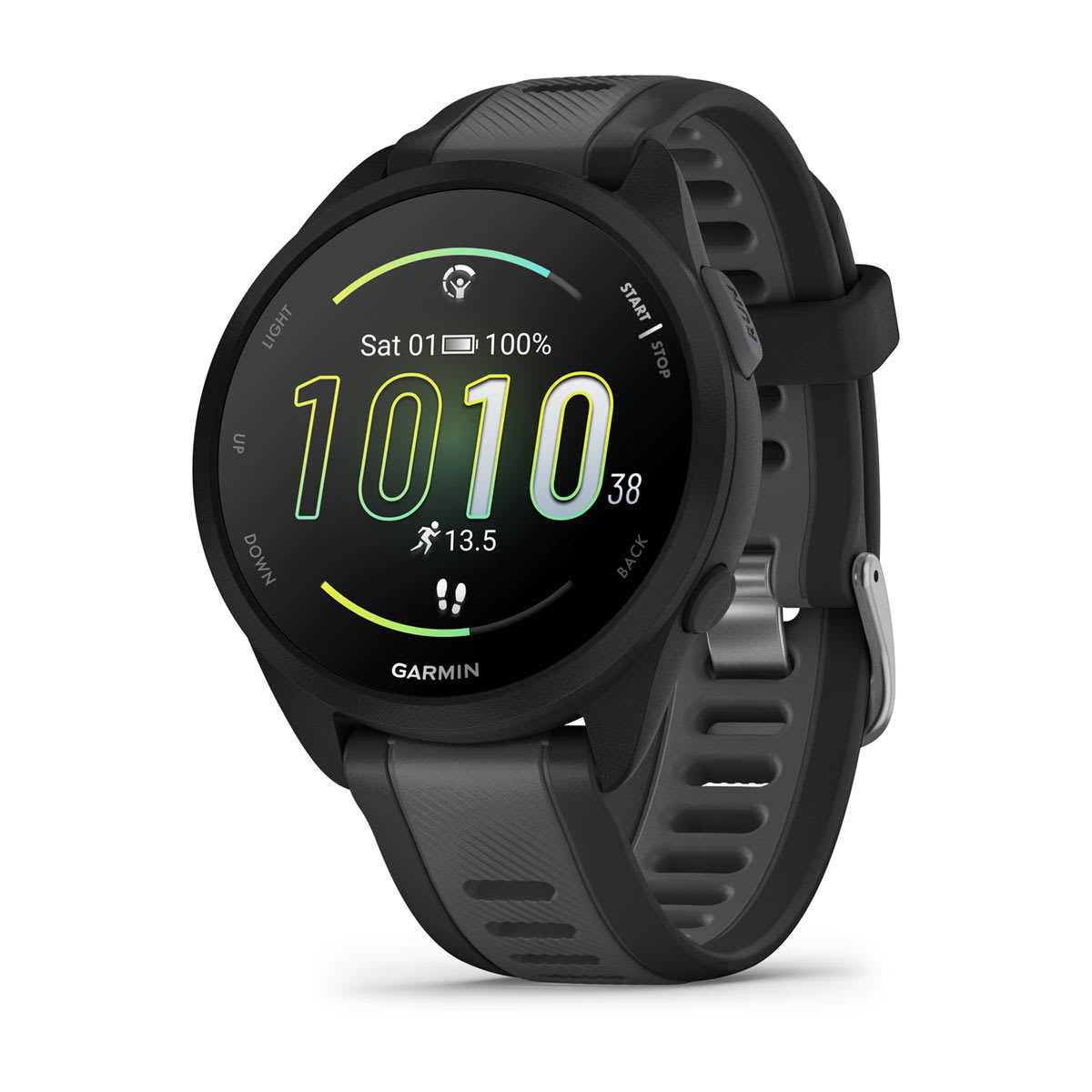
Forerunner 165, Black/Slate Gray
£199.99 at Garmin buys GPS, GLONASS and Galileo with up to 19 hours in GPS-only mode, a barometric altimeter for elevation and floors, Garmin Pay and 4 GB of storage in a 43 mm, 39 g case, on standard 20 mm quick-release bands, under a two-year warranty.
Before you buy: No Wi-Fi and no Bluetooth sensor support on this model, a proprietary charging plug, 11 days in smartwatch mode against the Forerunner 70's 13, and no Training Readiness or Training Status rows on its sheet.
Price checked 16 October 2026. Retailer prices can change.What the watch records with the phone at home
The sensor list on the 165's page names GPS, GLONASS and Galileo alongside the Elevate wrist heart rate monitor, Pulse Ox, barometric altimeter, compass, accelerometer, thermometer and ambient light sensor. Pace, distance and elevation therefore come from the watch itself. Garmin rates battery at up to 19 hours in GPS-only mode, up to 17 hours with all satellite systems on, and up to 25 hours in UltraTrac, which records track points less often. Smartwatch mode is up to 11 days, or up to 20 with the battery saver.
The running side is on the sheet rather than in an app subscription: GPS-based distance, time and pace, VO2 max, race predictor, HRV status, PacePro pacing strategies, wrist-based running power, stride length and ground contact time. One gap shows in the spec text: ground contact time is listed, ground contact balance is not. A treadmill or a track has its own profile, so the phone-free case covers indoor work as well.
A previous model that undercuts its replacement
Garmin UK's page carries the Running > Previous Models breadcrumb, and the Black/Slate grey watch is £199.99. The Forerunner 70, the model now in that slot, is £219.99, the 170 sits above it at £259.99 and the 170 Music at £299.99. Higher on the Running page the 265 is £369.99 in its 46 mm size and the 570 is £429.99 in 47 mm. The 165 is the only one of these whose page lists shipping in four to seven business days rather than one to three, which is worth a glance at checkout and nothing more.
On the sheets, the older watch is the cheaper one and the one with more hardware. The 70 wins on runtime, up to 13 days in smartwatch mode and 23 hours in GPS-only against 11 days and 19 hours, and it lists Training Readiness and Training Status, rows the 165 page does not carry. The 165 wins on hardware the 70 sheet does not list: a barometric altimeter, a compass, a thermometer, Garmin Pay and 4 GB of storage where the 70 lists 512 MB. Floors climbed is on the 165 list and not on the 70's. Garmin's blurb says the 170, £60 above the 165, adds Garmin Pay and floors climbed.
Where the phone comes back into it
Connected features require pairing through the Garmin Connect app, and the manual's list of them is specific: glances, the controls menu, notifications, safety and tracking features, and anything that comes from the phone apps. Weather and calendar data arrive from the phone. Courses and custom interval workouts are built in Garmin Connect and sent to the watch, which then runs them without the phone in hand. Wind-adjusted running power uses wind data from the phone combined with the watch's own barometer, heading and speed, so the metric degrades to no-wind on a phone-free run.
The two restrictions that separate this watch from the music version are stated plainly in the manual: Wi-Fi is available only on the Forerunner music watch, and Bluetooth sensors are available only with a music watch. So activity uploads, software updates and downloaded training plans travel over a paired phone rather than a network of its own, and external speed, cadence or heart rate straps have to speak ANT+. Safety features have the same dependency with a sharper edge: Assistance and incident detection send your location through a paired phone that has a data plan and coverage, and Garmin states that the app does not contact emergency services for you.
Bands, a proprietary plug, and two years
The case is 43 by 43 by 11.6 mm and 39 g on a silicone strap, over a wrist range Garmin gives as 126 to 203 mm, with a chemically strengthened glass lens and a fibre-reinforced polymer bezel. Bands are 20 mm quick-release, which the manual shows swapping by hand and which the spec calls an industry standard, so a worn-out strap is an off-the-shelf part rather than a model-specific order. Water rating is 5 ATM, described as withstanding pressure to 50 m.
Charging is the weaker half of the accessory story: the spec lists a Garmin proprietary plug charger, and a fully depleted battery takes up to two hours. Garmin UK's Consumer Limited Warranty covers non-aviation products for two years from purchase, with the customer paying transportation and Garmin choosing repair, replacement or refund. Damage from power or data cables Garmin did not supply is excluded, as are cosmetic wear and batteries unless a defect caused the damage. Garmin adds that it does not exclude or limit other legal rights you hold under your country's laws.
Skip it if the phone is coming with you
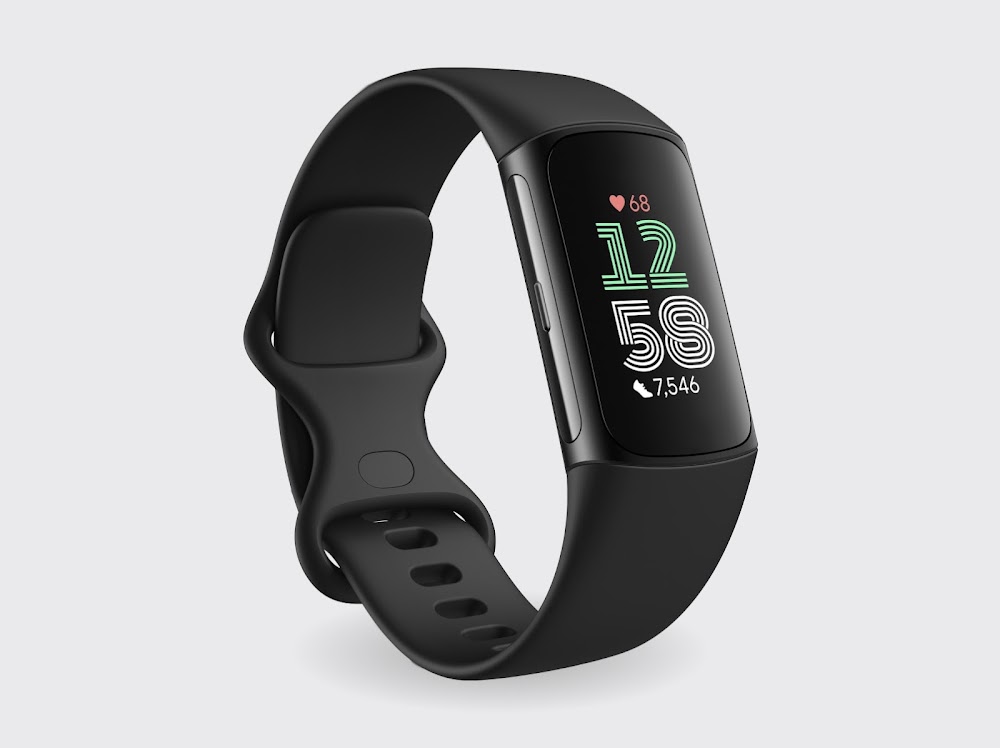
If the run keeps the phone in a pocket, the 165 is more watch than the task needs. Garmin's own vívosmart 5 is £129.99 and describes connected GPS, which is a band that borrows the phone's fix rather than a training computer, and on a run with the phone in a pocket that borrowed fix is all the band needs. The Fitbit Charge 6 lists built-in GPS at £139.99 on the Google Store, so a runner happy with a band shape saves £60 against Garmin's price for the 165 and gives up the barometric altimeter, floors climbed and the training screens above.
Within Garmin the two hard skips are also clear. Runners after the coaching rows the 165 page lacks belong on the Forerunner 70 at £219.99, which lists Training Readiness and Training Status and runs 23 hours in GPS-only mode. And a runner wanting music on the wrist has a Garmin option on the same product page: the Forerunner 165 Music, £239.99 in Black/Slate grey, is £40 above this watch and is the variant whose listing carries the Wi-Fi row the manual reserves for the music model. The newer Forerunner 170 Music, £299.99, is £100 above the 165.
How we put this together
Built from the product pages and listings below, without test scores or results we have not measured. Specifications and prices change, so check the original page for the exact model, current price, delivery, and returns.
- Garmin UK: Forerunner 165 product page (opens in a new tab)
- Garmin: Forerunner 165 Series owner's manual (PDF) (opens in a new tab)
- Garmin UK: Consumer Limited Warranty (opens in a new tab)
- Garmin UK: Forerunner 70 product page (opens in a new tab)
- Garmin UK: Forerunner 170 product page (opens in a new tab)
- Garmin UK: Forerunner 170 Music product page (opens in a new tab)
- Garmin UK: Forerunner 265 product page (opens in a new tab)
- Garmin UK: Forerunner 570 product page (opens in a new tab)
- Garmin UK: vívosmart 5 product page (opens in a new tab)
- Google Store UK: Fitbit Charge 6 listing (opens in a new tab)