Product image supplied by the brand
In this guide
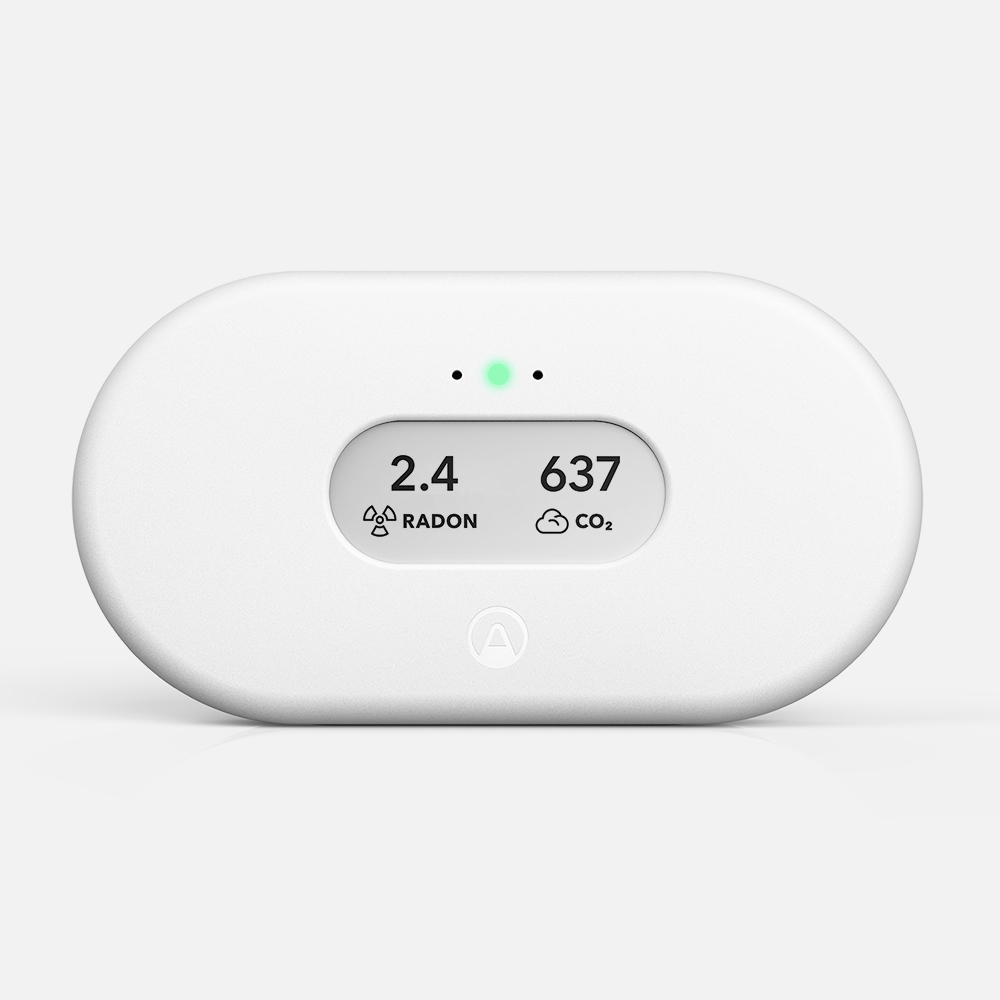
Radon comes up out of the ground, seeps through cracks and floors, and cannot be seen, smelled, or tasted, which is why the standard advice is simply to test. The Airthings View Plus is a $329.99 white pill of a monitor that sits on a shelf, watches radon continuously along with six other things, and puts the numbers on a 2.9-inch e-ink screen and in an app. Airthings builds this line for homes and long-term averages, not as a lab instrument.
The real question is what that buys over a cheaper particle-only monitor, or over paying someone to test the house. Two facts decide it. The View Plus reads radon and carbon dioxide, which the cheap units ignore, and none of its readings are trustworthy on day one: the VOC and CO2 sensors need about a week to calibrate, and the radon figure narrows to its rated 5% accuracy only after two months. If the number has to carry paperwork, this monitor will not produce one.
Our verdict
Worth $329.99 to watch radon and indoor air over months in one home; hire a certified measurement professional instead when you need a report for a sale or a reading above 4 pCi/L.
- A good fit for
- Someone with a radon worry — a new house, a basement, a low-lying floor — who wants continuous readings and long-term trends and will give the monitor weeks to settle.
- We would skip it if
- You only care about wildfire smoke or dust, where a particle-only monitor is cheaper; you need a certified test with paperwork; or you are unwilling to let the monitor calibrate for a week.
Reasons to consider it
- The radon sensor spans 0–500 pCi/L with a passive diffusion chamber and alpha spectrometry, and the app flags readings at the EPA action level of 4 pCi/L
- Seven sensors in one unit: radon, PM2.5, CO2, VOCs, humidity, temperature, and air pressure
- The North American warranty starts at 12 months and becomes a free five-year one when the device is registered within 30 days
The compromises
- Rated radon accuracy tightens from about 10% after seven days to about 5% only after two months
- The VOC and CO2 sensors need roughly a week of initial calibration before their readings settle
- It reports domestic long-term averages and cannot produce a certified measurement for a property transaction
What we have not verified: Nothing published shows how the radon sensor drifts after several years, or how close six AA batteries come to the two-year rating with the display and Wi-Fi reporting running.
The things in this guide
A closer look at the products, who they may suit, and what to check before buying.
View Plus
One device tracks radon, PM2.5, CO2, VOCs, humidity, temperature, and pressure, shows live values on an e-ink display, and streams trends to a free app over Wi-Fi.
Before you buy: The radon reading is rated to about 5% only after two months, it is a domestic monitor rather than a certified test, and the warranty excludes batteries, wear, and water damage.
Price checked September 23, 2026. Retailer prices can change.The radon sensor is the reason to pay
The feature that separates this from a cheaper particle-only monitor is the radon sensor. It measures from 0 to 500 pCi/L with a passive diffusion chamber and alpha spectrometry, and logs one radon data point an hour; the five-minute sampling interval on the spec sheet belongs to the air-quality sensors. In the app, anything at or above 4 pCi/L, the EPA's action level, turns the display red; between 2.7 and 4 it sits yellow, and below that green. The EPA calls radon the second leading cause of lung cancer after smoking, which is why this is the reading most buyers came for.
The radon figure forms slowly: the reading is an average, and Airthings builds its homeowner line for domestic use, meaning a reliable long-term figure rather than an instant measurement. Where you put it counts as much as what it costs: the lowest lived-in floor, at breathing height and no higher than six feet, at least three feet from vents, windows, and fans, and never in air above 85% humidity, which can permanently damage the radon sensor inside.
A cheaper monitor answers a smaller question
Inexpensive monitors usually do one job: fine particles, the PM2.5 that wildfire smoke, gas cooking, and candles throw into the air. The View Plus measures that too, using a laser-scattering particle counter, and adds carbon dioxide, total VOCs, humidity, temperature, and air pressure. The CO2 sensor is NDIR and spans 400 to 5,000 ppm, and the app flags 1,000 ppm, a level Airthings notes a closed bedroom regularly reaches overnight. VOCs, the airborne chemicals off paint, cleaning sprays, and new furniture, are flagged at 250 ppb.
For a buyer whose only worry is smoke drifting in from outside, none of that justifies $329.99. A particle counter alone tracks the thing you can already smell in the hallway. The extra sensors answer questions your nose cannot: whether a bedroom is stuffy from carbon dioxide, whether a fresh coat of paint or a new sofa is off-gassing, whether a basement reading climbs on the days the weather turns. If those questions are not yours, a particle-only monitor is enough.
The first week is calibration, not data
Nothing here is trustworthy in the opening days. Airthings gives the VOC and CO2 sensors an initial calibration of about seven days, and radon behaves even more slowly: the rated accuracy is roughly 10% after seven days at 5.4 pCi/L, tightening to about 5% only after two months. The radon chamber refills with new air in 30 to 45 minutes and logs one data point an hour, so the early numbers swing on very little information. A single alarming morning is noise, not a measurement.
That shapes what week one should look like. Buy it, place it, then leave it alone; treat the first fortnight as the device learning your house rather than as a result. Airthings' own guidance for its homeowner monitors is to measure for as long as possible, and at least 30 days, before reading the average as settled, because that lets temperature swings, wet weather, and daily habits average out. Two months in, the figure is stable enough to act on.
It measures your radon; it does not certify it
So what does a $329.99 monitor replace? A stack of one-off test kits and the guesswork between them. It watches continuously, keeps short- and long-term averages, and can warn you the day a reading crosses the EPA action level of 4 pCi/L. The EPA is blunt on the point: testing is the only way to know your level, and it recommends testing all homes below the third floor, radon being invisible and odorless. For staying aware of the house you live in, that is a fair substitute for hiring someone every few years.
It is not a certified measurement, though, and that line decides a lot of purchases. Airthings' professional device, the Corentium Pro, is AARST-NRPP certified and carries four of the same radon sensors to count many more events per hour; the consumer line is sold for domestic use and long-term averages. A View Plus reading will not stand in for a certified test in a real-estate transaction, and no monitor lowers radon, because mitigation is a separate trade. Buy the monitor to understand your house; hire a certified tester when the number needs a signature.
Buy it for the radon, or buy something cheaper
The price reads best against Airthings' own shelf. The View Radon costs $219.99 but reads only radon, humidity, and temperature. The Wave Plus is $249.99 and drops PM2.5 and the screen. The Corentium Home is $149.99, radon-only with no app or Wi-Fi. The View Plus adds the particle sensor, the e-ink display with its red, yellow, and green glow, and the hub that shares its Wi-Fi with battery-powered Wave monitors. It runs up to two years on six AA batteries, or always-on over USB-C.
Two loose ends are worth knowing. The North American warranty runs 12 months and becomes a free five-year one if you register within 30 days, and it covers sensor failure or inaccurate readings but not batteries, normal wear, or water damage. The unit is HSA and FSA eligible through Truemed for people whose plan allows it. Then the skip list: choose a particle-only monitor if smoke is your only concern, and if you need an official radon test, put the money toward a certified tester instead.
How we put this together
Built from the product pages and listings below, without test scores or results we have not measured. Specifications and prices change, so check the original page for the exact model, current price, delivery, and returns.
- Airthings: View Plus product page (opens in a new tab)
- Airthings: Consumer Warranty (opens in a new tab)
- Airthings: compare monitors (opens in a new tab)
- Airthings Help Center: Corentium Home compared with a professional radon detector (opens in a new tab)
- Airthings Help Center: how radon is measured (opens in a new tab)
- US EPA: A Citizen's Guide to Radon (opens in a new tab)