Product image supplied by the brand
In this guide
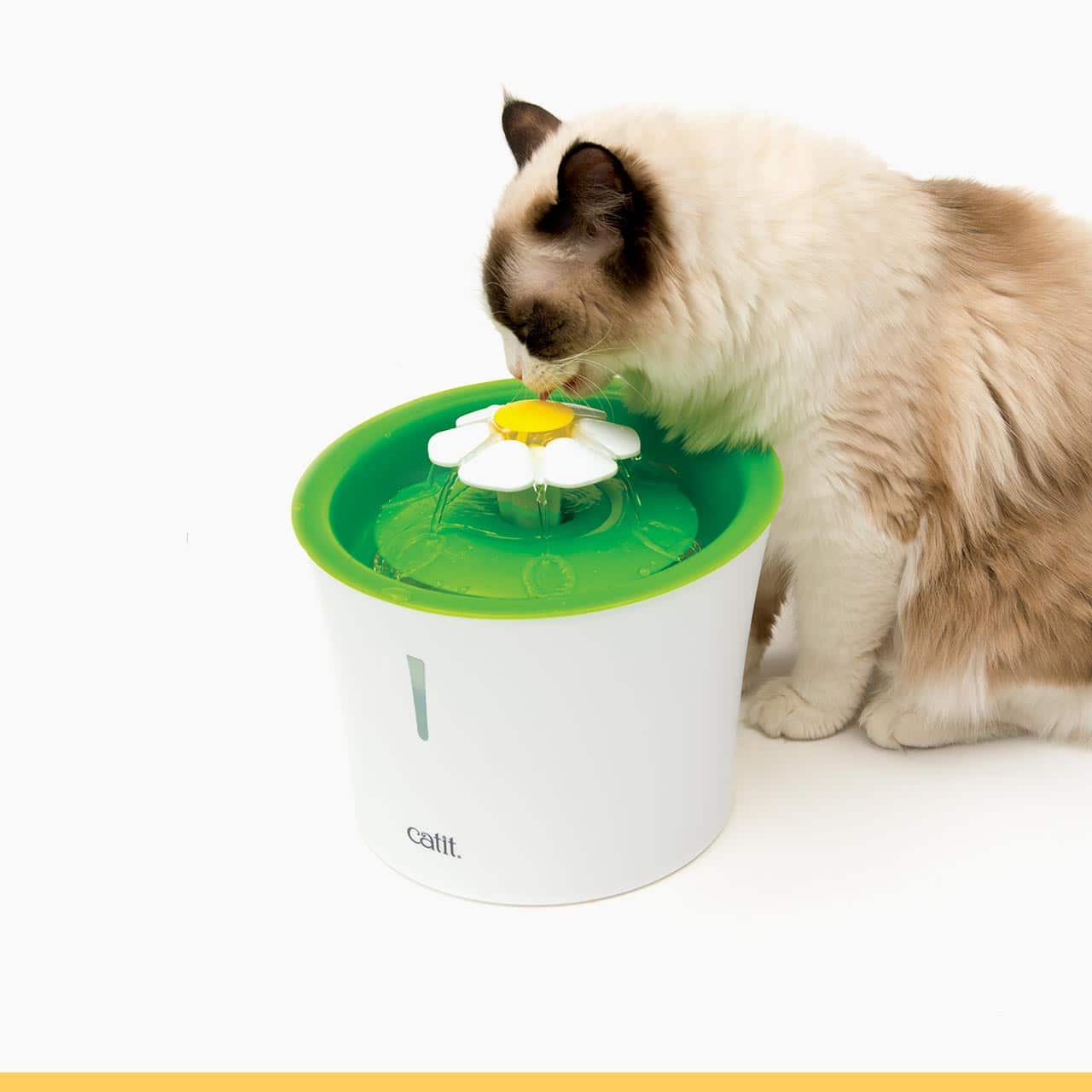
Catit lists the Flower Fountain as product #43742 with a 3 L (100 fl oz) reservoir, a footprint of 8.3 by 8.3 inches, a height of 7.3 inches, and a weight of 1.32 lb (590 g). It runs from a 120 V, 12 VA, 60 Hz supply in North America, uses BPA-free plastics, and includes one Triple Action filter pad. The brand site does not list a price, so the price field on this page stays empty on purpose.
What follows is a research review built only from Catit's own product, filter, cleaning, Q&A, and setup pages. There is no hands-on testing behind it. The angle worth reading for is the running cost: a filter pad Catit says to replace every 30 days, plus a pump teardown on a two-week cadence. Those two chores decide whether this fountain is a good buy for your house.
Our verdict
A sensible fountain for a household that will commit to a filter pad every month and a pump teardown every two to four weeks. If that routine sounds unlikely, a bowl you rinse daily is the better outcome for the cat.
- A good fit for
- Single- or two-cat homes with a hard, level floor and someone who already does a recurring chore on a calendar
- We would skip it if
- You expect to run it unattended for months, you want a stated noise figure, or you need a wattage number to compare running cost
Reasons to consider it
- 3 L (100 fl oz) reservoir with a water level window, so refills are visible without lifting the top
- Three flow settings from one flower accessory, which gives a fussy cat more than one way to drink
- Every component is cleaned with warm water and dish soap, and the pump comes apart without tools
The compromises
- Catit says to replace the Triple Action pad every 30 days or when saturated, a recurring cost the brand site does not price
- The pump needs disassembly and rinsing every two weeks per the cleaning guide (the Q&A says monthly), which is more upkeep than a bowl
- The brand site lists no price, no decibel figure, and no cord length for this model, so those have to come from a retailer
What we have not verified: Catit does not publish a price, a noise rating, dishwasher guidance, or a cord length for #43742, and the two support pages disagree on pump-cleaning frequency (biweekly vs monthly). The urinary-health language is the manufacturer's and has not been verified for this review.
The things in this guide
A closer look at the products, who they may suit, and what to check before buying.
Flower Fountain
Large reservoir for its footprint, three drinking modes, tool-free disassembly, and a filter Catit sells in 2-packs and 6-packs so the monthly swap is at least easy to stock.
Before you buy: No price, noise figure, or cord length on the brand site; the filter is a permanent monthly expense; support pages disagree on how often the pump needs cleaning.
Price checked September 11, 2026. Retailer prices can change.What the spec sheet says, and what it leaves out
The published numbers are a 3 L (100 fl oz) reservoir inside a 21 by 21 by 18.5 cm body that weighs 590 g empty. In use, that capacity means a single cat will go several days between top-ups, which is the main reason to pick this over a bowl if you travel for a weekend. For a two-cat home the interval shrinks, but the water level window on the front shows the remaining volume without lifting the top, so the check takes a glance. The call: capacity per square inch of floor is good for this class of fountain. The limit is that Catit does not say how low the water can drop before the pump runs dry, only that the fill line is a wavy mark in the plastic rim.
Power is listed as 120 V, 12 VA, 60 Hz, 300 mA for North America, and the fountain is made from BPA-free plastics. The 12 VA figure is an apparent-power rating for the adapter, not a measured draw, so it sets an upper bound on running cost without telling you the actual wattage. That matters to anyone comparing fountains on electricity, and for them the spec is incomplete. The call: treat running cost as small and unknown. Cord length, a decibel rating, and dishwasher compatibility are all absent from the #43742 page, and the newer Easy Clean model's 59 in cord does not transfer to this one.
The filter pad is a monthly subscription in everything but name
Catit's Triple Action pad has three layers: a cotton mesh outer that catches hair and debris, activated carbon for odor and impurities, and an ion exchange resin that the company says removes calcium and magnesium. The stated tip for use is to replace it every 30 days, or sooner if it looks saturated. In practice that means twelve pads a year for one fountain, on top of whatever the fountain itself costs. For a household that already forgets to change a furnace filter, this is the line that should give pause. The call: buy the 6-pack (#43739) if you buy at all, because the 2-pack (#43738) will have you reordering six times a year. Catit does not list a pad price on the brand site, so the annual figure has to be computed at checkout.
The pad also needs prep before it goes in. Catit's setup page says to shake and tap the dry filter so the granules do not clump, rinse it thoroughly to keep black sediment out of the reservoir, then submerge it and press the mesh so trapped air escapes and it stops floating. Each replacement repeats that routine. The Q&A adds that a pad left above the waterline can grow mold, so the fountain has to stay filled to the wavy line and switched off only for cleaning. Anyone who lets a bowl run half-empty will need to change that habit here. The call: the filter works as described only if it stays wet and gets swapped on schedule. The limit is that the 30-day interval is a manufacturer figure, not a measured saturation point, and a multi-cat home with long-haired cats may hit saturation sooner.
Cleaning: what Catit asks of you every two weeks
Catit's cleaning guide says every component can be washed in warm water with a soft sponge and dishwashing soap, and that aggressive detergents and abrasive sponges are off limits. The top parts need regular cleaning to keep scale from settling, which matters most in hard-water areas where mineral film shows up on the flower and the drinking surface within days. For a renter with soft municipal water the scale note is minor; for a well-water home it becomes the dominant chore. The call: plan on a sink session, not a wipe-down. The guide does not say whether any part is dishwasher safe, so assume hand washing until Catit states otherwise.
The pump is the part that decides whether you keep the fountain. The cleaning guide says it should be removed and disassembled for cleaning on a biweekly basis, with each part rinsed separately before reassembly, while the Q&A page says to clean the pump each month. Both pages agree on the failure mode: a pump clogged with cat hair loses flow, and the fix is to take it apart. That discrepancy means the true cadence is somewhere between two and four weeks depending on how much hair your cat sheds. For a Maine Coon household, plan on the shorter interval. The call: biweekly is the safer schedule. Note that only older units have a flow slider on the pump; if yours has one, Catit says to slide it to + for full flow, and if it does not, there is no flow adjustment at the pump.
The urinary-health claim, kept at arm's length
Catit's filter page states that the pads make water more appealing and 'can even reduce the risk of urinary tract infections', and that the ion exchange resin removes calcium and magnesium which, in the company's words, could build up in the lower urinary tract. Those are manufacturer claims, and nothing on this page verifies them. In use, the practical effect a buyer can observe is softer-tasting water and less mineral scale on the top; any effect on a cat's bladder is not something a product page can demonstrate. The call: buy the fountain for hydration convenience and filtered taste, and do not buy it as a treatment. This is not veterinary advice; if your cat has a urinary history, a vet should be the one deciding what water, diet, or fountain to use.
Catit's #43742 page carries a second, quieter claim: the design 'pushes only filtered water to the surface', so the cat drinks only what has passed through the pad. Taken at face value, it means the filter's condition directly sets the water quality at the bowl, which is another reason the 30-day swap is load-bearing. For an owner who keeps the schedule, the claim is plausible mechanically since the pump draws from below the pad. For one who lets the pad go for three months, the same mechanism delivers water through a saturated filter. The call: the design only helps if the maintenance is real. The limit is that Catit publishes no filtration performance data, so 'filtered' here describes a path through the pad and nothing more quantitative.
When to skip it
Skip this fountain if the placement will be a countertop or a wooden floor and you are sensitive to hum. Catit's own Q&A says the fountain runs quieter on a sturdy, fully level surface, that it belongs on the floor and not a table, and that a wooden floor is naturally noisier than concrete or tile. No decibel figure is published, so a buyer in a small apartment with a bedroom near the kitchen has no way to judge the noise from the spec alone. The call: without a stated rating, treat noise as unknown and place it on tile if you can. Filling to the wavy line and cleaning the pump also affect noise per Catit, so the maintenance schedule and the sound level are linked.
Skip it as well if the recurring cost has no place in your budget or if the price matters and you need it from the manufacturer. Catit's brand site lists no price for the fountain or the pads, so the total cost of ownership over a year has to be assembled from a retailer's numbers for the unit, twelve pads, and the occasional flower accessory (#44820, sold separately). A home with a cat that only drinks from a running tap may still get value from the three flow modes; a home with a cat that drinks fine from a bowl gains mostly a chore. The call: if you cannot picture yourself disassembling a small pump every two weeks, the bowl wins. The limit of this review is that every claim above comes from Catit's pages, with no independent measurement.
How we put this together
Built from the product pages and listings below, without test scores or results we have not measured. Specifications and prices change, so check the original page for the exact model, current price, delivery, and returns.
- Catit Flower Fountain product page (#43742) (opens in a new tab)
- Catit Flower Fountain Triple Action Filter Pad page (opens in a new tab)
- Catit Flower Fountain cleaning guide (opens in a new tab)
- Catit Flower Fountain Q&A (opens in a new tab)
- Catit Flower Fountain getting started (opens in a new tab)