Product image supplied by the brand
In this guide
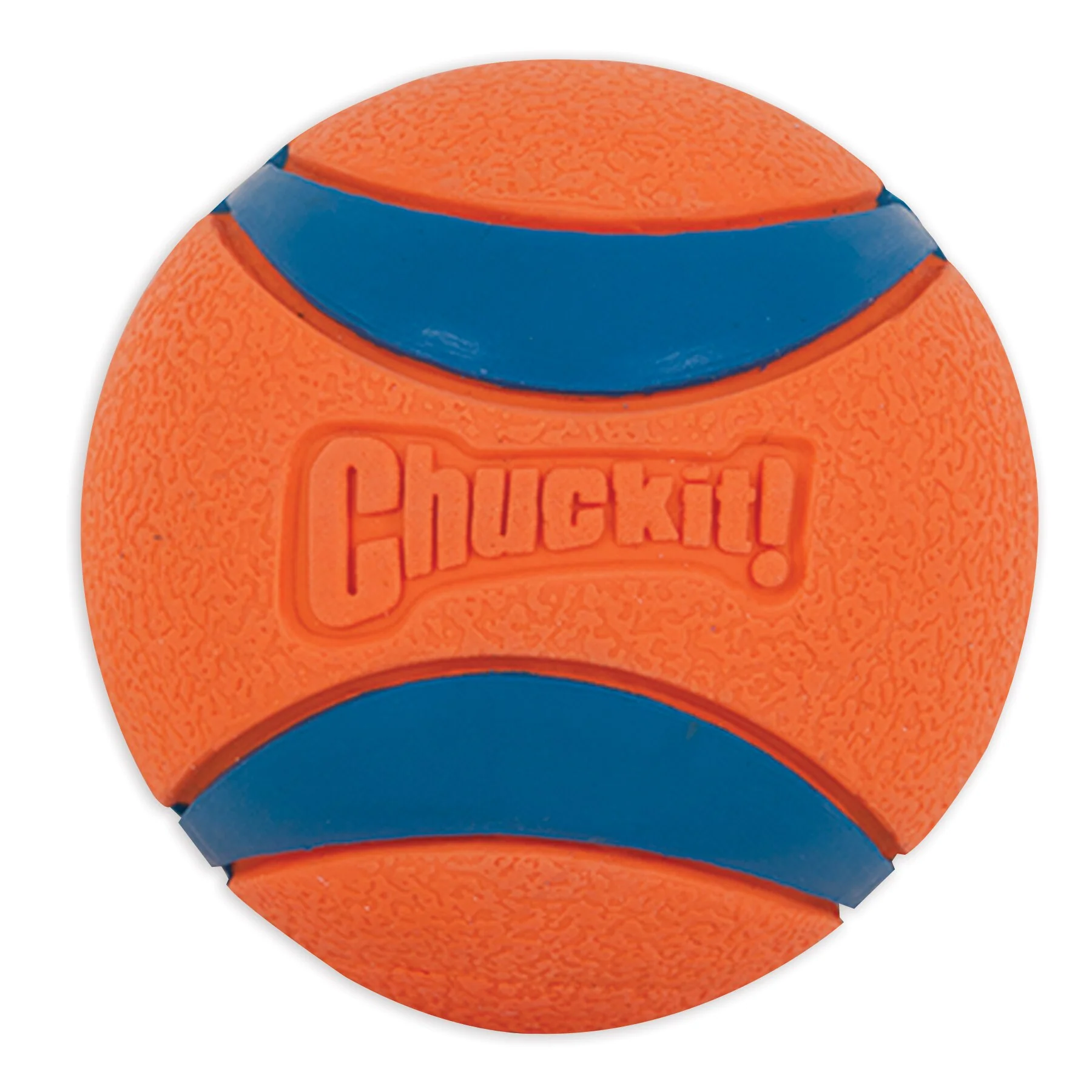
Petmate, which runs the official Chuckit! store, lists the Ultra Ball in six options: small 2-pack, medium, medium 2-pack, large, XL, and XXL. The medium single (SKU 170015) is $8.99 and weighs 0.26 lb; the medium 2-pack (SKU 17001) is $11.99. Image captions on the same page put the medium at 2.5 in (6.4 cm), next to a 2.7 in tennis ball for scale.
Everything here comes from Petmate's product page and its structured product data, with no hands-on use. The review is short because the product is simple: a rubber ball that floats and fits a launcher. The two decisions that matter are the size, which Petmate frames as a safety choice, and whether to pay $3.00 more for a second ball. Both get their own section below.
Our verdict
For a dog in the medium launcher's size band, the Ultra Ball is an inexpensive, high-visibility fetch ball with a floating rubber core. The single is $8.99; the pair is $11.99, and losing one is the most common way this toy ends, so the pair is the one to order.
- A good fit for
- Owners who throw with a Chuckit! launcher or play fetch in water and want a ball that stays visible in grass and floats when it lands in a pond
- We would skip it if
- Your dog chews balls apart, you need an exact rubber compound for allergy reasons, or you are unsure which size cannot fit entirely in your dog's mouth
Reasons to consider it
- Medium is 2.5 in (6.4 cm), close to a tennis ball, and launcher-compatible per Petmate
- Floats and is rated for land or water use, with bright orange and blue for visibility
- Medium 2-pack is $11.99 against $8.99 for one, so the second ball costs $3.00
The compromises
- Petmate says 'extra-thick rubber core' but does not name the compound, so no natural-vs-synthetic answer
- Petmate's own notice says to supervise play and replace any ball with rips, tears, or cuts, so it is a consumable
- Size guidance for medium lives in an image, not text; the weight band is not stated in Petmate's text
What we have not verified: Rubber composition, country of manufacture, and a text-based dog-weight range for medium are not stated on the Petmate page. The 20 to 60 lb range appears only in an image file name and is not treated as confirmed here.
The things in this guide
A closer look at the products, who they may suit, and what to check before buying.
Ultra Ball, Medium
Launcher-compatible, floats, bright colors, and a 2-pack price that makes the spare almost free; the 2.5 in medium matches the common medium launcher.
Before you buy: Rubber compound unstated; Petmate treats it as a supervised, replace-when-damaged toy; sizing guidance is in an image rather than a text spec.
Price checked October 4, 2026. Retailer prices can change.Sizing: medium means 2.5 inches, and the choice is a safety call
Petmate's image captions state the medium Ultra Ball is 2.5 in (6.4 cm) across, slightly smaller than a 2.7 in tennis ball, while the small is 2 in, the XL is 3.5 in, and the XXL is 4 in. In use, the medium is the one that fits the standard medium launcher, and it is the size a dog that already chases tennis balls will treat as familiar. That matters for owners replacing a shredded tennis ball who do not want to retrain a retrieve. The call: medium is the default for a mid-size dog. The limit is that the dog-weight band for each size is shown in a chart image, and the only text hint, a 20 to 60 lb range, sits in an image file name, so it is not a confirmed spec.
Petmate's additional information block says choosing the right size can be difficult and points to its infographic. The reason it matters is the same reason any ball matters: a ball small enough to pass the back of the mouth is a hazard, and a ball too large is one the dog cannot carry. For a large-breed owner, the medium is the wrong pick even though it is the most common one on shelves; the large at 3.05 in packaged width or the XL is the correct starting point. The call: measure your dog's mouth against a tennis ball first, then pick the size that cannot fit entirely inside it. The page gives per-size package dimensions and weights, which help with launcher fit, but it does not publish a text table of breed or weight ranges.
Price: $8.99 alone, $11.99 as a pair
Petmate's variant data lists the medium single at $8.99 and the medium 2-pack at $11.99, both in orange and blue. The arithmetic is plain: the second ball adds $3.00, or about a third of the single price. In use, a fetch ball's most common end is being lost in tall grass, a hedge, or a lake, not being worn out, and the two-pack covers that failure without a second shipment. For anyone who plays away from home, the spare in the bag is the more useful purchase. The call: order the 2-pack. The other sizes run $10.99 for the small 2-pack, $12.99 for large, $14.99 for XL, and $18.99 for XXL, so the spare-ball discount is specific to the medium listing.
Petmate also offers a subscribe-and-save option that the page shows as a 10 percent reduction with a free first-box gift, and the listing is tagged as eligible for free shipping promotions. A subscription on a rubber ball only makes sense for a household that loses balls on a predictable schedule, which describes a dog that swims more than one that plays in a fenced yard. For most owners a one-time 2-pack is simpler. The call: skip the subscription unless you already know your loss rate. The limit is that prices on the Petmate store were read on 2026-09-11 and are the manufacturer's direct price, which may differ from a pet retailer's shelf price in either direction.
Materials, floating, and what the page does not say
The Petmate description says the Ultra Ball has an extra-thick rubber core and high-quality material that lets it float, and the feature list adds high bounce, high buoyancy, and a construction that is strong and durable yet gentle on a dog's mouth. In use, buoyancy is the feature that separates this from a tennis ball, which soaks up water and gets heavier; a ball that floats is retrievable from a pond edge and dries without a smell. That matters most to owners of dogs that swim. The call: for water fetch, this is a good match. The limit is that Petmate never names the rubber compound, so whether it is natural rubber, a synthetic blend, or something else is unknown from the brand site.
Bright orange with blue curved stripes is the only listed color for the Ultra Ball, and Petmate frames the color as a visibility feature to keep the ball from being lost. In practice, orange stands out against grass and water in daylight; against fall leaves it is less distinct, and there is no glow variant of the Ultra Ball on this listing. The medium single weighs 0.26 lb (118 g) per the variant data, heavier than the small 2-pack's 0.28 lb for two balls. For an owner who throws by hand instead of with a launcher, the extra mass changes the throw slightly and the page does not describe bounce height in any measurable way. The call: expect a heavier, denser ball than a tennis ball. Country of manufacture is not stated on the page.
Supervision and when to retire a ball
Petmate's own additional information says it is important to always supervise play and to always replace any toy with rips, tears, or cuts in it. That is the manufacturer telling you the ball is a consumable with a defined end of life, not a chew toy. In use, a dog that settles down to gnaw on a ball between throws will eventually open the surface, and once the rubber is cut the ball should be pulled from rotation. For owners of power chewers, this turns an $8.99 ball into a recurring purchase; for fetch-only dogs, it lasts as long as it stays found. The call: buy it for throwing, not for unsupervised chewing. Petmate does not publish a chew-strength rating or a durability test figure for the Ultra Ball.
The reviews Petmate publishes on the listing describe dogs that chew the ball for hours without damage, but those are customer accounts, not a specification, and this review does not rely on them. The distinction matters because a buyer choosing between the Ultra Ball and a purpose-built chew toy needs a stated design intent, and Petmate's stated intent is fetch: 'specifically crafted for fetch', in the description's words. For a household with one fetch-obsessed dog and one chewer, that means the ball goes away when the throwing stops. The call: treat the supervision notice as the operating rule, not fine print. The limit is that with no hands-on testing here, the ball's real lifespan under a specific dog is unknown, and Petmate's replace-when-cut rule is the only guidance the brand gives.
When to skip it
Skip the medium if you cannot confirm your dog's mouth size from the chart, because Petmate's guidance on choosing a size is an image, and a ball that is one size too small is the one safety risk this product carries. A large-breed owner should look at the large ($12.99), XL ($14.99), or XXL ($18.99) listings on the same page instead, and a toy-breed owner at the small 2-pack ($10.99). The call: when in doubt, size up, since a ball too large to carry is an inconvenience and a ball too small is a hazard. This review has no way to verify the weight ranges on the chart beyond the file name of the image, so the sizing decision stays with the owner.
Skip it also if your dog is a dedicated chewer, if you need a named rubber compound for a sensitivity, or if you want a ball with a squeaker; Petmate sells the Ultra Squeaker Ball as a separate product for that. The Ultra Ball does one job, which is to be thrown, found, and thrown again, and it does it at a price where the second ball costs $3.00. For an owner with a launcher and a dog that retrieves, there is little to argue with. For anyone else, the value depends on the dog. The limit of this write-up is that it rests entirely on Petmate's listing and structured data, read on 2026-09-11, with no independent bounce, buoyancy, or durability measurement behind any claim.
How we put this together
Built from the product pages and listings below, without test scores or results we have not measured. Specifications and prices change, so check the original page for the exact model, current price, delivery, and returns.
- Petmate Chuckit! Ultra Ball Dog Toy page (opens in a new tab)
- Petmate product data (variants and prices) (opens in a new tab)