Product image supplied by the brand
In this guide
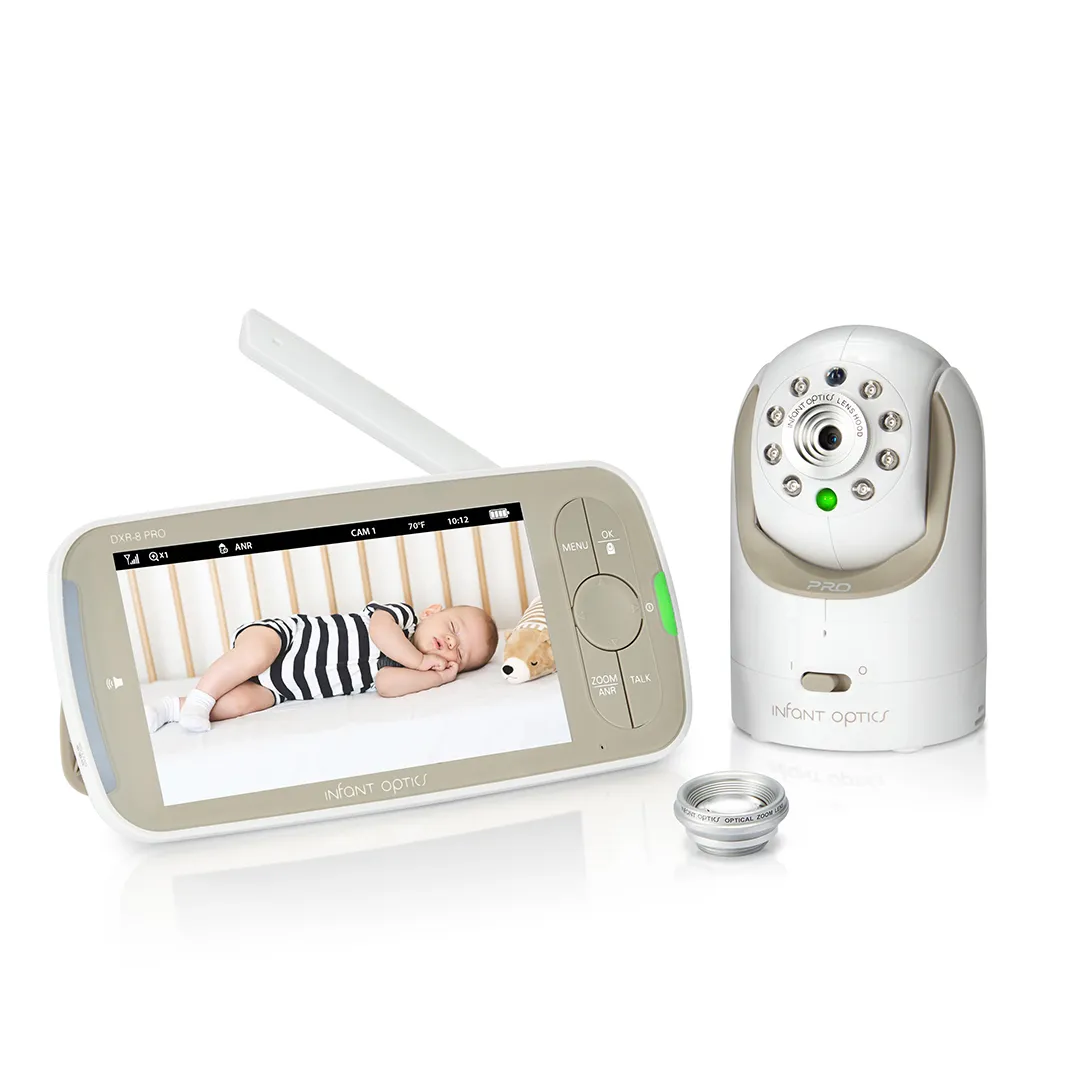
Infant Optics sells this monitor as the DXR-8 PRO Full Kit at $199.99, in white: a 5-inch parent unit, a pan/tilt camera, an optical zoom lens, and power adapters for both units. The company has built non-WiFi monitors since 2011 and positions the PRO as its standard: 1280x720 video on the 5-inch screen, a closed 2nd-generation FHSS radio between camera and monitor, four camera slots, and Active Noise Reduction, a patented hardware filter Infant Optics bills as a first for baby monitors. There is no app to install and no account to make; the monitor runs the moment both adapters are plugged in.
One purchase decision sits underneath the specifications: a nursery camera that never touches the internet gives up everything the internet does. Nothing records — there is no card slot in either unit and no cloud behind them — and no one can check the nursery from the office or the road. What $199.99 buys instead is a link that exists only between the camera and the monitor in your house, a screen with physical buttons, and audio tuned for rooms where a white-noise machine runs all night. Three answers settle the trade: recordings needed or not, remote viewing needed or not, and the room count.
Our verdict
Buy the $199.99 DXR-8 PRO when the nursery feed must stay off the router and the cloud: closed FHSS signal, remote pan/tilt, Active Noise Reduction, and four-camera capacity, with no subscription. Skip it if anything needs recording or away-from-home viewing.
- A good fit for
- A nursery with a white-noise machine on all night, where parents want video, two-way talk, and sound alerts from hardware that never touches an app or the internet, and will keep the monitor plugged in.
- We would skip it if
- Whoever needs the feed recorded anywhere, wants to check the nursery from outside the house, or needs two rooms heard at once — that is the $299.99 PRO SS's job, not this monitor's.
Reasons to consider it
- The closed architecture is the product: 2nd-generation FHSS on 2400–2483.5 MHz between camera and monitor only — no router, no app, no account, no subscription anywhere in the chain, so nothing about the feed exists outside the house
- Active Noise Reduction, patented hardware filtering, aims at the exact failure mode of nursery audio — a white-noise machine drowning the baby — and the sound-activated LED bar shows noise levels with the screen off
- The hardware plan is long-term: a user-replaceable monitor battery with a free swap past the 6.4 mm swelling threshold, interchangeable lenses, expansion to four cameras, and an official 3,000 mAh replacement pack
The compromises
- Nothing records — the system has no card slot and no cloud behind it, so a 2 a.m. event leaves no clip to review; that is the price the closed signal pays
- The battery figures are modest: 6 hours screen-on, 10 hours standby, 7 hours on the charger per the manual, so overnight use means a plugged-in monitor
- Single view, single audio: with more than one camera the PRO shows and hears one at a time, and simultaneous two-room audio belongs to the $299.99 PRO SS
What we have not verified: The 1,000-foot range and every battery figure above are manufacturer numbers, published for line-of-sight conditions that a house interior does not offer; Infant Optics publishes no runtime at partial brightness or with the speaker at volume, and no measured ANR performance. Accessory prices load dynamically on infantoptics.com, so the add-on camera and wide-angle lens prices could not be pinned, and the availability field in the page's offer markup is an unfilled placeholder, leaving direct-purchase stock unconfirmed.
The things in this guide
A closer look at the products, who they may suit, and what to check before buying.
DXR-8 PRO
The kit price covers a 5-inch 1280x720 monitor with physical controls and a sound-activated LED bar, a corded pan-tilt camera with automatic infrared night vision, an optical zoom lens, and Active Noise Reduction tuned against white-noise machines. The 2nd-generation FHSS link is rated to 1,000 feet line of sight, expansion reaches four cameras, the monitor battery is user-replaceable with a free end-of-life swap, and no subscription exists anywhere in the system.
Before you buy: Nothing records and nothing is viewable away from home; the single-view monitor shows and hears one camera at a time; the battery is rated at 6 hours screen-on with 7 hours to recharge; and the one-year US warranty comes with buyer-paid return shipping.
Price checked September 15, 2026. Retailer prices can change.What a closed signal buys, and what it refuses to do
The radio is the product. Infant Optics describes it as 2nd-generation FHSS private frequency technology, and the manual's specification page is more concrete: 2400 to 2483.5 MHz, GFSK modulation, frequency-hopping spread spectrum, four selectable camera channels. The camera talks to the monitor directly and to nothing else — the company's page states there is no router, no cloud, and no subscription in the chain, and that the connection can't drop when the WiFi does. The rated reach is up to 1,000 feet, with the manual attaching the condition that matters: line of sight, no obstructions. Indoors, walls spend that budget fast; treat 1,000 feet as the open-air ceiling, not a floor-plan promise.
The same closedness is the limit. Because neither unit connects out, there is no live view away from home, no push alerts to a phone, and — since neither unit has a card slot — no recording of anything, ever. A 2 a.m. cry exists only if someone hears it. The alert system is deliberately local: the monitor's speaker, a sound-activated LED bar that glows with the screen off, and a level indicator onscreen. App-and-cloud monitoring answers who is at home from anywhere; this answers who is crying in the room next door — nothing beyond that.
The 5-inch monitor, and a battery to plan around
The parent unit is a 5-inch TFT color display at 1280 x 720, per the manual, driven by buttons rather than a touchscreen: a MENU/OK dial, a ZOOM/ANR key, a TALK key, and a volume rocker, all operable in the dark without looking. The status bar shows which of the four camera slots is live, the room temperature read from a thermometer inside the camera unit, signal strength, and the clock. A 1000 mW speaker sits behind the grille, and the sound-activated LED bar along the upper edge brightens with nursery noise even when the screen and audio are switched off.
The battery figures come from Infant Optics and deserve planning: 6 hours with the screen on, 10 hours on standby, 7 hours to charge from empty. The 3.85 V lithium-ion cell is user-replaceable, and the manual rates it for roughly 500 charge cycles or 24 months before swelling becomes normal wear, with a caliper check at 6.4 mm and a free replacement pack by email past it; the official spare is a 3,000 mAh part sold for the PRO and the PRO SS. Read together, the numbers describe a monitor meant to live on wall power overnight and run on battery for daytime trips around the house and yard.
A corded pan-tilt camera with swappable optics
The camera unit pans 135 degrees to the left and 135 to the right and tilts 95 degrees up and 25 degrees down, all from the monitor's controls; digital zoom adds reach the optics don't. Night vision is automatic infrared from 8 LEDs and a low-light sensor. The camera has no battery: its adapter must reach an outlet, and the manual's strangulation warning requires the cord to sit at least 3 feet from the crib. Set the mounting spot with that in mind. On the lens mount, the aluminum hood ships installed, the optical zoom lens is in the box, and the 170-degree wide-angle lens is sold separately — the manual notes the wide view costs some distortion and clarity.
Expansion goes to four cameras, paired through a Camera 1–4 menu, and the add-on camera unit is the same pan-tilt hardware with its adapter included; Infant Optics notes it works only with the 5-inch PRO line, not the older 3.5-inch DXR-8. One limit shapes multi-camera use: the PRO is a single-view, single-audio monitor, so two cameras means switching between rooms, hearing one at a time. Simultaneous two-room audio is what the DXR-8 PRO SS adds for $299.99, under patent 11,804,120, combining both feeds into one continuous signal at the base station — if a second baby or a toddler room is in the plan, that $100 separates hearing the right room from hearing both.
Active Noise Reduction, and the audio around it
The PRO's signature feature addresses a specific nursery problem: white-noise machines. Most monitors pass that constant sound through as ambient hiss, so a parent sleeping with the volume up hears the machine all night. Infant Optics filters it in hardware — Active Noise Reduction, protected by U.S. Patent Nos. 11,875,769 and 11,240,590 and marketed as a first for baby monitors — and the company's description is careful: it targets steady background noise so the sounds that vary, a child's, come through. The key is shared: a short press runs digital zoom, a long hold toggles ANR, and the TALK button turns the monitor into an intercom for the room.
The published record for ANR is qualitative: no attenuation figure, no frequency range, no measured before-and-after — the claim rests on the two patents and the company's description. Whether ANR tames a particular machine is something a buyer can try at home: the direct store allows 30 days to send a unit back, at the buyer's shipping cost and with sale items excluded.
The price, the terms, and where this design stops
The full kit lists at $199.99 in the product page's own offer data, direct from Infant Optics, with free expedited shipping over $90 — though the page's availability field is an unfilled placeholder, so direct stock went unconfirmed on 2026-09-15. Terms: 30 days to send back a direct purchase with an RMA number and buyer-paid return shipping; a one-year limited warranty covering US purchases, original owner only, with Infant Optics choosing replacement over repair; accessories, including the 3,000 mAh battery and the wide-angle lens, carry the same one-year term and load their prices dynamically on the site. Registering the warranty unlocks support benefits, per the warranty page.
App-driven cameras typically cost less, record to a card or the cloud, and ping a phone at the first cry — and they need the router up and an account. The DXR-8 PRO answers the opposite brief: $199.99 once, $0 a month, nothing stored anywhere, and a signal that stops at the nursery wall. Buy it for one room with no internet in the chain; skip it the moment recordings, remote check-ins, or two rooms heard at once matter — the last one is the PRO SS's $299.99 job. Check the second-room question before checkout; it is the one that changes the cart.
How we put this together
Built from the product pages and listings below, without test scores or results we have not measured. Specifications and prices change, so check the original page for the exact model, current price, delivery, and returns.
- Infant Optics: DXR-8 PRO product page (US) (opens in a new tab)
- Infant Optics: DXR-8 PRO user manual (PDF, V3.7) (opens in a new tab)
- Infant Optics: Warranty page (opens in a new tab)
- Infant Optics: Shipping & Returns page (opens in a new tab)
- Infant Optics: DXR-8 PRO Camera Unit accessory page (opens in a new tab)
- Infant Optics: DXR-8 PRO SS product page (US) (opens in a new tab)
- Infant Optics: DXR-8 PRO / PRO SS Replacement Battery accessory page (opens in a new tab)