Product image supplied by the brand
In this guide
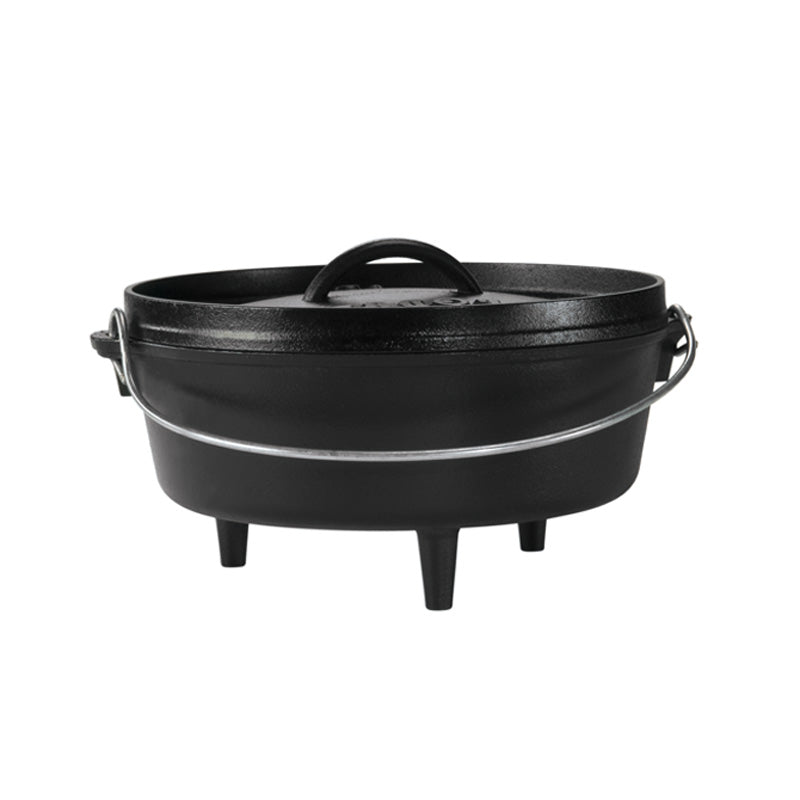
A camp Dutch oven is a kitchen Dutch oven with three things bolted on: legs to lift it off a bed of coals, a rim around the lid to keep more coals on top, and a wire bail to move the whole hot assembly. Lodge's 10 inch, 4 quart version, item L10CO3, sells direct for $79.95 and weighs 11.29 lb with its lid. It is the second-smallest of six sizes in the range, above a 2 quart and below a 5 quart deep model that shares the same 10 inch footprint.
Whether the three additions are worth the money depends entirely on the heat source. Over charcoal briquettes they turn a pot into an oven with controllable top and bottom heat; on a camp stove or a grill grate they are dead weight, and Lodge's own cheaper kitchen Dutch oven does the job better. This piece reads the dimensions, the care page, the coal chart guidance and the Made Right warranty to draw that line clearly.
Our verdict
A well-specified 4 quart coal-cooking pot at $79.95 whose three features, legs, flanged lid and bail, are useless on a stove and essential over charcoal; buy it for briquette cooking, and buy the kitchen Dutch oven for everything else.
- A good fit for
- A camper or backyard cook who will bake, braise or stew over charcoal briquettes for two to four people, owns or will buy a lid lifter, and accepts the wash, dry, oil routine after every trip.
- We would skip it if
- Your outdoor cooking happens on a propane stove or a grill grate, you cook for more than four, or you want one Dutch oven that also works in the kitchen, where the 5 quart L8DOL3 costs less and sits flat on a burner.
Reasons to consider it
- Lodge publishes a full coal method for this design: a ring of charcoal under the legs, a checkerboard on the flanged lid, and a quarter turn every 10 to 15 minutes
- The lid does two jobs, holding coals for top heat and inverting into a second cooking surface, which no kitchen Dutch oven lid can do
- Made in the USA, seasoned with vegetable oil, and covered by the Made Right promise for the life of the pot against cracks, warps and casting defects
The compromises
- At $79.95 for 4 quarts it costs more than the 5 quart kitchen Dutch oven at $59.90, and the legs keep it off a stovetop, a grill grate and most tabletops
- Lodge does not publish a cooking-surface diameter, an interior depth or a lid weight, so pan-fit questions for bread or a whole chicken stay open
- Rust, pitting, sticky seasoning and flaking are excluded from the warranty, which puts the entire maintenance burden on the owner after every fire
What we have not verified: No L10CO3 was cooked in, weighed or measured for this article; the 11.29 lb figure, the 11.81 by 10.43 by 6.37 inch envelope and the coal guidance are Lodge's own numbers, and the $79.95 price was checked once, on September 11, 2026.
The things in this guide
A closer look at the products, who they may suit, and what to check before buying.
10 Inch / 4 Quart Cast Iron Camp Dutch Oven
The 4 quart L10CO3 gives a charcoal cook a legged pot, a lid that holds coals and doubles as a griddle, and a bail handle for a tripod, with Lodge's coal placement method and lifetime casting warranty behind it, for $79.95.
Before you buy: Legs make it useless on a burner or a grate, Lodge omits the interior dimensions, the lid lifter and any tote bag cost extra, and every trip ends with hand washing, thorough drying and a wipe of oil to keep the seasoning off the warranty's exclusion list.
Price checked September 11, 2026. Retailer prices can change.Three legs and a rim are the entire product
Lodge's camp oven care page breaks the design into three parts. The three small cast legs hold the flat bottom above the heat source so air can circulate under it and so the pot does not rock on uneven ground. The lid has a flanged outer edge, a raised rim that keeps a layer of charcoal in place on top, and Lodge says the same lid can be flipped over and used as a second cooking surface. The heavy-gauge wire bail handle is for hanging the oven over a fire from a tripod and for carrying it, hot, away from the coals.
No one of those parts helps on a flat burner. The legs lift the base off a stove grate or a camp stove, so heat transfer collapses; the flange collects nothing useful indoors; the bail is redundant next to a pair of loop handles. Lodge marks the oven as safe for campfire and direct flame and says it belongs outdoors, and the combustion warning on the same page is a reminder that a charcoal fire is the intended heat source. A replacement 10 inch lid alone costs $24.95, which gives some sense of how much of the $79.95 sits in that flanged casting.
What Lodge publishes for the 4 quart, and what it leaves out
The 4 quart variant is listed at 11.81 inches long, 10.43 inches in width and 6.37 inches tall, at 11.29 lb. The length includes the bail's ears and the width is the outside of the body, so the usable interior is somewhat under 10 inches across; Lodge does not publish a cooking-surface diameter, an interior depth or a separate lid weight for any camp size. For a loaf of bread or a small chicken, that means checking fit at home with a tape measure before the trip, not reading it off a page.
The 10 inch footprint is shared with the 5 quart L10DCO3, which costs $10 more and is the deep version. Lodge's care page explains the split: shallow ovens are the bread ovens, because the coals on the lid sit close to whatever is baking and brown the top as well as the bottom, while deeper sides give room for roasts, stews and soups. The 4 quart is the shallow one. That makes it the better choice for biscuits, cobbler and rolls, and the weaker choice for a pot roast that needs headroom.
Lodge's coal method, and why it needs a lifter
The care page gives a complete procedure. Charcoal briquettes go under the oven in a circle at least half an inch inside the edge, and on the lid in a checkerboard, never bunched, because bunched coals create hot spots that burn food and can damage the iron. Every 10 to 15 minutes the oven gets a quarter turn one way and the lid a quarter turn the other. Briquettes should be lit 15 to 20 minutes ahead; a wood fire needs 30 to 45 minutes to produce usable coals. Lodge publishes a downloadable coal chart that maps counts on top and underneath to oven temperature.
Two practical consequences follow. First, the routine assumes a lid lifter: rotating a lid piled with coals, and lifting it without dumping ash into dinner, is not a bare-hands or oven-mitt job, and Lodge sells its own lifter and a 4-in-1 tool separately. Second, the whole method is charcoal arithmetic. A cook who plans to set the pot on a propane stove gets none of the top heat that the flange and the checkerboard exist for, and would be better served by a flat-bottomed pot at a lower price.
Wash, dry, oil, and what the Made Right warranty leaves to you
The oven arrives seasoned with vegetable oil, which Lodge defines simply as oil baked onto the iron to give an easy-release finish that improves with use. The care routine is three steps: scrape out food and wash by hand in hot water with a small amount of mild detergent, dry the pot and lid thoroughly with towels, then rub a very light layer of cooking oil onto the warm surface and wipe until no residue remains. For storage Lodge says to leave the lid ajar, a rolled paper towel works as a prop, so moisture cannot collect inside.
The Made Right promise, limited and lifelong, covers seasoned cast iron that cracks or warps in normal household use, casting defects such as holes, metallic projections or grind marks that hurt performance, and pieces damaged in shipping, with replacement at Lodge's option and Lodge possibly asking for photos or a return at its own expense. It does not cover rust, pitting, roughness, sticky seasoning, flaking or odors, and it is voided by a dishwasher, by soaking, or by a microwave. Read together, the warranty protects the casting and puts the surface entirely on the owner: skip the drying step after a campsite wash and the resulting rust is yours to fix, not Lodge's.
Skip it if your fire is propane, your crowd is big, or your kitchen needs a Dutch oven too
The comparison that settles most purchases is inside Lodge's own catalog. The 5 quart kitchen Dutch oven, L8DOL3, is listed at $59.90 against a $69.95 regular price, and it has a flat base, loop handles and a domed lid that work on a burner, in a home oven and on a grill grate. The camp version costs $20 more for a quart less, and every dollar of the difference buys the legs, the flange and the bail. If charcoal is not part of the plan, the cheaper pot is the better pot, outdoors included.
Capacity draws the other line. Four quarts feeds two to four people in one sitting; Lodge's 6 quart and 8 quart camp models were on sale at $79.90 and $99.90 at the time of writing, so a group cook gets more iron for about the same money, at 18 lb and 20.87 lb respectively. Buy the 4 quart when the party is small, the heat is briquettes, and a lid lifter is already on the shopping list. Otherwise the money is better spent on a size that matches the crowd or on the kitchen oven that matches the stove.
How we put this together
Built from the product pages and listings below, without test scores or results we have not measured. Specifications and prices change, so check the original page for the exact model, current price, delivery, and returns.
- Lodge: Camp Dutch Oven, 10 Inch / 4 Quart (L10CO3) (opens in a new tab)
- Lodge: Cleaning and Care of your Camp Dutch Oven (opens in a new tab)
- Lodge: The Lodge Made Right Limited Lifetime Warranty (opens in a new tab)
- Lodge: Camp Dutch Oven Lids (replacement, 10 inch L10CL3WEB) (opens in a new tab)
- Lodge: 5 Quart Cast Iron Dutch Oven (L8DOL3) (opens in a new tab)