Product image supplied by the brand
In this guide
The Misen 8-inch chef's knife lists at $124 on misen.com, about 85 percent more than the $67 Victorinox Fibrox that the beginner end of this category settles on. It is not a first-knife pick. What it answers is narrower and more expensive: for a cook whose daily knife is already on the board, the $57 step between a stamped workhorse and Misen's Japanese-steel alternative buys published hardness, a published edge angle and about 1.7 ounces more mass.
Most of that step is documented rather than advertised. Misen prints the steel supplier, an HRC range, a per-side edge angle and a five-line spec panel; the care page restates the numbers with the tests behind them. The parts a buyer cannot check in a store — actual blade thickness, what the 60-day test drive covers, how the edge behaves on bones and frozen food — are recorded as gaps below, not smoothed over. Prices here use the $124 list.
Our verdict
At $124 list from Misen, the 8-inch ACUTO440 chef's knife buys published steel, a 14-degree edge and 49 mm of heel height; the 8.1 ounces (230 g) against a stamped knife's 6.4 is the part you have to want.
- A good fit for
- Cooks already committed to one chef's knife as the main blade, who hand wash and dry after every use and want a heavier, harder-steel upgrade.
- We would skip it if
- Buyers entering the category, a household that needs a dishwasher-safe knife, anyone who prefers a light blade, or households that will not dry the blade after washing.
Reasons to consider it
- AICHI ACUTO440 steel with Misen's own numbers attached: 58±2 HRC, 8.26 inches of blade, 49 mm at the heel and a 50/50 grind at 14 degrees per side
- Corrosion resistance is the documented difference from ordinary high-carbon stainless — Misen's care page cites roughly 18 percent chromium and immersion and dishwasher tests
- The sloped bolster and 49 mm heel give knuckle clearance and room for a pinch grip, and the blade face carries a laser-etched MISEN mark rather than printed decoration
- A limited lifetime warranty covering faults in the alloy and the construction applies when the knife is bought directly from Misen
The compromises
- Lifetime covers defects only: chips, broken tips, dulling, rust spots and discoloration from food are all named exclusions, as is buying through a reseller instead of Misen directly
- Hand washing and immediate drying are Misen's instructions; the dishwasher survives the steel, but Misen warns loose blades can cut rack material and bang against flatware
- The warranty, the 60-day test drive and free returns all attach to direct purchases, so buying elsewhere changes what the buyer actually gets
- The extra 1.7 ounces over a $67 stamped knife helps through heavy prep and hurts during long fine work, without changing what the knife can cut
What we have not verified: Blade thickness is absent from Misen's specifications, and the page's geometry section gives only height and handle thickness. The larger gap is the returns terms: the listing advertises a 60-day test drive with free returns, but the maker's returns page answers 404 and the support form behind it carries no text, so what applies to a used knife is unverified and left out of the verdict. Whether a 14-degree edge chips under rough handling, and whether the steel discolors quickly outside the maker's lab tests, would each change the tradeoff list.
The things in this guide
A closer look at the products, who they may suit, and what to check before buying.
8" Chef's Knife (ACUTO440) · Black
AICHI ACUTO440 at 58±2 HRC, a 210 mm blade with 49 mm of heel, a 14-degree-per-side grind and a sloped bolster, at $124 list from Misen direct on 2026-10-12.
Before you buy: It needs hand washing and immediate drying, chips and discoloration are not covered, the lifetime warranty applies only to direct purchases, and its 8.1 ounces are a liability to cooks who prefer a light knife.
Price checked October 12, 2026. Retailer prices can change.The steel, and what Misen is willing to print
Misen names the supplier: AICHI ACUTO440, a Japanese high-carbon stainless steel from Aichi. The number that matters most for daily cooking is 58±2 HRC, which the maker prints on its listing and repeats in the steel comparison chart on its care page.
The other published figure is about 18 percent chromium. That is the difference Misen sells hardest, and it is the one the care page backs with test results: 50 dishwasher cycles and 50 days submerged with no rust reported. If your current knife rusts when it sits wet in the sink, that test is the clearest thing the higher sticker buys.
What the page does not print is a comparison. Victorinox publishes no HRC figure for the $67 Fibrox at all, so the claim that one holds an edge longer than the other has no shared figure to rest on. Both makers still tell you to hone and sharpen on a schedule; a printed HRC is a number to hold Misen to, not a promise of fewer sharpenings.
The blade's geometry
Misen prints 49 mm (1.93 in) of height at the heel and 13.5 inches overall; the Victorinox figures used here give no blade height to set beside it. At the board, 49 mm of heel height under a 210 mm blade leaves room for finger clearance through a full pile of onions.
The edge is the more meaningful break from a stamped knife. Misen describes a hybrid profile, designed for rocking, chopping, drawing and slicing, ground symmetrically at 14 degrees per side. Victorinox does not publish an edge angle for the Fibrox, so there is no per-degree comparison to make — only the geometry: a 14-degree edge slices with less force and gives that up in durability.
One number is missing: blade thickness. The spec panel lists handle thickness at 18 mm and blade height at 49 mm but never the spine width, and neither does the care page.
The rounded spine, and the grip it is for
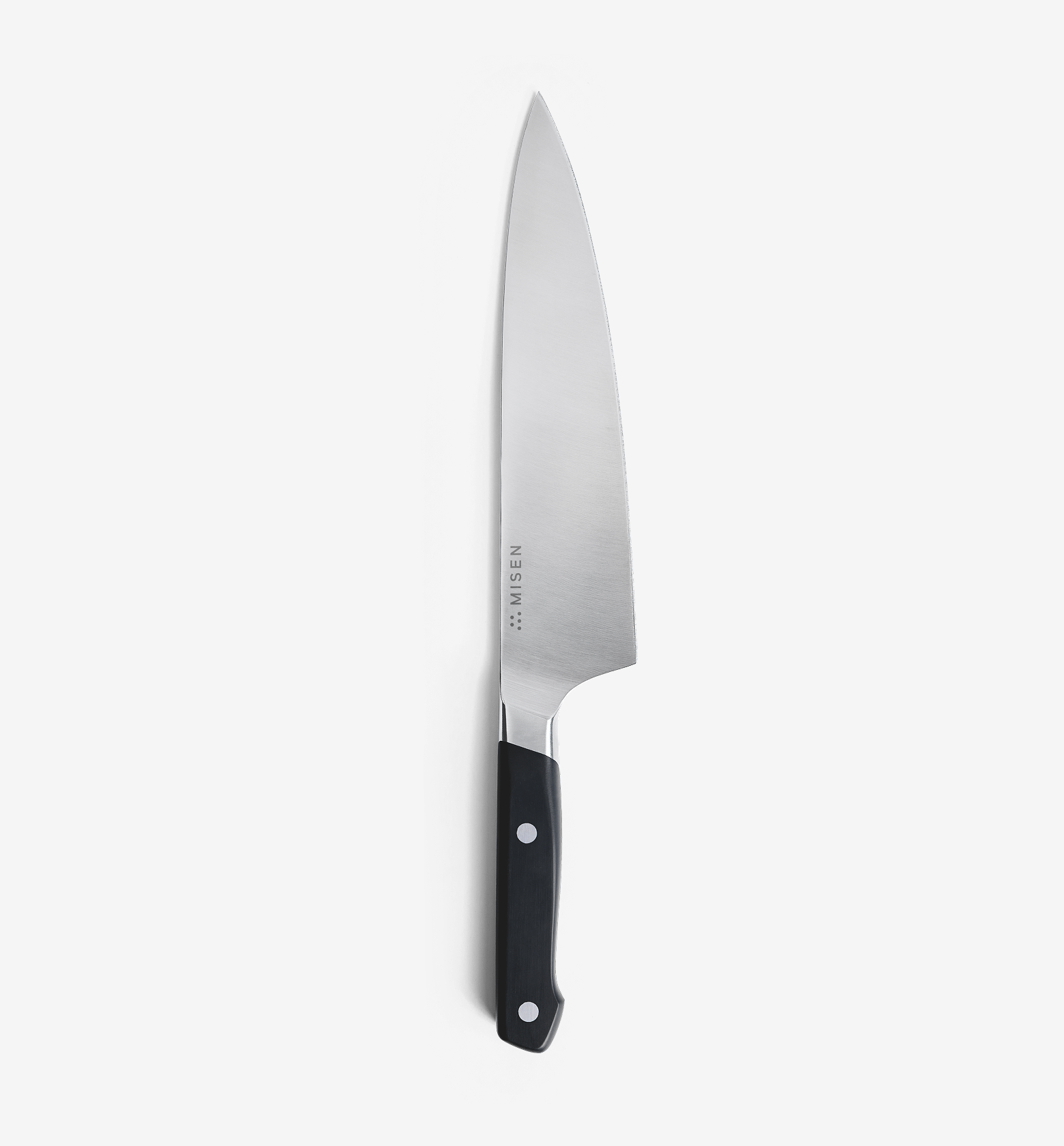
The product photography shows a laser-etched MISEN mark on the blade face and a sloped bolster that meets the handle without a hard shoulder. Misen prints no spine or bolster measurements, but the care page does state the design intent: a rounded spine and heel to reduce pressure points for a pinch grip over long sessions. The practical logic is the same logic the maker states — a square spine grinds against the second knuckle once the forefinger and thumb pinch the bolster. Whether the rounding matters to you is a judgment about hours of prep, not a spec line.
Worth naming plainly: nothing in Misen's documentation says the blade is forged, and no page discloses a tang length or construction method. The $67 Fibrox is documented as stamped by Victorinox, so what separates these two knives in print is the gap in weight and edge angle, not a manufacturer statement about how the Misen blade was formed. Buyers who want a forging claim should expect to find it somewhere this page does not.
The 1.7 ounces, and who wants them
Misen lists 0.5 lb, or 230 g; the Fibrox lists 6.4 oz, about 181 g. The metric gap is 230 g − 181 g ≈ 49 g, about 1.7 oz. Whether that helps is editorial reasoning, not a maker claim: extra mass lets the blade fall through squash or a chicken with less push from the shoulder and steadies a rocking chop, while a lighter knife is easier to steer and lift all evening.
The same reasoning flips in fine work. Mincing shallots, tourneing, or filleting small fish rewards a light blade steered with the fingertips, and 8.1 ounces will fatigue a wrist sooner than 6.4 ounces over a long session. Balance is the part of that question a buyer cannot read off a spec panel.
None of that makes the heavier side of the argument automatic. The comparison here is more mass against less, not better against worse, and both knives sharpen and cut food. Buyers who already find a light knife pleasant can read the extra 1.7 ounces as a reason to keep what they have, not as proof they are missing out.
The knife comes in several colors, and the makers' pages document no performance difference by finish, so color is a preference rather than a spec decision.
The handle, and the care that follows it
Polyoxymethylene is the handle material, a dense engineering plastic rather than wood, so there is no oiling routine and nothing to season. Misen's instruction for the knife is one line: hand wash and dry immediately after use.
The dishwasher question is where Misen's pages disagree. The listing reports the steel was lab-tested through 100 dishwasher cycles; the care page counts 50. Two pages from one maker give two numbers; the lower one is the safer reading. Both pages then recommend hand washing anyway, because a loose blade in a basket can cut rack material and bang against flatware. What stays consistent is the alloy's roughly 18 percent chromium, the number behind the corrosion claim: the steel survives a night in the sink, but the maker is not promising a knife that tolerates neglect.
Sharpening is on you, on a 4-6 month schedule or whenever the knife stops biting. Misen sells mail-in service from $11, and the warranty does not cover a dull blade, so the care cost is either a stone you learn or a shipping label twice a year.
What the lifetime warranty actually covers
Misen's Limited Lifetime Warranty hinges on how the knife was built: faults in the alloy, the construction and the workmanship that appear in ordinary use are covered. The knife paragraph is where buyers should slow down: chips, broken tips, dulling, rust spots and discoloration from food are all listed as not covered, along with dropped or misused knives. A broken tip is never a warranty claim, and blade discoloration is cosmetic rather than claimable.
There is also a receipt rule. Coverage extends only to the original purchaser and only to knives bought from misen.com or Misen's Amazon account; resellers, marketplaces and secondhand purchases are excluded. That makes the lifetime promise a direct-sales benefit, and it puts more weight on where the order is placed than on which SKU is chosen.
The advertised 60-day test drive and the returns policy have no readable terms behind them. Both appear as badges on the listing, while the maker's returns address answers 404 and the Help Hub's only returns link leads to a support form with no published terms. Whether a used knife is still returnable, who covers the cost of returning it and what counts as abuse are therefore unverified, and the verdict above does not lean on them. The warranty page is clear by comparison, and the sharpening page holds the care policy.
When the $57 is the wrong $57
Skip the ACUTO440 if $67 is already committed to a knife that gets sharpened. What the Misen adds in steel and edge angle is published numbers and a thinner edge, not a different dinner. The extra weight is only a feature for the cook who values it.
Leave it on the shelf if the knife will live in the dishwasher, if the blade will not be dried, or if anyone in the house prefers a light knife. Misen's own care instructions rule out the first, the corrosion claim is what the second would test, and the weight is the tradeoff the maker's numbers spell out plainly.
For the cook who does want the heavier blade, the direct-purchase question decides the rest. At $124 list, from misen.com rather than a reseller, the warranty attaches, and the advertised test drive is a misen.com badge whose terms are unpublished; a reseller purchase loses the warranty. The knife that fits is 210 mm of ACUTO440 at about 8 ounces, a 14-degree edge and a lifetime of hand-drying.
How we put this together
Built from the product pages and listings below, without test scores or results we have not measured. Specifications and prices change, so check the original page for the exact model, current price, delivery, and returns.
- Misen: 8" Chef's Knife (ACUTO440) - Black product page (opens in a new tab)
- Misen: warranty page (opens in a new tab)
- Misen: ACUTO440 Knives Use & Care (opens in a new tab)
- Victorinox: Fibrox Chef's Knife Extra Wide, 8 in (5.2063.20) US product page (opens in a new tab)