Product image supplied by the brand
In this guide
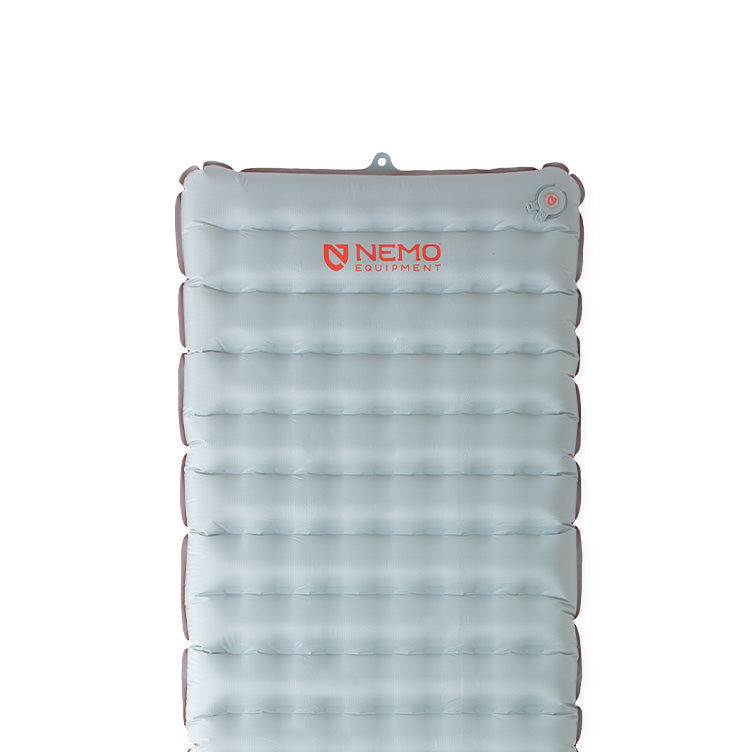
NEMO's Tensor line is four inflatable pads, and the Tensor All-Season Ultralight Insulated Sleeping Pad is the middle one: R 5.4, 3.5 in of loft, the same bluesign approved 20D recycled-nylon top and 40D bottom on every size. On November 6, 2026, the $199.95 Regular Mummy and the $259.95 Long Wide were in stock at NEMO's US store, while the two rectangular cuts between them offered only a signup for restock notice. The decision is whether that middle band covers the nights you actually sleep outside, and what the width ladder costs.
The other three Tensors answer different problems, and NEMO's own store filter states the split in R-value bands of 2-3, 5-6 and 7-8+. The Trail sits at 2.8 with one suspended layer of metallized Thermal Mirror film; the All-Season uses two; the Extreme Conditions suspends four inside an Apex baffle and reaches 8.5; the Elite drops to 2.4 and 7.6 oz on 10D fabric. Loft separates none of them except the Elite's 3.0 in, so this is a choice about ground warmth and grams, not about cushioning.
Our verdict
Buy the Tensor All-Season if your three-season nights routinely start with frost on the ground and you want one pad instead of two; skip it if you pack summer-only or refuse air-pad upkeep.
- A good fit for
- Backpackers and car campers whose shoulder-season ground is cold enough that an R 2.8 pad leaves them choosing between weight and warmth; the 14.1 oz mummy cut replaces a foam pad ounce for ounce.
- We would skip it if
- Summer-only hikers who can live with the Trail's R 2.8, gram-counters who will pay for the Elite's 7.6 oz, and anyone unwilling to dry a pad before storing it.
Reasons to consider it
- Two suspended layers of metallized Thermal Mirror film carry the R 5.4 figure, putting the pad in the 5-6 band NEMO's own store filter uses, at the same 3.5 in loft as the cheaper Trail
- Minimum weight of 14.1 oz (400 g) at the Regular Mummy cut, so shoulder-season ground warmth arrives at a foam pad's ounce count
- Stuff sack, Vortex pump sack, Velcro strap, repair patches and setup instructions are all included; no extra purchase is needed to inflate it
The compromises
- Upkeep is written into the product: no machine washing or drying, storage outside the stuff sack with valves open, and a 24-hour dry before use after a patch
- The rectangular Regular and Regular Wide showed no stock at NEMO's own store, and NEMO's R 6.2 Eclipse All-Season lists its 72 x 20 in Regular $60 below the matching Tensor
- Claim timelines of 2-6 weeks in NEMO's warranty terms and 4-6 weeks on the repairs page; the owner covers the outbound leg
What we have not verified: NEMO publishes no maximum user weight or burst-load figure for the Tensor pads and no data on how the film layers hold their R-value after years of packing cycles; either gap could push a heavier sleeper or a multi-year owner toward the Extreme Conditions tier or back to foam. Restock dates for the Trail sizes and for the All-Season's rectangular Regular and Regular Wide were not stated anywhere on the store when the prices above were read.
The things in this guide
A closer look at the products, who they may suit, and what to check before buying.
Tensor All-Season Ultralight Insulated Sleeping Pad · Long Wide
Two suspended film layers put the All-Season in NEMO's 5-6 R band at the same 3.5 in loft and 20D/40D fabric as the cheaper Trail, and the Regular Mummy cut carries that at 14.1 oz minimum weight. The Long Wide is the rectangular option in stock at the maker's store, at $259.95.
Before you buy: No maximum user weight or burst load is published, and the Regular and Regular Wide cuts were unavailable at NEMO when this was read.
Price checked November 8, 2026. Retailer prices can change.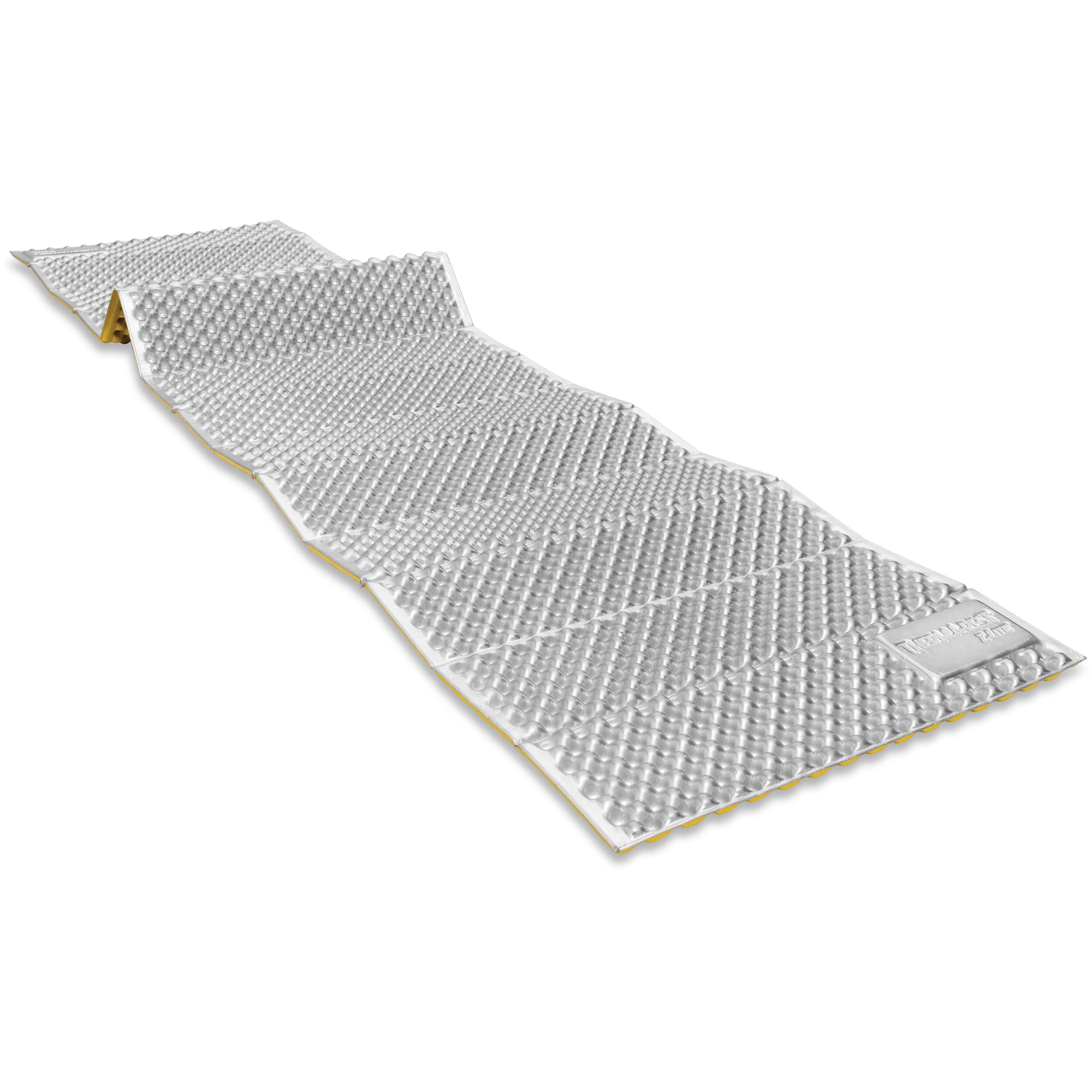
Z Lite Sol Sleeping Pad · Regular (Limon/Silver)
The Z Lite Sol's retail page lists 14 oz, 72 x 20 x 0.75 in and $59.95 in stock, with no inflation step, no patch procedure and no storage rule attached. If you will not dry a pad before packing it, the foam pad gets used more.
Before you buy: It offers 0.75 in of loft against the Tensor's 3.5 in, so the ground stays under you on rough sites.
Price checked September 21, 2026. Retailer prices can change.R 5.4 Is a Lab Comparison, Not a Temperature Promise
R-value for camping mattresses is defined by ASTM F3340, the standard test method for thermal resistance using a guarded hot plate. The method clamps the specimen between two plates, holds a constant compressive force, waits for steady state and measures one-dimensional heat flow. Its own scope calls the result a repeatable comparative measurement that may not always correlate to actual insulation performance in use.
NEMO prints 5.4 for the All-Season and explains it in a tooltip as a measure of warmth where higher numbers mean better insulation from the ground. It names no test standard, publishes no temperature rating or comfort limit for the pad, and offers no conversion from R-value to conditions. The nearest thing to guidance is NEMO's own filter: pads sort into bands of 2-3, 5-6 and 7-8+.
That distinction changes how you read the price ladder. Two layers of metallized film lifting the All-Season from the Trail's 2.8 to 5.4 is a real difference in measured resistance, and the same rig says nothing about what a windless morning on frozen ground feels like. Where the number does work is ranking: the All-Season is the family's middle rung, and the 7-8+ band is where the maker's winter claims live.
Trail, All-Season or Extreme Conditions: What $10 and $60 Buy
Three of the four Tensor pads share 3.5 in of loft and the same bluesign approved 20D top and 40D bottom, so this ladder is not about comfort. It is about film. The Trail suspends one layer of Thermal Mirror in its Spaceframe baffles and rates 2.8; the All-Season suspends two and rates 5.4; the Extreme Conditions holds four layers in an Apex baffle and rates 8.5. The Elite is the outlier, at 3.0 in of loft and 10D CORDURA fabric.
At the mummy cut, listed prices on November 6 were $189.95 for the Trail, $199.95 for the All-Season and $259.95 for the Extreme Conditions, with minimum weights of 13.0 oz, 14.1 oz and 1 lb 1 oz. Ten dollars and 1.1 oz separate summer-only warmth from NEMO's middle band. Sixty dollars and 2.9 oz separate the middle band from a pad the maker lists for mountaineering and winter camping.
Availability moved that day. All four Trail sizes were marked unavailable at NEMO's US store, as were the All-Season's rectangular Regular and Regular Wide, while every Extreme Conditions size could be bought. A tier that cannot be ordered is a price to compare at dealers rather than an option to choose, so the Trail's $10 saving only counts if a shop has it in stock.
NEMO's own catalogue also holds a cheaper route to a warmer rating, outside the Tensor line. The Eclipse All-Season suspends two Thermal Mirror layers as well and rates 6.2 at 4.0 in of loft; its 72 x 20 in rectangular Regular lists at $159.95 with a 1 lb 0 oz minimum weight, $60 less and 0.5 oz more than the rectangular Tensor All-Season Regular. On November 8, 2026 the Eclipse was waitlisted at NEMO's US store, so it is a price to watch rather than an order to place, but anyone choosing a rectangular cut on warmth per dollar should check it first.
For readers whose three-season trips begin with frozen ground, the All-Season is the tier to buy: the Trail's copy aims at spring through fall where weight leads every decision, and the All-Season is sold as a pad for all year. Pay the Extreme Conditions' premium when snow camping is planned, since its advantage is insulation rather than softness.
Four Sizes, Two Shapes, and the Price of Room
The size list changes one dimension at a time. Regular Mummy and Regular are both 72 x 20 in; Regular Wide widens to 72 x 25 in; Long Wide is 76 x 25 in. Only the mummy cut tapers, and NEMO prints a single width for it rather than the head-and-foot range its own spec note describes for tapered pads, so how much narrower the feet are is not on the record.
Weight follows the same ladder: 14.1 oz minimum for the Regular Mummy, 15.5 oz for the rectangular Regular, 1 lb 3 oz for the Regular Wide and 1 lb 4 oz for the Long Wide. From the lightest cut to the widest, that is 5.9 oz before you count the stuff sack, and packed diameter grows from 10.0 x 4.0 in to 10.5 x 4.5 in. Each step on the price list is $20.
Two situations justify the wider deck. Side sleepers whose shoulders reach the edge of a 20-inch deck lose warmth exactly where the pad needs to hold it, and the 25-inch cuts fix that for 3.5 oz over the rectangular Regular. Sleepers over about 6 ft who also want the wide deck are the reason the 76-inch Long Wide exists; at 1 lb 4 oz it is the heaviest option and the only rectangular shape in stock on NEMO's US site when these prices were read.
Coming From Foam: What Changes and What You Take On
For anyone upgrading from closed-cell foam, the comparison is weight for weight. The Z Lite Sol's retail page on November 6 listed 72 x 20 x 0.75 in, 14 oz and $59.95 in stock, with R-Value 2.6 printed in its own bullets; the pad's own maker page prints R-Value 2.0 for the same model. The Tensor's Regular Mummy is 14.1 oz at minimum weight with 3.5 in of loft and 5.4. Between 2.8 and 3.4 R-values and 2.75 in more height, for 0.1 oz and $140.
What the air pad adds to your routine is written on NEMO's care page. Do not machine wash or dry a pad, because washing machines destroy the lightweight materials. Air dry flat or on a line with valves open, away from direct sunlight. Store it outside the stuff sack, flat or loosely rolled, with valves open. Mold inside the chamber is handled by drying the pad fully inflated in short sun exposure and then leaving it unrolled overnight.
For a reader whose argument for foam is durability, that is not small print: a puncture becomes a repair job rather than a shrug. The Tensor's counter-argument is loft and the middle R band. If neither changes your nights, the foam pad stays the sensible end of the argument and the upgrade belongs to the person who stops sleeping because the ground is pulling heat out of them.
What Ships in the Bag, and How It Fills Up
The product page's What's Included list runs five items: stuff sack, Vortex pump sack, Velcro strap, repair patches and setup instructions. The Trail page states that the pump sack comes with all NEMO sleeping pads, so the bag and the patches are not an accessory bought later, and the pad needs no extra purchase to be usable on the first night.
The published instruction sheet is short and bilingual. Setup has four steps: pull the tab labeled INFLATE to remove the valve's upper cap, blow into the valve or use the included pump sack to reach the pressure you want, fine-tune by pressing the inner valve to release air, then reinstall the cap. Deflation and packing has three: pull the DEFLATE tab, roll the pad to push the air out and reinstall the valve, then fold it with the pump sack and roll tightly.
The pump sack matters for maintenance rather than convenience. NEMO's own copy says it saves breath at elevation and minimizes moisture entering the pad, and the care page's worst jobs, mildew inside the chamber and a full drying cycle, are what breath inside a pad causes. Mouth inflation is allowed by step two of the setup sheet, so the bag is a choice that keeps water out of the baffle rather than a requirement.
Lifetime Warranty, and the Weeks It Actually Takes
NEMO's guarantee is lifetime and is written against defects in workmanship and materials for the original owner, on proof of purchase naming an authorized dealer, resolved by replacement or repair at NEMO's discretion and credited only when the product is no longer available. Normal wear and tear, unauthorized modification, improper use, improper maintenance, misuse and neglect fall outside it, and the same document says that kind of damage can still usually be repaired for a fair rate.
Two timelines are on the record and they differ. The guarantee terms put warranty processing at between 2 and 6 weeks depending on the time of year; the repairs page puts repairs at 4-6 weeks not including shipping to NEMO. Both require a return authorization number, an item received in laundered condition, and a tracked box sent to Dover, New Hampshire at the owner's cost, and NEMO pays the ground shipment back to US or Canadian addresses.
Field repair is the faster path and the kit is already packed: NEMO puts that kit in a small pocket inside the stuff sack. Its patch procedure asks for rubbing alcohol, a rounded patch with no sharp corners, adhesive spread at least one inch past the hole on all sides, and a two-hour cure, with 24 hours of drying before a full night. Leak finding is a bathtub dunk or a listening pass with the pad inflated firm.
The cost of that coverage is time and a form rather than a price list. Spare parts go through a Spare Part Request Form, with tent clips and Jake's feet named as examples, and NEMO says it works to maintain spare parts for many models. No repair fee schedule is published, so an out-of-warranty patch is quoted after the claim opens, and the in-box patches are what most owners reach for.
Skip It If the Cold Never Reaches Your Ground
Three conditions argue against this pad. Summer-only hikers are the Trail's audience, at 13.0 oz minimum weight, R 2.8 and $10 less at the mummy cut, and paying for insulation you never need is the wrong trade. Gram-counters have the Elite at 7.6 oz and R 2.4 on 10D CORDURA in mummy shapes only, which is a different class of pad with a thinner fabric under it. And a reader who will not dry a pad before storing it should stay on foam.
Two gaps in the published record could change this recommendation. NEMO gives no maximum user weight or burst-load figure for the Tensor pads, so a heavier sleeper has no maker number to check a load against. There is also no long-term data on how the suspended film layers hold their R-value after seasons of rolling and unrolling, which is the assumption inside every one-pad-for-the-whole-year purchase.
Buy it on the numbers you have: R 5.4 in NEMO's middle band, 3.5 in of loft, 14.1 oz at the Regular Mummy cut for $199.95 and 1 lb 4 oz at the 76 x 25 in Long Wide for $259.95, the two prices NEMO's US site showed on November 6, 2026. If the rectangular Regular or Regular Wide is the size you want, price it where it is in stock rather than assuming today's $219.95 and $239.95 listings will be buyable.
How we put this together
Built from the product pages and listings below, without test scores or results we have not measured. Specifications and prices change, so check the original page for the exact model, current price, delivery, and returns.
- NEMO Equipment: Tensor All-Season Ultralight Insulated Sleeping Pad product page (opens in a new tab)
- NEMO Equipment: Tensor series setup instructions sheet (opens in a new tab)
- NEMO Equipment: The Adventure Forever Guarantee (opens in a new tab)
- NEMO Equipment journal: Cleaning, Repairing, and Storing Your Sleeping Pad (opens in a new tab)
- NEMO Equipment journal: Easy Fix - Sleeping Pad Has a Leak (opens in a new tab)
- ASTM International: F3340 standard test method for thermal resistance of camping mattresses (opens in a new tab)
- NEMO Equipment: Tensor Trail Ultralight Insulated Sleeping Pad product page (opens in a new tab)
- NEMO Equipment: Tensor Extreme Conditions Ultralight Insulated Sleeping Pad product page (opens in a new tab)
- NEMO Equipment: Tensor Elite Ultralight Insulated Sleeping Pad product page (opens in a new tab)
- Amazon: NEMO Equipment Tensor All-Season Sleeping Pad, Blade / Spicy Orange, Reg Mummy (opens in a new tab)
- Amazon: Therm-a-Rest Z Lite Sol Sleeping Pad, Regular (opens in a new tab)
- NEMO Equipment: Tensor Sleeping Pads collection filters (opens in a new tab)
- NEMO Equipment: Repairs page (opens in a new tab)
- Therm-a-Rest (Cascade Designs): Z Lite SOL Sleeping Pad product page (opens in a new tab)
- NEMO Equipment: Eclipse All-Season Lightweight Insulated Sleeping Pad product page (opens in a new tab)