Product image supplied by the brand
In this guide
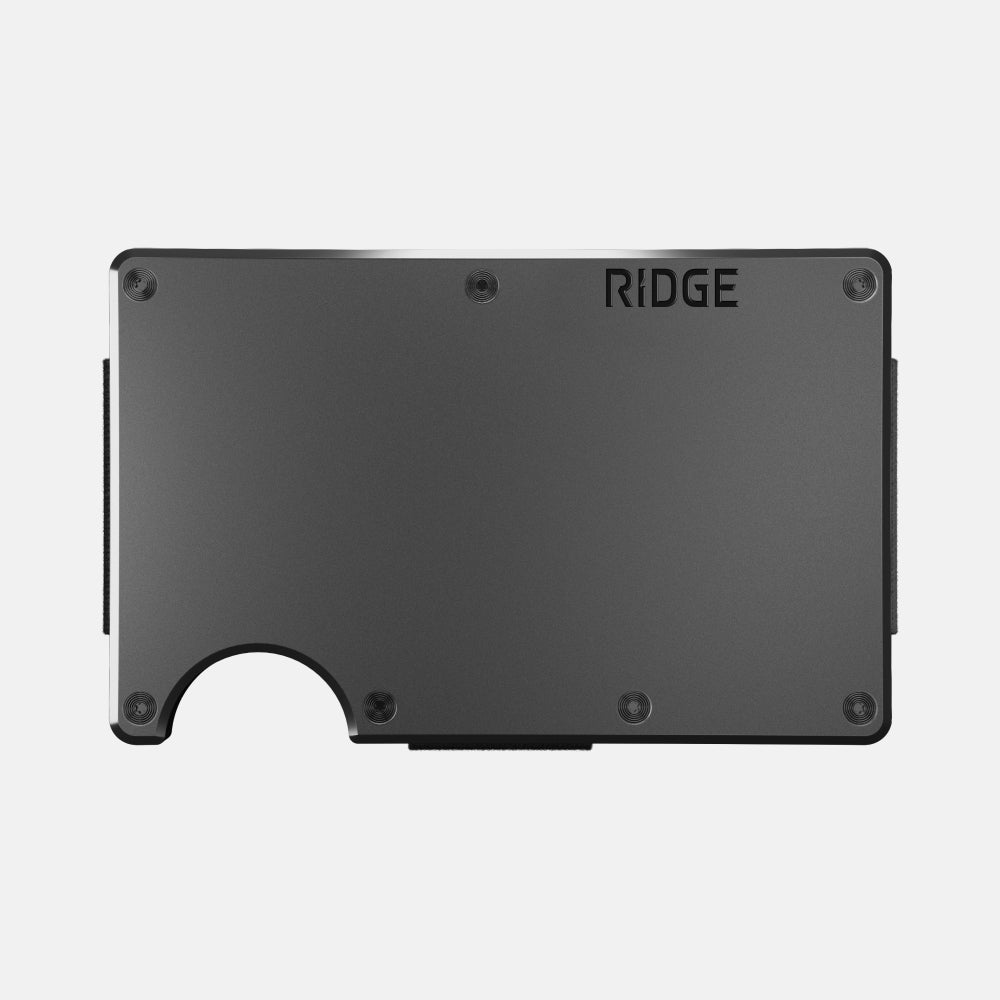
The Ridge Wallet is the product that made the metal card clamp a category: two machined plates, an elastic band along the edges, and a strap on the back for folded bills. The version covered in this piece is the base aluminum model in the Gunmetal anodized finish, which Ridge sells at $95, the same price as its other plain aluminum colors and well under its $150 carbon fiber and $195 titanium bodies. Ridge describes it as the Wallet 2.0, 10% lighter than the previous generation and with a plated cash strap and refreshed accessories.
Two things distinguish this from the cheaper aluminum clones that fill the same shelf. One is documentation: Ridge publishes the alloy, the card range and the dimensions. The other is what happens after the sale, since the wallet is covered by a program that ships replacement elastic and screws free and replaces a lost or stolen wallet for a fee. How much either matters rests on whether your carry fits a stack of cards plus a folded bill or two, because the design does not bend to anything else.
Our verdict
A $95 card clamp whose value sits less in the two aluminum plates than in the replaceable elastic, the RFID shielding and a replacement program that covers losing it; if you carry bills flat or coins at all, it is the wrong design.
- A good fit for
- A front-pocket carry of three to eight cards and a few folded bills, from a buyer who will actually use the free replacement parts and the loss-and-theft replacement.
- We would skip it if
- Your wallet holds coins, unfolded bills, receipts or more than a dozen cards, or you dislike the idea of a metal slab against your phone or leg.
Reasons to consider it
- 1–12 card capacity in a body that measures 86 × 54 × 6 mm, with RFID-blocking plates built in
- Elastic and screws are user-replaceable, and Ridge ships defective parts free under the Built for Life program
- Lost or stolen wallets can be replaced twice for a $17.95 processing fee on wallets under $150, plus a 99-day return period
The compromises
- Cash goes only under an outside strap, folded; there is no bill section, coin pocket or ID window
- Ridge does not publish a weight for the aluminum version, only a claim that the 2.0 body is 10% lighter than before
- Scratches, dents and discoloration are excluded from the warranty, and anodized aluminum picks those up
What we have not verified: No wallet was handled for this article; the elastic's tension over years, how easily the fanned cards come out one at a time, and how the anodized finish wears were not observed, and the weight figure is missing from Ridge's own specs.
The things in this guide
A closer look at the products, who they may suit, and what to check before buying.
Ridge Wallet · Aluminum, Gunmetal
Up to 12 cards in a 6 mm anodized 6061-T6 body with RFID-blocking plates, a cash strap for folded bills, user-swappable elastic and screws, and a loss-and-theft replacement program at $17.95 per claim.
Before you buy: Nothing on it holds coins, flat bills or an ID behind a window, the weight is not published, and cosmetic wear on the finish is outside the warranty.
Price checked September 11, 2026. Retailer prices can change.Twelve cards in a 6 mm stack, and a strap for whatever else
Ridge rates the wallet for 1 to 12 cards, and the phrase it uses is that the elastic expands without stretching out, which is the whole engineering problem with this design. The plates measure 86 × 54 × 6 mm, so the footprint is barely larger than a credit card and the thickness quoted is for the shell, not the shell plus a full load. The elastic runs along the sides and does the gripping; the plates do the protecting; the outside strap does the cash. Ridge credits a patented dual-track layout for holding that range without the stack getting thick.
Everything that is not a card has to fit under the cash strap on the back, folded. Ridge's own phrasing is that the strap holds several folded bills or additional items, and the phrasing describes its limits honestly: no coin pocket, no full-length bill section, no ID window. The Gunmetal handle ships only in the Cash Strap configuration, and a money clip that swaps in for the strap is a $20 accessory sold separately. The screws that hold the strap and elastic are the same ones you would remove to change either part.
6061-T6 aluminum, anodized, with the wear parts meant to be swapped
The alloy is 6061-T6, a heat-treated aluminum used for bicycle frames and machined enclosures, and the Gunmetal finish is anodized, which is a converted surface layer rather than a paint. Ridge's feature list calls the exterior scratch resistant, and anodizing does hold up better than a powder coat, but anodized aluminum still shows bright metal where a key or a coin scores through it. The same page lists the RFID-blocking plates as standard, so the shielding is the metal itself, not an added layer inside the elastic.
What Ridge sells as modularity is really a short list of replaceable pieces: the elastic, the screws, the cash strap or money clip, and an AirTag attachment. Because the wallet is two plates and a band, wear concentrates in the band, and the design accepts that by making it the part you can change. Ridge calls the 2.0 body 10% lighter than the previous generation, but no absolute weight appears in the specs, so the figure a buyer most wants for a pocket carry is the one Ridge leaves out.
Free parts, paid replacements, and a 99-day return period
Wallets purchased from October 14, 2025 onward from Ridge or its authorized sellers fall under the Built for Life program, which goes further than a defect warranty. Defective parts ship free. A full replacement for loss, theft or accidental damage costs a processing fee, $17.95 for wallets priced under $150 and $27.95 above that, and each customer gets at most two full replacements. Ridge may ask for photographs of the damage, and for wallets bought through a retailer it may ask for a receipt on lost or stolen claims. Cosmetic damage that does not affect function, named as scratches, dents and discoloration, is excluded outright, and so are wallets from unauthorized marketplaces.
Returns run for 99 days from the order, with a prepaid USPS label for US customers and a requirement that the item come back in usable condition; personalized wallets and warranty replacements cannot be returned. Exchanges ship free inside the US once the return is approved, and original shipping charges are not refunded, though Ridge ships most orders over $35 free in the first place. Read together, the terms mean a $95 wallet with a realistic replacement cost of about $18 if it goes missing, which is the part of the price a cheaper clone does not include.
Against the Bellroy Note Sleeve at the same $95
The Bellroy Note Sleeve costs the same $95 and answers a different question. Bellroy rates its leather billfold for 4 to 11 cards, gives flat bills a full-height section, adds a coin pocket, and lists a thickness of 0.4 inches with three years of cover. The Ridge holds one more card at the top of its range in a 6 mm body, a little more than half as thick, but folds every bill and has nowhere for a coin. The two products overlap only for a carry that is mostly cards.
The warranties point in opposite directions too. Bellroy's covers faults for a fixed term and expects the leather to age. Ridge's runs for the life of the product, ships wear parts free and will replace a wallet you lost, but treats scratches on the anodizing as your problem. If the object itself should still look good in five years, leather has the argument; if it only has to keep functioning, and to be replaceable when it does not, has an argument for the plates.
When to skip it
Skip it if any part of your carry is not a card or a folded bill. Coins, receipts, a transit pass that should stay visible, or a passport card have no home on this wallet, and the cash strap holds a few folded notes and nothing structured. The same goes for anyone above a dozen cards, since 12 is the ceiling Ridge itself sets and the elastic is the only thing enforcing it.
Also pass if the appeal is the metal and not the program. Two anodized plates and a band can be had for far less from makers who copy the shape, and what the $95 pays for here is the documented alloy, the RFID plates, the replacement parts and the $17.95 loss-and-theft replacement, all of which only matter if you keep the wallet long enough to use them. If you replace wallets every couple of years for the look of it, the Built for Life terms are paying for something you will not collect on.
How we put this together
Built from the product pages and listings below, without test scores or results we have not measured. Specifications and prices change, so check the original page for the exact model, current price, delivery, and returns.
- Ridge: Ridge Wallet, Gunmetal product page (opens in a new tab)
- Ridge: Warranty policy (opens in a new tab)
- Ridge: Returns and exchanges (opens in a new tab)
- Ridge: Shipping and delivery (opens in a new tab)
- Ridge: Money Clip accessory (opens in a new tab)
- Bellroy: Note Sleeve product page (opens in a new tab)