Product image supplied by the brand
In this guide
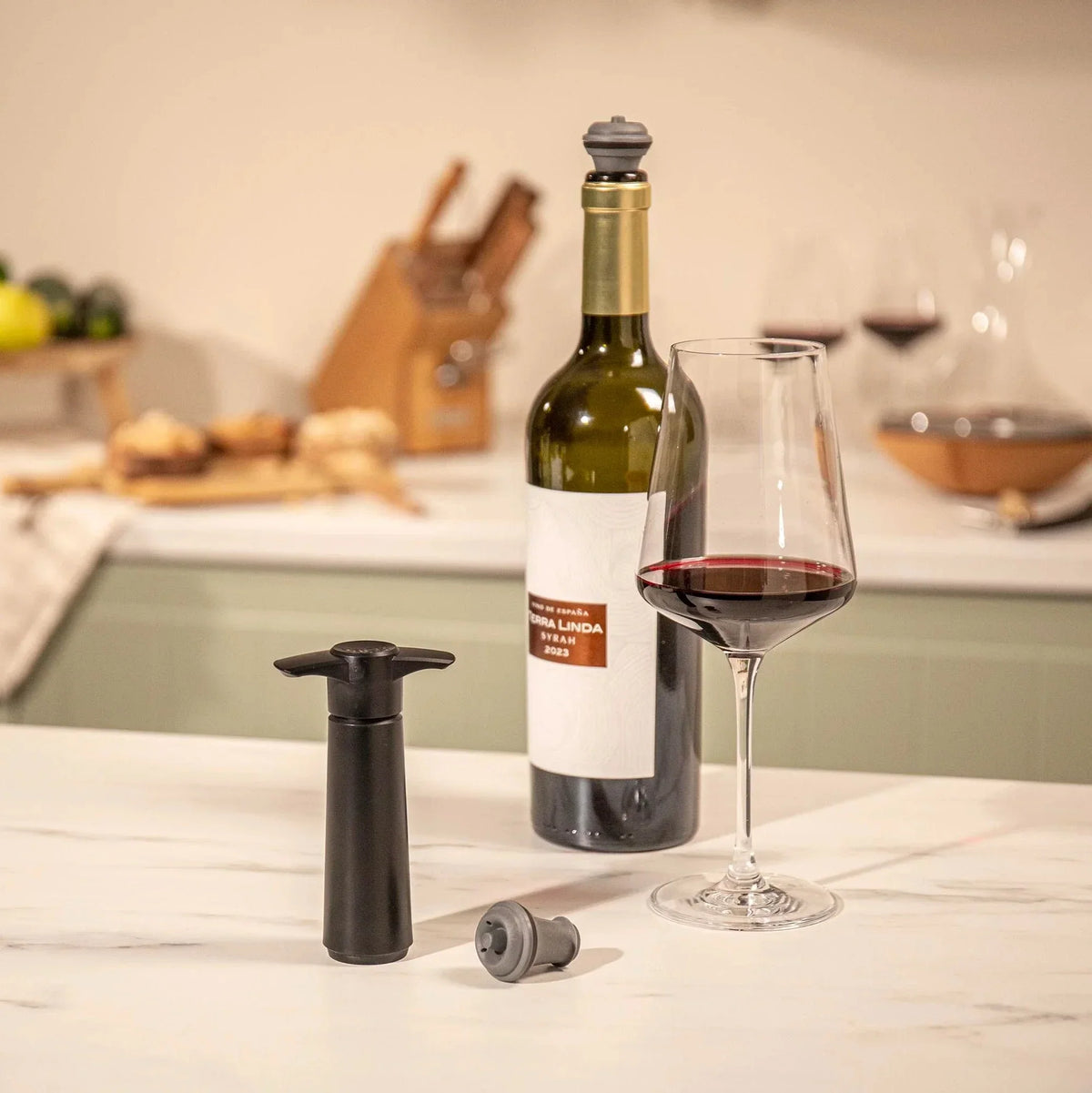
The Vacu Vin Original Wine Saver is the black plastic pump that has been sitting in kitchen drawers since 1986. You push a rubber stopper into an open bottle, set the pump on top, and pull the handle until the pump clicks; the click is a built-in indicator that says enough air has been removed. The version sold on us.vacuvin.com with two stoppers costs $19.99, ships from North Carolina, and carries a warranty term of five years.
The pitch is oxidation control on a budget. Air is what turns Tuesday's pinot into vinegar-adjacent liquid by Thursday, and pulling most of it out slows the process. Vacu Vin now has an outside lab report to back the claim that still wine stays drinkable for up to ten days under vacuum. The report is worth reading with its limits in mind, and so is the small print about which bottles the pump cannot help.
Our verdict
The cheapest credible answer to a half-finished bottle of still wine: $19.99 for a pump that has been sold in the same basic form since 1986, two stoppers, and lab data behind the ten-day claim.
- A good fit for
- A household that opens a bottle on a weeknight, drinks two glasses, and wants the rest to taste like wine on Saturday without buying an argon can or an electric gadget.
- We would skip it if
- You mostly drink sparkling wine, you store bottles on their side, or a one-button device is worth $39.99 to you, which is what the Electric Wine Saver costs.
Reasons to consider it
- Click indicator removes the guesswork about how much to pump
- Stoppers are reusable, survive the dishwasher, and old and new ones interchange with old and new pumps
- Warranty term of five years against manufacturing defects, with a claim process that starts by email
The compromises
- Does nothing for sparkling wine; Vacu Vin points you to its Champagne Saver for that
- The pump itself must stay out of the dishwasher and out of water, and can get sticky if wine is sucked in
- The ten-day number rests on a study Vacu Vin commissioned, with three wines and a 20-point sensory scale
What we have not verified: No bottle was pumped for this review. How long a seal holds on a given bottle neck, how the stopper rubber ages, and whether the pump stays smooth after a year were not assessed.
The things in this guide
A closer look at the products, who they may suit, and what to check before buying.
Original Wine Saver, Black, with 2 stoppers
A $19.99 kit with a click-indicator pump and two stoppers, made in the Netherlands, with defects warranted through year five plus lab data showing still wine still scoring as good on day ten.
Before you buy: Only for still wine stored upright; the pump stays out of the dishwasher, and the study behind the ten-day claim was funded by Vacu Vin.
Price checked September 11, 2026. Retailer prices can change.A stopper, a pump, and a click
The system has two parts and both matter. The gray rubber stopper goes into the neck first and makes the seal; the pump then sits over the stopper and pulls air out through a one-way valve. Vacu Vin's FAQ is blunt that without the stopper no vacuum forms, which is why the kit ships with two and why the refill sets exist. The pump body weighs 128 grams net in the US version and measures roughly 76 by 171 by 39 millimeters on the EU listing, so it stands about as tall as a wine glass.
The click is the useful part. Older vacuum stoppers gave no feedback, so people either under-pumped or kept going until the stopper deformed. On the current pump a vacuum indicator makes an audible click once the target level is reached; the FAQ goes on to say that pumping further does no harm to the wine. After sealing, the instructions call for storing the bottle upright, in the fridge or on the counter. Lay it down and wine can creep into the stopper, break the seal, and on the next use get drawn into the pump.
What the Meron lab study does and does not show
Vacu Vin's US site now hosts a summary of a study by Meron B.V., an ISO-certified food and beverage lab in Almere, Netherlands. Three wines were tested: a Pinot Noir, a Pinot Grigio and a Grenache Rosé. Each bottle was opened on day zero, two 250 ml portions were drawn for a baseline, and the bottle was stoppered and pumped with the Original Wine Saver. Sensory panels and GC-MS/MS chemistry ran on days 0, 3, 7 and 10, with a control bottle closed without vacuum. Microbiology was farmed out to a second accredited lab.
The results, on a 20-point sensory scale, are consistent across the three wines: the vacuum bottles scored 14 to 15 out of 20 on day ten, while the control bottles fell to 12 by day five to seven with oxidative notes. Color and fruit aromas were judged intact for at least seven days under vacuum, and no oxidative markers were found in the chemistry. Two caveats belong next to those numbers. The study was commissioned by the company selling the pump, and three bottles of three wines is a demonstration, not a population. Meron states it worked without outside influence; even so, read 'up to ten days' as the best case, with a softer aroma by the end.
Dishwasher for the stoppers, soapy water for the pump
The stoppers are reusable and dishwasher-safe. The pump is not: the FAQ is explicit: never put it in the dishwasher or submerge it, because wine that gets sucked into the mechanism turns it sticky. The fix is low-tech, wipe the inside with dishwashing soap and water, let it dry, and put a little Vaseline or similar grease on the inner wall so the piston runs smoothly again. That is the kind of maintenance a $20 kitchen tool can reasonably ask for, but it does mean the pump is not a fire-and-forget object.
Compatibility is broad. Vacu Vin says its new stoppers fit old pumps and old stoppers fit new pumps, and that the Loop stoppers and the traditional gray ones interchange as well; the one exception is the Wine Saver & Server, which only takes its own server stoppers. Extra gray stoppers are $7.99 for two or $19.99 for six on the US site. The Original Wine Saver is for still wine only; sparkling wine needs the separate Champagne Saver & Server because a vacuum would pull the carbonation out. A California Proposition 65 notice sits at the bottom of the listing, as it does on much of the range.
$19.99, five years on defects, and a 14-day change of mind
At $19.99 the two-stopper black kit is $3.50 more than the single-stopper version at $16.49, which makes the second stopper close to free. The Electric Wine Saver is $39.99 with two stoppers, and the stainless steel hand pump is $32.99; both do the same job, one with a button and one with nicer material. Orders over $50 ship free from Vacu Vin USA in Indian Trail, North Carolina, and the site says orders leave within two business days. Below $50 the shipping cost shows at checkout.
Every Vacu Vin product carries a warranty term of five years against manufacturing defects unless a product manual says otherwise. To use it you email customer service with the receipt, which has to carry a date and the name of a recognized retailer, a photo of the defect and a description of when it appears; Vacu Vin asks that you not mail the product in unprompted, because unsolicited returns are not reimbursed. Accidental damage, normal wear, abuse and home repairs void it. For plain buyer's remorse, the terms give a 14-day cooling-off period from receipt: contact sales@vacuvin.com, return the item unused in original condition and packaging at your cost, and the refund follows within 14 days of the return arriving.
Skip it if bubbles or a sideways fridge are involved
Pass on the Original Wine Saver if most of what you open is Prosecco, Cava or Champagne. A vacuum strips carbonation, Vacu Vin says so itself, and the Champagne Saver & Server is the product for that job. Also pass if your bottles live on their side in a wine fridge with no upright slot; the pump only earns its ten days when the bottle stands, and a leaking stopper gives you an ordinary corked bottle plus a sticky pump.
It is also fair to want something else at this price. If pulling a handle eight or ten times feels like a chore, the Electric Wine Saver does the same thing at $39.99 with a button, and if the point is a nicer object on the counter, the stainless version costs $32.99. The black plastic pump wins only on price and on a track record that goes back four decades, which for most kitchens is exactly enough.
How we put this together
Built from the product pages and listings below, without test scores or results we have not measured. Specifications and prices change, so check the original page for the exact model, current price, delivery, and returns.
- Vacu Vin USA: Original Wine Saver Black with 2 stoppers (opens in a new tab)
- Vacu Vin USA: Return, refund and warranty policy (opens in a new tab)
- Vacu Vin USA: FAQ (opens in a new tab)
- Vacu Vin USA: Meron B.V. study summary (opens in a new tab)
- Vacu Vin USA: product catalog (stoppers, Electric Wine Saver, stainless pump prices) (opens in a new tab)
- Vacu Vin (EU): Original Wine Saver Black with 2 stoppers (opens in a new tab)