Product image supplied by the brand
In this guide
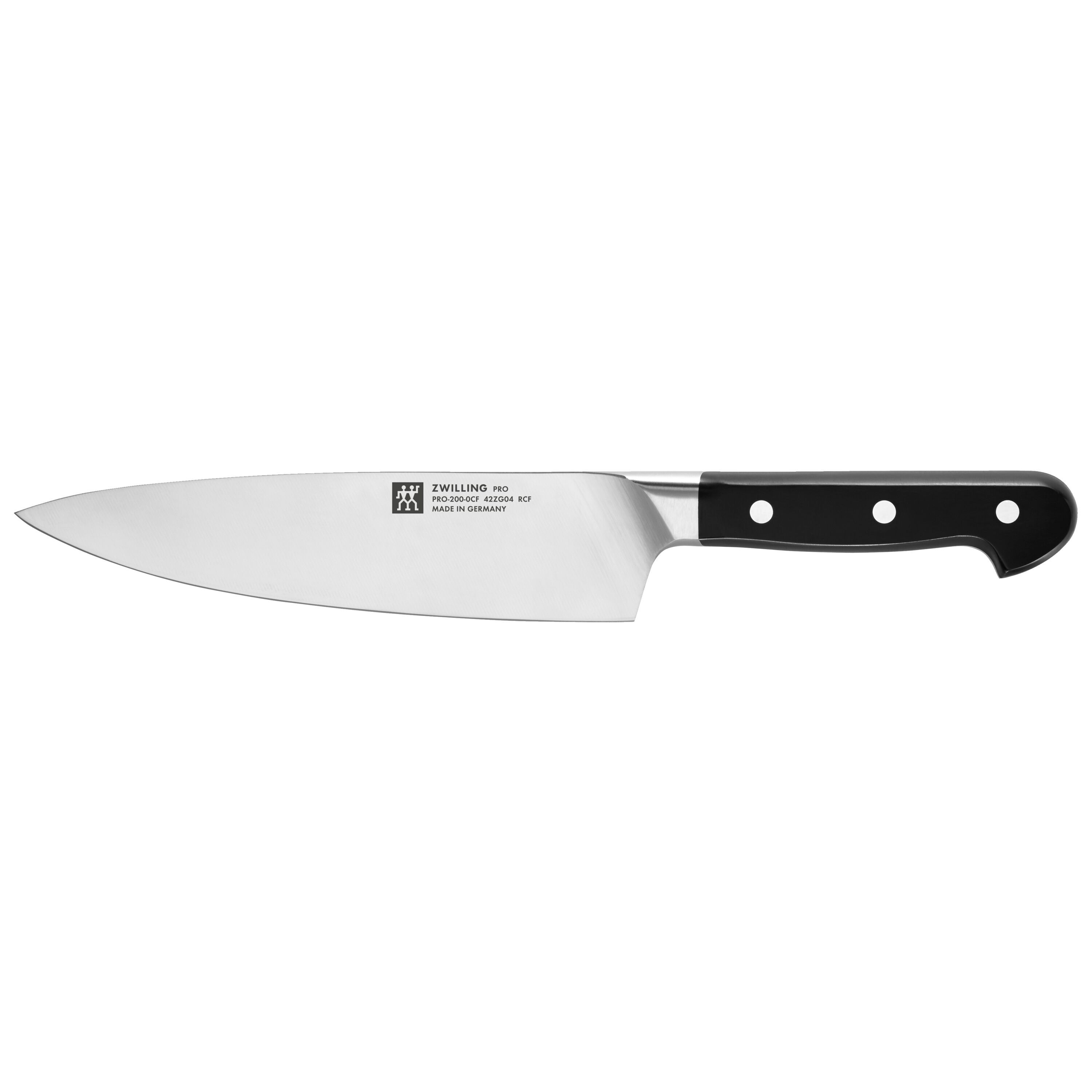
ZWILLING sells the Pro 8-inch Traditional Chef's Knife at $169.99 in the US and ships it itself, listed as item 38411-203 and made in Germany. It is a one-piece forging in ZWILLING's special-formula steel, ice-hardened and finished at 55-58 HRC, with a curved bolster, an exposed full tang and a triple-riveted handle. Two other chef's knives have been reviewed here: a $67 stamped Victorinox and a $124 Misen in Japanese steel.
So whether a forged German knife is good is not the issue. What matters is where the extra $100 over a stamped blade goes, and whether that difference shows up in a home kitchen or mostly in the hand. Three things separate this knife from the cheaper one: how it was made, how hard the steel is, and how the bolster guides the grip.
Our verdict
Buy the $169.99 ZWILLING Pro when you want one forged knife as your main blade for years and will wash it by hand. The $67 Victorinox remains the better first knife.
- A good fit for
- A home cook who owns a knife already, prefers a heavier Western blade in a pinch grip, and wants the next one to last a decade or more.
- We would skip it if
- Skip it if this is your first serious knife, if it will live in the dishwasher, or if you prefer a thinner Japanese profile and a steeper edge angle.
Reasons to consider it
- The blade is SIGMAFORGE, drawn from one billet of ZWILLING's special-formula steel in Germany, then ice-hardened in the FRIODUR process and rated at 55-58 HRC on ZWILLING's specification panel.
- The curved bolster is shaped to sit under a pinch grip rather than forcing a handle grip, and the exposed full tang is triple-riveted into a matte black handle.
- The 8-inch blade is 7.87 in long with a flatter profile, and the whole knife is 12.99 in and 0.57 lb.
- ZWILLING backs the knife for life, subject to proof of purchase from a US authorized seller.
The compromises
- The lifetime warranty excludes normal wear, so an edge that dulls from use is maintenance, not a claim; a receipt or an order confirmation is required to use it at all.
- Steel at 55-58 HRC is tough and easy to maintain, but it is not the hardest edge available: Misen's competing 8-inch knife lists AICHI ACUTO440 steel at 58 +/- 2 HRC.
- The handle is plastic over a full tang, and ZWILLING calls it dishwasher safe while still recommending hand washing.
- The geometry is Western. A cook who likes a thin blade with a narrow edge angle will find this one heavier behind the cut.
What we have not verified: ZWILLING does not publish the blade's spine thickness, the factory edge angle or the steel's composition beyond special-formula, so no honest comparison can be drawn to the 14-degree-per-side edge Misen prints. How long the edge lasts between sharpenings is also unmeasured here.
The things in this guide
A closer look at the products, who they may suit, and what to check before buying.
Pro 8-inch Traditional Chef's Knife
A German forged chef's knife in one piece of special-formula steel, ice-hardened and rated 55-58 HRC, with a 7.87 in blade, a curved bolster for a pinch grip, a triple-riveted full tang and a lifetime warranty.
Before you buy: The lifetime warranty excludes normal wear, requires proof of purchase from a US authorized seller, the handle is plastic, and the maker's dishwasher-safe line is no reason to skip hand washing.
Price checked October 15, 2026. Retailer prices can change.Forged from one piece, and why that is the headline
ZWILLING describes the blade as SIGMAFORGE, forged in one piece of steel. That is a manufacturing method rather than a performance number: the blank is formed under pressure instead of being stamped from a sheet and ground to shape. The practical difference is in the bolster and the tang, which come out of the same piece of metal as the blade rather than being welded or fitted to it.
What a buyer can check is the surface. A forging leaves a visible transition between blade and bolster that a stamped knife lacks, and ZWILLING's own photograph shows that thick, continuous junction behind the maker's mark on the blade. Whether it makes the knife cut better is a separate question; it does make it a single object rather than an assembly.
The steel gets a separate process. ZWILLING calls the blade FRIODUR, its ice-hardening treatment, and lists the finished hardness at 55-58 HRC. That figure travels, because it can be compared against other knives.
55-58 HRC against the alternatives
Hardness is the most quoted and least understood number on a knife box. A harder edge resists rolling and holds a keener angle, at the cost of being more brittle and slower to sharpen. ZWILLING puts this blade at 55-58 HRC. Misen, whose knife already has a review here, prints 58 +/- 2 HRC for its AICHI ACUTO440 blade at $124.
Those ranges overlap. Anyone choosing on hardness alone is choosing on a figure the manufacturers quote differently and test by unpublished methods. The honest reading is that both knives sit in the same general band, and edge geometry, which ZWILLING does not publish, matters more than a one-point difference on the box.
Where this knife is easier to live with is maintenance. A 55-58 HRC Western blade is forgiving on a honing rod and does not demand the care a very hard, very thin edge does.
The flatter blade and the curved bolster
The 8-inch blade measures 7.87 in and is described as a traditional profile with a straighter edge from heel to tip, meant for push and pull cutting. That is the Western pattern: rock the tip down through herbs, push forward through an onion. Cooks who work from the shoulder with a long slice will find the profile familiar, and the whole knife weighs 0.57 lb, about 9.1 oz.
The bolster is the more opinionated part. It curves upward toward the blade so a thumb and forefinger can pinch the blade in front of it, and ZWILLING treats the shape as an extension of the hand. Pinch grips give better control than a handle grip, but they only feel natural if the bolster does not dig into the fingers, and that is a shape question to test in person rather than to read.
Under the hand, the construction is conventional: an exposed full tang, a matte black handle, three rivets.
Life warranty, with two conditions that matter
The knife is sold with a lifetime warranty, and ZWILLING mentions it in the same breath as made in Germany. Read the terms and the value changes shape. It covers knives bought from ZWILLING or a US authorized seller within the country, and it excludes defects from normal wear and tear, misuse, abuse, alteration and negligence.
The piece most buyers miss is the paperwork. ZWILLING asks for proof of purchase on any claim: a sales receipt, an order confirmation, a retail invoice, or a card or bank statement showing the purchase. A knife given as a gift and separated from its receipt has a warranty in name only.
That favors buying direct or from an authorized retailer over a marketplace listing, and it gives the order email a second purpose. It also means an edge dulled by years of use is not a claim. The guarantee covers a defect in the knife, not the work of cooking with it.
Dishwasher safe is not a recommendation
ZWILLING prints the usual contradiction on the listing: the Pro is dishwasher safe, and hand washing is recommended. The second instruction is the sensible one. Detergent, heat and the basket's spacing work against a fine edge and the rivets, and no warranty covers damage from normal wear.
The routine the knife actually wants is short. Rinse and dry it by hand after use rather than leaving it wet on the board, keep it out of a sink full of other cutlery, and store it on a magnetic strip, in a block or on a blade guard. Then hone it lightly before most sessions and sharpen it when honing stops bringing the edge back.
None of that is specific to this knife. At $169.99 the care is the same as at $67; the premium covers the forging, the profile and the name behind it, not a knife that maintains itself.
When the $67 knife is the better answer
When it is your first chef's knife, buy the cheaper one instead. The Victorinox Fibrox at $67 is a stamped Swiss blade this site already reviewed, and learning to sharpen, to pinch-grip and to keep a board clear does not require a forged German blank. A dull $169 knife cuts worse than a sharp $67 one, and you will be sharpening either of them.
Skip the Pro if it will live in a dishwasher, if it will be shared with people who cut on frozen food or pry open cans with it, or if handle material counts for as much as steel. The plastic handle is functional and unromantic, and the lifetime warranty will not cover the damage that misuse brings.
Buy it when you have cooked enough to know you prefer a heavier Western blade in a pinch grip, you want the maker's reputation behind the purchase more than the lowest price, and you are ready to wash it by hand.
How we put this together
Built from the product pages and listings below, without test scores or results we have not measured. Specifications and prices change, so check the original page for the exact model, current price, delivery, and returns.
- ZWILLING: Pro 8-inch Traditional Chef's Knife product page (US) (opens in a new tab)
- ZWILLING: Warranty page (US) (opens in a new tab)
- Victorinox: Fibrox Chef's Knife 8 in product page (US) (opens in a new tab)
- Misen: 8-inch Chef's Knife ACUTO440 product page (US) (opens in a new tab)