Product image supplied by the brand
In this guide
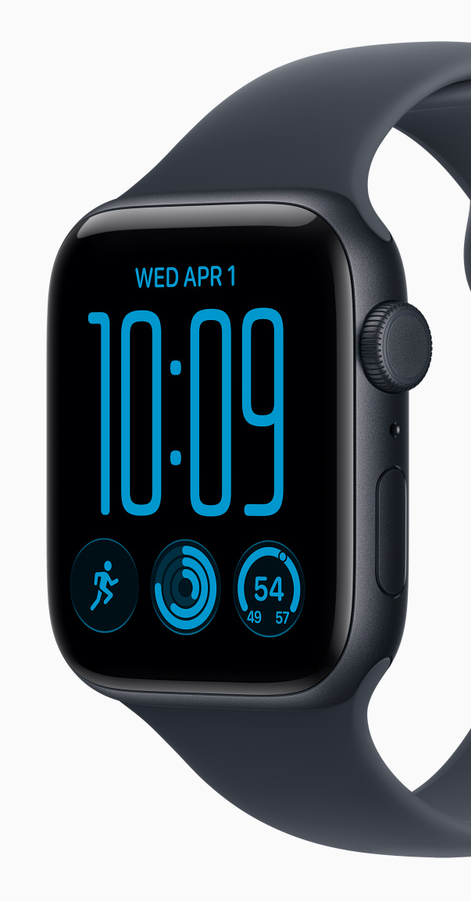
Apple Watch SE 3 is the aluminum-only model in a current line of three, at $249 for the 40mm GPS version, $279 for 44mm and $50 more to add cellular, in Midnight or Starlight. It runs the S10 chip with a 64-bit dual-core processor and 64GB of storage, and keeps an Always-On Retina display — OLED on an LTPO backplane, under Ion-X glass Apple rates 4x more crack resistant than the SE 2's. Water resistance is rated to 50 m, and the case takes the standard Apple Watch band system. It pairs with an iPhone 11 or later on iOS 27 or later, and Apple Watch does not work with Android at all.
What the $249 leaves out is one family of hardware, and it cannot be added later. The SE 3 has a second-generation optical heart sensor instead of an electrical one, no blood-oxygen sensor, and no hypertension detection. Apple's spec sheets and comparisons put those three on Series 12, which starts at $399, so the $150 step is worth paying only if those readings are why you want a watch.
Our verdict
Buy the $249 Apple Watch SE 3 for notifications, sleep tracking and heart-rate trends on an iPhone; pay the $150 more for Series 12 only if an ECG, blood oxygen or hypertension alerts are why you want a watch.
- A good fit for
- A buyer new to smartwatches, on an iPhone, who wants notifications, sleep and heart-rate trends, and does not have a heart condition their doctor is monitoring.
- We would skip it if
- If you need the ECG app, blood-oxygen readings or hypertension notifications, skip it; so should anyone on Android, and owners of a watch that already records an ECG, since the SE 3 would take that away.
Reasons to consider it
- An Always-On Retina display with OLED and LTPO, Ion-X glass rated 4x more crack resistant than the SE 2, and a 50 m water-resistance rating
- Sleep apnea notifications, sleep stages, sleep score, temperature sensor 2 and advanced cycle tracking, for $249
- 18 hours of normal use, 32 hours in Low Power Mode with sleep tracking, and fast charging rated at 15 minutes for 8 hours of use
The compromises
- No electrical heart sensor, so no ECG app — Apple's own footnote says the app excludes Apple Watch SE models
- No blood-oxygen sensor and no hypertension notifications, and neither can be added by software later
- Aluminum is the only case material, and cellular adds $50 on top of $249 rather than being included
What we have not verified: Apple publishes no capacity-retention curve for the battery, so a second-year owner cannot tell how long the watch will still run, and the sleep apnea feature is worded as detecting signs rather than diagnosing a condition.
The things in this guide
A closer look at the products, who they may suit, and what to check before buying.
Apple Watch SE 3
At $249 the 40mm SE 3 keeps the Always-On Retina display, the S10 chip, 64GB of storage, 50 m water resistance and the full sleep set — stages, score and sleep apnea notifications — plus temperature sensor 2 and advanced cycle tracking. Fast charging is rated at 15 minutes for 8 hours of normal use, and AppleCare+ costs $2.99 a month or $29.99 a year with accidental damage at $69.
Before you buy: No electrical heart sensor means no ECG app, which Apple's own footnote excludes from Apple Watch SE models; blood oxygen and hypertension notifications are missing too, and cellular costs another $50.
Price checked October 4, 2026. Retailer prices can change.What $249 buys: the screen, the chip and the waterproofing
The SE 3 comes in two case sizes and one material. The 44mm case fits wrists from 140 to 245 mm at 32.9 g, or 33.0 g with cellular; the 40mm takes 130 to 200 mm at 26.3 g. The 44mm adds $30, 6.6 g and a larger display, 977 sq mm against 759. Both run the S10 chip with a 4-core Neural Engine and 64GB of storage.
The display is Always-On Retina with OLED and LTPO, under Ion-X glass Apple rates 4x more crack resistant than the SE 2's, and water resistance is rated to 50 m for pool and open-water swimming. The case takes the standard band system, the controls include the digital crown with haptic feedback plus single tap, double tap and wrist-flick gestures, and the watch carries emergency SOS, fall detection and crash detection.
The three features that stay on Series 12
Apple's SE 3 specification page lists a second-generation optical heart sensor and then stops. There is no electrical heart sensor, and the consequence is spelled out in Apple's own footnote on the Series 12 page: the ECG app is available on Apple Watch Series 4 and later, excluding Apple Watch SE models, and is meant for people 22 and over. Without that sensor, no software update can add the ECG app to the SE 3.
Two more rows are missing. The SE 3 has no blood-oxygen sensor, so no Blood Oxygen app, and no hypertension notifications — the feature Apple lists on Series 12 and Ultra 4, with its own limits of people under 22, anyone already diagnosed with hypertension, and pregnant persons. Series 12 starts at $399 in 46mm and 42mm, Ultra 4 at $799 in 49mm titanium. The $150 between the SE 3 and Series 12 buys no bigger screen and no faster chip; it buys one sensor family and the apps behind it.
Sleep apnea notifications, sleep score and cycle tracking
Apple's footnote states sleep apnea notifications are available on Apple Watch Series 9 and later, Ultra 2 and later, and SE 3, and that the feature is meant to detect signs of moderate to severe sleep apnea in adults 18 and up who have never had a diagnosis. It flags signs rather than diagnosing anything, which makes it a prompt to see a doctor rather than an answer.
Alongside it the SE 3 logs sleep stages and a sleep score, and carries temperature sensor 2, which feeds cycle tracking. The advanced cycle-tracking app adds fertile-window estimates, retrospective ovulation estimates and perimenopause and menopause support; Apple's own footnote limits cycle-deviation notifications including perimenopause to people 40 and older, and states the app should not be used for birth control or to diagnose a condition.
18 hours, 32 in low-power mode, and what the charging claim measures
Apple rates the SE 3 at up to 18 hours of normal use, up to 32 hours in Low Power Mode including sleep tracking, and up to 7 hours of workout tracking. The 18-hour figure comes with a published protocol: 300 time checks, 90 notifications, 15 minutes of app use, and a 60-minute workout with music played from the watch over Bluetooth. The low-power figure uses a more demanding protocol over 32 hours — 430 time checks, 130 notifications, 20 minutes of app use, a 60-minute workout and six hours of sleep tracking — with the cellular model on an on-demand connection for part of it.
Fast charging is quoted in two ways. Fifteen minutes on the charger gives up to 8 hours of normal use; 8 minutes gives up to 8 hours of sleep tracking. Those two figures are the arithmetic behind wearing it overnight and topping it up while you shower. Apple measured both with its Magnetic Fast Charger to USB-C cable plugged into a 20W USB-C power adapter, and notes that charge time varies with the adapter.
The $50 cellular question, and what it unlocks
Cellular is a $50 add-on at the 40mm size, taking the watch from $249 to $299, and it changes two things. The watch gets 5G and LTE bands plus international emergency calling, which Apple lists only for the cellular models. It also becomes the only way to use Apple Watch For Your Kids: Apple's own FAQ makes a GPS + Cellular model a requirement for pairing watches for children who do not have an iPhone.
For an adult who carries a phone everywhere, the GPS model covers the usual jobs — distance, pace and route mapping run off the watch's own L1 GPS with GLONASS, Galileo, QZSS and BeiDou, independent of the phone. The cellular version earns the $50 when you leave the phone behind on purpose: running without a pocket, or giving a child a watch that can call without handing over an iPhone. Both models are limited to 2.4GHz Wi-Fi networks.
Returns, the one-year warranty and the $69 repair
Apple takes the SE 3 back within 14 days and covers the return shipping; Amazon, which sells the Midnight 40mm GPS model itself at the same $249, allows 15 days, and its Starlight version with a Sand band read $239.99. The 12-month warranty covers the watch and the accessories Apple puts in the box against manufacturing defects; a drop, or a cell that ages through ordinary use, sits outside it. Repairs and their parts carry a 90-day guarantee, or the rest of that first year if longer.
The SE 3's AppleCare+ plan is $2.99 a month or $29.99 a year, and an accidental-damage repair under it costs $69 — $79 for Ultra and Hermès models — with a free battery swap below 80% capacity. Without it, Apple's out-of-warranty estimate for an SE 3 GPS 40mm is $99 for battery service and $199 for other damage, before Apple's inspection sets the final fee; authorized service providers set their own.
How we put this together
Built from the product pages and listings below, without test scores or results we have not measured. Specifications and prices change, so check the original page for the exact model, current price, delivery, and returns.
- Apple: Buy Apple Watch SE 3 (US store page) (opens in a new tab)
- Apple: Apple Watch SE 3 technical specifications (US) (opens in a new tab)
- Apple: Apple Watch Series 12 technical specifications (US) (opens in a new tab)
- Apple: compare Apple Watch models (US) (opens in a new tab)
- Apple Support: service and repair for Apple Watch (US) (opens in a new tab)
- Apple: AppleCare (US) (opens in a new tab)
- Apple: AppleCare service fees and deductibles (US) (opens in a new tab)
- CPSC: saferproducts.gov recall search, ProductName=Apple Watch (opens in a new tab)
- Amazon: Apple Watch SE 3 GPS 40mm listings (opens in a new tab)