Product image supplied by the brand
In this guide
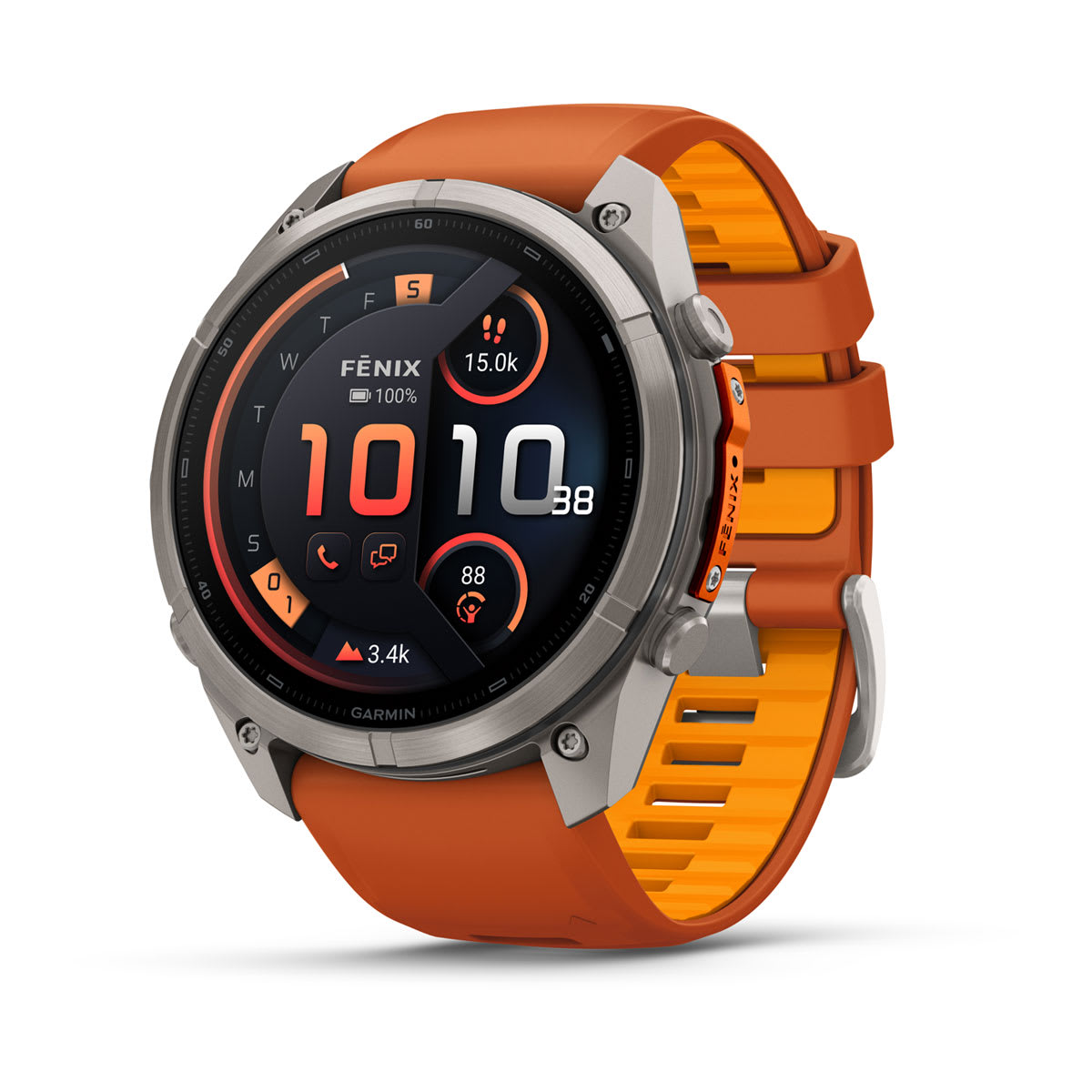
Garmin sells the fēnix 9 Pro – inReach at $1,299.99 for the 51 mm titanium part number 010-04337-00, listed sellable with the Add To Cart control live on November 8, 2026, and from $1,199.99 for the 43 mm and 47 mm versions. It is a serious multisport instrument: a 1.5 inch AMOLED at 466 x 466 pixels rated up to 3000 nits, 64 GB on board, built-in mapping, a 10 ATM rating, a 40 m dive depth limit, an LED flashlight and a smartwatch battery Garmin rates at up to 31 days.
The reason it costs more than the watch next to it is the connectivity, and the connectivity is where the conditions stack up. Garmin's own buy page carries a legal line stating that an active plan is required, that LTE coverage is not universal, and that the satellite and SOS functions on this device have important limitations compared with other inReach devices. The feature-requirements page explains what that means: the watch talks to geostationary satellites, while the inReach handhelds talk to Iridium.
Our verdict
Buy it if you travel inside Garmin's satellite coverage and will keep a plan running. As an emergency link this watch is deliberately narrower than the inReach handhelds it shares a name with.
- A good fit for
- Backcountry use in the continental U.S., southern Canada or most of Europe, where a watch that sends check-ins and triggers an SOS on its own replaces a device you would otherwise carry.
- We would skip it if
- Any trip outside the continental U.S., parts of Canada and most of Europe, terrain that blocks a fixed satellite, or a buyer who will not keep a plan active.
Reasons to consider it
- Satellite and LTE messaging works with no phone connection: Garmin's own listing describes check-ins, weather forecasts once a satellite link is established, and an interactive SOS to the 24/7-staffed Garmin Response center, with a microphone and speaker for calls where LTE reaches.
- A 1.5 inch AMOLED at 466 x 466 pixels rated up to 3000 nits, 64 GB holding about 7,000 songs, built-in mapping, 10 ATM and a 40 m dive maximum operating depth in a titanium case.
- Up to 31 days in smartwatch mode and 151 hours in max-battery activity mode on the anchored 51 mm part number, with the LED flashlight on every variant and the ECG app and Pulse Ox on the watch itself where Garmin offers them, rather than behind a subscription.
The compromises
- The watch's satellite link is geostationary, not the Iridium network the inReach handhelds use, so Garmin restricts it to the continental U.S., parts of Canada and most of Europe and asks for a clear view generally to the south and west.
- An active inReach plan is required at $7.99 to $49.99 a month. Satellite live tracking is listed as not available on smartwatches, though the anchored spec table shows LTE LiveTrack at up to 27 hours of activity battery where LTE coverage reaches.
- $1,299.99 sits $100 above the same 51 mm Pro without inReach, $200 above the 51 mm fēnix 9 and $100 above Garmin's fēnix 8 Pro 51 mm AMOLED, which carries the same satellite coverage; ECG and LTE are region-limited.
What we have not verified: Garmin states how long a satellite connection takes but publishes no success rate for the watch's fixed-satellite link, and nothing on its pages measures that link in the field. That gap sits under a $1,299.99 price and a recurring plan fee, and a buyer can only close it on the terrain they actually walk. Garmin also gives no reason in its own copy for the Solar 51 mm listing at the same price as the non-Solar, and its pages do not say what the fēnix 9 Pro's link does better than the fēnix 8 Pro's, which points to the same coverage sentence and the same plan legal text.
The things in this guide
A closer look at the products, who they may suit, and what to check before buying.
fēnix 9 Pro – inReach, 51 mm Titanium
$1,299.99 for the 51 mm titanium inReach version on Garmin.com on 2026-11-08, with satellite and LTE messaging that needs no phone, a 3000-nit AMOLED, 64 GB, built-in mapping, a 40 m dive rating and up to 31 days of smartwatch battery.
Before you buy: Needs an active inReach plan from $7.99 to $49.99 a month, and the satellite link is fixed-satellite coverage over the continental U.S., parts of Canada and most of Europe rather than global service; satellite live tracking is unavailable on smartwatches.
Price checked November 8, 2026. Retailer prices can change.The satellite in the name is a different satellite
Garmin's feature-requirements page is blunt about it: unlike handheld products that use inReach technology to connect to a global satellite network, Garmin smartwatches use geostationary satellites, which stay in a fixed position in the sky. The consequence is a coverage sentence rather than a capability sentence — a smartwatch with inReach technology only provides coverage in the continental U.S., parts of Canada and most of Europe. The plans page tells it from the subscription end, crediting handhelds with the Iridium network and global coverage while noting that satellite and LTE on smartwatches is not available in all countries.
A fixed satellite also changes how you use the watch in the field. Garmin warns that because the satellite does not move, an obstructed connection means moving somewhere with a clear view of it, and that as you travel north the satellite sits lower on the horizon, so trees and terrain block it more easily. Its guidance is to look for open ground, water or a summit with a clear view generally to the south and west, and it points to a coverage map for areas where the satellite clears 20 degrees above the horizon.
The same page puts a number on the wait. With the on-screen guidance followed and the antenna pointed at clear sky, Garmin states that a connection can take 30 seconds or more of good signal strength, and that once it is up, messages generally send in less than 10 seconds — a link that is slow to reach the sky and quick once it gets there.
What the plan buys, and what it never will
The buy page spells the requirement out: an active plan is required, LTE coverage is not available in all regions, and the satellite and SOS functions on this device carry important limitations compared with other inReach devices. Garmin's plan list runs from $7.99 a month for Enabled to $14.99 for Essential, $29.99 for Standard and $49.99 for Premium, all billed monthly and auto-renewing, with emergency SOS messaging included on every tier and the first activation fee waived on smartwatches.
Two details matter for anyone planning to pay only in seasons. The plans page states that a suspended plan costs $0 for up to 12 months with no reactivation fee, though reactivating a cancelled plan pays the one-time activation fee again — and after 12 consecutive months of suspension, select devices move automatically onto the Enabled plan. Elsewhere in the same table, satellite photo and voice messaging is marked available on inReach Plus-enabled devices only, and satellite live tracking, the follow-along feature that makes inReach handhelds useful to a family at home, is listed as not available on smartwatches with inReach technology.
Suspension does not switch off the emergency button on this watch. Garmin's support note on SOS during suspended service lists the fēnix 9 Pro inReach series among devices that keep SOS when the plan is suspended, provided the watch is on current software, paired in the Garmin Messenger app and was on an active plan before the switch. The plan prices themselves exclude state and local taxes, and messages beyond a tier's limits are charged extra.
Strip the connectivity away and it is still a fēnix
The 51 mm titanium case carries a 1.5 inch (38.1 mm) AMOLED at 466 x 466 pixels, rated up to 3000 nits, with a touchscreen and a 10 ATM water rating. Storage is 64 GB, which Garmin describes as room for about 7,000 songs from Spotify, Deezer or Amazon Music, and the health stack includes Elevate wrist heart rate, Pulse Ox and the ECG app. Diving is specified to a 40 m maximum operating depth with single-gas and apnea modes, and the LED flashlight offers dimmable white, red or green illumination.
A pair of them arrive with limits Garmin prints beside the feature itself. The footnote states Pulse Ox is not available in all countries, and for the ECG app it states the feature is not available in all regions, directs readers to Garmin's own ECG availability page, and limits it to adults aged 22 years and over. Neither caveat changes what the watch measures; both decide whether a feature you are paying for is switched on where you live.
Battery figures on the anchored part number read up to 31 days in smartwatch mode, 42 days in low power, 56 hours in activity mode, 22 hours with music, 151 hours in max-battery activity mode, 65 hours in extended battery and 45 hours at max accuracy, charging through Garmin's proprietary plug. Nothing here needs the plan. That separation is the point of the purchase decision: the sensors, the maps and the music run on the watch whether or not an inReach subscription is active, and Garmin's Connect+ layer at $6.99 a month or $69.99 a year is offered as an addition to features it states remain free.
What the variants cost, and what $100 buys
Prices on 2026-11-08 form a ladder worth reading before you pick a case size. The 43 mm and 47 mm Pro – inReach versions start at $1,199.99, the 51 mm at $1,299.99, and the 51 mm Pro – inReach Solar at the same $1,299.99 as the non-Solar. Without satellite connectivity the 51 mm Pro AMOLED is $1,199.99, and the 51 mm fēnix 9 without the Pro label is $1,099.99, described by Garmin at up to 29 days of smartwatch battery against the Pro's 31.
So the inReach upgrade on a 51 mm case costs $100 on the watch and $95.88 a year at the cheapest plan (12 months at $7.99). The Solar version of that same 51 mm inReach watch lists at the identical $1,299.99 and moves the battery line instead of the price: its own spec entry gives up to 30 days in smartwatch mode, 57 days with solar, against 31 days for the non-Solar, and 186 hours in max-battery activity mode rising to 1,000 hours with solar. A buyer choosing the Solar is buying charge from light, at parity, on a watch that is otherwise specified the same size and the same price.
The older watch on the same shelf matters too. Garmin still sells the fēnix 8 Pro, described on its own page as a multisport watch with satellite and cellular connectivity for calls, location sharing, two-way messaging and SOS, at $1,199.99 for the 51 mm AMOLED and $1,099.99 for the 47 mm on 2026-11-08. Its buy page carries the same active-plan and important-limitations legal line, and its feature-requirements page repeats the continental U.S., parts of Canada and most of Europe coverage sentence. The inReach link alone is therefore not what the extra $100 on the fēnix 9 Pro buys; the newer screen and battery figures are, and those belong on each watch's own spec table.
Owning it: a year of cover and a month to change your mind
Garmin warrants the watch for one year from the date of purchase under the consumer limited warranty text revised December 30, 2025, with repaired or replaced parts covered for 90 days, and its store page allows a refund return within 30 days of receiving the order. The plan is the shorter leash: it renews monthly until you cancel ahead of the renewal date, so what needs scheduling is the subscription rather than the hardware.
The 30-day refund period is also the only instrument for the coverage question. Garmin's limitation is geographic and physical rather than a setting, so the way to test whether the fixed satellite is visible from your terrain is to walk a route you really use; if the link does not hold there, the watch goes back inside the window and the plan is cancelled at the following renewal date.
The two reasons to walk away: geography and the bill
Do not buy this watch as a substitute for an inReach handheld if your travel leaves the continental U.S., the parts of Canada and the parts of Europe Garmin names, or if your activity is defined by canopy, canyon and ridgeline where a satellite parked low on the horizon cannot be reached. In those cases you are buying a superb watch with a feature set you will not use, and the $1,199.99 non-inReach Pro AMOLED delivers the same instrument for $100 less with no monthly bill attached.
Buy it when the coverage map is your map: day hikes and overnight trips in the lower 48, forested trails in southern Canada and most of Europe where you can reach open ground, and readers who would otherwise carry a separate satellite messenger. If the fēnix 8 Pro's specification already covers you, its 51 mm AMOLED reaches the same satellite map for $100 less. The $1,299.99 plus $7.99 a month replaces a second device and a second charging cable, which is why the pairing exists at all — and nothing in Garmin's own pages supports treating it as global emergency cover.
How we put this together
Built from the product pages and listings below, without test scores or results we have not measured. Specifications and prices change, so check the original page for the exact model, current price, delivery, and returns.
- Garmin: fēnix 9 Pro – inReach, 51 mm (part number 010-04337-00) (opens in a new tab)
- Garmin: fēnix 9 Pro product family page (opens in a new tab)
- Garmin: fēnix 9 Pro feature requirements (opens in a new tab)
- Garmin: inReach Consumer Plans (opens in a new tab)
- Garmin: inReach Enabled Plan (opens in a new tab)
- Garmin: fēnix 9, 51 mm (part number 010-04763-00) (opens in a new tab)
- Garmin: fēnix 9 Pro – inReach Solar, 51 mm (part number 010-04339-00) (opens in a new tab)
- Garmin: Consumer Limited Warranty (opens in a new tab)
- Garmin: Shipping, Returns & Refunds (opens in a new tab)
- Garmin: Garmin Connect+ press release (opens in a new tab)
- Garmin Support: SOS With inReach Suspended Service (opens in a new tab)
- Garmin: fēnix 8 Pro, 51 mm AMOLED (part number 010-03199-00) (opens in a new tab)
- Garmin: fēnix 8 Pro feature requirements (opens in a new tab)
- Amazon US: search results for the fēnix 9 Pro inReach 51 mm (opens in a new tab)