Product image supplied by the brand
In this guide
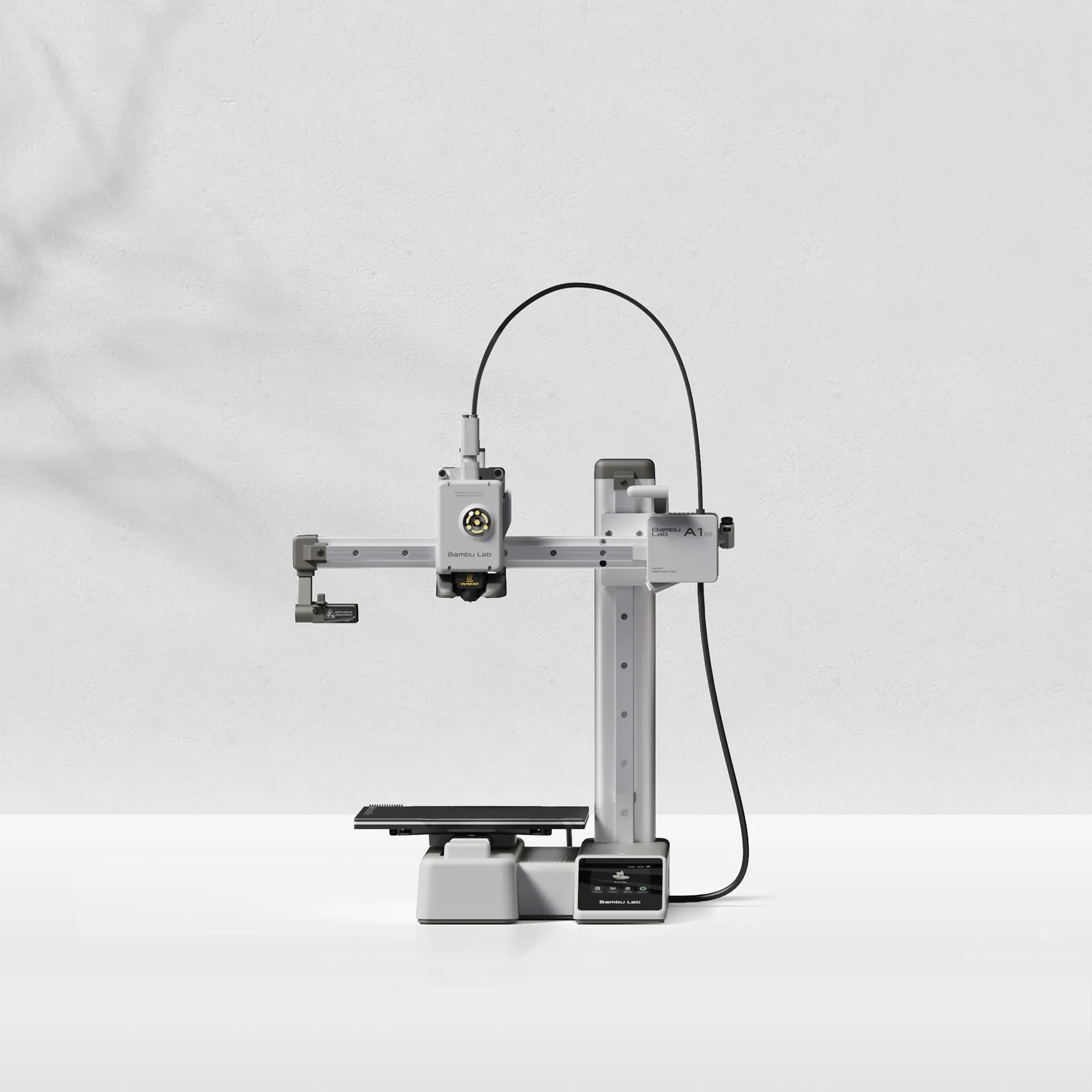
Bambu Lab lists the A1 mini at $219 in the US, and the same page offers the A1 mini Combo with the AMS lite at $329; both read InStock in the product's own structured data on October 11, 2026. The machine is a cantilever design on a 347 x 315 x 365 mm frame that weighs 5.5 kg, with one 0.4 mm stainless nozzle and a 180 x 180 x 180 mm build volume. It ships assembled with a textured PEI plate, a spool holder and a 20 g sample of filament.
What $219 does not include is a bigger build volume or a heated chamber. ABS, ASA, PC, PA and PET are listed as not recommended on this open frame, so it is a PLA and PETG printer unless an enclosure is added. The $110 step to the Combo buys four spool slots on the AMS lite and the purge waste that comes with changing colors. Buy it when the parts are small and that material list is enough.
Our verdict
Buy the $219 A1 mini when the parts fit inside 180 mm and PLA or PETG will do. Pay for the $110 AMS lite only if multicolor is the project, not a someday hope.
- A good fit for
- A first printer in a dorm, apartment or spare room, for small parts in PLA and PETG, where the buyer will learn a slicer and live with failed prints.
- We would skip it if
- Anyone printing one-piece parts longer than 180 mm, ABS or ASA on this open frame, or who does not want to run a desktop slicer and its cloud features alongside the printer.
Reasons to consider it
- 180 x 180 x 180 mm of build volume on a 347 x 315 x 365 mm frame weighing 5.5 kg, with one 0.4 mm stainless nozzle rated to 300 C.
- Automatic bed leveling and flow calibration, filament run-out and tangle sensors, and power-loss recovery are on the machine rather than sold as upgrades.
- The $329 Combo adds the AMS lite, which holds four spools and changes filament between layers, so multicolor works from the first print.
The compromises
- The supported filament list is PLA, PETG, TPU and PVA; ABS, ASA, PC, PA and PET are listed as not recommended because the frame is open.
- A 180 mm cube rules out larger one-piece parts, and the bigger A1 prints 256 x 256 x 256 mm for $299, or $399 as a Combo.
- Every color change on the AMS lite purges filament as waste, and the unit is the open multicolor option for the A1 series: running the enclosed AMS on an A1 mini instead needs the AMS HUB accessory.
What we have not verified: Nothing here measures how much filament a four-color model purges, and Bambu Lab publishes no figure for it; a measured waste rate would change how the $110 Combo step reads. Whether the cloud features require a Bambu account is unconfirmed, and the spool and nozzle prices are single-day listings that move with bulk discounts.
The things in this guide
A closer look at the products, who they may suit, and what to check before buying.
A1 mini 3D Printer
$219 at Bambu Lab's US store when checked on 2026-10-11, InStock, with a 180 x 180 x 180 mm build volume, a 0.4 mm nozzle rated to 300 C, automatic calibration, filament run-out and tangle sensors, and power-loss recovery. The $329 Combo adds the AMS lite and its four spool slots.
Before you buy: Open frame, so ABS, ASA, PC, PA and PET are not recommended; no enclosure and no larger build volume; each color change on the AMS lite purges filament as waste.
Price checked October 11, 2026. Retailer prices can change.What 180 mm of build volume rules out
The A1 mini prints a 180 x 180 x 180 mm cube. A phone stand, a cable clip, a bracket, a miniature or a set of parts that slot together all fit; a helmet shell does not, and neither does a lamp base meant to enclose a bulb and a socket in one piece. Slicers handle the limit by cutting models into sections, and the seams that produces are usually visible unless the part is designed around them.
The A1 is the same family with 256 x 256 x 256 mm of volume and a $299 price, or $399 with the AMS lite. That is $80 more for roughly 2.9 times the volume. Choose the 180 mm machine when the parts are small by nature; choose the A1 when one of them might not be.
The $110 AMS lite and what it changes
The Combo version costs $329 and adds the AMS lite, a four-spool holder that feeds filament to the toolhead and swaps colors between layers. The FAQ on Bambu Lab's A1 mini page is the clearest guide here: the AMS lite is not enclosed, it is the multi-color option for the A1 mini, and it does not work with the X1 or P1 printers, which use the enclosed AMS instead. The reverse route exists, and the A1 mini page spells it out: connecting this printer to the enclosed AMS, AMS 2 Pro or AMS HT needs the AMS HUB (SA013) accessory.
Every color change moves filament through the hot end and purges the previous color at each swap, and that purged material is waste. It is the part a buyer rarely prices in. Single-color owners can skip the AMS lite entirely and feed the printer from the spool holder in the box; the $110 then buys nothing. Multicolor is worth the step when a model is designed in several colors, not when the plan is to paint or glue parts after printing.
PLA and PETG, and the materials this frame cannot hold
Bambu Lab lists PLA, PETG, TPU and PVA as supported, with ABS, ASA, PC, PA, PET and reinforced polymers marked not recommended. The reason is structural rather than a firmware limit: those materials want a warm, still chamber, and the A1 mini is an open cantilever with an 80 C maximum bed. A draft across the plate is enough to lift a corner on a large ABS part.
That leaves the machine for the materials most first projects already use. PLA prints ornaments, jigs, toys and brackets and is the easiest filament to buy anywhere; PETG adds some heat and impact resistance for parts that live outdoors or near a car. TPU works for phone cases and feet at slow speeds, and PVA is a support material for models that need dissolving supports. Anyone set on ABS from the start should be shopping for an enclosed printer instead.
Bambu Studio, the camera and the account question
Slicing is done in Bambu Studio on a computer, and Bambu Lab's A1 mini listing advertises Bambu Handy for remote monitoring and a one-click handoff from MakerWorld, the model library. The printer has no built-in memory and ships with a 32 GB microSD card already in the slot; Bambu Lab's FAQ says a print can start from that card with no internet connection at all, so the network features are an addition rather than the only path to a print.
The built-in camera is listed as low framerate at up to 1080p with timelapse support, which is enough to check whether a first layer is going down and not enough to watch a print at any real frame rate. Filament run-out, tangle detection and power-loss recovery are handled by the machine. Whether the cloud monitoring and MakerWorld features require a Bambu account is not stated on the A1 mini listing or in its wiki FAQ, which matters to anyone who keeps shop tools off the network.
What the order adds up to
Inside the $219 carton: the printer, a spool holder, a purge wiper, the textured PEI build plate, one PTFE tube, a stainless 0.4 mm nozzle, a 20 g sample of filament and the pre-installed 32 GB microSD card the wiki FAQ lists. That is enough to finish setup and a calibration print, not enough to finish a project. A first spool is the next order: PLA Basic lists at $15.99 on the same store, with a bulk rate of $11.19 a roll at ten or more. A replacement 0.4 mm stainless nozzle for the A1 series lists at $9.99, and the 0.2, 0.6 and 0.8 mm hot ends at $11.99 each.
Bambu Lab covers the printer for two years, offers 30-day returns with 30-day price protection, and delivery in the US costs nothing. Add $110 for the Combo if multicolor is the plan, and skip that line if the printer will feed from a single spool.
When to leave it in the cart
Skip it when any part of the plan is bigger than 180 mm in one piece. Cutting a model into sections works, but it adds glue joints and sanding to every build, and the A1 is $80 away with 2.9 times the volume. The same goes when the material is fixed: ABS and ASA need an enclosure this printer does not have, and no firmware setting closes that gap.
The other skip is the buyer with no appetite for slicing. Any printer of this kind needs a model prepared for the nozzle, supports decided and a plate cleaned between prints. The A1 mini automates calibration and leveling, not that work. For small PLA parts and a willingness to learn the slicer, the $219 A1 mini is the cheaper of the two machines checked here, and the A1 is the one to buy when the parts grow.
How we put this together
Built from the product pages and listings below, without test scores or results we have not measured. Specifications and prices change, so check the original page for the exact model, current price, delivery, and returns.
- Bambu Lab: A1 mini product page (opens in a new tab)
- Bambu Lab: A1 product page (opens in a new tab)
- Bambu Lab Wiki: A1 mini manual (opens in a new tab)
- Bambu Lab: A1 series hot end (opens in a new tab)
- Bambu Lab: PLA Basic filament (opens in a new tab)
- Bambu Lab Wiki: A1 mini FAQ (opens in a new tab)