Product image supplied by the brand
In this guide
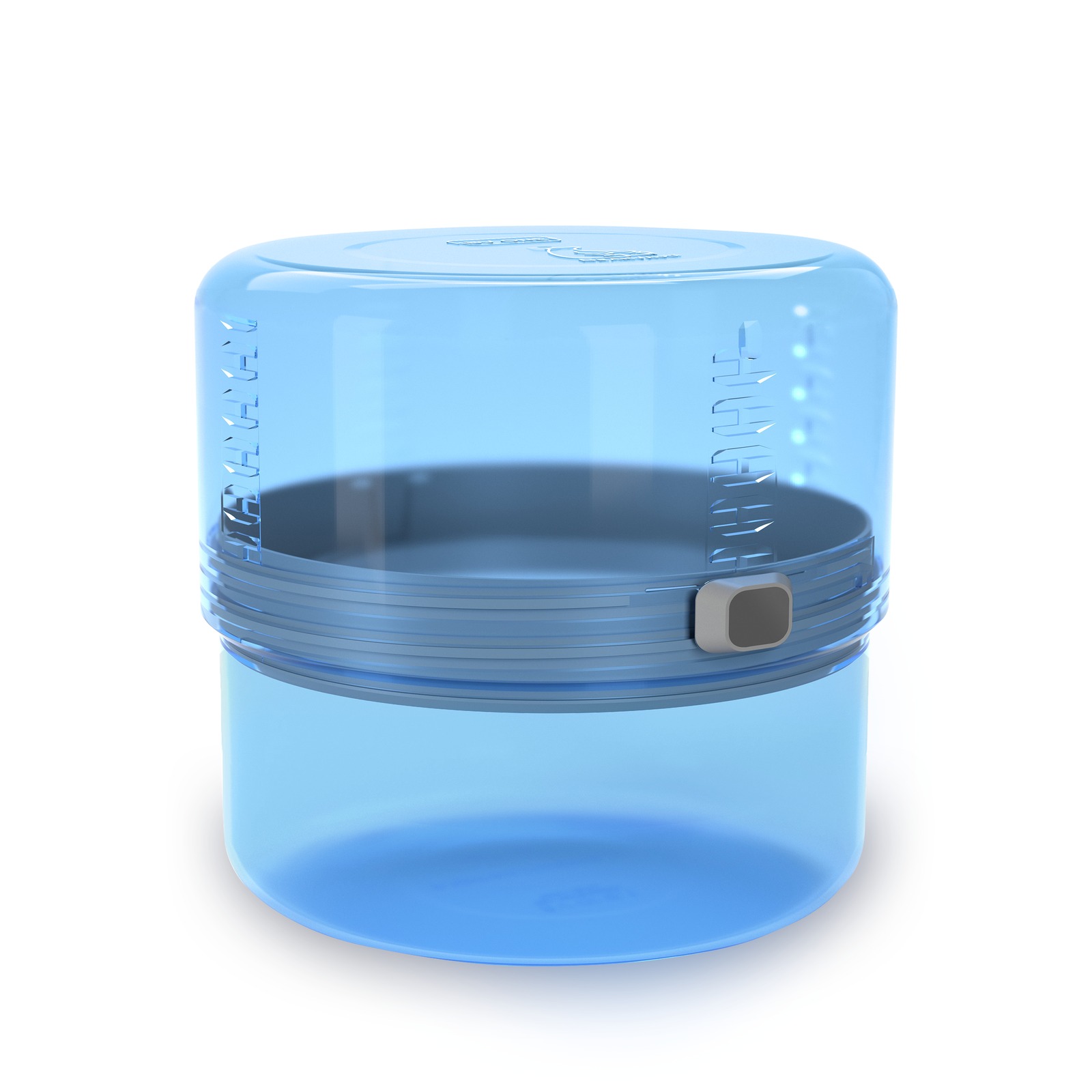
BearVault calls the BV ONE the first adjustable bear canister, and it is the most expensive canister the maker sells: $120.00 on bearvault.com on 2026-09-29, with an Add to cart button live and the product feed marking it available. The body telescopes, so the canister is 8.5 in tall when full and 5.6 in once the food is gone, and it weighs 1.97 lb (895 g) either way, against $84.99, $89.99, $94.99 and $99.99 for the fixed BV425, BV450, BV475 and BV500.
Two things settle whether the $20 to $35 premium is worth paying. The first is whether the canister is allowed where you are going: the BV ONE carries IGBC certification #255500 and WMI certification #BB0018, and BearVault's own FAQ says it is not approved in Yosemite, Sequoia or Kings Canyon. The second is what 8.3 L of expanded volume holds in days of food for one person, and what share of that space returns on a trip of ordinary length.
Our verdict
Buy the $120 BV ONE for four-day-plus trips where any IGBC-certified canister is accepted; in Yosemite, Sequoia and Kings Canyon the $89.99 BV450 and $99.99 BV500 are the models on the allowed lists.
- A good fit for
- Backpackers on four-day-plus routes through areas that accept any hard, IGBC-certified canister, who want the 8.3 L expanded volume and the 3.65 L of pack space that returns as the food goes down.
- We would skip it if
- Skip it for Yosemite, Sequoia and Kings Canyon, where the BV450 and BV500 are the listed models, and on one- and two-night trips, where the $84.99 BV425 holds 1-2 days for less.
Reasons to consider it
- IGBC certification #255500 appears on the IGBC certified products list dated 2026-07-31, alongside WMI black bear certification #BB0018 on BearVault's product page
- 1.97 lb with 8.3 L expanded against the $89.99 BV450's 2.1 lb and 7.2 L, which is the maker's 'more internal volume than the BV450, with 2 oz less weight' claim checked against its own two spec blocks
- The only canister in the line whose outside volume falls during a trip — 8.5 in tall expanded, 5.6 in collapsed, 9 in across — with a removable center divider and two soft-touch buttons in place of a screw lid
- Free ground shipping on US and Canadian orders over $50 before tax, and returns accepted for 45 days after receipt
The compromises
- It is not on the Yosemite allowed-container list or the Sequoia and Kings Canyon list, while the cheaper BV450 and BV500 are on both, and BearVault's own FAQ concedes it is not approved in those parks
- $20.01 more than the $99.99 BV500, which holds 3.2 L more than the BV ONE fully expanded and is rated 7 days rather than 1-4+
- Exposure to DEET 'irrevocably voids your warranty regardless of any other claims', and the New York DEC warns that bears in the Eastern High Peaks have regularly defeated clear plastic canisters
- At 9 in it is 0.3 in wider than the BV450, BV475 and BV500, and the four-canister chart there lists strap guides on the BV450 and BV475 and none on the BV ONE
What we have not verified: The days-per-person-day band is read off BearVault's own volume-to-days pairs rather than published as a rating, and it assumes freeze-dried food at about 1.6 to 2.4 L per person-day; a different mix moves the 8.3 L figure by more than a day. No field failure report for this canister was found. BearVault's own page gives the collapsed volume as both 4.65 L and 4.56 L, and its sibling weight lines round inconsistently — the BV500 reads 2.5 lb, 2 lb 9 oz and 1.16 kg on one line — so the ounce and liter gaps are approximate. The maker also prints IGBC #5340 against the BV450 and #5339 against the BV500, the reverse of the IGBC list, which is a mismatch on the same pages this article takes its sibling prices and volumes from; the BV ONE's own number matches on both sides. REI matched the maker's $120 on 2026-09-30, and an Amazon search the same day returned BearVault listings for the four fixed sizes only; the BV425 and BV475 are also missing from both park lists, so the omission is not unique to the BV ONE. Neither park publishes a date for adding newer models.
The things in this guide
A closer look at the products, who they may suit, and what to check before buying.
BV ONE
BearVault listed the BV ONE at $120.00 on 2026-09-29, in stock with free ground shipping over $50: 1.97 lb, 8.3 L expanded and 4.65 L collapsed, IGBC certification #255500 and WMI certification #BB0018, and 2.1 oz lighter than the $89.99 BV450 while holding 1.1 L more when full.
Before you buy: BearVault's own FAQ and the park lists agree it is not approved in Yosemite, Sequoia or Kings Canyon, where the BV450 and BV500 are, and the 3.65 L it sheds only comes back near the end of a four-day-plus trip.
Price checked September 29, 2026. Retailer prices can change.Two kinds of required, and only one of them names the model
Yosemite is the sharpest version of the question. The park requires food, drinks, trash, toiletries and anything else scented to be stored in an allowed bear-resistant container or a food locker, and hanging food is illegal throughout the park. It publishes the containers it allows, and the list itself reads "still valid, accurate, and complete as of July 2026": the Garcia Backpackers' Cache 812, the BearVault 110B, 200, 250, 300, 350, 400, 450 and 500, the Bearikade Weekender and Expedition, the Bear Keg, the Bare Boxer Contender and Champ, the Lighter1 Big Daddy and Lil' Sami, the UDAP No-Fed-Bear and the Tahoe. The BV ONE is not on it.
Sequoia and Kings Canyon name the same BearVault models — 110b, 200, 250, 300, 350, 400, 450 and 500 — and require a container in Dusy Basin, the Rae Lakes Loop, North Dome, Rock Creek and the Pear and Emerald Lakes areas from May 1 through October 31. BearVault does not dispute the omission. Its BV ONE FAQ is explicit: the canister "meets the same IGBC certification standards as all BearVault canisters, but it is not approved for Yosemite, Sequoia, or Kings Canyon", because those parks "maintain their own approved product lists and have not added any new products in several years", and it tells buyers heading there to carry an approved model instead.
The Adirondacks work the opposite way. New York defines a bear-resistant canister by construction — "a commercially made container constructed of solid, non-pliable material manufactured for the specific purpose of resisting entry by bears" — and requires one for overnight campers in the Eastern High Peaks Wilderness between April 1 and November 30. No brand list is involved, and non-rigid sacks and food hangs do not qualify. On that rule the BV ONE is legal. The same page carries a warning aimed at clear plastic: bears in the Eastern High Peaks "have regularly defeated bear-resistant canisters made of clear plastic", and campers are encouraged, though not required, to choose another type there.
The certifying body draws the line the same way. The IGBC states that certification "does NOT guarantee that a product is BEAR-PROOF" and that approval "does not imply that products have automatically been approved for use on all public lands", and it advises matching the number molded into a product against its published list, because manufacturers have to re-verify every year to stay on it. Certification #255500 is the entry ticket; a land manager decides whether it is accepted.
What 8.3 liters holds, in days
BearVault rates the BV ONE at 1-4+ days of food for one person and quotes its siblings on the same scale: 5 L for 1-2 days on the BV425, 7.2 L for 3-4 days on the BV450, 9.3 L for 5-6 days on the BV475 and 11.5 L for 7 days on the BV500. Those pairs are the only conversion BearVault publishes, and read together they imply a working density of roughly 1.6 to 2.4 L of canister per person-day of typical freeze-dried backpacking food — 11.5 L over 7 days is 1.64 L a day, 9.3 L over 5-6 days is 1.55 to 1.86, 7.2 L over 3-4 days is 1.8 to 2.4.
Working that band back onto the BV ONE, 8.3 L expanded lands at about five days at 1.6 L per person-day and about three and a half at 2.4. That arithmetic runs on published volumes rather than on a published rating, and New York's DEC gives it an outside check: "Canisters typically are 8 inches by 12 inches in size and hold up to 5 days of food for 1 person, when properly packed." An 8 in across by 12 in tall cylinder is about 9.9 L, or close to 2 L a person-day.
What moves you inside the maker's 1-4+ range is food density: a bag of wet food, a bottle of oil or a box of no-cook bars eats the margin faster than the liter count suggests.
The collapsed figure is the one that is easy to oversell. At 4.65 L the shrunken body still holds about 2 to 2.9 days of food across the same 1.6 to 2.4 L band, so the full 3.65 L difference between 8.3 L expanded and 4.65 L collapsed only comes back once what is left in the can fits in 4.65 L — under three days at the loose end of the band and under two at the dense end. On a two-night trip the canister spends almost all of its life near full height, and the adjustability has almost nothing to do.
BearVault's FAQ concedes the shape of this. It says experienced backpackers can stretch the BV ONE to six-day capacity by keeping the first day's food outside the canister while hiking and storing all food and trash inside overnight — a technique that works with a fixed canister too, and one that puts the sixth day outside the certified volume rather than inside it.
Buttons, care, and the DEET clause
The BV ONE replaces the screw lid of every other BearVault with two soft-touch push buttons and a body that splits at the middle: press both buttons, flip the loaded half so the food stays put, then twist, with no tool involved. The maker's packing rules limit what goes in — no long-handled spoons, sporks or toothbrushes — and dense or bulky items have to sit in the bottom half, under the removable center divider.
There is no lubrication schedule and no consumable to buy: the care guide is a rinse with mild soap and warm water after each trip, no abrasive scrubbing, and air-drying every part before storage. New York's DEC adds that canisters are not watertight and do not float.
The chemical rule is where care turns into cost. The product page warns that harsh chemicals "including DEET" will damage the material and void the warranty, and the warranty page states it flatly: exposure to DEET "will cause the material to spontaneously crack, and irrevocably voids your warranty regardless of any other claims". The maker treats DEET contact as owner damage rather than a defect, so repellent has to stay away from the canister.
The rest of the coverage is broad in one direction and narrow in the other. BearVault's limited lifetime warranty applies to products made in 2017 or later and covers the failure that matters most on a food canister: it will repair or replace, at its discretion and at no cost, any canister compromised by wildlife damage. Workmanship and material faults are covered only if a claim is filed within six months of purchase, and "lifetime" is defined as the product's life, "in most cases ... about ten years".
The exclusions are the narrow direction. They name normal wear and tear, material aging, accidental or deliberate damage, negligence, ultraviolet exposure, dirt, extreme temperatures and chemical damage, and coverage reaches only an original, unaltered canister bought new from a dealer BearVault authorizes in the US or Canada.
Buying terms are simple. Free ground shipping applies to US and Canadian orders over $50 before tax, with Alaska and Hawaii excluded, so $120 is the all-in price for most buyers. The return period is 45 days from the delivery date, and the canister has to arrive in new condition with all its packaging and contents. Original shipping is not refunded, return shipping comes out of the refund, and refusing a shipment costs the outbound and return freight plus an $8 processing fee.
Who should buy the fixed model
Three cases point away from the BV ONE. If the trip goes into Yosemite, Sequoia or Kings Canyon, a canister is mandatory in the areas named above and the BV ONE is not one of the allowed models, so bring the $89.99 BV450 or the $99.99 BV500 instead. If the trip is one or two nights, the $84.99 BV425 holds 5 L at 1 lb 12 oz and there is almost nothing for a telescoping body to shed. And if the route crosses the Adirondack Eastern High Peaks, the BV ONE satisfies the regulation but wears the clear plastic body the state's own page warns has been defeated there.
If a park-accepted canister is already in the closet, $120 buys pack space in the second half of a trip rather than a better canister: the BV ONE's certification is the same class of proof as the number already molded into the one you own. The premium is easiest to justify on a four-day-or-longer route in a place that accepts any commercial hard-sided container, or any IGBC-certified one — the Adirondack Eastern High Peaks among them, and the many land managers that, as the IGBC describes it, use its list as the means of approving products — and in a pack where 8.5 oz off the load and 3.65 L back by the last day is worth about $20.
How we put this together
Built from the product pages and listings below, without test scores or results we have not measured. Specifications and prices change, so check the original page for the exact model, current price, delivery, and returns.
- BearVault: New: BV ONE Adjustable Bear Canister product page (opens in a new tab)
- BearVault: BV450 Jaunt product page (opens in a new tab)
- BearVault: BV500 Journey product page (opens in a new tab)
- BearVault: BV425 Sprint product page (opens in a new tab)
- BearVault: BV475 Trek product page (opens in a new tab)
- BearVault: Limited Lifetime Warranty (opens in a new tab)
- BearVault: Shipping & Returns (opens in a new tab)
- IGBC (Interagency Grizzly Bear Committee): Bear Resistant Products (opens in a new tab)
- IGBC: Certified Products List (PDF, dated 260731) (opens in a new tab)
- NPS Yosemite: Allowed Food Storage Containers (opens in a new tab)
- NPS Yosemite: Bears & Food Storage While Backpacking (opens in a new tab)
- NPS Sequoia & Kings Canyon: Wilderness Food Storage (opens in a new tab)
- NPS Sequoia & Kings Canyon: SEKI Allowed Food Storage Containers (PDF) (opens in a new tab)
- NY DEC: Bear-Resistant Canisters (opens in a new tab)
- REI Co-op: BearVault BV ONE Adjustable Bear Canister (product C06509) (opens in a new tab)