Product image supplied by the brand
In this guide
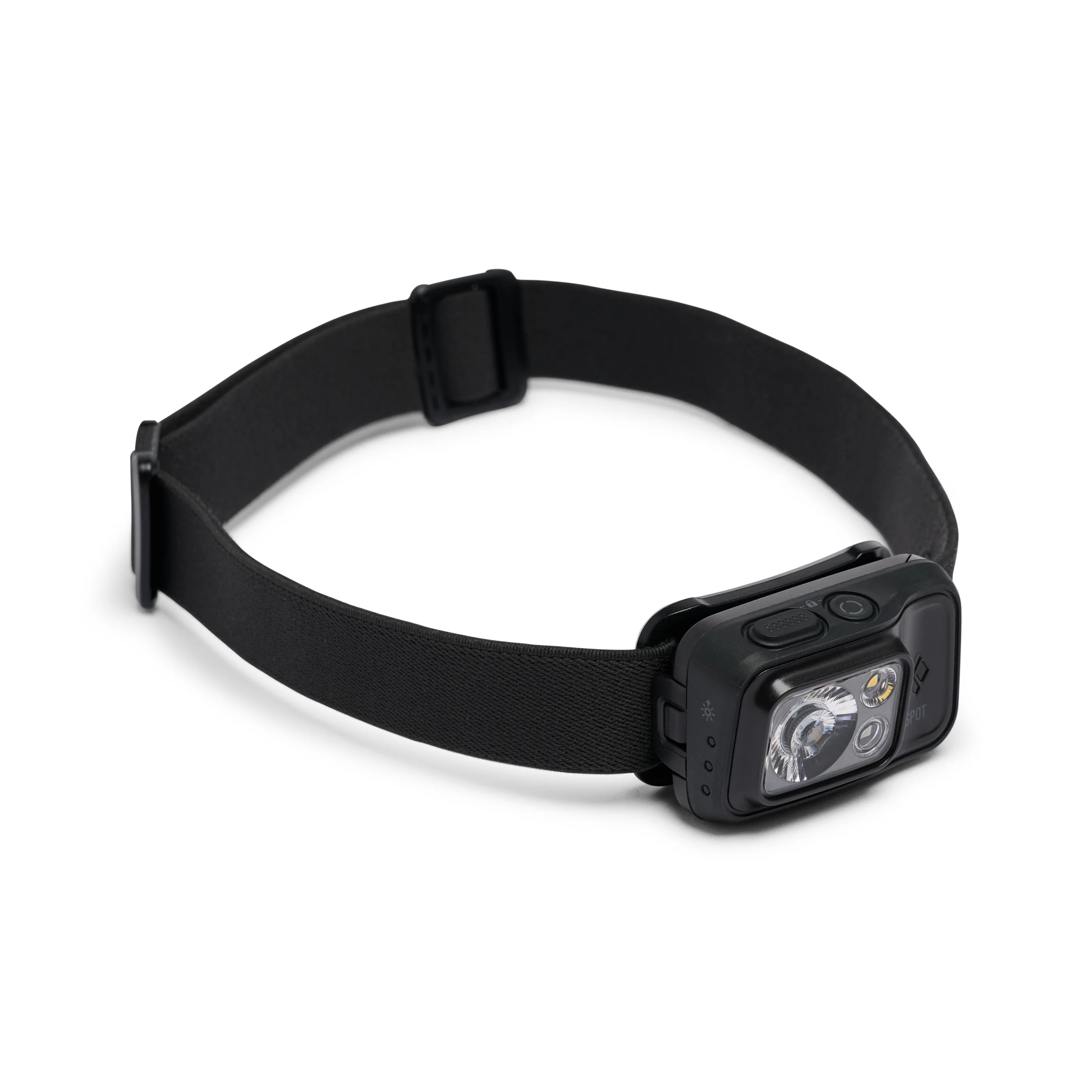
Black Diamond's Spot 400 is a $59.95 headlamp that ships with three AAA alkaline cells and accepts, as an alternative, the brand's BD 1500 lithium-ion pack. That Dual-Fuel arrangement is the whole design pitch: one lamp body, two power sources, and a spec sheet that quotes a different weight and burn time for each.
Reading the two columns side by side is more useful than reading the 400-lumen headline. On AAAs the lamp weighs 86 grams and lasts 2.5 hours on high; on the BD 1500 it drops to 72 grams and stretches to 4 hours. Getting the second column costs another $44.95 for the battery-and-charger kit, and that number belongs in the price comparison from the start.
Our verdict
A sensible $59.95 headlamp for camp and approach use, judged on published specs alone. Treat the rechargeable option as an extra $44.95 decision, because the box ships with alkaline AAAs and no charger.
- A good fit for
- A camper or climber who wants one lamp that runs on store-bought AAAs in a pinch and on a Li-ion pack the rest of the time, and who does not mind carrying a separate charger.
- We would skip it if
- You want to plug the lamp itself into a USB cable, you need more than about four hours at full brightness, or you expect the 400-lumen figure to hold for a whole night.
Reasons to consider it
- Runs on three AAA alkaline cells or the BD 1500 Li-ion pack, so a dead pack on a trip can be covered from a gas station
- IPX8 housing rated to keep operating at 1.1 meters for 30 minutes, with Black Diamond stating water may enter the battery compartment without stopping the light
- Published output steps of 400, 200 and 6 lumens, with a six-setting battery meter and a lockout to stop it switching on in a pack
The compromises
- High mode is rated for 2.5 hours on AAAs and 4 hours on the BD 1500, so the headline brightness is a short-burst figure
- The BD 1500 battery and its charger are a separate $44.95 purchase, and the lamp listing shows no charge port on the body
- Lumen and burn-time numbers are Black Diamond's own measurements under its own test conditions, not independent readings
What we have not verified: Black Diamond states the lumen, burn-time and distance figures without naming the test method behind them, does not say which AAA cells the runtime column assumes, and publishes no charge time for the BD 1500 on either listing. Neither listing describes what the 6-lumen low actually lights an arm's length away, and no sibling Spot model was read for comparison.
The things in this guide
A closer look at the products, who they may suit, and what to check before buying.
Spot 400 Headlamp
The published spec is complete on alkalines out of the box, and the BD 1500 kit can be added once you know how often you actually run it on high.
Before you buy: The lamp has no charge port of its own on the listing, so the rechargeable route always means carrying the separate charger.
Price checked September 11, 2026. Retailer prices can change.Dual-Fuel means two different lamps on paper
The listing quotes every runtime and weight twice: 86 grams and 2.5 hours on high with three AAAs, 72 grams and 4 hours on high with the BD 1500. Medium runs 5 hours on alkalines and 8 on the pack, and low runs 200 and 225 hours. The AAAs come in the box; the Li-ion pack is marked as sold separately.
In practice the pack is the configuration Black Diamond's own numbers favor, and the alkaline set is the fallback. Anyone planning to use high mode for more than a couple of hours per outing is really buying a $104.90 system once the $44.95 battery-and-charger kit is added. A weekend camper who mostly reads by low mode can stay on AAAs for years. Both columns are Black Diamond's own figures, produced under conditions neither listing describes.
The lumen figure is a peak, and the burn time says how brief
Black Diamond lists three white-light steps: 400 lumens on high, 200 on medium and 6 on low, with rated beam distances of 100, 60 and 12 meters. The 400-lumen number is the manufacturer's claim under its own test method, and the listing is silent on whether output is held steady or allowed to fall as the cells drain.
The pairing that matters is 400 lumens against 2.5 hours. Full brightness is for finding a cairn or checking an anchor, then dropping back. A night hiker who expects to walk on high from dusk to camp will run past the rated time on alkalines. The 6-lumen low is where the 200-hour figure lives, and 6 lumens is enough for reading in a tent, not for walking. PowerTap lets you jump to full power with a tap and return, which is how the spec expects the lamp to be used.
IPX8 comes with a sentence about the battery door
The IPX8 line reads as a test statement: operates at least 1.1 meters underwater for 30 minutes. Black Diamond adds that water may enter the battery compartment when submerged, that the lamp will keep working, and that it should be dried out completely afterward. The housing is rated; the compartment is not described as sealed.
For a paddler or a caver, the useful translation is that a dunking is survivable and that a wet compartment with alkaline cells in it becomes a corrosion job waiting at home. Someone who only sees rain will never meet the limit. Open the door and dry it after any submersion, and do not store it wet with AAAs inside. How the seal ages after years of door openings is something no listing can tell you.
Lockout, memory and a second switch
Three features on the listing address annoyances rather than brightness: a digital lockout so the lamp cannot switch on inside a pack, Brightness Memory so it comes back at the level you left it, and a red night-vision mode that dims and strobes without first cycling through white. A second switch handles lens mode selection, and a three-LED meter shows remaining charge in six steps.
Red light that activates without a white flash matters to anyone sharing a tent or checking a map beside other people at night. Lockout matters to anyone who has found a dead lamp at the bottom of a bag. These are the features that decide whether a headlamp gets used or replaced, and they are all present here. Whether the two-button layout is learnable with gloves on is a matter of practice, and no page settles it: Black Diamond describes what each switch does without describing how long that takes to learn.
Three years of coverage, one more thing to pack
All Black Diamond lighting products carry a three-year warranty, and the BD 1500 kit is covered on the same terms. The kit weighs 46 grams and is priced at $44.95; the lamp listing shows no charge port, so recharging means removing the pack and placing it in the separate charger, then putting it back.
A separate charger is a fair trade for a lamp that also runs on AAAs, and a poor one for a person who wants to top up from a power bank in a tent. A thru-hiker charging from a bank wants a port on the lamp. A car camper with a wall socket does not care. Decide which of those you are, then choose between the Spot 400 and a lamp with a port. A full charge of the BD 1500 has no printed time.
Skip it if the second purchase bothers you
If you already know you will only ever run the lamp on the rechargeable pack, the AAA compatibility is weight and cost you are paying for without using, and the separate charger becomes the one irritating part of an otherwise simple lamp. A headlamp with the cell built in and a USB port on the body suits that buyer better.
Move along as well if your nights involve hours of continuous full-power use, such as night road crews or long descents after dark. A rated 2.5 to 4 hours on high is a burst budget. And anyone who reads 400 lumens as a fixed output should read the burn-time column first; the two numbers describe the same lamp under conditions Black Diamond chose.
How we put this together
Built from the product pages and listings below, without test scores or results we have not measured. Specifications and prices change, so check the original page for the exact model, current price, delivery, and returns.
- Black Diamond: Spot 400 Headlamp (US store listing) (opens in a new tab)
- Black Diamond: BD 1500 Battery & Charger (US store listing) (opens in a new tab)