Product image supplied by the brand
In this guide
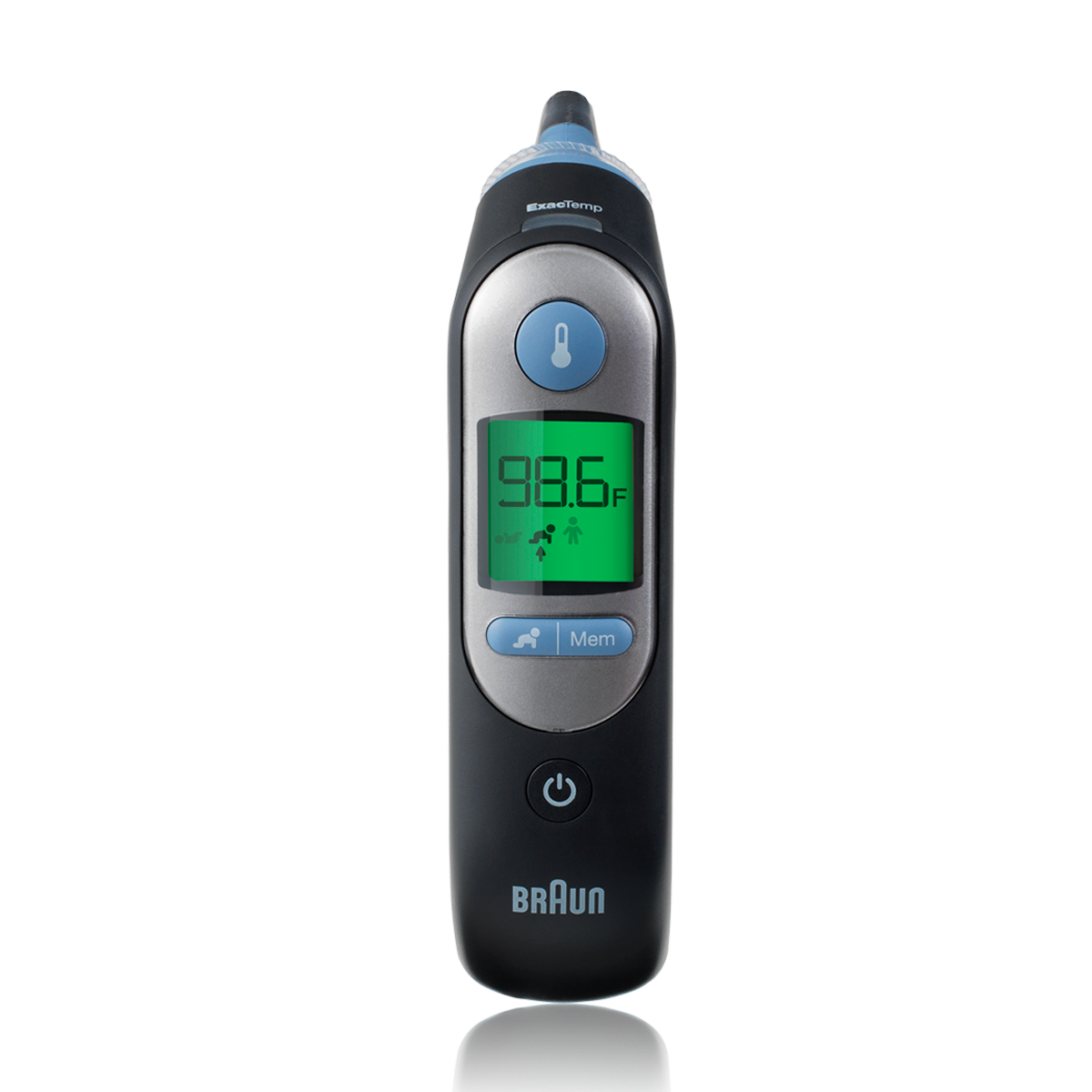
The ThermoScan 7 (IRT6520) is Braun's ear thermometer with age-adjusted fever guidance, sold by Amazon itself at $59.99 on 2026-09-18 — In Stock, free 30-day returns, FSA and HSA eligible. The carton carries the thermometer, a protective case, two AA batteries and a starter pack of disposable lens filters. Two things define the machine: Age Precision, which re-cuts the fever thresholds by the child's age before coloring the display green, yellow or red, and a hard dependency on those filters, with a manual that calls for a fresh one on every measurement.
Method and cadence decide it. An ear reading with age-recalibrated bands stands against the no-touch forehead check — iHealth's PT3 plays that side of the table at $30.95, reading a forehead in about a second and storing nothing. And a thermometer that bills a consumable on every reading has to fit the checking cadence of the house: sparse users spend pocket change a year, while a rough fever season reorders the box.
Our verdict
Buy the ThermoScan 7 at $59.99 when age-recalibrated fever bands and a stability-gated ear reading beat one-touch convenience. Price the filters first: the hardware refuses to run without them.
- A good fit for
- Parents of babies and toddlers who want the device itself to judge a reading — green, yellow or red — against the child's age band.
- We would skip it if
- Skip it for no-touch checks on a sleeping child, for logs past nine readings or app syncing, or if a per-reading consumable rankles.
Reasons to consider it
- Age Precision prints its thresholds: under 3 months red starts above 99.4 °F with no yellow band, 3–36 months turns yellow above 99.6 °F and red above 101.3 °F, and 36 months to adult yellow above 99.9 °F and red above 103.0 °F
- ExacTemp gates every reading on stability — the light pulses while measuring, holds solid 3 seconds on success, and a slipped probe returns an error instead of a number
- Nine-reading memory, two AA cells rated 350 measurements or two years asleep, a stated 5-year service life and a 3-year Kaz warranty
The compromises
- One new lens filter per reading, enforced in hardware; the manual restricts the device to genuine Braun LF 40 filters, while the cheapest pack on the listing is a 200-count from another seller at $9.29
- The age band must be selected before measuring and the last setting silently becomes the default, so a shared thermometer can read a sibling on the wrong band
- ASTM's infrared allowance is ±0.4 °F against ±0.2 °F for glass and electronic thermometers, a looser standard the manual itself prints; earwax, cold rooms and a 20-minute acclimation wait all distort readings
What we have not verified: Genuine LF-40 refill pricing is an open number: Braun's LF 40 page lists the 40-count box with no price, and a $5.94 search snippet for the 40-count on Amazon went unverified, so the per-reading figure stands on the third-party 200-pack alone. No independent accuracy testing of the IRT6520 appears in these sources; the rectal-equivalence claim is Braun's, footnoted to studies from 1999 and 2006 whose texts sit behind the footnotes. Braun's page contradicts itself on memory — a feature bullet says 10 readings where the manual and the page's FAQ say 9. The '#1 pediatricians' line rests on a survey Braun describes in a footnote but does not publish.
The things in this guide
A closer look at the products, who they may suit, and what to check before buying.
ThermoScan 7 Ear Thermometer (IRT6520)
$59.99, sold and shipped by Amazon itself — Age Precision fever bands at 0–3, 3–36 and 36+ months, an ExacTemp stability gate, nine-reading memory, and 21 lens filters plus two AA cells in the box.
Before you buy: One new lens filter per reading, genuine LF 40 by the manual's wording; the under-3-months band carries no yellow, and pre-term and small-for-gestational-age newborns are excluded outright.
Price checked September 18, 2026. Retailer prices can change.What Age Precision actually changes
The manual prints the bands the display follows. From birth to 3 months, green spans 96.4–99.4 °F (35.8–37.4 °C) and everything above 99.4 °F lights red — the youngest band carries no yellow, and the warnings section pairs it with an instruction to call a physician immediately above that number under 3 months of age. From 3 to 36 months, yellow runs above 99.6 °F up to 101.3 °F, with red beyond. From 36 months to adult, yellow starts above 99.9 °F and red above 103.0 °F. The cite behind the age drift is printed as well: Herzog and Phillips, "Addressing Concerns About Fever," Clinical Pediatrics, 2011.
Operating the feature means picking the band first. The age button toggles 0–3, 3–36 and 36+ months, no measurement starts until one is chosen, and the last selection silently becomes the default — a two-child household handing the thermometer back and forth runs on that memory. The colors interpret a number for the age selected; the manual puts it plainly: the device "is not intended to diagnose or monitor a serious medical condition or disease."
The ear argument and the infrared fine print
The case for the ear, as the manual builds it: the eardrum shares blood supply with the hypothalamus, the brain's temperature-control center, so the ear reflects core changes sooner than armpit or mouth sites, which drink, food and mouth-breathing distort. The same document concedes the tolerance — under ASTM E1965-98, infrared thermometers may err ±0.4 °F across 98–102 °F where glass and electronic sticks are held to ±0.2 °F — and the ThermoScan's specs sit at that bar: ±0.4 °F from 95 to 107.6 °F, ±0.26 °F clinical repeatability, display referenced as an oral equivalent. Braun's page reaches further, "clinically proven to be as accurate as rectal measurements in newborns," footnoted to published studies from 1999 and 2006.
Against the forehead method, the two makers' print pins the positions. iHealth's accuracy page puts ear readings 0.5 to 1 °F above oral and forehead scanners the same distance below it, and names sweat, hair and room temperature as forehead skews — the two devices bracket an oral reading from opposite sides, so a household owning both should log one method rather than mix the two. The PT3 reads a forehead in about a second without contact and keeps no record. The ThermoScan instead gates itself on placement: ExacTemp pulses while it measures, holds its light solid 3 seconds on a stable read, and answers a slipped probe with short beeps and a POS error.
Every reading costs a filter
The filter rule has no workaround. The manual instructs a new, clean lens filter for each measurement and restricts the device to genuine Braun ThermoScan LF 40; the hardware backs the first half by refusing to read with none attached, blinking a filter indicator until one goes on. Genuine LF 40 (LF40US01) ships 40 to a box, BPA-free and fitted to every ThermoScan model; the LF 40 product page has no price on it. The cheapest refill visible on the thermometer's own listing was a third-party 200-count at $9.29 — 4.6 cents a cover — against the manual's genuine-only wording.
The starter pack barely covers a first cold: 21 filters by Braun's page, "Box of 20" by the manual's parts list. A bundle at ASIN B0778Q98R1 undercuts the bare unit by a cent — thermometer plus 40 filters at $59.98, shipped from Amazon, sold by the third-party Elta Beauty, in the white colorway.
Memory, batteries and the fine print
Memory is where Braun contradicts Braun. The manual and the product page's FAQ both store the last 9 readings; the page's feature bullet says 10. Two documents against a marketing line settle it at 9 — recalled through the Mem button, readings marked M1 upward, the mode quitting after 5 idle seconds. Power comes from two AA cells rated for 350 measurements or two years asleep, against a stated 5-year service life and a 3-year Kaz warranty. The unit wakes showing the last temperature for 5 seconds, shuts off after 60 unattended, and lights its display for 15 seconds at a time in the dark.
The manual's cautions reach into real use. The manual directs readings to one ear — right and left differ — and posts a 20-minute wait after extreme room temperatures or a hearing aid; an ear treated with drops sits out, and earwax blocks accuracy. Pre-term and small-for-gestational-age newborns up to 4 weeks are excluded outright. Fahrenheit ships as the US default, and switching scales means holding the power button about 3 seconds.
Where this model sits, and one recall that is not about it
Braun's US site sells the ThermoScan 3, 4, 4 Connect, 5, 6, 7 and 7 Connect, with forehead and stick models beside them; no ThermoScan 9 appears in the US navigation. The 7 (IRT6520) is the age-guidance model without a radio; the 7 Connect (IRT6575) is the app-paired sibling, and its box lists the same 21-filter pack. The "#1 brand recommended by pediatricians" in the listing title rests on a footnote Braun describes — among surveyed pediatricians who recommend a thermometer brand, Braun is the most recommended — with the survey itself unpublished. Amazon sells the 7 in black and black-blue-grey colorways; the white unit shows on the bundle.
One recall line belongs here precisely because the names blur. An FDA Class 2 recall initiated 2024-06-13 by Baxter Healthcare covered the ThermoScan PRO 6000, the professional model — 265,647 units shipped with a compact disc holding an outdated version of its instructions for use. The consumer IRT6520 is a different device.
When the ear method is wrong for the house
A home whose real scenario is a sleeping child gets better service from the PT3, which answers without contact and confirms with a vibration instead of a beep, at $30.95. A household logging a temperature history for a pediatrician finds nine stored readings and no export — enough to outrun the PT3's zero, short across one bad week — while app syncing belongs to the 7 Connect. And a resentment of consumables disqualifies outright: the filter rule is enforced by the hardware itself, so the sticker price is not the end of the spending.
Past those three, the case is specific. From 3 months through toddlerhood, Age Precision turns 100.1 °F into a yellow screen with a printed threshold behind it, the interpretation a parent would otherwise be looking up at 2 a.m. Under 3 months, the red band starts exactly where the manual already says to call a physician — the device automates a rule the youngest households are following anyway. Order a refill box alongside the thermometer and the filter bill stays a planned cents-per-reading cost.
How we put this together
Built from the product pages and listings below, without test scores or results we have not measured. Specifications and prices change, so check the original page for the exact model, current price, delivery, and returns.
- Amazon: Braun ThermoScan 7 Digital Ear Thermometer listing (ASIN B07F4JJH1Z) (opens in a new tab)
- Braun: ThermoScan 7 Ear Thermometer product page (opens in a new tab)
- Braun: ThermoScan 7 owner's manual (IRT6520, form A001684R5, 2022-06-15) (opens in a new tab)
- Braun: ThermoScan Lens Filters (LF 40) product page (opens in a new tab)
- Amazon: Braun Thermoscan 7 IRT6520 Thermometer + Bonus 40 ThermoScan Lens Filters bundle (ASIN B0778Q98R1) (opens in a new tab)
- FDA: Class 2 Device Recall, Braun Thermoscan PRO 6000 Ear Thermometer (recall entry) (opens in a new tab)
- iHealth Support: How accurate is the thermometer? (opens in a new tab)
- iHealth: PT3 Infrared No-Touch Forehead Thermometer product page (opens in a new tab)
- Braun: ThermoScan 7 Connect Ear Thermometer product page (opens in a new tab)