Product image supplied by the brand
In this guide
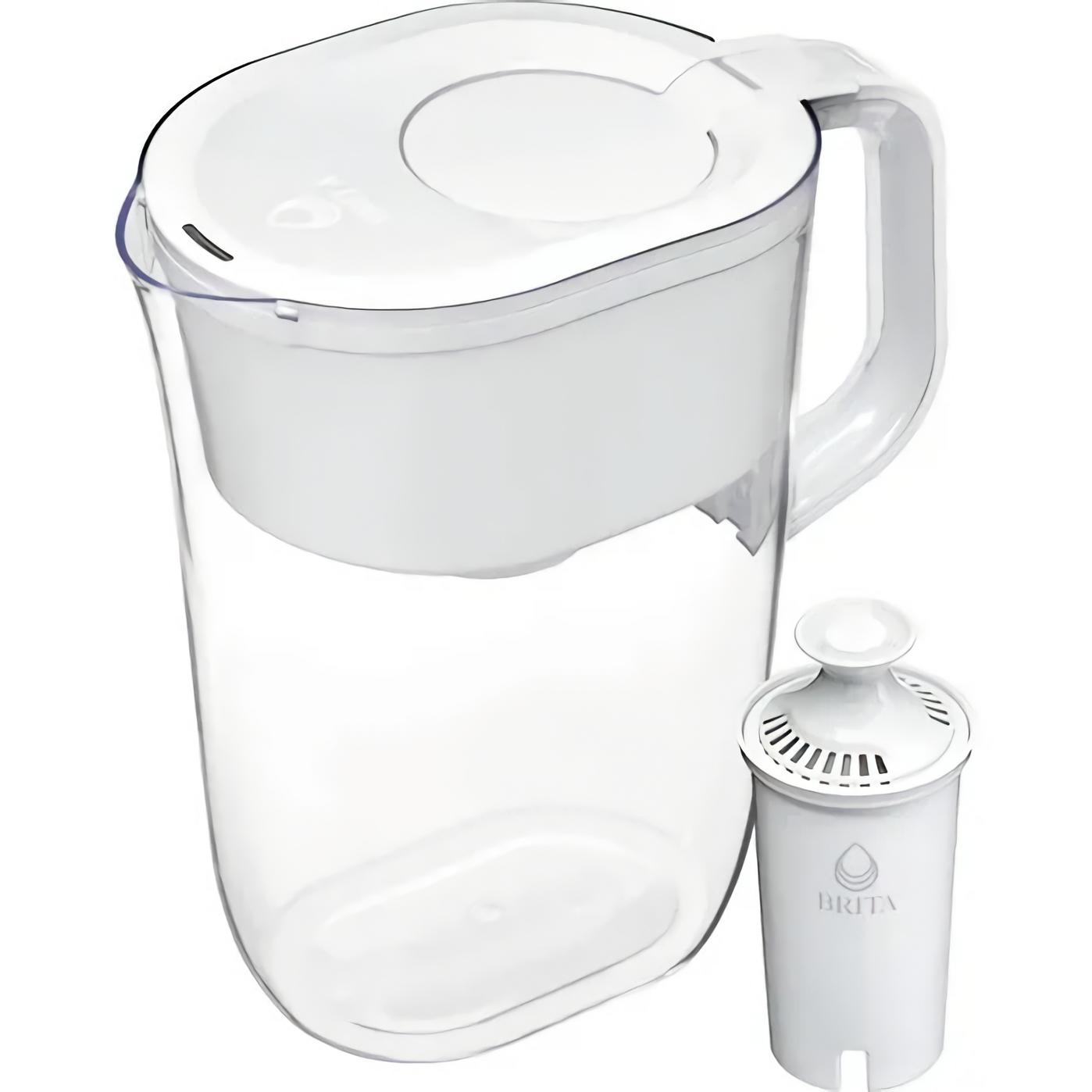
Amazon sells the Brita Everyday as the Large 10-Cup Water Filter Pitcher with BritaPlus Filter, listed at $44.79, in stock at Amazon.com on 2026-09-16, in Stone Blue, Clear, Black, and White. Brita's FAQ files the body under its model number, the Everyday Pitcher OB46, and the listing's description still calls it the Large 10-Cup Everyday — but brita.com's catalog no longer lists an Everyday; its pitchers page lists Denali, Tahoe, and Champlain. The body holds 10 cups, is made without BPA, and takes Brita's pitcher cartridges with one named exception: the listing labels the included BritaPlus 'compatible with all Brita pitchers and dispensers except Stream.' That interchangeability is what turns a one-time purchase into a subscription the buyer chooses.
Three cartridges fit that body, and they are not interchangeable in what they are certified to do. The Original (Standard) filter costs $7.99 and lasts 40 gallons; the BritaPlus in the box costs $6.50 in a four-pack and lasts the same 40 gallons against a twice-the-Standard contaminant claim; the Elite costs $19.99 and lasts 120 gallons — and its data sheet is the only one Brita certifies for lead and for the pharmaceutical traces of NSF/ANSI 401. The Original and Plus sheets carry NSF/ANSI 42 and 53 without a lead line. So the review question is not pitcher choice but cartridge choice, and the cartridge sets both the certifications and the yearly bill.
Our verdict
Buy the $44.79 Everyday only if the boxed BritaPlus and Amazon delivery matter — brita.com's Tahoe takes the same cartridges from $36.99; pay for Elite only for lead or pharmaceutical reduction, and skip it for microbiologically unsafe water.
- A good fit for
- A household drinking chlorinated municipal tap water by the pitcher, with fridge-door space 10.47 inches tall and room in the budget for two to six cartridges a year, whose water already meets microbiological standards.
- We would skip it if
- Skip for microbiologically unsafe or untested water, a job every Brita data sheet refuses, or for softer water or fewer dissolved minerals, where Brita publishes no claim; certified lead reduction requires the Elite cartridge's premium.
Reasons to consider it
- Cartridge choice is real: Original, Plus, and Elite all fit the OB46 body, and the yearly bill ranges from $29.99 (Original six-pack) to $47.94 (Original singles) at list prices, with the Elite two-pack at $32.99 buying the widest certificate
- The Elite data sheet is the only pitcher-filter sheet Brita certifies for lead — 99.5 percent at pH 6.5, 99.6 at pH 8.5 — and for the NSF/ANSI 401 emerging-compound list, with WQA the named certification body
- The purchase carries unusually complete paperwork: 10-cup capacity, fridge-door dimensions (10.47 x 5.59 x 10.94 in), BPA-free construction, a 30-day money-back guarantee, and a one-year warranty all appear in Brita's own documents
The compromises
- Lead reduction is gated to the most expensive cartridge: the word lead appears nowhere in the Original (OB03) or BritaPlus (OB08) data sheets, and NSF/ANSI 53 certification for copper, cadmium, and mercury is not a lead claim
- Certification has a hard stop: Brita's FAQ states filter performance is not certified after 40 gallons, and every data sheet refuses microbiologically unsafe or unknown-quality water outright
- Care and claims both have edges — hand-wash only (never dishwasher), a 15-second flush plus three discarded pitchers at setup for the Original cartridge, hard water shortening the cycles, and no softening or dissolved-solids claim anywhere
What we have not verified: Brita publishes no dimensions for the Everyday body outside Amazon, and the listing contradicts itself: its specification block lists 10.95 x 10.83 x 6.06 inches while Brita's infographic on the same page sizes the body at 10.47 x 5.59 x 10.94 inches, unreconciled. The $240-a-year saving and the 300-bottles-per-filter figure are manufacturer projections on a stated 11-cups-per-day basis with a September 2024 price snapshot, not measurements. Whether the Clear and Black variants carry the same $44.79 price — the White buybox was read at $44.79 on 2026-09-17, leaving only Clear and Black unchecked — and how fast hard water actually clogs a BritaPlus cartridge, are numbers the listing does not settle.
The things in this guide
A closer look at the products, who they may suit, and what to check before buying.
Everyday Pitcher (10 cup)
The listing's $44.79 buybox ships the OB46 Everyday with the WQA-certified BritaPlus cartridge (NSF/ANSI 42 and 53, 40 gallons), and the same body accepts Original six-packs at $29.99 a year or Elite two-packs at $32.99 — the only route certified for lead (99.5-99.6 percent) and the NSF/ANSI 401 compounds. Capacity is 10 cups, the body stands 10.47 inches tall for fridge doors, and Brita backs it with a 30-day guarantee and a one-year warranty.
Before you buy: The shipped cartridge carries no lead claim — neither the BritaPlus nor the Original sheet lists it — certification expires at 40 gallons, care is hand-wash only, no document claims softening or microorganism reduction, and hard water shortens every published cycle.
Price checked September 17, 2026. Retailer prices can change.Reading 42, 53, and 401: which cartridge carries which certificate
NSF/ANSI 42, 53, and 401 measure different jobs, and NSF's consumer guide draws the lines plainly. Standard 42 covers aesthetic effects: chlorine taste and odor, particulates. Standard 53 covers contaminants with health effects — the substances the U.S. EPA and Health Canada regulate, lead among them. Standard 401 covers emerging compounds, pharmaceuticals and chemicals not yet regulated, fifteen by name. Microorganisms sit outside all three; NSF handles those in other standards, such as 55 and 244. A water standard names each substance, an influent challenge concentration, and a maximum allowable in the filtered water, which is what makes these certificates checkable line by line.
The certificates split across Brita's three cartridges. The Original (Standard) filter (model OB03) is WQA-certified against NSF/ANSI 42 and 53: its sheet lists chlorine at 95 and zinc at 64 percent under 42, and cadmium, copper, and mercury under 53, with no lead row. The BritaPlus (OB08) in this pitcher's box is likewise WQA-certified to 42 and 53 only; its 53 rows add benzene, ethylbenzene, tetrachloroethylene, toluene, and 1,2,4-trichlorobenzene, again with no lead row. The Elite (OB06) carries the full set, 42, 53, and 401: lead 99.5 percent at pH 6.5 and 99.6 at pH 8.5, asbestos and atrazine added under 53, and the named emerging-compound list of 401. On Brita's paper, lead reduction starts where the Elite pricing starts.
The yearly filter bill: six cartridges or two, $29.99 to $47.94
Brita's own usage basis makes the annual count simple: the company's footnote assumes 11 glasses a day, about 240 gallons a year, and its documents schedule the Original and BritaPlus cartridges at 40 gallons — about two months — and the Elite at 120 gallons, about six. At one cartridge per 40 gallons, 240 divided by 40 is six cartridges a year; the Elite's 120 gallons divides to two. Six Original singles at $7.99 come to $47.94 a year. The same six cartridges in Brita's six-pack, at $29.99, cost $5.00 each and $29.99 for the year. The Elite's two singles cost $39.98, or $32.99 in a two-pack at $16.50 each.
The BritaPlus lands between: Amazon lists its four-pack at $25.99 — $6.50 a cartridge — which prices a six-cartridge year at $39.00, and its six-pack at $36.49 does the year for less. Priced per gallon, the ordering inverts Brita's marketing: the Original six-pack costs 12.5 cents a gallon ($5.00 for 40), the Elite two-pack about 13.8 ($16.50 for 120). The cheapest certified water this pitcher makes comes from the humblest cartridge, and the Elite premium buys exactly one thing — the wider certificate, lead and the 401 list, that the cheaper sheets do not carry. Households that only want chlorine taste controlled can stop at the six-pack; households with lead in their test results cannot.
The bottled-water claims, and the footnote they stand on
Both of Brita's bottle claims trace to one stated basis. The Amazon listing promises that one BritaPlus filter replaces up to 300 single-use 16.9-ounce bottles; the Elite page scales the same ratio up — switching from bottled water saves up to $240 a year and replaces up to 1,800 bottles. Six cartridges at 300 bottles each is 1,800, and 240 gallons a year is 30,720 ounces, about 1,818 of those 16.9-ounce bottles, so the two claims line up, and both rest on the 11-cups-a-day footnote. The $240 figure carries its own recipe on the page: Amazon list prices as of 9/25/24, an average bottle cost from IRI scanner data for the 52 weeks ended 6/16/24, and the same 240-gallon household.
What the footnote cannot fix is the household. Eleven cups a day is Brita's assumed family; a lighter-drinking one replaces fewer bottles, saves less, and still pays the same cartridge bill, so the saving scales down faster than the costs do. The bottle-replacement figure also measures waste, not purity — replacing 1,800 bottles settles nothing about which contaminants matter in a given tap, which is the certificates' job, read in the section above. As a manufacturer projection with its basis printed, the $240 claim is usable as a ceiling, not as a return the pitcher pays out.
Four boundaries the documents draw before the first pour
Every performance data sheet cited here ends with the same refusal: the filter is not intended to purify water, and it must not be used with water that is microbiologically unsafe or of unknown quality without adequate disinfection before or after the system. Brita's FAQ adds a second expiry that the marketing pages leave out: filter performance is not certified after 40 gallons — the sentence that settles whether stretching a cartridge stretches the budget or just the risk. That FAQ also narrows the input: only potable drinking water goes through the pitcher, with alcohol and juice named and banned.
The documents draw three more lines worth reading before checkout. Nothing Brita publishes claims to soften water or reduce dissolved solids — the Elite page's own phrasing is that the filter works while preserving certain minerals and electrolytes, and the FAQ keeps fluoride in — so hard-water households buy taste control, not scale control, and the FAQ warns hard water may require more frequent changes. Care is hand-wash only: Brita states its pitchers and dispensers are NOT dishwasher safe — mild detergent, never abrasive cleaners. And the OB46's electronic indicator tracks both cartridge types on different resets — two seconds for Standard, six for Elite — while Brita says pitchers bought before 2019 may not track Elite life at all.
One family, one decision: picking the cartridge, not the pitcher
Brita's pitcher family mostly collapses into one decision, because the cartridges are the system: Original (Standard) and Elite filters fit all Brita pitchers and dispensers, per the FAQ, so a 6-cup Denali, this 10-cup Everyday, and the 27-cup Ultramax dispenser differ in capacity and lid style, not in certified content. brita.com's current 10-cup pitcher, the Tahoe at $36.99 with the Original filter or $41.99 with the Elite, takes the same cartridges and the same yearly bills as this one for $2.80 to $7.80 less; its SmartLight indicator and flip-top lid are body features, so the Everyday's $44.79 is paying for the BritaPlus in the box and Amazon delivery, not for a better pitcher. The exception is Stream, whose gray filter mounts in the lid and filters as you pour — Brita states only Stream filters work in them, and Standard and Elite will not.
Three checkable preconditions govern the purchase: municipal water that already meets microbiological standards, a fridge door or shelf at least 10.47 inches tall, and a drinking volume that justifies two to six cartridges a year. Pick the cartridge by certificate, not by habit: Original six-packs for chlorine taste at 12.5 cents a gallon, the in-box BritaPlus for the wider 53 list at $36.49 a year, Elite when a lead test or a pharmaceutical concern exists. The skip cases mirror them: microbiologically unsafe or untested water, which every data sheet refuses; softer water or fewer dissolved minerals, which no document claims; and sediment-heavy wells, where the FAQ points to whole-home or under-sink systems because sediment shortens Elite cartridge life.
How we put this together
Built from the product pages and listings below, without test scores or results we have not measured. Specifications and prices change, so check the original page for the exact model, current price, delivery, and returns.
- Brita: Everyday pitcher Amazon listing (ASIN B0GMT987FX) (opens in a new tab)
- Brita: Original Pitcher and Dispenser Replacement Filters product page (opens in a new tab)
- Brita: Elite Replacement Filters product page (opens in a new tab)
- Brita: Water Pitchers FAQs (opens in a new tab)
- Brita: Replacement Filters FAQs (opens in a new tab)
- Brita: Performance Data Sheet for the Elite filter (model OB06, January 2026 PDF) (opens in a new tab)
- Brita: Performance Data Sheet for the Standard filter (model OB03 PDF) (opens in a new tab)
- Brita: Performance Data Sheet for the Brita Plus filter (model OB08 PDF) (opens in a new tab)
- NSF: Standards for Water Treatment Systems (consumer article) (opens in a new tab)
- Brita: Tahoe Water Pitcher with Elite Filter product page (opens in a new tab)