Product image supplied by the brand
In this guide
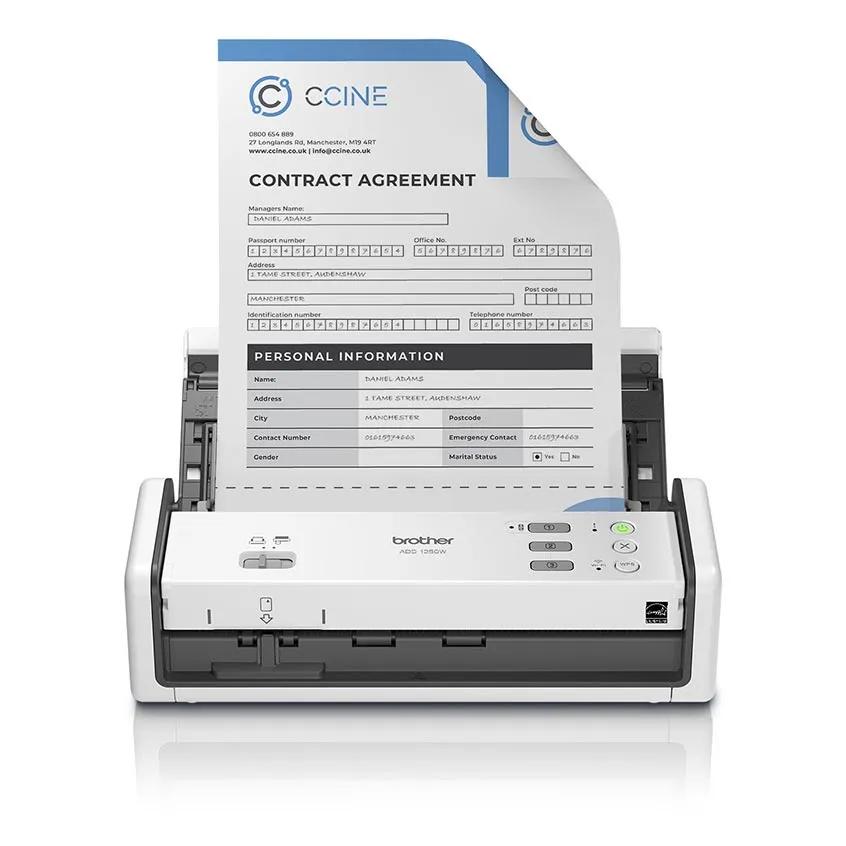
Brother sells the ADS-1350W at $289.99 on brother-usa.com, in stock new on September 11, 2026, with a refurbished RADS1350W priced at $229.99 but not orderable. It is the wireless member of Brother's smallest desktop scanner family: a 20-sheet automatic feeder, a dual CIS sensor that reads both sides of a page in one pass at up to 30 pages and 60 images per minute, 600 by 600 dpi optical resolution, and a body 11.3 in wide, 4.0 in deep and 3.3 in tall that weighs 3.0 lb.
Two comparisons frame it. The first is the ADS-1300, the same scanner without Wi-Fi, listed at $254.99. The second is the multifunction laser this site has already covered, the DCP-L2640DW at $209.99, which has a flatbed and a 50-page feeder but scans one side at a time and needs a full printer on the desk. The ADS-1350W is for the person whose paper problem is stacks of two-sided documents and whose printing problem is already solved, or does not exist.
Our verdict
A fully specified compact duplex scanner at $289.99 for a desk that scans stacks of paper weekly and wants to do it from a phone; the USB-only ADS-1300 does the same paper work for $35 less if the Wi-Fi will never be used.
- A good fit for
- A home office or small practice that receives multi-page, double-sided paperwork, needs searchable PDFs, and would rather scan from a laptop or phone than from a printer's control panel.
- We would skip it if
- Your scanning is a few single pages a month, a multifunction printer with a feeder is already on the desk, or you need to scan bound books, photos or anything that will not go through rollers.
Reasons to consider it
- Single-pass duplex at up to 30 ppm and 60 ipm from a 20-sheet feeder, in a 3 lb body
- Bus power over a USB Type-C connection, so it can run from a laptop with no adapter on the desk
- TWAIN, WIA, ICA and SANE drivers, searchable and PDF/A output, and a slot for plastic cards
The compromises
- $35 over the USB-only ADS-1300 buys only wireless and the mobile app
- A 20-sheet feeder and 1,000-page daily cycle put it below the larger ADS models for volume
- Brother's web spec table lists a Micro USB 3.0 interface while the brochure and carton say Type-C 3.2 Gen 1
What we have not verified: The scanner was not run for this review; real throughput at 300 dpi color, feed reliability with mixed receipts, OCR accuracy and Wi-Fi setup on macOS were not assessed. Whether an AC adapter is included is unclear from the maker's pages.
The things in this guide
A closer look at the products, who they may suit, and what to check before buying.
ADS-1350W Wireless Compact Desktop Scanner
One-pass duplex at 60 ipm, a 20-sheet feeder, searchable PDF output through TWAIN, WIA, ICA or SANE, Wi-Fi for phone scanning, and bus power from a laptop, all in a 3 lb unit.
Before you buy: The $35 Wi-Fi premium over the ADS-1300 is wasted on a desk with one wired computer, and the feeder capacity and duty cycle suit a home office, not a mailroom.
Price checked September 11, 2026. Retailer prices can change.Twenty sheets, both sides at once, up to legal length
The feeder holds 20 sheets of 20 lb paper and the dual contact image sensors capture both faces in a single pass, which is the feature that separates a document scanner from the glass on a printer. Brother rates it at up to 30 ppm single-sided and 60 ipm duplex, measured with letter paper at 200 or 300 dpi in either black or color; at 600 dpi it will be slower, and the brochure warns that software processing time adds to the figure. The daily duty cycle is 1,000 sheets, a ceiling meant for comparing Brother models more than a target to hit.
Paper handling is wider than the size suggests. Documents from 2.0 to 8.5 in wide and 2.76 to 14 in long pass through the feeder, so legal pages fit, and a single sheet can run as long as 197 in for a continuous form. The media weight range is 13.8 to 34.1 lb, with receipts recommended through the optional carrier sheet, and a dedicated slot takes plastic cards up to 1.24 mm thick with embossing. Books, photos and anything fragile are the flatbed's job, and there is no flatbed here.
Wi-Fi, a USB Type-C jack, and a spec table that disagrees with itself
The scanner connects over 802.11 b/g/n wireless or a wired Type-C link, and Brother's page says it can draw its power from the computer through the included lead with Type-C plugs at both ends. The brochure gives the draw as roughly 9 W scanning on bus power and 11 W on an AC adapter, and lists the interface as USB Type-C 3.2 Gen 1. The web spec table on the same product, however, still says Micro USB 3.0, which reads like a carried-over entry; the carton contents entry and the brochure both point to Type-C, and the supplied cable is Type-C. Whether an AC adapter ships with it is not stated on either page, and the carton list does not include one.
The wireless side is what the $35 over the ADS-1300 buys. Both scanners share the feeder, sensor, speeds and duty cycle; the 1350W adds Wi-Fi Certified 802.11 b/g/n with WPA2 security, the Brother Mobile Connect app for iOS and Android, and scan-to-cloud through iPrint&Scan to OneDrive, Google Drive, Dropbox and Evernote. Drivers cover TWAIN and WIA on Windows, ICA on macOS and SANE on Linux, and the output formats include searchable PDF, secure PDF, PDF/A, multi-page TIFF, JPEG, PNG and BMP.
What a $209.99 laser multifunction cannot do
The DCP-L2640DW covered elsewhere on this site is the natural in-house rival: for $80 less than the ADS-1350W it prints, copies and scans, and its 50-page feeder is larger. What it lacks is duplex scanning of any kind, so a two-sided lease agreement is two feeder passes and a merge in software, or a flip by hand on the glass. It also weighs many times as much, needs mains power, and its scanner speed is tied to a printer engine built for a different task.
The ADS-1350W's case is narrower and stronger. It does one thing, ingests stacks of paper and turns them into searchable files, and it does that two-sided at 60 ipm from a device you can slide into a laptop bag and run from the laptop's Type-C jack. A household that has the DCP-L2640DW or the HL-L2400D and scans a form now and then does not need it; an office that files invoices, medical records or signed contracts every week will find the multifunction's glass tedious within a month.
A software bundle, one year of coverage, and rollers that wear
Brother bundles iPrint&Scan for desktop, Kofax PaperPort 14SE and Power PDF, Presto! BizCard, BR-Receipts and the Mobile Connect app, and some of those are Windows-only. Image processing on the scanner side covers auto deskew, blank page skip, background and bleed-through removal, color dropout, hole-punch removal, auto rotation and 2-in-1 scanning, with automatic color detection. The unit has no display, so job setup happens on the computer or phone, and a lock slot is the only physical security feature.
Coverage is one year through Brother support. The wear parts are a pick-up roller (PUR-2001C) and a separation pad (SP-2001C), both listed as replacement supplies, and an optional output tray, carrier sheet pack and legacy kit round out the accessory list; Brother does not publish prices or replacement intervals for the rollers on its site. The scanner is ENERGY STAR 3.0 and EPEAT Silver rated, sleeps at about 1 to 1.6 W, and is built in China.
Skip it if the paper is thin, rare or bound
A sheet-fed scanner is only worth its desk space when paper arrives in quantity. If you scan a few single pages a month, the flatbed on a multifunction such as the DCP-L2640DW at $209.99 already does the job and prints besides. If your originals are books, photographs, fragile receipts or anything that must not go through rollers, a feeder-only scanner with no glass is the wrong device regardless of speed.
Then there is the wireless question. The ADS-1300 is the same scanner at $254.99 without Wi-Fi or the phone app; a desk with a single wired computer gains nothing from the extra $35. And for high volume, a 20-sheet feeder and a 1,000-page daily cycle mean reloading often, which is where Brother's larger ADS models start to make sense. For the middle case, weekly stacks of two-sided paper from a laptop or phone, the ADS-1350W is correctly sized and correctly priced.
How we put this together
Built from the product pages and listings below, without test scores or results we have not measured. Specifications and prices change, so check the original page for the exact model, current price, delivery, and returns.
- Brother USA: ADS-1350W product page (opens in a new tab)
- Brother USA: ADS-1350W brochure (PDF) (opens in a new tab)
- Brother USA: ADS-1300 product page (opens in a new tab)
- Brother USA: DCP-L2640DW product page (opens in a new tab)