Product image supplied by the brand
In this guide
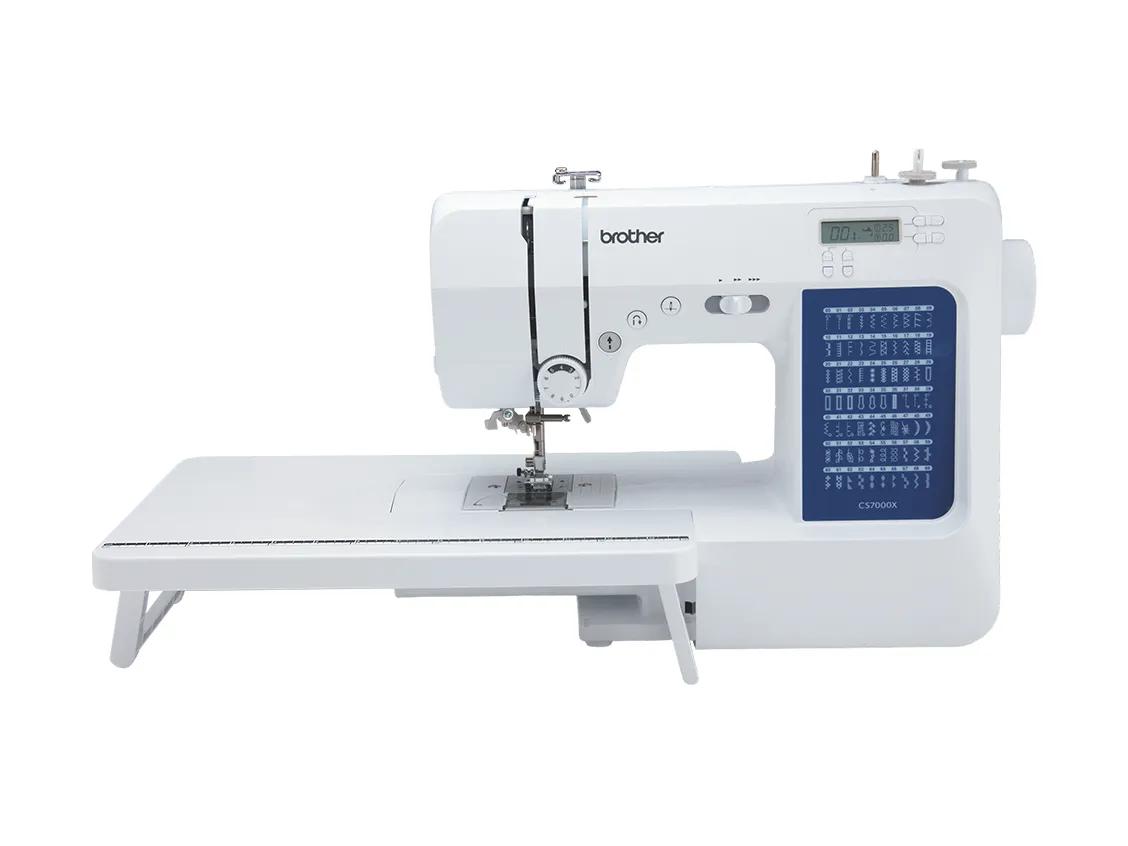
The CS7000X is a 70-stitch computerized sewing and quilting machine with an LCD, an automatic needle threader, a top-drop quick-set bobbin and a detachable wide table, sold direct by Brother on its American store at $279.99 with the purchase button live on 2026-10-04. The spec page puts maximum sewing speed at 750, stitch width at 7 mm and stitch length at 5 mm, the unit at 12.2 by 6.65 by 16.26 inches, and its weight row at 10.5 with no unit printed beside it.
Five computerized Brother sewing machines answered with a live buy button on the maker's store on 2026-10-04, priced from $169.99 to $289.99, and the interesting comparison is not between brands. The $259.99 CP100X prints the same unit dimensions, the same unit weight, the same carton dimensions, the same 750 speed and the same 7 mm by 5 mm envelope as the CS7000X, and it lists 100 built-in stitches and 8 buttonhole styles against the CS7000X's 70 and 7. What deserves answering is what the CS7000X's extra $20 buys, and what the $110 between it and the $169.99 CS5055 buys.
Our verdict
Buy the $279.99 CS7000X only when a shop you trust stocks it or a bundle moves it under the CP100X. The CP100X prints the same physical figures with 30 more stitches for $259.99 direct, $229.99 sold by Amazon.
- A good fit for
- A first computerized machine for garment seams and pieced quilting, bought wherever stock is real, with the wide table, hard cover and ten presser feet arriving in the same carton.
- We would skip it if
- The order is going to Brother's own store or to Amazon and nothing else drives the choice: the CP100X prints the same box, weight and speed with 30 more stitches, for $20 less direct and $50 less from Amazon.
Reasons to consider it
- The carton is the value: the included-accessories sheet gives part codes SA140, SA129, SA125 and SA132 for the walking, quilting, 1/4-inch piecing feet and quilting guide, priced one at a time on those items' pages at $97.99, $58.99, $28.99 and $20.99
- Threading is documented as a seven-step numbered path printed on the machine itself, with a quick-set bobbin whose thread is fed through a slit and pulled to cut, so the bobbin thread never has to be drawn up by hand
- The wide table is a detachable panel with its own folding support leg, and the cover listed in the carton is a hard case, which is what the page means when it promises 'convenient portability and class use'
The compromises
- The Quilting accordion prints Built-in Quilting Stitches No and Included Quilting Feet No while the same page's copy claims quilting stitches among the 70 and its carton list names a Quilting foot; both readings are recorded here and neither is resolved
- The headline 25 Year Limited Warranty is the chassis casting. Brother's warranty document gives 1 year on parts, labor and accessory items and 2 years on electronic components and printed circuit boards, with replacement labor on the boards excluded
- Nothing is oiled by the owner. The manual states the machine must not be oiled by the user and warns against oil on the bobbin case, so a dry, noisy machine goes to an authorized service center instead of getting a bottle of sewing oil
What we have not verified: The two quilting rows on the CS7000X page contradict its own carton list, and no document read here says which is wrong, so someone who plans free-motion work should confirm the drop-feed behavior and the foot that ships against the box rather than the copy. Brother lists no price at all for the SAWT7 wide table, which leaves the replacement cost of the single most distinctive inclusion unknown. The CP100X panels show no Drop Feed row anywhere, a gap in its documentation and not proof that it lacks the feature. Every figure quoted is Brother's or a retailer's own print, from pages read on 2026-10-04.
The things in this guide
A closer look at the products, who they may suit, and what to check before buying.
CS7000X Computerized Sewing & Quilting Machine with Wide Table
Ten feet, a quilting guide, a wide table with its own support leg and a hard cover ship in the carton, and the maker's included-accessories sheet names the part codes for them: SA140 walking foot, SA129 quilting foot, SA125 1/4-inch piecing foot, SA132 quilting guide, SAWT7 wide table and a hard case. The four foot items are priced one at a time on their respective pages at $97.99, $58.99, $28.99 and $20.99, a sum of listed prices of $206.96 before the table and the cover are counted, against a $110 step up from the CS5055, which ships seven feet, no table and no case.
Before you buy: On Brother's own store the CP100X sits $20 lower with the same printed physical figures and 30 more stitches, and the CS7205 sits $10 higher with 205 stitches, 11 feet, a memory and an 850 speed. The CS7000X wins on neither end of that ladder. On Amazon it repeated its $279.99 direct price on 2026-10-04, while the CP100X sold there for $229.99 to any buyer.
Price checked October 4, 2026. Retailer prices can change.Two Brother pages, one set of physical numbers
The CS7000X page and the CP100X page print the same machine body. Unit Dimensions 12.2" x 6.65" x 16.26", Carton Dimensions 12" x 20" x 18", Unit Weight 10.5, Maximum Sewing Speed 750, Stitch Width 7, Stitch Length 5, Quick Set Bobbin Yes, Needle Threading System Automatic, Built-in Lettering Fonts 0, USB Cable Not Included, 25 Year Limited Warranty. Both pages count ten included feet with a walking foot, a quilting foot and a 1/4-inch piecing foot among them, and both say a wide table and a hard case ship with the machine.
Each page records its box in its own form. Memory Card Reader No is a CS7000X row, and the CP100X panel prints no such line. The CS7000X Carton Contents row itemizes 'hard protective cover, wide table', while the CP100X in-box row names neither and leaves them to that page's About copy and its INCLUDED ACCESSORIES strip. The feet rows split the same way: eleven entries on the CS7000X because a Quilt Guide sits among them, ten on the CP100X, whose in-box text still names a Quilting guide.
What differs is the stitch ROM and the price. The CP100X page reads 100 built-in stitches and 8 buttonhole styles at $259.99; the CS7000X page reads 70 and 7 at $279.99. On the printed figures from those two pages, the cheaper machine is the one with the longer stitch list, and the extra $20 on the CS7000X is attached to no feature either page documents.
Both pages were opened in a browser on the same morning, both prices come from the panel beside the enabled Add to Cart control on each model, and both JSON-LD blocks repeat those figures. The support site maps both model identifiers to one Operation Manual file and one included-accessories notice, so the documents behind these two pages are shared even where the panels are not. Neither page offers a reason for the order. On the maker's store alone, the CS7000X is the pricier of a matched pair rather than a step up.
What the $110 above the CS5055 actually buys
The bottom of the direct ladder is the CS5055 at $169.99, and the gap up to the CS7000X is the clearest value case in the line. The CS5055 prints 60 built-in stitches, 7 buttonhole styles, the same 750 maximum speed, the same 7 mm width and 5 mm length, and the same automatic needle threader. It ships seven presser feet, and its carton names no walking foot, no quilting foot, no 1/4-inch piecing foot, no quilt guide, no wide table and no hard cover.
The CS7000X adds exactly those items. The included-accessories sheet ties them to part codes: SA140 walking foot, SA129 quilting foot, SA125 1/4-inch piecing foot and SA132 quilting guide. Priced one at a time on those items' pages on 2026-10-04, the four read $97.99, $58.99, $28.99 and $20.99, which is $206.96 before the table and the cover are counted, against the $110 step between the two machines. Two of the four cannot be put in a basket today: the walking foot page has no purchase control at all, its price row followed by a 'Locate a Dealer' button, and the quilting guide is Out of Stock, so that total describes a shelf rather than a shopping list you can complete.
The CS5055's Start/Stop Button and Needle Position Key rows both read No, so the foot controller does the starting and the handwheel does the needle placement. For hemming, cuffs and anything where the needle should stop down in the fabric, those two absent rows matter more than the 10 missing stitches.
The two spec rows that contradict the carton
The CS7000X page carries a Quilting accordion that reads Drop Feed Automatic, Built-in Quilting Stitches No, Free Motion Quilting Foot Yes, Included Quilting Feet No. The same page's About panel says the 70 built-in stitches include 'decorative stitches, quilting stitches and seven styles of one-step, auto-size buttonholes', and its In the Box panel lists a 'Quilting Foot' and a 'Quilt guide' among the carton contents, while the Basic Features panel answers Specialty Feet Included: Yes.
Both readings are on the record here and neither is taken as the correct one, because nothing in the documents read resolves them. The included-accessories sheet names the quilting foot as SA129 and the quilting guide as SA132, and the manual tells you to remove the presser foot holder when installing a foot that does not use one, 'such as the walking foot and quilting foot'. If free-motion work is the reason for the purchase, the foot and the drop feed are what to confirm on arrival.
Seventy patterns with zero built-in lettering fonts and a 7 mm maximum width is a utility and decorative set sized for garment sewing and pieced quilt borders, not a monogramming machine. The alphanumeric work lives on the XR9550 page instead, $10 cheaper, at 165 stitches with 1 lettering font.
Threading, and the tolerances that will bite a beginner
The manual's upper threading path is seven numbered steps: raise the presser foot lever, raise the needle to its highest position, switch the power off if it is on, pull up the spool pin and load the spool so the thread unwinds as shown, pass the thread through the thread channel 'in the order shown' while following 'the numbered path printed on the machine', slide the thread behind the needle bar thread guide, then put it 'through the eye of the needle' and under the presser foot leaving 10 cm. The manual's own reason for threading carefully is printed above that path: 'Make sure you thread the machine properly. Otherwise, the thread could tangle and break the needle.'
The bobbin is the longer job in the manual, fifteen numbered steps against seven for the upper thread. Wind with the power on but the machine idle, hold the thread end, stop when the bobbin 'seems full and begins spinning slowly', cut the thread, slide the winder shaft left, raise the needle and the presser foot lever, turn the machine off, open the cover, drop the bobbin in and pull the thread through the slit so the built-in cutter trims it. The manual states the payoff plainly: 'You can begin sewing without drawing up the bobbin thread.' Its CAUTION also names what goes wrong: not winding properly 'may cause the thread tension to loosen, and may break the needle'.
Three consumable limits apply to every project. Use only SA156 bobbins or the same Class 15 type: 'A bobbin designed for this machine is not used' is a cause the symptom table prints under a breaking needle, a breaking upper thread, tangled bobbin thread, incorrect thread tension and a high-pitched sewing noise, while 'The bobbin thread cannot be pulled up.' is attributed only to a turned, bent or dull needle and to a bobbin installed incorrectly.
Keep thread between 30 and 90 weight. That limit is printed twice in two wordings, as a threading CAUTION ('Never use a thread weight of 20 or lower.') and as a note in the fabric table ('Never use thread of 20 weight or lower. It may cause machine to malfunction.'). The automatic threader is the third boundary: it works only with needles sized 75/11 to 100/16, so a 65/9 needle for fine fabric means threading by hand, and the twin needle and wing needle always do.
Maintenance you are allowed to do, and the one you are not
There is no oiling schedule on this machine, by design. The manual's Restrictions on oiling section says the machine 'must not be oiled by the user', that it was built with the oil it needs, and that difficulty turning the handwheel or an unusual noise means stopping and going to an authorized Brother dealer or service center. The cleaning section repeats the point where it is tempting: 'Do not put oil on the bobbin case.'
The manual's Cleaning the race section is a six-step strip-down, not a brush through the needle plate: turn off and unplug, raise the needle and remove the presser foot, remove the needle and the presser foot holder, loosen two screws and lift the needle plate, take out the bobbin case and brush the dust from the race, then refit the case with its alignment marks level, replace the plate and tighten. Its step 3 note says to be careful not to drop the removed screws in the machine, and the same section adds that compressed air is not recommended.
The symptom table sends 'Dust has accumulated under the needle plate or in the bobbin case' and a high-pitched sewing noise to the same cleaning page, and its header says what the starred rows mean: 'If the reference page is "*", contact your authorized Brother dealer or the nearest Brother authorized service center.' A scratched bobbin case is one of those starred rows, and the care section sends a replacement to the same place: 'For a new bobbin case, contact your nearest Brother authorized service center.'
What the 25 years is a warranty on
The CS7000X page sells the coverage as 'a 25-year limited warranty' and its In the Box row prints '25 Year Limited Warranty'. The document that link opens is Brother's standard limited warranty, and it splits the machine into three clocks, all of them running from the day the machine is bought: '1 year ... for Parts, Labor and accompanying Accessory Items, 2 years ... for Electronic Components and Printed Circuit Boards (replacement labor excluded) and 25 Years ... for the Chassis Casting'. The 25 years applies to the chassis casting alone.
A board failure inside the two-year window gets the part covered and the replacement labor charged. The document also puts the shipping cost on the owner, lets Brother decide between repair and replacement, allows a refurbished replacement, and gives a replacement only the remaining term plus thirty days. Bobbins and needles are named as uncovered consumables, and the warranty is void if the product has been altered, including an attempted warranty repair by anyone but an authorized Brother repair center.
The condition that changes where you should buy comes first: coverage runs to the original end-user, to machines bought and used domestically, and the document warns that a product taken from 'someone other than an authorized Brother reseller' may not be covered at all. Proof is a dated bill of sale, not an account. Registration shows up only as a footer link to Brother's device-registration page, which offers 'Priority access to our warranty services' as a benefit and never states that registering is required for coverage.
The other models' own rows show how loosely the label is applied inside the line: the XR9550 prints '1/2/25 Year Limited Warranty', the CS7205 prints '1/5/25 Year Limited Serger Warranty' on a sewing machine page, and the discontinued CS6000I prints '1 Year Limited'.
Which shelf, and where to buy it from
All five direct prices below were read on 2026-10-04 from each model's own rendered page, and every one of them is a maker-direct figure. CS5055 $169.99, CP100X $259.99, XR9550 $269.99, CS7000X $279.99, CS7205 $289.99, each with an enabled Add to Cart on its own machine button. The CS7000I sits at $219.99 with its machine button reading Out of Stock, and the CS6000I at $209.99 with no machine purchase control at all; both pages carry a Discontinued status.
$169.99 buys 60 stitches and seven feet with no table. $259.99 buys 100 stitches, ten feet, a table and a case. $279.99 buys 70 stitches and the same physical box. $289.99 buys 205 stitches, 11 feet, a memory, an 850 speed and a wide table, but no hard case in the carton.
On Amazon on 2026-10-04, with Amazon as shipper and seller and 'FREE 30-day refund/replacement' on each listing, the CS7000X read $279.99 and the XR9550 $269.99, the same as Brother's store; the CS7205 read $269.00 against a $289.99 list; the CS5055 read $134.00 against a $169.99 list; and the CP100X read $229.99 to any buyer, under a Prime-member deal price of $218.49. Those are Amazon's dated figures, and the CP100X one changes the matched pair: there it sits $50 below the CS7000X, not $20.
Brother will not sell the discontinued CS7000I, and the Amazon copy of it was $349.99 from a marketplace merchant called PORTABLE GUY rather than Amazon's own stock, above the $289.99 that is the top of the direct ladder read here. Brother's warranty text is what makes that a bad trade rather than merely an expensive one: a machine bought from a seller that is not an authorized Brother reseller may not be covered at all, and the proof it asks for is a dated bill of sale.
Skip it in these three situations
If the order is going into Brother's own store or to Amazon and nothing else is driving the choice, the CP100X is the same printed machine with 30 more stitches for $20 less direct, or $50 less at Amazon's October 4 price, and the CS7000X has no documented answer for that gap. Keep the CS7000X when a specific retailer stocks it, when a bundle price moves it below the CP100X, or when the exact accessory set in its carton is what a class or a guild requires.
If the plan is heavy free-motion quilting, buy on the quilting rows rather than the stitch count. The CS7000X page answers Built-in Quilting Stitches No and Included Quilting Feet No while its carton lists a quilting foot, and the XR9550 is the page in this band that says drop feed for free motion in its own copy, with 165 stitches and an upper thread sensor for $10 less.
If a first machine is being bought for someone who may not sew weekly, the CS5055 at $169.99 direct, $134.00 on Amazon on October 4, keeps the automatic threader its panel prints as Needle Threading System Automatic and the Quick-Set bobbin its About copy names by name. What it drops is the wide table, the hard cover and the walking foot, which are the pieces that matter for quilts rather than for a first hem.
How we put this together
Built from the product pages and listings below, without test scores or results we have not measured. Specifications and prices change, so check the original page for the exact model, current price, delivery, and returns.
- Brother: CS7000X Computerized Sewing & Quilting Machine product page (opens in a new tab)
- Brother: CS7000X Operation Manual (product code 888-N00/N02/N20/N22/N40/N42/N60), PDF on the maker's download host (opens in a new tab)
- Brother: Notification about included accessories (CS7000X manual hub), PDF on the maker's download host (opens in a new tab)
- Brother: Limited Warranty (Standard), PDF linked from the CS7000X product page (opens in a new tab)
- Brother: Product Registration page (opens in a new tab)
- Brother: CS5055 Computerized Sewing Machine product page (opens in a new tab)
- Brother: CP100X Computerized Sewing & Quilting Machine product page (opens in a new tab)
- Brother: XR9550 Computerized Sewing Machine product page (opens in a new tab)
- Brother: CS7205 Computerized Sewing Machine product page (opens in a new tab)
- Brother: CS7000I Computerized Sewing Machine product page (opens in a new tab)
- Brother: CS6000I Computerized Sewing Machine product page (opens in a new tab)
- Brother: SA140 Walking Foot for 7mm Stitch Width Sewing Machines product page (opens in a new tab)
- Brother: SA129 Free Motion Foot product page (opens in a new tab)
- Brother: SA125 1/4 Inch Piecing Foot product page (opens in a new tab)
- Brother: SA132 Quilting Guide product page (opens in a new tab)
- Brother: SAWT7 Wide Table Accessory product page (opens in a new tab)
- Brother: 5300A Sewing Machine Hardcase product page (opens in a new tab)
- Brother: SA156 Clear Plastic Bobbins 10-Pack product page (opens in a new tab)
- Amazon: Brother CS7000X Sewing and Quilting Machine listing (ASIN B08BH5GTNC) (opens in a new tab)
- Amazon: Brother CP100X Computerized Sewing and Quilting Machine listing (ASIN B0924X8MZ3) (opens in a new tab)
- Amazon: Brother CS7205 Computerized Machine listing (ASIN B077JFN4DM) (opens in a new tab)
- Amazon: Brother XR9550 Computerized Sewing and Quilting Machine listing (ASIN B088JDJ6MS) (opens in a new tab)
- Amazon: Brother CS7000i Sewing and Quilting Machine listing (ASIN B07T6MYVKG) (opens in a new tab)
- Brother: CS7000X and CP100X manual lists on the maker's support site (opens in a new tab)
- Amazon: Brother CS5055 Computerized Sewing Machine listing (ASIN B08BGB5GPZ) (opens in a new tab)