Product image supplied by the brand
In this guide
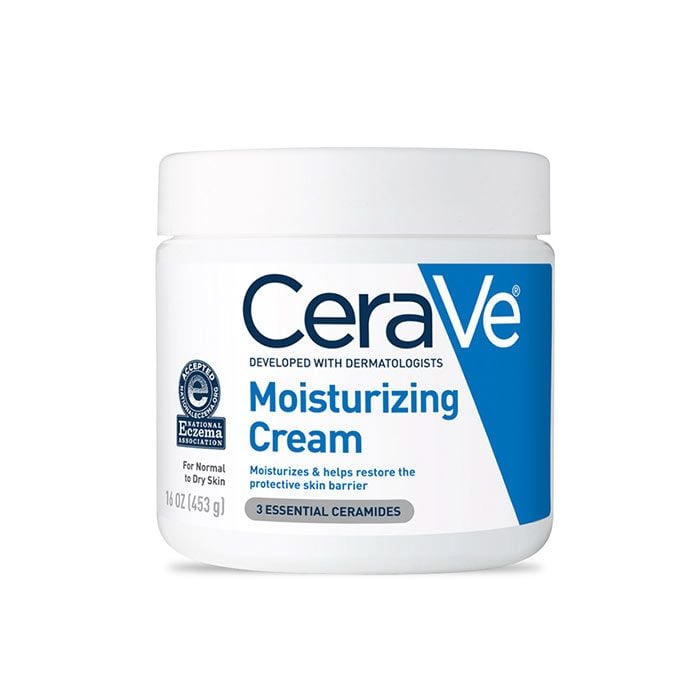
CeraVe Moisturizing Cream is a thick, fragrance-free cream for face and body whose whole pitch is a short ingredient list: three ceramides, hyaluronic acid, petrolatum and dimethicone in a base the brand calls MVE Delivery Technology. The 16 oz tub cost $15.97 at Amazon on 2026-09-19 — In Stock, sold and fulfilled by Amazon — and cerave.com carries the cream at $14.99 on a page that prints no size. L'Oréal owns the brand; the formula is positioned for normal to dry skin, ages three and up, face and body, day or night.
Nearly every claim on the tub checks against a record anyone can open: the ingredient list against the ceramide advertising, the seal against the National Eczema Association's published entry rules, the benzene headlines against the FDA's own recall list. The ceramide story holds. The controlled-release claim has no published test behind it. And the money question is simpler than the marketing — one formula in four containers, where the container, not the chemistry, moves the price.
Our verdict
Buy the $15.97 16 oz tub for dry face-and-body skin; the printed formula carries the ceramide story, and 16 ounces runs about $1.00. Skip it for oily or acne-prone skin — CeraVe points that skin to a lighter lotion.
- A good fit for
- Dry to normal skin on face and body, ages three and up, that needs a fragrance-free daily cream and doesn't mind scooping from a jar.
- We would skip it if
- Oily or acne-prone skin — CeraVe's FAQ steers that skin type to its oil-free lotion — plus pump-bottle preferers and anyone treating a diagnosed condition that needs more than a moisturizer.
Reasons to consider it
- The ingredient list backs the advertising: Ceramide NP, Ceramide AP and Ceramide EOP all print, alongside sodium hyaluronate, petrolatum, cholesterol and phytosphingosine — and no fragrance anywhere in the list
- Four containers of one formula make a clean price ladder: $1.69 an ounce for the 8 oz tube, about $1.00 for both 16-ounce formats, $0.94 for the 19 oz jar
- The NEA seal's published rules require a fragrance-free formula and a clinical safety test per formula, and HSA/FSA eligibility is printed beside it
The compromises
- An open jar invites fingers: the National Eczema Association's moisturizer guidance suggests scooping cream out with a clean spatula instead of your hands, a discipline a tube or pump spares you
- Ceramide doses stay private: seal applicants file exact concentrations with the NEA, but the public reads a presence claim on the label
- The MVE 24-hour controlled-release figure exists only in the brand's FAQ wording, with no test data published anywhere on the site
What we have not verified: Ceramide concentrations are printed on no page — product, listing or FAQ — so 'three essential ceramides' can be checked for presence only, not for dose. Amazon's bullet copy names 'ceramides 1, 3 and 6-II' while the maker's ingredient list prints NP, AP and EOP, and no page fetched maps one naming scheme to the other. The cerave.com page prices the cream at $14.99 without printing an ounce count, so the 16 oz identity rests on the Amazon listing alone. The NEA's public product directory did not show this cream on its first page, leaving the seal claim to CeraVe's page. Stock depth has swung between checks — the listing has shown both a 'Only 7 left in stock' banner and a first-party In Stock offer — so availability deserves a fresh look at purchase time.
The things in this guide
A closer look at the products, who they may suit, and what to check before buying.
Moisturizing Cream (16 oz jar)
$15.97 at Amazon on 2026-09-19 — In Stock as Amazon's own offer — covers 16 ounces of a fragrance-free, non-comedogenic cream whose printed ingredient list carries the three ceramides, sodium hyaluronate and petrolatum the label advertises, with the NEA Seal of Acceptance printed beside them.
Before you buy: A jar you scoop by hand, ceramide doses printed nowhere, and the 24-hour MVE release claim has only the brand's wording behind it. Oily or acne-prone skin belongs in CeraVe's lighter oil-free lotion.
Price checked September 19, 2026. Retailer prices can change.The label against the ceramide advertising
The ingredient list settles more than the advertising does. It prints CERAMIDE NP, CERAMIDE AP and CERAMIDE EOP — exactly three ceramides, no more — alongside SODIUM HYALURONATE where the marketing says hyaluronic acid, plus petrolatum, cholesterol, phytosphingosine and dimethicone. Amazon's bullet copy for the same tub names them 'ceramides 1, 3 and 6-II,' an older naming scheme; CeraVe's own pages print only the INCI names, with no crosswalk across the two. What nothing prints is how much: concentrations appear on no page checked — not the product page, the listing, nor the FAQ, so 'three essential ceramides' verifies as presence, and stops short of dose.
CeraVe's FAQ describes ceramides as substances skin already contains — they keep moisture in, keep irritants out, and repair the barrier — and pegs that barrier at 50 percent ceramides, 25 percent cholesterol, 10 to 25 percent fatty acids. The National Eczema Association's moisturizing guide runs parallel: barrier creams are 'infused with lipids and ceramides,' naturally occurring substances in healthy skin barriers that lock moisture in while keeping impurities out. Two independent wordings, one direction. The pitch amounts to replacing what the barrier is built from, and the list confirms the replacement parts are in the jar.
MVE Delivery Technology is where the wording outruns the record. The FAQ defines it: a patented multivesicular emulsion that releases key ingredients slowly over time, and keeps working 'up to 24 hours after application.' The product page repeats it as continual release for long-lasting hydration. Both are maker statements — no test result, release curve or comparison sits behind them on the site. The footer holds the legal lines: MVE is a registered trademark of DFB Technology, Ltd., patented under No. 6,709,663, and CeraVe does not treat underlying skin conditions. A board-certified dermatologist's recommendation — Dr. Tiffany Clay, printed verbatim — rounds out the page, and the 24-hour figure stays a brand claim.
Fragrance-free and the seal, as printed
Fragrance-free has a definition on CeraVe's FAQ, and it is stricter than 'unscented': absolutely no fragrance, whereas a product labeled unscented may carry subtle masking fragrances. The line extends brand-wide — all CeraVe products are fragrance-free and non-irritating, so the FAQ reads — and this cream adds allergy-tested to its page. Non-comedogenic appears as 'won't clog pores,' with the FAQ conceding that only the majority of the product line carries the label and directing readers to each product page; this one's page carries it. The page also prints HSA/FSA eligibility for health-account spending.
The NEA Seal of Acceptance has published entry rules, and they describe a screen rather than a prize. Applicants must be fragrance free, must contain nothing on the association's Ecz-clusion List of known irritants and allergens, and must hold one clinical safety test per formula — a human repeat insult patch test, a cumulative irritation test, or a safety-in-use study. Exact ingredient concentrations get filed with the application. The association states it earns nothing from product sales. Read that way, the seal tells you the formula passed a skin-safety screen under fragrance-free rules — a meaningful floor for sensitive skin, and no ranking of this cream against any other.
Jar, tube, pouch: the per-ounce ladder
Four Amazon listings sell the same cream in four containers, and their spec tables name the formats. The 8 oz listing is a Tube at $13.52. The 16 oz is a Jar at $15.97, first-party at Amazon. The new 16 oz Refill is a Pouch at $15.99 against a $17.99 list price. A 19 oz Jar rounds it out at $17.80. Divided out, the tube costs $1.69 an ounce, both 16-ounce formats land at a dollar, and the 19 oz jar edges lowest at 94 cents. The formula does not change between them — the container does.
CeraVe's own store prices tell the same story with one wrinkle: the tub page lists $14.99 and prints no size anywhere, so the ounce count lives on the retailer's listing rather than the brand's page. The refill page prices at $17.99 and pitches '-75% less plastic vs 16oz jar' as the format's reason to exist; Amazon's $15.99 undercuts it by two dollars. The ingredient list reads identically in both places. Between jar and pouch at Amazon prices, the choice is two cents and a plastic question, not a formula one.
The benzene record, product by product
The benzene stories around this brand are real and about other bottles. In March 2024 the independent laboratory Valisure petitioned the FDA to investigate and withdraw benzoyl peroxide acne products, reporting that heated BPO can form benzene at over 800 times the FDA's conditional 2 ppm limit; its screening covered 175 acne products, and the 76 without benzoyl peroxide — salicylic acid and adapalene formulas — showed no detectable benzene or levels under 2 ppm.
A lawsuit landed nine days later. A proposed class action filed in Louisiana on March 15, 2024 — Grossenbacher v. L'Oréal USA — names two CeraVe benzoyl-peroxide washes, the Acne Foaming Cream Cleanser and the Acne Foaming Cream Wash, alleging their active degrades into benzene at harmful levels and citing the WHO's no-safe-level advice and the FDA's 2 ppm recall threshold. Both products are acne treatments; the Moisturizing Cream is not a party to the suit.
A year later the FDA's record fixed the scope. Testing 95 benzoyl peroxide acne products, the agency found more than 90 percent with undetectable or extremely low benzene; six BPO treatments were recalled at the retail level — L'Oréal's La Roche-Posay Effaclar Duo among them, plus two Walgreens items, two Proactiv items and SLMD's lotion — and Zapzyt recalled its gel separately. The agency's risk statement: even with daily use for decades, the cancer risk from the benzene in these products is very low, and the recalls instructed retailers, not consumers. Every recalled item is a benzoyl peroxide acne treatment; Moisturizing Cream prints none and appears on no list, so a recall claim about this tub has no record behind it.
Who should skip it
CeraVe's own FAQ writes part of the skip list. Oily or acne-prone skin gets steered to the oil-free Daily Moisturizing Lotion instead of this rich cream. Children under three go to the Baby Moisturizing Cream, a pediatric-dermatologist formula. And the footer's disclaimer — CeraVe does not treat underlying skin conditions — draws the medical line: eczema, psoriasis or any diagnosed condition needs a treatment plan, with a cream like this in support, not in charge. Anyone wanting scent should look elsewhere; this formula contains none by definition.
The jar itself is the last trade. Eczema-association guidance suggests scooping moisturizer out with a clean spatula rather than fingers, and patch-testing new products with a pea-sized amount before committing. A tub invites the opposite routine: open lid, dig in, close lid. The 8 oz tube answers the hygiene question at the steeper per-ounce price above, and a pump answers it in a format this anchored 16 oz listing doesn't offer — it ships a jar. The free-sample offer printed on the product page is the cheap way to test tolerance before any tub-size money moves.
How we put this together
Built from the product pages and listings below, without test scores or results we have not measured. Specifications and prices change, so check the original page for the exact model, current price, delivery, and returns.
- CeraVe: Moisturizing Cream product page (opens in a new tab)
- CeraVe: Moisturizing Cream Refill product page (opens in a new tab)
- CeraVe: FAQs page (opens in a new tab)
- Amazon: CeraVe Moisturizing Cream 16 Ounce listing (ASIN B07XP8K162) (opens in a new tab)
- Amazon: CeraVe Moisturizing Cream 16oz Refill listing (ASIN B0FH7FPFPB) (opens in a new tab)
- Amazon: CeraVe Moisturizing Cream 8 Fl Oz listing (ASIN B087GNBPXT) (opens in a new tab)
- Amazon: CeraVe Moisturizing Cream 19oz listing (ASIN B00TTD9BRC) (opens in a new tab)
- National Eczema Association: Seal of Acceptance application page (opens in a new tab)
- National Eczema Association: Moisturizing for Eczema guide (opens in a new tab)
- FDA: Limited number of voluntary recalls initiated after FDA testing of acne products for benzene (drug alert, 3/11/2025) (opens in a new tab)
- FDA: Frequently Asked Questions on Benzene Contamination in Drugs (opens in a new tab)
- Valisure: Valisure Detects Benzene in Benzoyl Peroxide announcement (March 6, 2024) (opens in a new tab)
- ClassAction.org: Certain CeraVe Acne Treatments Contain Harmful Levels of Benzene, Class Action Says (opens in a new tab)
- CeraVe: Daily Moisturizing Lotion product page (opens in a new tab)