Product image supplied by the brand
In this guide
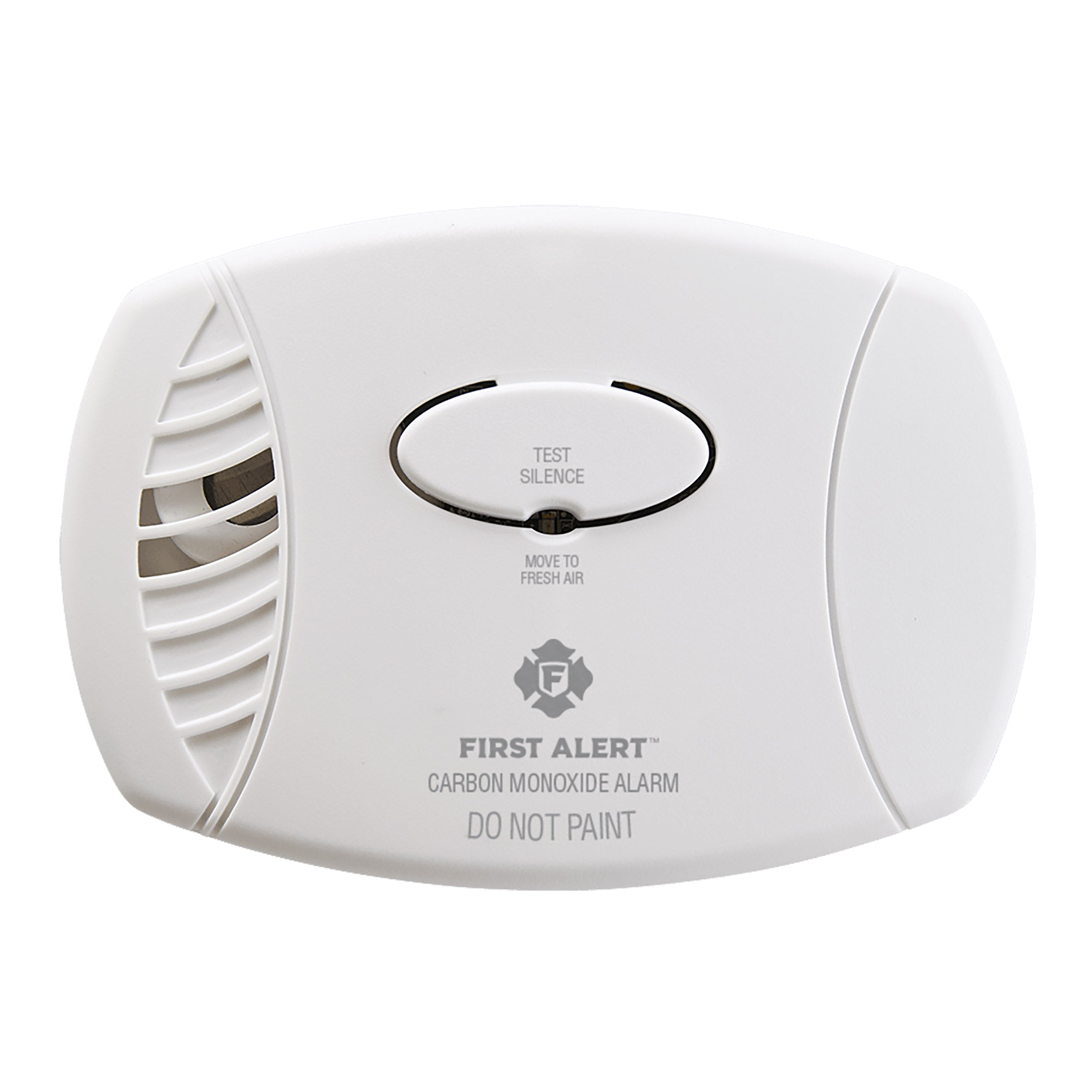
First Alert's Battery Powered Carbon Monoxide Alarm, model CO400, is priced at $24.99 on firstalert.com under SKU CO400XP, and the same page offers a second $24.99 SKU, CO400-3, plus a sold-out base SKU at $21.99. When we checked, the CO400XP variant showed an 'Add to cart' button next to a note that it was backordered and would ship once back in stock. The specification rows describe an electrochemical sensor, one replaceable 9V battery, an 85 dB horn measured at 10 feet, a housing of 5 by 3.4 by 1.5 inches at 0.7 lb, and a warranty row reading '7 Years Limited'.
The user's manual linked from the page holds most of the detail: the UL 2034 alarm points, the signal patterns for alarm, low battery, malfunction and end of life, the wall-mounting steps, and the NFPA placement recommendations. This article reports only what First Alert prints. Where a CO alarm goes, how many a home needs, and whether a battery-only unit satisfies the rules for a given room are matters for local code, the manual, and an inspector; a desk review like this one cannot stand in for a professional inspection.
Our verdict
The CO400 is the plainest carbon monoxide alarm First Alert currently prices, and it makes sense where a wall-mounted, battery-only unit with no readout is what local code and the manual allow; the cost of that simplicity is a 9V battery you replace on a schedule and an alarm the manual tells you to retire after five to seven years.
- A good fit for
- A household after an inexpensive CO alarm for a wall location where a plug-in unit is impractical, and who are prepared to press the test button weekly and swap a 9V battery when the low-battery chirp starts.
- We would skip it if
- You want a ppm readout or peak-level memory, you would prefer a sealed ten-year battery, your jurisdiction requires interconnected or hardwired CO detection, or you need the unit soon, since the $24.99 CO400XP SKU was backordered on firstalert.com when we checked.
Reasons to consider it
- Electrochemical CO sensor and an 85 dB horn, with the manual stating the alarm is listed to UL 2034 and printing that standard's required alarm points
- Standard 9V battery that the user replaces, with three named acceptable replacements in the manual and an 'Easy Access Battery Compartment' entry in the feature row
- Distinct chirp patterns for low battery (1 per minute), malfunction (3 per minute) and end of life (5 per minute), each paired with a red LED, laid out in the manual
The compromises
- No digital display, no peak-level memory and no interconnect; First Alert's CO615 and CO710 add a readout at $39.99 and $54.99
- The manual's record page says to replace the alarm 5 years after installation while also stating the end-of-life signal sounds at approximately 7 years, and the warranty row reads '7 Years Limited'
- Battery-only power means the manual's warning applies in full: remove the battery or let it run down and the alarm gives no protection, and the low-battery warning is rated to last only about 7 days
What we have not verified: The listing offers two purchasable SKUs at $24.99, CO400-3 and CO400XP, without stating how they differ; the base CO400 SKU at $21.99 was sold out. The 'Listed to UL 2034 Standard' row appears only in the specification block for the six-pack SKU CO400B6CP, so for CO400XP the UL 2034 statement is taken from the manual, which carries a 06/15 print code. A 'Works with First Alert App' label sits on the listing, but neither the page nor the manual describes any app function for this model. Color is read from the product photographs; no text on the page states it. The manual's five-year replacement note and its seven-year end-of-life figure are reported as printed, without a resolution.
The things in this guide
A closer look at the products, who they may suit, and what to check before buying.
Battery Powered Carbon Monoxide Alarm (CO400)
Among First Alert's carbon monoxide alarms showing a price when we checked, the CO400 at $24.99 was the least expensive, and it is the only one in that group that runs on a user-replaced 9V battery with no cord and no display.
Before you buy: It has no readout, no interconnect and no sealed battery, the manual puts its service life at five to seven years, and the CO400XP SKU was backordered.
Price checked September 11, 2026. Retailer prices can change.What $24.99 Buys On firstalert.com
The CO400 page lists nine variants, but only two carried a price and an available flag in the store feed when we checked: CO400-3 and CO400XP, both at $24.99. The original CO400 SKU was $21.99 and sold out, the six-pack CO400B6CP showed $0.00 and sold out, and five numeric SKUs were in the same state. The page does not say what separates CO400-3 from CO400XP, and the specification blocks for the two are identical apart from the UPC. The CO400XP variant, which the URL above selects, showed 'Add to cart' and a backorder notice at the same time.
First Alert's short description says the alarm 'utilizes an electrochemical carbon monoxide sensor', is battery operated 'making it portable and easy to use, even in the event of a power outage', and sounds 'a loud 85-decibel alarm' when CO levels become elevated. The specification rows for CO400XP give the model as CO400, the type as Carbon Monoxide Alarm, the sensor as Electrochemical, the power source as Battery Operated, the battery as one 9V, 'Battery Replaceable: Yes', sound level 85dB at 10 feet, height 1.5 in, length 5 in, width 3.4 in, weight 0.7 lb, features 'End-of-Life Warning; Easy Access Battery Compartment', UPC 194160015650, and warranty '7 Years Limited'. A 'Similar Models' row names two Kidde units, KN-COB-B-LS and KN-COB-LP2.
The Electrochemical Sensor And What The Manual Says About UL 2034
The manual describes the CO400 as having 'a permanently installed sensor and an 85 dB alarm horn' plus a silence feature, and it opens its basic safety list with a capitalized reminder that the unit is not a smoke alarm and is 'NOT designed to detect smoke, fire, or any other gas'. Under 'Standards' it cites 'Underwriters Laboratories Inc. Single and Multiple Station carbon monoxide alarms UL2034' and quotes Section 1-1.2 of that standard on the sources a CO alarm is intended to respond to. On the listing, the row 'Approvals and Standards: Listed to UL 2034 Standard' appears in the block for the six-pack SKU only, so for the single-unit SKUs the standards statement rests on the manual.
The manual prints the UL 2034 required alarm points: at 400 ppm the alarm must sound between 4 and 15 minutes, at 150 ppm between 10 and 50 minutes, and at 70 ppm between 60 and 240 minutes, with a footnote that the unit is designed not to alarm at a constant 30 ppm for 30 days and 'is not formulated to detect CO levels below 30 ppm typically'. It also lists the gases the unit was UL tested against for false-alarm resistance, including methane at 500 ppm and carbon dioxide at 5000 ppm. The audible alarm is specified as 85 dB minimum at 10 feet. What those thresholds mean for a particular household is a question the manual directs to emergency services and a qualified appliance technician, and this article does not add to that.
The 9V Battery, The Chirp Patterns, And How Long The Unit Is Meant To Last
One 9V battery comes in the box; the manual's installation steps are to push and lift the battery door, snap the battery onto the terminals, close the door, and hold the Test/Silence button until the horn gives an acknowledging chirp followed by 4 beeps, a pause, and 4 beeps. Acceptable replacements are named as Duracell MN1604, Energizer 522 and Ultralife U9VL-J-P, and the manual says not to use rechargeable batteries. The maintenance schedule is a weekly test with the button and a monthly vacuum of the cover with a soft brush, with no water, cleaners or solvents.
The signal table separates four states by chirp count and LED: the power light flashes once a minute with the horn silent in normal operation; a low battery is one chirp per minute with a red flash and is rated to last up to 7 days; a malfunction is 3 chirps per minute; and end of life is 5 chirps per minute, both of the last two meaning the alarm 'needs to be replaced'. The end-of-life chirp can be quieted with the button for about 2 days at a time. The record page then says to 'Replace alarm 5 years after installation' and, two lines later, that the end-of-life signal sounds 'approximately 7 years after installation'. The manual does not reconcile the two figures, and the warranty row on the listing is '7 Years Limited', so a buyer is left with a five-year instruction, a seven-year signal and a seven-year warranty.
Placement Wording, Wall Mounting, And The Seven-Year Warranty
The manual's placement section quotes the NFPA recommendation that a CO alarm 'should be centrally located outside of each separate sleeping area in the immediate vicinity of the bedrooms', adds bedroom, per-level and 20-feet-from-the-furnace guidance for single-level and multi-level homes, and gives a separate list for mobile homes. Its 'do not locate' list includes garages, kitchens and furnace rooms, spots within 5 feet of a cooking appliance or 10 feet of a shower or humidifier, temperatures below 40 F or above 100 F, turbulent air near fans and vents, and direct sunlight. All of that is the manufacturer's wording; which lines apply to a given wall is for local code, the manual and an inspector to settle.
Mounting is wall-only in the manual: choose a spot no closer than 4 inches to the wall-ceiling junction, mark the keyholes with the template, drill with a 3/16 inch bit, tap in the plastic anchors, leave the screw heads 1/8 inch proud, and slide the alarm on until it clicks. The listing's accessory photo shows the screws and anchors packed with the unit. The manual's warranty section comes from BRK Brands, which makes First Alert products: a seven-year limited promise covering faults in how the alarm was made, with repair or replace at BRK's option using new or remanufactured parts, valid for the original retail purchaser with a sales receipt, not transferable, and excluding normal wear, misuse and the battery itself, for which BRK makes no warranty at all.
When To Skip The CO400
Skip it when you want to see a number: the CO400 has no display, and First Alert's CO615XP plug-in with digital display was $39.99 and the CO710XP with a 10-year sealed battery and a temperature display was $54.99 on the same collection page. Skip it when your jurisdiction calls for interconnected or hardwired CO detection, because this unit has neither and the manual describes it as a single-family residential alarm that is not a substitute for a detection system in buildings that house many people. Set it aside as well if you would rather not track a 9V battery; the sealed-battery CO710 exists for that reason, at more than twice the price.
It is also a poor fit for anyone unwilling to replace the whole alarm on the manual's schedule, since the five-year replacement note and the seven-year end-of-life chirp both end in a new purchase, and the $24.99 CO400XP SKU was backordered when we checked. For a wall location that local code and the manual permit, where a plain battery alarm with a test button and a known chirp table is enough, the CO400 is the least expensive CO alarm First Alert had priced, and its seven-year warranty runs as long as the signal that tells you to retire it.
How we put this together
Built from the product pages and listings below, without test scores or results we have not measured. Specifications and prices change, so check the original page for the exact model, current price, delivery, and returns.
- First Alert: Battery Powered Carbon Monoxide Alarm, CO400 (opens in a new tab)
- First Alert: CO400 User's Manual (English and Spanish, PDF) (opens in a new tab)
- First Alert: Carbon Monoxide Alarms collection (opens in a new tab)
- First Alert: storefront product feed (opens in a new tab)