Product image supplied by the brand
In this guide
The Fitbit Inspire 3 sells on the Google Store for $99.95 in Midnight Zen, Lilac Bliss, and Morning Glow. The listing leans hard on two numbers: a battery claim of up to 10 days and a water protection rating of 5 ATM. Behind those two numbers is a software split that decides whether $99.95 is the whole cost or the first payment.
The store listing, the tech specs page and the Google Health Premium page between them carry the device figures below, and Google's own footnotes say the heart-rate, blood-oxygen, sleep and stress features are not intended to diagnose or treat any medical condition.
Our verdict
Buy the Inspire 3 for what the Base tier shows without paying: steps, heart rate, sleep stages, SpO2, HRV, and breathing rate. Treat Premium coaching as a separate $9.99-a-month purchase you can decline after the three-month trial.
- A good fit for
- People who want a small screen-forward tracker with a long battery claim and are comfortable running a Google account and the Google Health app on Android 11+ or iOS 16.4+.
- We would skip it if
- You need built-in GPS, you refuse a Google account, or your main reason for buying is the coaching, in which case the ongoing subscription cost matters more than the tracker price.
Reasons to consider it
- Up to 10 day battery claim on the spec sheet, with a two-hour charge time and both band sizes included in the box.
- The sensor list covers an optical heart rate monitor, red and infrared SpO2 sensors, a device temperature sensor, and an ambient light sensor at a $99.95 price.
- Google's own listing separates Base features from Premium ones, so you can see the free tier before you commit.
The compromises
- No onboard GPS; pace and distance use Connected GPS from your phone.
- SpO2 tracking carries a manufacturer note that it requires more frequent charging, which eats into the ten-day claim.
- The mindfulness library, wellness report PDF, detailed stress breakdown, and Google Health Coach all sit behind the $9.99 monthly membership.
What we have not verified: The battery, heart-rate, SpO2, sleep and stress figures are Google's stated features rather than independent measurements, and the ten-day claim carries Google's own caveat that charging cycles vary with use. The one-year warranty term is documented on two Google pages.
The things in this guide
A closer look at the products, who they may suit, and what to check before buying.
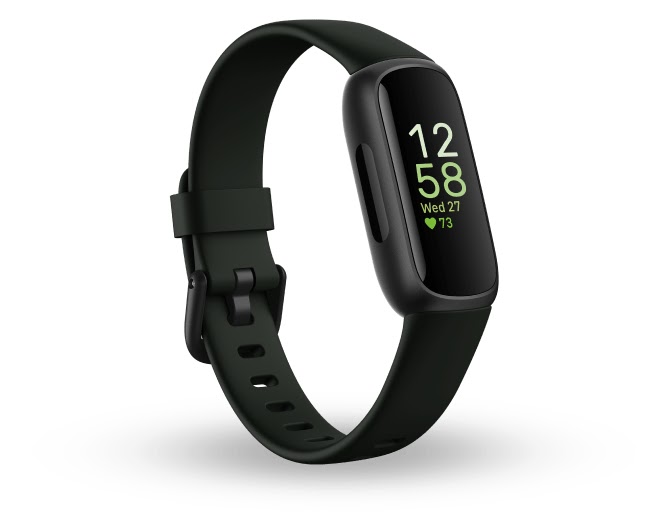
Fitbit Inspire 3
Both wristband sizes come in the box, the sensor list is complete for a screen-and-band tracker at this price, and the Base tier of the Google Health app keeps heart rate, sleep stages, SpO2, HRV, and breathing rate available without a membership.
Before you buy: Coaching, the workout library, most mindfulness sessions, and the wellness report require Google Health Premium at $9.99 per month after the bundled three months.
Price checked September 11, 2026. Retailer prices can change.What $99.95 buys on paper
The spec sheet lists a 3-axis accelerometer, an optical heart rate monitor, red and infrared sensors for SpO2, an ambient light sensor, a device temperature sensor, and a vibration motor. The display is AMOLED under Corning Gorilla Glass 3, the radio is Bluetooth only, and the body weighs 17.69 g at 39.32 mm long by 18.6 mm wide. Memory holds seven days of minute-by-minute motion data and thirty days of daily totals, with heart rate stored at one-second intervals during tracked exercise.
The box includes the tracker, a charging cable, and the Classic wristband in both small and large. Google gives the small band a 5.1 to 7.5 inch wrist range and the large band 6.3 to 8.7 inches, so the usual buy-the-wrong-size problem does not apply here. The band is silicone with a plastic buckle and tang, and Google sells translucent, mesh, and clip accessories separately if you want to move the tracker off your wrist.
Battery and water claims, with Google's own caveats
Google states battery life of up to 10 days and a zero-to-full charge time of two hours on a lithium-polymer cell. The same page adds that battery life and charge cycles vary with use and settings, and recommends charging every few days. Two listed features carry an explicit battery cost: SpO2 tracking says it requires more frequent charging, and the always-on display mode says it may, so a buyer who turns both on should expect something short of ten days.
The water rating is 5 ATM under ISO 22810:2010, which Google describes as water resistant to 50 meters. The fine print is unusually direct: the tracker is not waterproof, resistance decreases over time with wear and repairs, a drop can end it, and the device is meant for shallow water, not high-velocity or high-temperature activity. Google also notes that some Inspire 3 accessory bands are not water resistant at all.
Health features are manufacturer claims, not diagnostics
The listing describes 24/7 heart rate, resting heart rate, high and low heart rate notifications, irregular heart rhythm notifications, SpO2 tracking, skin temperature variation, heart rate variability, breathing rate, sleep stages with a Sleep Score, and a daily Stress Management Score. Each of these is a software feature Google attaches to the sensors above. Google's footnotes say heart rate accuracy is affected by physiology, device placement, and movement, and that the SpO2, HRV, breathing rate, and sleep features are not intended to diagnose or treat any medical condition.
Read those notes as the manufacturer setting expectations. The Inspire 3 is a consumer wellness tracker, not a medical device, and a reading that worries you belongs with a clinician rather than a chart in an app. On the positive side, the Google Health Premium page lists heart rate, heart rate variability, breathing rate and blood oxygen (SpO2) under the Base tier that comes with the app, so the raw feature set stays available if the membership lapses.
Warranty, app, and account requirements
The Fitbit Limited Warranty document covers new Fitbit-branded devices against defects in materials and workmanship for one year from purchase for the original purchaser. The same document sends devices bought on or after July 11, 2023 to the Google Hardware Warranty Center, and that center lists the warranty type for Fitbit-branded hardware as the Google Consumer Hardware Limited Warranty (1 year), so the term is one year whichever side of that date the purchase falls. The Google Store also sells Pixel Care+ for repairs and replacements, added at purchase or within 30 days.
Platform requirements are firmer than the warranty. The Fitbit app is now the Google Health app, setup needs a Google account plus internet access, and the phone must run Android 11 or newer or iOS 16.4 or newer. Syncing uses Bluetooth LE with a stated range of up to 30 feet. Anyone keeping an older phone or avoiding Google accounts is locked out of the device entirely, not just out of Premium.
When to skip the Inspire 3
Skip it if you run or ride without your phone and want pace and distance recorded, because the Inspire 3 has no GPS radio and relies on Connected GPS from a nearby phone. Skip it if a Google account is a dealbreaker, since the Google Health app requires one. Skip it if you expect the ten-day battery while running SpO2 and the always-on display, because Google says SpO2 requires more frequent charging and the always-on display may.
Skip it as a coaching product unless you have priced the membership honestly: $9.99 a month after the three included months, or about $120 a year against a $99.95 tracker. Skip it if you are shopping for anything resembling a medical monitor; Google's own footnotes say the heart, blood-oxygen, sleep, and stress features are wellness information rather than diagnosis. Buy it when a small, long-battery band with the Base tier is the whole plan.
How we put this together
Built from the product pages and listings below, without test scores or results we have not measured. Specifications and prices change, so check the original page for the exact model, current price, delivery, and returns.
- Google Store: Fitbit Inspire 3 overview (opens in a new tab)
- Google Store: Fitbit Inspire 3 tech specs (opens in a new tab)
- Google Store: Google Health Premium (opens in a new tab)
- Google support: Fitbit Limited Warranty (opens in a new tab)
- Google Support: Google Hardware Warranty Center (opens in a new tab)