Product image supplied by the brand
In this guide
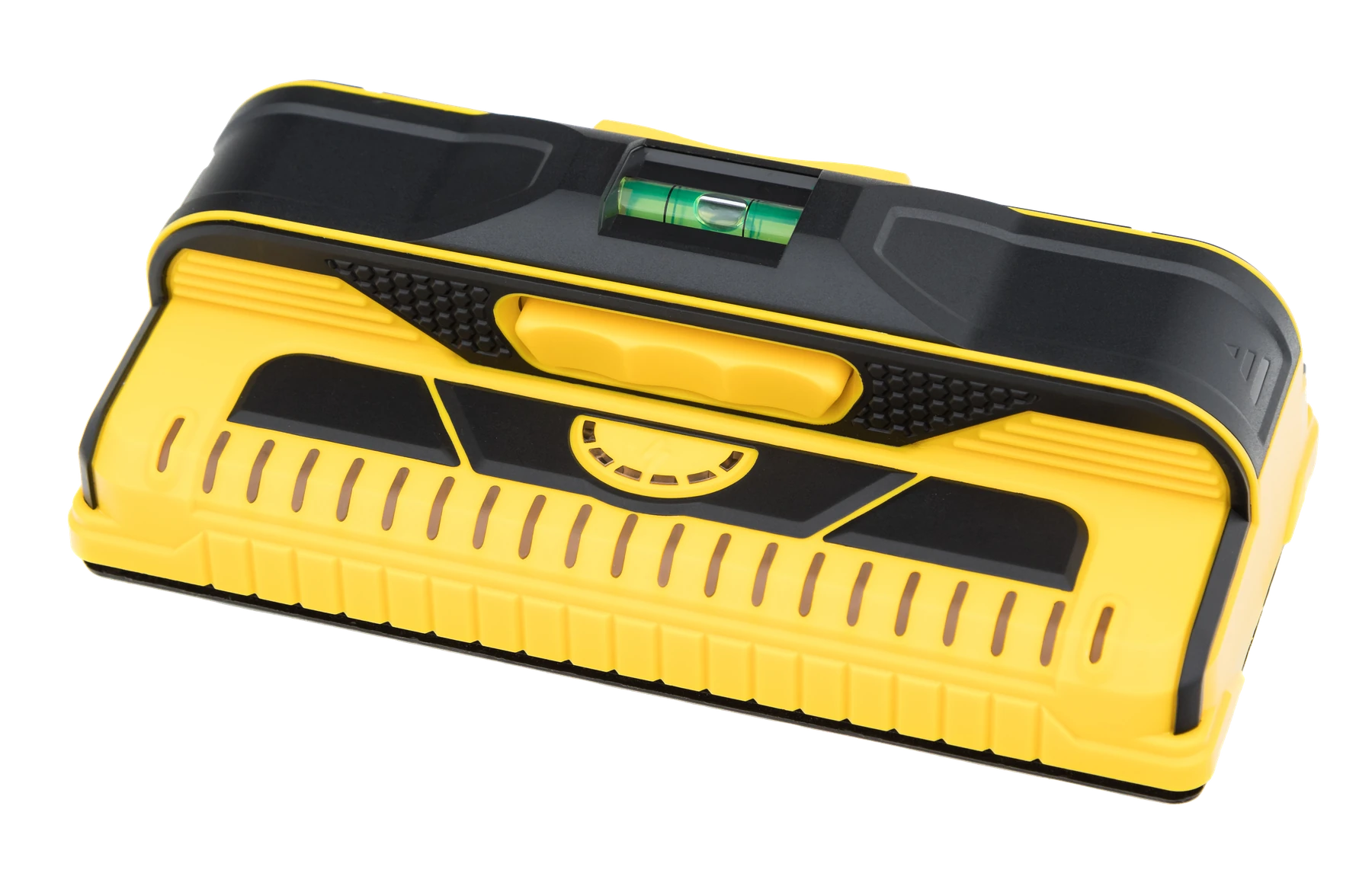
Franklin Sensors' page calls the ProSensor M210 its top-of-the-line stud finder: thirteen sensors reading at once behind a 21-LED strip, a bubble level set into the grip, a pencil caddy and a Live Wire Meter, running on two AA batteries. Franklin's site listed it in stock at $59.99 on September 25, 2026, but its only buy button leaves for Amazon, where the same M210 (ASIN B0917VXLDK) sold for $59.97, shipped by Amazon and sold by Franklin Sensors Inc.
Two cheaper tools answer much the same question. C.H. Hanson's magnetic stud finder, model 3040, listed at $14.96 against a $19.98 regular price that day, while Franklin's own step-down M150 sat at $39.99 with nine sensors and a 1.5-inch depth. Above the M210, Franklin's site also lists a deeper-scanning ProSensor MAX at $119.99.
Our verdict
Buy the $59.99 M210 when one wall needs a full-width stud read and a live-wire check. For a shelf or a cabinet on clean drywall, the $14.96 magnetic 3040 marks the same framing with no batteries.
- A good fit for
- A homeowner hanging one TV, cabinet or shelf run who wants the stud's edges and center in a single pass, plus a wire warning before the drill comes out.
- We would skip it if
- Anyone who only needs to know roughly where the framing is, is working on metallic wallpaper or foil-backed insulation, or needs to scan double-layer drywall, which Franklin assigns to its $119.99 ProSensor MAX.
Reasons to consider it
- Thirteen sensors and 21 LEDs light a stud's edges and center at once, with no calibration step and a stated 1.7-inch detection depth
- The bubble level, pencil caddy and Live Wire Meter are built into the body; the $39.99 M150 lists the wire warning but no level or caddy
- A Limited Lifetime Warranty covering build flaws, with returns to a US address in Meridian, Idaho
The compromises
- $59.99 is four times C.H. Hanson's $14.96 magnetic 3040 — $45.03 more for a full-width read instead of a fastener's point
- The operating instructions warn that foil-backed insulation, metallic wallpaper, tile, roofing and exteriors can defeat the scan, and note that metal mesh in plaster may go undetected
- No published weight, battery life or accuracy test, and Franklin's warranty page publishes no terms; the sheet itself admits the finder's function is not guaranteed
What we have not verified: Franklin publishes no accuracy test, weight or battery-life figure for the M210, and its sheet says metal-mesh plaster may go undetected and does not mention double-layer drywall. The $14.96 magnetic alternative is overstock clearance in limited quantities; Amazon, the M210's only sales channel, sold it at $59.97 on 2026-09-25.
The things in this guide
A closer look at the products, who they may suit, and what to check before buying.
ProSensor M210 Stud Finder · M210
Thirteen sensors and 21 LEDs show a stud's edges and center in one pass with no calibration, the bubble level and pencil caddy are on the body, and on September 25, 2026 Franklin listed it at $59.99 while Amazon, where its buy button leads, sold it for $59.97. The Live Wire Meter is a safety check the $14.96 magnet does not offer.
Before you buy: Four times what C.H. Hanson charges for its $14.96 magnetic 3040; foil-backed insulation, metallic wallpaper, tile and metal-mesh plaster can defeat it, the operating sheet says; no published weight, battery life or accuracy test.
Price checked September 25, 2026. Retailer prices can change.The price gap is a multiple of four
Franklin Sensors listed the M210 in its page's own product data at $59.99 on September 25, 2026, marked in stock, SKU M210. There is no cart: the page's only purchase button leaves for Amazon's listing for the same model, ASIN B0917VXLDK, which showed $59.97 that day with Franklin Sensors Inc. as the seller and Amazon handling shipping and free returns.
C.H. Hanson's magnetic 3040 came in at $14.96 against a $19.98 regular price that day, so the M210 costs four magnets' worth: $45.03 more at Franklin's figure.
What thirteen sensors put on the wall
The M210 reads with 13 sensors and reports through 21 LEDs, and Franklin puts its detection depth at 1.7 inches. The strip shows the full width of a stud, not a single point, so the edges and the center appear in one pass; on the models that carry it, the middle LED turns green at the center.
Nothing needs calibrating first. Hold the button down and keep your fingers on the handle — the operating sheet warns against touching the detector outside the handle area — and the LEDs flow toward the center as soon as the unit has power. The Live Wire Meter runs for as long as the button is held, its yellow LEDs lighting in sequence as the electrical field strengthens.
The level and the caddy come attached rather than carried. Franklin built a bubble level into the top grip and a pencil caddy into the housing. The sheet names 2 AA batteries as the power source and never gives a weight.
Where the manual hedges
Franklin's sheet says the finder sees up to 1.7 inches and therefore works on most lath and plaster walls. Past that depth detection is not guaranteed, and the sheet adds that the finder may not be able to detect plaster carrying metal mesh reinforcement.
Three more exclusions sit in the same column of text. Foil-backed insulation can cause inconsistent readings 'with all electronic stud finders, including the ProSensor'; wallpaper with metallic content can block the detector's signals; and tile, flooring, roofing and exterior materials vary too much in thickness and density for detection to be guaranteed.
Heavy texture and wall irregularities light the LEDs too, so the sheet prescribes a test, not a setting. Keep the button down and scan up and down: a stud holds the LEDs steady while an irregularity flickers, and the same move separates pipes and wires from framing. Stay 3 in / 7 cm from wood trim, outlets and switches, and turn the unit vertical to hunt fire blocks.
The $14.96 magnet and what it refuses to do
C.H. Hanson's 3040 finds studs a different way. Rare-earth magnets lock onto the screws and nails that hold drywall, plaster and paneling to the framing, so it reads wood and metal studs alike, never needs batteries, and carries a rotating level for marking lines. Hanson lists 0.15 lb with CN as the origin, and a limited lifetime warranty against defects.
A magnet marks where a fastener sits: a point on the wall, not the 1.7-inch read of a stud's edges and center the M210 gives, and nothing in the $14.96 tool warns about live wires — the Hanson page lists no electrical detection at all. For a single bracket on clean drywall the point is enough, and it is $45.03 cheaper.
The low price comes with fine print. Hanson flags the $14.96 as an overstock clearance item that cannot be combined with other promotions or discounts, with limited quantities; the $19.98 regular price is the figure that remains once that stock is gone.
Franklin's $39.99 step-down and $119.99 step-up
The ProSensor M150 sat at $39.99 on Franklin's own page the same day, with its buy button also pointing at Amazon. It reads with 9 sensors through 15 LEDs at a stated 1.5-inch depth, and Franklin credits it with showing double-stud width. Its manual lists 2 AAA batteries and a Live Electrical Warning that lights one yellow lightning-bolt symbol, where the M210's Live Wire Meter lights its yellow LEDs in sequence as the signal strengthens.
Twenty dollars buys the difference: four more sensors, six more LEDs, two tenths of an inch of depth, and the bubble level and pencil caddy, neither of which appears on the M150's page or in its manual's parts list. Anyone wanting the level built into the tool has to go up a model, not down.
Above the M210 sits the ProSensor MAX, $119.99 on Franklin's site and also sold through Amazon: 13 larger sensors, 35 LEDs, a 2.5-inch maximum depth, a built-in bubble level, and a second mode for layered surfaces such as double-layered sheetrock and lath and plaster. The M210 has no such mode; its sheet stops at 1.7 inches.
The lifetime warranty, and the numbers that are missing
Franklin's operating sheet puts a Limited Lifetime Warranty on all its products. Build faults are covered for as long as the tool lasts, the company decides whether to fix or replace the unit, and incidental and consequential damage is excluded. Returns go to 6675 N Pollard Ln, Meridian, ID 83646.
The same sheet also states outright that 'the function of the products is not guaranteed', adding that wood, metal, wiring or other objects behind a surface can go undetected and that the finder does not identify what it lights up on. Franklin's warranty page is bare: its body is two panels headed 'Register your product' and 'Warranty information', and no terms are printed as text.
No accuracy test, weight or battery-life number appears anywhere for the M210, and its sheet is silent on double-layer drywall, which Franklin's layered mode on the MAX is built for. Two AA batteries are named; how long two AA batteries last is not.
How we put this together
Built from the product pages and listings below, without test scores or results we have not measured. Specifications and prices change, so check the original page for the exact model, current price, delivery, and returns.
- Franklin Sensors: ProSensor M210 Stud Finder product page (opens in a new tab)
- Franklin Sensors: ProSensor X2100 & M210 operating/safety instructions (X2100_M210.E, 09/24) (opens in a new tab)
- Franklin Sensors: Warranty page (opens in a new tab)
- C.H. Hanson: Magnetic Stud Finder (sku 3040) product page (opens in a new tab)
- Franklin Sensors: ProSensor M150 product page (opens in a new tab)
- Amazon: Franklin Sensors ProSensor M210 13-Sensor Stud Finder (ASIN B0917VXLDK) (opens in a new tab)
- Franklin Sensors: ProSensor M90, M92, M150 & X990 operating/safety instructions (English, 072525) (opens in a new tab)
- Franklin Sensors: ProSensor MAX Stud Finder product page (opens in a new tab)