Product image supplied by the brand
In this guide
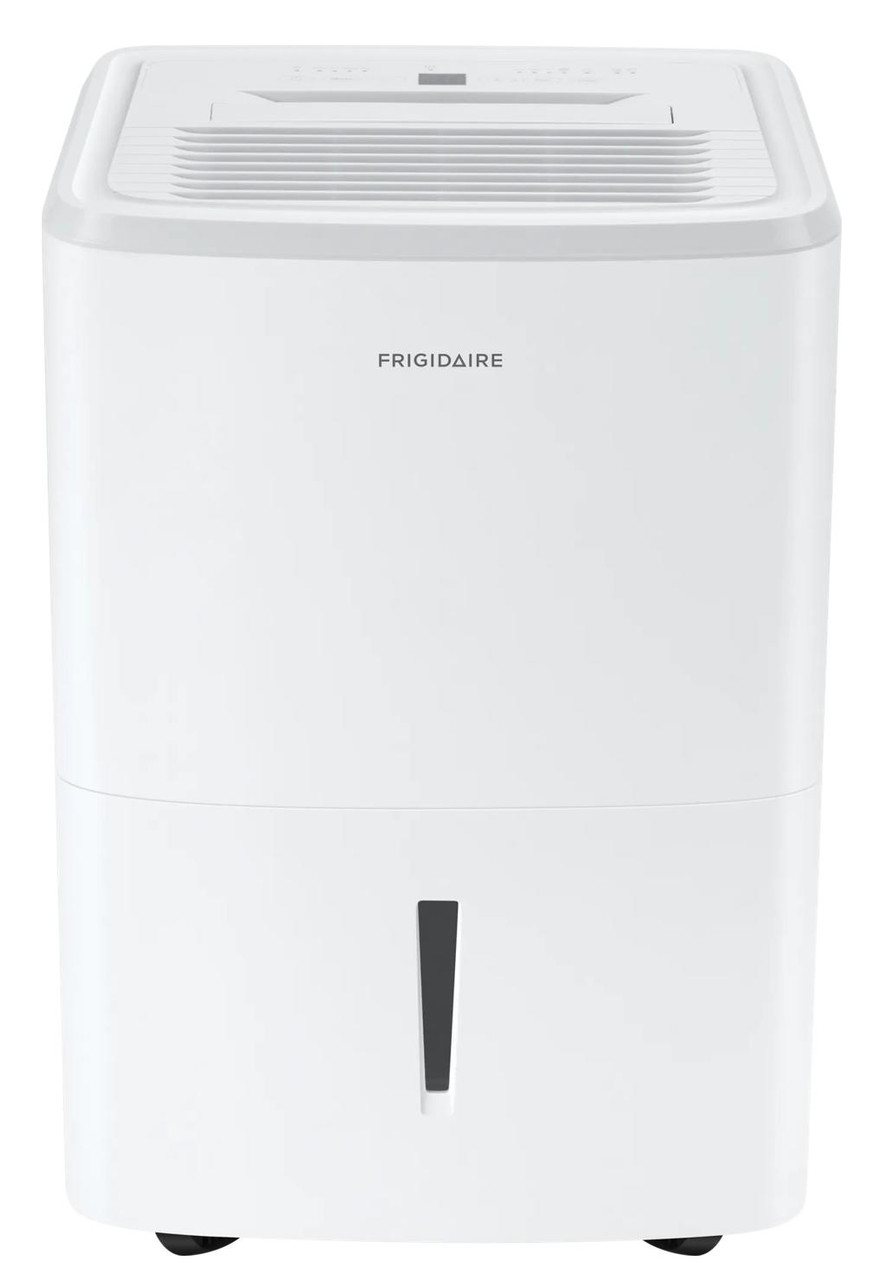
Frigidaire sells the FHDD5034Y1 as a 50-pint, Wi-Fi-equipped, ENERGY STAR certified dehumidifier in one color, white. Abt listed it at $269 on 2026-09-16, Doyon's Appliance at $299.99, and Total Home Supply at $309.00 with an InStock availability flag. The ENERGY STAR record dates the model to August 2025 on the R-32 refrigerant Electrolux is standardizing on — 5.5 ounces of it — and Total Home Supply's copy notes the FHDD5034Y1 replaces the FHDD5034W1, while the earlier FFAD5033W1 no longer returns a row in ENERGY STAR's certified list. The cabinet stands 24.7 inches tall, 15.9 wide, and 12.2 deep, rolls on casters at 41 pounds, draws 470 watts from a 115-volt outlet, and carries a one-year parts-and-labor warranty.
Three readings decide the purchase. Capacity first: the 50-pint label is 49.71 pints a day under DOE's current basement-temperature test, the number ENERGY STAR publishes, and it lands at the top of EPA's sizing table for a genuinely wet space over 2,000 square feet. Drainage second: there is no pump, so water leaves in a 21.6-pint bucket or through a gravity hose that needs somewhere lower to go. Power third: 521 kWh a season is a real line on a bill — $95.55 at the June 2026 national average residential rate. The modes, the app, and the washable filter arrange themselves around those three.
Our verdict
Buy the $269 FHDD5034Y1 for a damp basement or a wet floor over 2,000 square feet when a drain sits below the unit; its 49.71 DOE pints are genuine capacity, and drainage is bucket or gravity hose, never a pump.
- A good fit for
- A wet basement or damp main floor over 2,000 sq ft with a floor drain or sump below the hose run, someone willing to wheel 41 pounds, and app control wherever the home Wi-Fi reaches.
- We would skip it if
- Small, lightly damp bedrooms belong to 20-30-pint units; spaces below 41°F are out of spec; and a spot with no drain means hauling a 21.6-pint bucket up to three times daily in wet weather.
Reasons to consider it
- Third-party verification for the headline number: ENERGY STAR's certification record lists 49.71 pints a day under DOE's Appendix X1 test, 521 kWh a year, and an integrated energy factor of 2.01 L/kWh, so the 50-pint class rating has a checkable basis
- Both drainage routes are covered out of the box: a 21.6-pint front bucket with splash guard, handle, and full-tank shutoff, plus a rear connector that takes a standard 1/2-inch-or-larger garden hose for gravity draining
- The controls span real conditions: five modes (Auto, Dry, Fan, Quiet, Continuous), humidity settings from 35% to 85% in 5% steps, a 0.5-to-24-hour delay timer, and app plus Alexa and Google Home command of on/off, humidity, schedules, and fan speed
The compromises
- No pump anywhere in the design: continuous drainage is gravity-only, so the hose must end lower than the rear connector, and without a drain the 21.6-pint bucket fills 2.3 times every 24 hours at the rated 49.71-pint load
- The published noise figures sit above bedroom-quiet — 47, 49, and 51 dB across the three fan speeds in Abt's spec table, while Frigidaire's own manual describes the sounds without a single dB number — and Quiet mode only locks the fan at its slowest speed while the compressor keeps cycling
- Hard boundaries from the manufacturer: the manual requires operation between 41°F and 89°F and 30-80% relative humidity, warranty coverage is functional repairs for one year, and the R-32 charge may only be serviced by certified technicians
What we have not verified: Every capacity and energy figure here traces to ENERGY STAR's certification record and DOE's test procedure; none comes from an independent lab rerun. The 47-51 dB figures live on Abt's spec table rather than in any Frigidaire document, and no fetched source publishes a fill rate for the bucket in a specific basement. App behavior is documented as feature lists and troubleshooting steps, not as long-term reliability, and EPA's own conversion table is labeled a rough correlation whose actual change varies by model.
The things in this guide
A closer look at the products, who they may suit, and what to check before buying.
50-Pint Dehumidifier FHDD5034Y1
ENERGY STAR's own record backs the class rating: 49.71 pints a day on DOE's Appendix X1 test, 521 kWh a year, 2.01 L/kWh, R-32 refrigerant. Five modes cover 35-85% humidity in 5% steps, the Frigidaire app and Alexa or Google Home handle on/off, schedules, and fan speed, the filter rinses clean, and $269 at Abt undercuts the $299.99 and $309 listings for the same one-year parts-and-labor warranty.
Before you buy: Drainage is bucket or gravity hose only — the hose must end below the rear connector. Without a drain, 49.71 pints a day through a 21.6-pint bucket means up to three hauls daily in wet weather; published noise runs 47-51 dB; operation below 41°F is out of spec.
What 50 pints means now: 49.71 under the basement-temperature test
The number on the box is rounded. ENERGY STAR's certification record for the FHDD5034Y1 lists water removal at 49.71 pints per day under the Department of Energy's Appendix X1 test — the procedure in force since June 2019 that tests portable dehumidifiers at 65°F instead of 80°F. EPA's own explainer says the 15-degree drop was meant to mirror basement conditions, and that cooler air holds less water to remove, which is why capacity ratings shrank when the change reached store listings in 2020.
That history reads old reviews correctly. EPA's rough conversion table puts a 70-pint machine from 2019 or earlier at 40-45 pints under the new procedure, with 50 old pints mapping to about 30 and 55 to 30-35. A new-machine rating of 49.71 therefore sits above the class shoppers used to call a 70-pinter, on the government's own correspondence — while EPA cautions that the shift varies model by model.
Area follows dampness, not the biggest number on the page. ENERGY STAR's sizing table asks how wet the space is and how big: a slightly to moderately damp large room over 2,000 square feet needs 30+ pints a day, a very damp one needs 40+, and a genuinely wet one — walls sweating or seepage present, 90-100% relative humidity — needs 50+. This machine's 49.71 sits at that top rung, the table's own answer for a wet space over 2,000 square feet, and far more than a musty bedroom requires.
Wetness is also where the job ends. Pulling water vapor from air does nothing about smoke, pollen, or dander; those are particles, and they belong to a filtration appliance rated by CADR with replaceable filters — a different device for a different problem. A damp, musty basement and a smoky living room look similar in discomfort and call for two machines; this one answers only the first.
Bucket, hose, or both: the route the water takes
The bucket holds 21.6 pints — 2.7 gallons — mounts at the front with a handle and splash guard, and the unit stops when it is full and restarts once it is reseated. At the rated 49.71 pints a day, the same bucket fills 2.3 times every 24 hours, which is the real price of running a drainless basement machine at capacity. The manual sets a cleaning rhythm: wash the bucket about every two weeks.
Continuous drainage exists, and it is gravity-only. A garden hose — Frigidaire recommends 1/2 inch (12.7 mm) or larger — screws onto a rear connector once the drain cap comes off, and water follows the hose downhill toward a floor drain or sump, with the manual warning against kinks and elevations along the run. The pump question is answered flatly in the spec sheets: Total Home Supply lists Drain Pump: No, and Abt's table agrees.
Placement is therefore the first decision, before price. A floor drain or open sump below the unit turns this into a set-once appliance; a finished room whose nearest drain sits uphill keeps the bucket in the loop permanently. Casters plus a top handle and side handles make the 41-pound cabinet wheelable to a utility sink, but wheeling it stays a regular errand whenever the weather is wet.
Five modes, 35-85%, and what the app actually adds
The panel runs five modes. Auto picks a humidity target and fan speed from room conditions; Dry accepts a manual target from 35% to 85% in 5% steps with the fan at High, Medium, or Low; Fan moves air without the compressor; Quiet locks low speed and an automatic target for overnight; Continuous, shown as CO on the display, runs without a target for maximum drying. A 0.5-to-24-hour delay timer and a control lock round out the hardware.
Wi-Fi adds remote reach rather than new physics. The Frigidaire app turns the unit on or off, changes the humidity setting, creates schedules, and adapts fan speed, and Amazon Alexa and Google Home cover on/off and speed by voice — the practical win for a basement appliance being a schedule that dries the space before anyone goes down there. After a power cut, the unit returns to its last setting on its own, per the manual.
One certification column needs reading correctly. ENERGY STAR's record marks this model Connected Capable: No — that flag tracks EPA's connected-criteria program, not the presence of Wi-Fi, which the manual's Wi-Fi indicator, FCC-listed radio module, and app troubleshooting rows document directly. Judge the radio by what it controls, which the retailer spec sheets spell out, not by the certification field.
521 kWh a year, 47-51 dB, and a filter that rinses
The electricity is priced in advance. ENERGY STAR's record lists 521 kWh a year at an integrated energy factor of 2.01 liters per kilowatt-hour, and EIA's Table 5.6.A put the June 2026 U.S. residential average at 18.34 cents per kWh: 521 × $0.1834 = $95.55 for a season at rated duty. Local rates scale that line directly — the same year at 28 cents a kWh reaches about $146.
Noise is published where the manufacturer goes quiet. Frigidaire's manual describes the normal sounds — dripping water, rushing air at the top, refrigerant gurgling, compressor chatter — but prints no dB value anywhere; Abt's spec table lists 47 to 51 dB depending on fan speed. Quiet mode locks the fan at its slowest speed while the compressor keeps cycling. For a basement, a workshop, or a laundry-adjacent run that is background hum; against a bedroom wall those are audible numbers.
Maintenance costs rinse water rather than filter money. The dust filter slides out of the back grille and washes clean on the manual's two-week schedule, with a filter light at 250 hours of operation as the backstop; the optional PureAir filter slots into reserved space on the same grille, is sold separately, and cannot be washed. Add the two-week bucket rinse and the one-hour upright rest before first start, and the whole care routine fits on a calendar.
The buy case, and the three exits
Buy it when three conditions hold together. The space is genuinely wet by ENERGY STAR's table — sweaty walls, seepage, 90-100% relative humidity — or a very damp floor over 2,000 square feet. A drain sits lower than the rear connector, or the household accepts 2.3 bucket trips a day at rated load. And the outlet stays above 41°F, the manual's operating floor, which excludes winter crawl spaces and unheated garages. Checkout prices differed by $40 at the same check: $269 at Abt, $299.99 at Doyon's, $309 at Total Home Supply.
Three situations end the purchase. A small or lightly damp room belongs to the 20-30-pint class — ENERGY STAR's own table puts a slightly damp space under 2,000 square feet there, a class this 49.71-pint machine over-serves at a higher power draw. A bedroom install runs into the 47-51 dB published figures. And a wet space with no drain below the unit turns the pump-less design into a daily bucket habit; that is the case for a pump-equipped model instead.
Set it up with the numbers in hand: a 35-85% target in 5% steps for occupied rooms, Continuous mode only when the hose is draining somewhere lower, at least a 1/2-inch hose without rises, a two-week filter-and-bucket rinse, and a season budget near $96 at the current national average rate. If the nearest drain sits uphill, decide the bucket arithmetic before ordering — 21.6 pints per trip against 49.71 a day at rated load.
How we put this together
Built from the product pages and listings below, without test scores or results we have not measured. Specifications and prices change, so check the original page for the exact model, current price, delivery, and returns.
- Frigidaire: FHDD5034Y1 use and care manual (PDF) (opens in a new tab)
- ENERGY STAR: Certified dehumidifiers dataset record for FHDD5034Y1 (opens in a new tab)
- ENERGY STAR: Dehumidifier buying guidance (opens in a new tab)
- ENERGY STAR: Dehumidifier testing and capacity (opens in a new tab)
- Abt: FHDD5034Y1 product page (opens in a new tab)
- Total Home Supply: FHDD5034Y1 product page (opens in a new tab)
- Doyon's Appliance: FHDD5034Y1 product page (opens in a new tab)
- U.S. EIA: Electric Power Monthly Table 5.6.A, average price of electricity by sector (opens in a new tab)