Product image supplied by the brand
In this guide
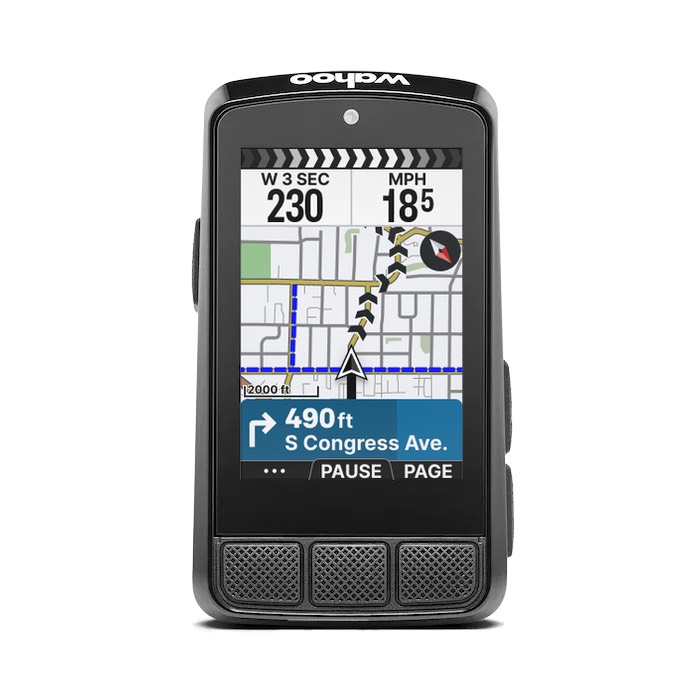
A phone clamped to the bars will record a ride, follow a route and show speed, and on a short ride that may be all it needs to do. The Wahoo ELEMNT BOLT 3 is the $349.99 case for the longer rides: a 2.3 in / 5.8 cm color screen, an 83 x 47 x 24 mm body at 3.0 oz, charging over USB-C, dual-band GPS across GPS, GLONASS, BEIDOU, Galileo, QZSS, SBAS and NavIC, and radios for Wi-Fi, Bluetooth and ANT+. Wahoo sells it direct, and the company's US shop carried it in stock at $349.99 on 2026-10-15.
What a phone gives up first is battery: a screen held awake with GPS locked for a four-hour ride spends the same battery that has to get you home, and Wahoo rates the BOLT 3 at 20 hours on one charge. Sunlight is next, which is why the 2.3 in panel is specified as anti-glare and optimized for bright sunlight. Then the route, with on-device Back on Track, Route to Start and Retrace Route plus Komoot Live Sync for changing a route mid-ride. Last are the radios: Bluetooth and ANT+ pairing for heart rate, power, cadence and radar, where most phones handle Bluetooth on their own and ANT+ only with extra hardware.
Our verdict
Buy the $349.99 ELEMNT BOLT 3 when on-device navigation, sensor data and a screen readable in sunlight matter more than the phone on your bars. Wahoo rates the battery at 20 hours; one FAQ line says 25.
- A good fit for
- Road, gravel and trainer riders who chase routes, power or heart-rate numbers on most rides and would prefer not to spend a phone battery doing it.
- We would skip it if
- Skip it if you ride once or twice a week on familiar roads and finish with a charged phone, or you need electronic drivetrain pairing, an IP rating or a published charge time first.
Reasons to consider it
- Wahoo rates one charge at 20 hours in its specification list and repeats that figure in the model-comparison panel, so a week of hour-long rides fits between USB-C top-ups.
- The 2.3 in / 5.8 cm TFT is specified as anti-glare and built for bright sunlight, with 16 million colors against the ELEMNT BOLT 2's 64-color screen.
- Back on Track, Route to Start and Retrace Route run on the device, and Komoot Live Sync pushes a mid-ride route change without reconnecting anything.
The compromises
- Wahoo's US page leaves out any IP or water-resistance rating, so rain and hose-down exposure sits beside a warranty exclusion for 'excess moisture' rather than a stated number.
- One FAQ answer on the same product page claims 25 hours but the specification list and the model-comparison panel both say 20, and the shared asterisk does not explain the gap.
- Custom waypoints lean on a Strava, Komoot or RideWithGPS premium account, which the computer's price does not cover.
What we have not verified: Wahoo's US product and warranty pages state no water-resistance rating, no charge time and no electronic-shifting support, and those three decide the rain, the pre-ride top-up and the gear display. If the BOLT 3 turns out not to pair with a Di2 or AXS drivetrain, riders who read gears off the computer lose part of the case. Fit of the included out-front mount on bar diameters other than 31.8 mm is likewise undocumented.
The things in this guide
A closer look at the products, who they may suit, and what to check before buying.
ELEMNT BOLT 3
$349.99 at Wahoo Fitness (InStock, checked 2026-10-15) buys on-device Back on Track, Route to Start and Retrace Route, Komoot Live Sync for mid-ride changes, an anti-glare 2.3 in color screen, dual-band GPS, plus radios for Wi-Fi, Bluetooth and ANT+ in a 3.0 oz body Wahoo rates at 20 hours per charge.
Before you buy: No published water-resistance rating or charge time, electronic-shifting support is not listed anywhere, and custom waypoints need a premium Strava, Komoot or RideWithGPS account.
Price checked October 15, 2026. Retailer prices can change.What a phone loses on the bars
A phone does the first hour well. It has the map, the GPS, the screen and a full battery, and a spare battery pack answers the runtime worry for a while. The trouble is that all of it draws on one battery that also has to make a call when the ride ends, and a screen held awake for navigation burns that battery faster than anything else the phone does. The BOLT 3 moves navigation onto a device with its own battery.
The other three differences show up later. Many phones dim as they heat, and a glossy screen flat on the bars collects glare in direct summer sun. A phone reaches a heart-rate strap or power meter over Bluetooth but sits out ANT+ accessories unless an adapter is in the mix. And changing a route mid-ride means stopping, unlocking, and hoping the reroute does not need a data signal. The BOLT 3 is aimed at those three plus the battery question, which is why its price has to be argued against a phone that is already in your pocket.
Twenty hours, and one FAQ line that says 25
Wahoo's battery figure is not clean. Its specification list reads 'Battery Life: up to 20 hours'; the hardware feature block repeats 'Up to 20 Hours of Battery Life'; and the model-comparison panel gives the BOLT 3 column 'Up to 20 hours battery life' against the ROAM 3's 25 and the ACE's 30. Then a FAQ entry below carries a different line: 'longer battery life at 25-hours* for all-day riding.' Three placements say 20 and one says 25.
The 20-hour reading is the one to use. It is the number in the spec field a buyer scans first, it is the number in the comparison column headed by the BOLT 3's own price, and 25 is what the ROAM 3 is rated one column over, which makes the FAQ line look like copy that travelled. Both figures carry the same asterisk, and it only warns that life varies with backlight brightness, GPS settings and the number of connected sensors, so it does not reconcile them. Take 20 hours and treat 25 as an open discrepancy rather than a free upgrade.
Twenty hours is still a different order of thing from a phone. A computer rated for 20 hours covers a long weekend of riding, the daily legs of a multi-day tour, or a month of half-hour commutes between charges, without the phone leaving your pocket. Charging is USB-C, the connector most riders already carry, and a 24 in / 61 cm USB-C cable comes with it. What Wahoo does not publish is a charge time, so planning a top-up before a morning start still has no hours-to-full figure.
The screen is the first thing you check, and the sun decides
The display is 2.3 in / 5.8 cm, specified as a high-resolution TFT with 16 million colors. Wahoo lists it under hardware features as optimized for clarity, especially in bright sunlight, and describes it elsewhere on the page as anti-glare. One FAQ entry supplies the comparison that matters for an upgrade: 16 million colors against the ELEMNT BOLT 2's 64-color screen. Color count is not the point on a bike; the anti-glare treatment and the sunlight claim are.
Readability is where a dedicated computer has a structural advantage. A phone screen is glass, glossy and usually tuned for use in the hand, and held flat on the bars it collects sky and glare. The BOLT 3's panel is specified for direct sun and sits at a fixed angle in front of the rider instead of being handled. The 2.3 in size is a deliberate limit: the ACE gets 3.8 in and the ROAM 3 2.8 in, and the smaller panel is why the BOLT 3 body is 83 x 47 x 24 mm and 3.0 oz.
On-device navigation, and a route you can change mid-ride
Wahoo files three route tools under On-Device Smart Navigation: Back on Track, Route to Start and Retrace Route. The name is the substance, because these run on the computer, so a rider who misses a turn or wants the shortest way home is not depending on a paired phone. Alongside them Wahoo documents SUMMIT climb information that works even without a preloaded route, and Google and Apple Maps route sharing, where a location shared from either app becomes a route on the ELEMNT.
Changing the plan mid-ride is the harder trick, and it is where the ecosystem clause bites. Komoot Live Sync is documented as updating the ELEMNT automatically when a route changes, with no reconnecting. Custom waypoints work differently: Wahoo states that creating personalized routes and waypoints runs through Strava, Komoot or RideWithGPS premium accounts, so the computer can hold and display what those services produce but cannot generate it alone. Storage is 32 GB, which Wahoo describes as increased over the earlier model and is plenty for maps and recorded rides.
The radios, and the pairing Wahoo leaves out
Connectivity is Wi-Fi, Bluetooth and ANT+, and Wahoo names what pairs over the two short-range radios: heart-rate monitors, power meters and power pedals including its own SPEEDPLAY POWER, speed and cadence sensors, and taillight radar such as the TRACKR RADAR. The page also states that the BOLT 3 connects to Zwift, Strava, TrainingPeaks and RideWithGPS, and music and device control runs Spotify, Apple Music, radar, lights and GoPro from the computer. Because the BOLT 3 pairs with those sensors directly, the phone can stay in a pocket.
What the BOLT 3 page does not list is electronic drivetrain support. No Di2, AXS or eTap entry appears anywhere on Wahoo's US page, and the page describes no gear-display feature, so a rider who wants the computer to show the current cog on a road bike has nothing to go on from the manufacturer's published material. Sensor pairing, by contrast, is documented class by class. Treat electronic shifting as unconfirmed until Wahoo's support pages say otherwise.
Mount, body, and the parts $349.99 does not cover
In the box: the BOLT 3, an out-front mount sized for 31.8 mm bars, a 24 in / 61 cm USB-C cord, a 7.5 in / 190 mm tether, and a stem mount with zip ties. The case is 83 x 47 x 24 mm and 3.0 oz. The mount is also the practical limit, because 31.8 mm is the common road and gravel bar diameter and Wahoo's page does not address other bar sizes or a different adapter.
Two specs a buyer would reasonably want are missing from the maker's copy. There is no IP or water-resistance rating on the BOLT 3's US page, while the warranty singles out damage from excess moisture rather than promising a submersion figure. There is no charge time either. What is published is the warranty itself: Wahoo places ELEMNT cycling computers in the 12-month tier on its US terms against 24 months in Europe, and the buy box repeats a 1-year warranty beside a 30-day satisfaction guarantee on hardware bought direct.
The accessories are priced separately, and three matter to the sensor story: the TRACKR RADAR lists at $249.99, the TRACKR SPEED at $44.99 and the TRACKR HEART RATE strap at $99.99. None is required to ride, and the computer's radios work with third-party sensors too. The premium routing accounts are the other running cost, since personalized waypoints depend on a Strava, Komoot or RideWithGPS subscription. Add those up before treating $349.99 as the whole bill.
When $349.99 buys you nothing
Skip the BOLT 3 if the rides are short, familiar and few. A rider who does two hour-long loops a week on roads they know, records on a phone and finishes with charge to spare is buying data fields and a sunlight-readable screen they will not use. The same goes for someone whose phone already lives on a bar mount with a battery pack and whose routes never change mid-ride: the battery and route problems the BOLT 3 answers are the two that arrangement already handles.
The missing specs are reason enough to wait. No published water rating leaves a genuine hole for a rider who trains through winter rain and hoses the bike down afterwards; no charge time means a pre-ride top-up has no schedule; and with no electronic-shifting listing, the gear display many road riders want from a computer stays unconfirmed. Anyone in those groups should wait for Wahoo's support pages to fill the blanks. For a rider who follows routes most days of the week and does not want the phone awake for all of it, the on-device navigation and the rated 20 hours are what the $349.99 buys.
How we put this together
Built from the product pages and listings below, without test scores or results we have not measured. Specifications and prices change, so check the original page for the exact model, current price, delivery, and returns.
- Wahoo Fitness: ELEMNT BOLT 3 GPS Bike Computer (opens in a new tab)
- Wahoo Fitness: Return Policy & Warranty Information (opens in a new tab)