Product image supplied by the brand
In this guide
Garmin sells the vívosmart 5 at $149.99 in the US, in black in two sizes and in white or Cool Mint in small/medium only, and all four were listed as shipping in one to three business days. It was supposed to be a Forerunner 55 sitting in this slot, but Garmin has moved that watch into its Previous Models category, keeps only the white version at $199.99, and shows it as not orderable with a five to eight week availability note. The vívosmart 5 is the current entry point in Garmin's US fitness-tracking line and the closer match to the two Fitbit bands already covered on this site.
The pitch is simple. It is a screen-only band with Garmin's optical heart rate sensor and a Pulse Ox sensor, it tracks sleep, stress, energy and breathing around the clock, and every one of those readings lands in the free Garmin Connect app. Fitbit's Inspire 3 costs $99.95 and the Charge 6 costs $159.95, and both ship with three months of Google Health Premium that renews at $9.99 a month if you want the coaching and readiness features to keep working. The Garmin costs more up front than the Inspire and less across a full year than either.
Our verdict
The band to buy if you want daily health tracking without a monthly charge attached; a weak choice for anyone who runs without a phone or wants a screen you can read at a glance in daylight.
- A good fit for
- A walker, gym-goer or sleep-curious person who will wear it around the clock, carries a phone on outdoor workouts, and does not want an app membership.
- We would skip it if
- You run or ride without your phone, you want tap-to-pay, or you are used to an AMOLED display and will resent an 88 by 154 pixel monochrome panel.
Reasons to consider it
- Sleep score, Body Battery, stress, respiration, Pulse Ox and VO2 max all appear on Garmin's spec sheet with no membership requirement
- Garmin rates the battery at up to 7 days, and the band weighs 24.5 g in small/medium
- Incident detection and Assistance can send your location to contacts from a compatible phone during select activities
The compromises
- No GPS in the band; outdoor distance and pace depend on the phone's GPS being along for the ride
- No NFC payments, no ECG app, and a small monochrome OLED against the Fitbit Charge 6's color AMOLED at $10 more
- The charger is a Garmin proprietary plug, so a lost cable means a Garmin part, not a spare from a drawer
What we have not verified: The band was not worn here. Real battery life with Pulse Ox running at night, the accuracy of the optical sensor during intervals, and how the touchscreen behaves with wet fingers were not assessed. Garmin lists the large band's wrist range as 148–228 mm in the specifications and 148–215 mm in the size picker; the discrepancy is theirs.
The things in this guide
A closer look at the products, who they may suit, and what to check before buying.
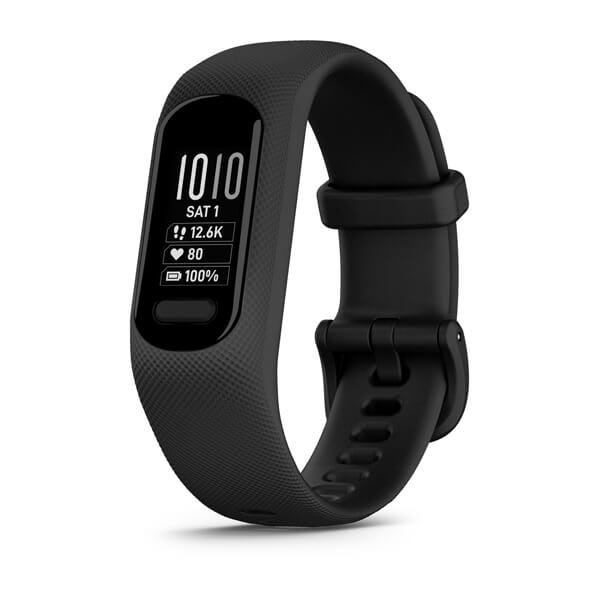
vívosmart 5, Black, Small/Medium
Sleep score, Body Battery, all-day stress, respiration, Pulse Ox and fitness age are on the band's own spec list, the battery claim is 7 days, and Garmin Connect+ stays optional at $6.99 a month for AI insights, nutrition logging and coaching extras.
Before you buy: No built-in GPS, no payments, a small monochrome screen, and a proprietary charging plug; the large size is offered in black only.
Price checked September 11, 2026. Retailer prices can change.What the sensors feed, and what needs the phone
Garmin's spec list lists four sensors: the Elevate wrist heart rate monitor, a Pulse Ox blood oxygen sensor, an accelerometer and an ambient light sensor. From those the band derives constant heart rate, resting heart rate, high and low heart rate alerts, respiration rate, all-day stress, Body Battery, an advanced sleep score, fitness age and a running VO2 max estimate. Pulse Ox can spot-check, run for part of the night, or run all day, and Garmin notes that it is not available in every country.
What is missing is a GPS chip. The table lists GPS speed and distance as connected GPS, meaning the band borrows the phone's fix during outdoor walks, runs and rides. The activity list is short and sensible: strength with automatic rep counting, HIIT, cardio, elliptical, stairs, rowing, walking, Pilates, yoga, treadmill, outdoor running, cycling and pool swimming. There is no Connect IQ app store on this band and no NFC, so watch faces, third-party data fields and wrist payments are off the table.
A small OLED, a 7-day claim, and a proprietary plug
The display is an OLED touchscreen measuring 10.5 by 18.5 mm at 88 by 154 pixels, with an ambient light sensor to manage brightness. It is monochrome and it is small; the tradeoff is that Garmin rates the battery at up to 7 days in smartwatch mode. The band stores seven timed activities and 14 days of tracking data before it needs a sync. Charging uses Garmin's own plug-in cable, which is the only accessory in the box besides the documentation, and replacement bands are $29.99 from Garmin.
Two sizes are offered. Small/medium is 19.5 by 10.7 by 217 mm, weighs 24.5 g and fits wrists from 122 to 188 mm; large is 255 mm long, weighs 26.5 g and is sold in black only. The case is polycarbonate, the lens is acrylic and the strap is silicone. Water rating is 5 ATM, which Garmin describes as fine for swimming and showering, and the pool swim profile is included. Anyone with a wrist near the top of the large range should note that Garmin prints 228 mm in one place and 215 mm in another.
Free app, optional Connect+, and how that compares with Fitbit
Every metric named above sits in the free Garmin Connect app. Garmin does sell a paid tier, Garmin Connect+, at $6.99 a month or $69.99 a year, and the Connect+ page frames the plan as a comparison chart between the free app and the premium features. Those features are AI-generated insights, calorie and macro tracking, a desktop performance dashboard, live activity viewing on the phone, extra coaching content, Garmin Trails and 3D maps, enhanced LiveTrack sharing, an annual report, offers and badges. Nothing on the vívosmart 5 spec list is on that paid side.
Fitbit's arrangement is different. The Charge 6 at $159.95 and the Inspire 3 at $99.95 both come with three months of Google Health Premium, and Google's footnote says the membership renews at $9.99 a month after the trial. Over a first year that is roughly $90 on top of the hardware if you keep it, which puts a Charge 6 plus membership near $250 against $149.99 for the Garmin. The Charge 6 answers with built-in GPS, NFC payments, an ECG app and a color AMOLED screen, so the money buys real hardware. The decision is whether you want those three things or a lower running cost.
Twelve months covered, and safety features that need a phone
Garmin covers non-aviation products for one year against faults in materials or workmanship, and will repair, replace or refund at its option. The customer pays transportation to the service center, cosmetic damage and battery wear are excluded, and in the US the coverage applies only to units bought from Garmin or a reseller it authorizes, with online auction confirmations not accepted. A repaired or replaced unit gets 90 days or the remainder of the original year, whichever is longer.
The safety features are worth reading carefully. Incident detection during select activities and the Assistance function can send your location to emergency contacts, but both route through a paired, compatible phone and Garmin points readers to its safety page for the limits. On a band with no GPS and no cellular radio that is the only way it could work, and it means the feature protects you on the walk with your phone in a pocket, not on the run you left it behind for.
Skip it if the run leaves the phone at home
The vívosmart 5 is at its best on someone who wears it to bed, checks Body Battery in the morning, logs a gym session by rep count and walks with a phone. Take it off the list if your training is outdoor running or cycling without a phone, because pace and distance stop existing the moment the phone stays home. Garmin's own Forerunner line exists for that buyer, and the Fitbit Charge 6 has GPS inside the band for $10 more.
Also skip it if you have lived with a bright color screen. The 88 by 154 pixel monochrome OLED is legible and it is the reason the battery lasts a week, but it is a step down in glanceability from either Fitbit. And if tap-to-pay at the coffee counter is part of why you want a wearable, this band cannot do it at any price. What it does is track health honestly for $149.99 and then leave you alone.
How we put this together
Built from the product pages and listings below, without test scores or results we have not measured. Specifications and prices change, so check the original page for the exact model, current price, delivery, and returns.
- Garmin: vívosmart 5 product page (US) (opens in a new tab)
- Garmin: Consumer Limited Warranty (opens in a new tab)
- Garmin: Garmin Connect+ plan page (US) (opens in a new tab)
- Google Store: Fitbit Charge 6 (opens in a new tab)
- Garmin: Forerunner 55 product page (US) (opens in a new tab)