Product image supplied by the brand
In this guide
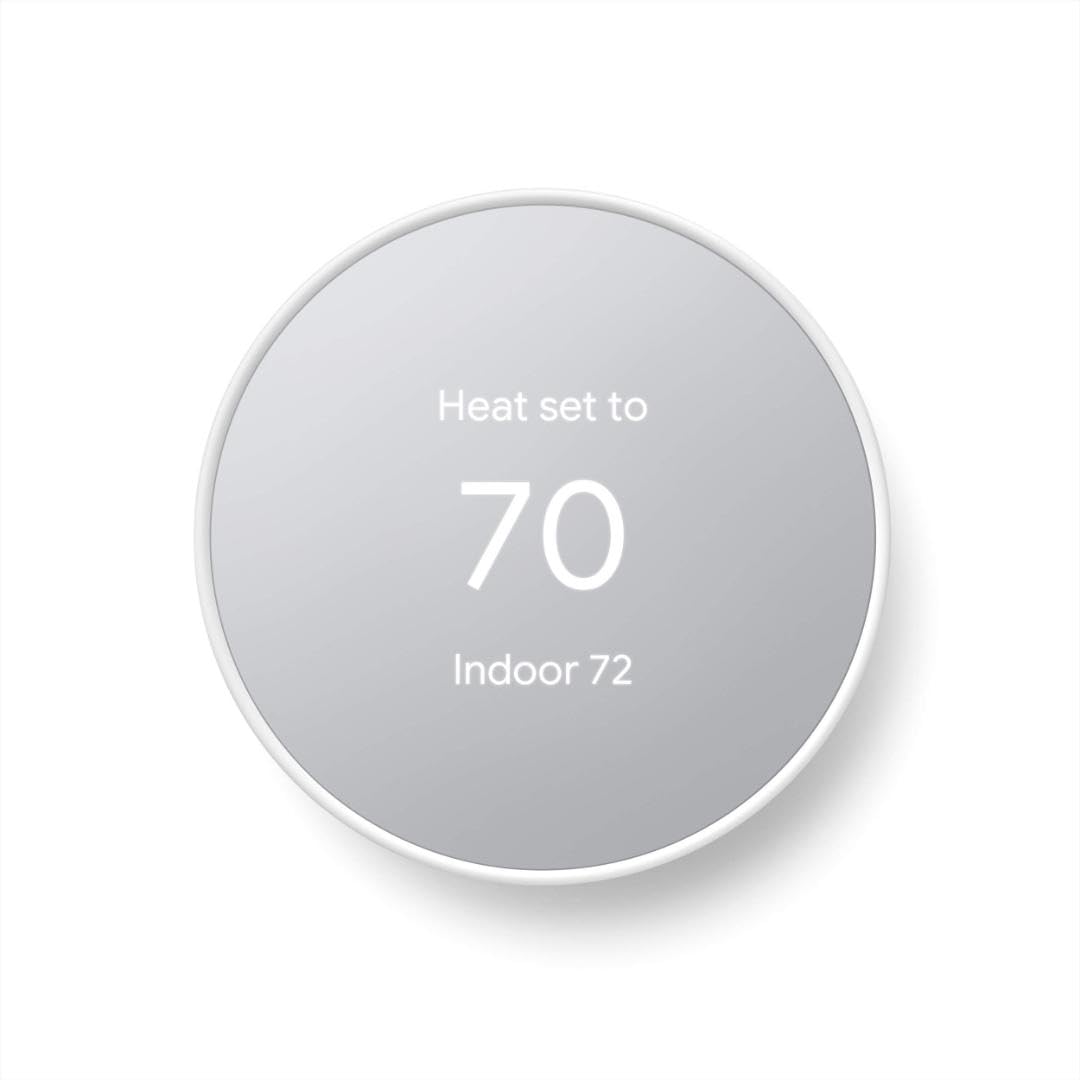
The Google Nest Thermostat, model GA01334-US in Snow, is the 2020 entry model under Google's Nest Learning Thermostat, the one Google says works with 85% of systems and self-installs in under 30 minutes. The Google Store had it in stock at $129.99 on 2026-09-21, payable as four installments of $32.50, in Snow, Sand, Fog, or Charcoal. Amazon's Snow listing showed $114.38 the same day from marketplace seller Advanctech with four units remaining and no Amazon-retail offer alongside it.
First check whether your system can power it. Google's documents flag heat-only, cool-only, heat pump, and some zoned systems for a C wire or Power Connector; the compatibility checker and setup power test determine your requirements. Then decide where the temperature should be measured. This model uses its own sensor, while the Learning Thermostat can use a bedroom sensor or average selected sensors. That can change which room drives the heating cycle, but it does not make a single-zone system heat each room independently.
Our verdict
Consider the $129.99 Nest Thermostat if Google's compatibility checks pass and its built-in temperature reading meets your needs. Budget separately for a Power Connector and installation if your system requires them.
- A good fit for
- A single-zone forced-air furnace or air conditioner in a home where nobody needs a second room sensor, owned by someone who will run every schedule change through the Google Home app.
- We would skip it if
- You need remote room sensors, wall-based schedule editing, or control of a two-stage heat pump, humidifier, or ventilation system. A 120 V or 240 V thermostat is not a direct replacement candidate.
Reasons to consider it
- Google lists support for one heating stage and one cooling stage plus a second stage of either, compatible single-stage heat pumps with auxiliary or emergency heat, and a single-speed fan; the compatibility checker must confirm your configuration
- When the checker does demand a C wire, the remedy Google sells is its own $24.99 Power Connector at the furnace, air handler, or zone controller instead of a new wire through the wall, and it is the same accessory the Learning Thermostat uses
- Google documents Savings Finder suggestions, Eco when Away, three-week Seasonal Savings adjustments, and System Health Monitor alerts for supported forced-air systems; Rush Hour Rewards depends on participation through your utility
The compromises
- It cannot use a Nest Temperature Sensor. The Learning Thermostat (4th gen) includes one and can use up to six for room-priority or average-temperature control, but sensors alone do not create independent heating and cooling zones
- There is no self-learning schedule and no editing the schedule on the wall: Google's settings article says temperature schedules "can only be changed in the Google Home app," with a temperature preset required for every entry and events at least 60 minutes apart
- The 2.4-inch 240-by-320 mirrored display, two AAA backup batteries, and a one-year warranty sit a clear step below the Learning Thermostat's 2.7-inch 600-by-600 screen, rechargeable cell, and two-year retail warranty
What we have not verified: The Amazon channel is the soft spot: the $114.38 Snow offer read on 2026-09-21 came from marketplace seller Advanctech with four units left, the Charcoal listing showed one unit from another marketplace seller, and no Amazon-retail offer appeared, so the discount depends on one seller's remaining stock and may vanish. Google's Store still lists the thermostat in stock at $129.99 with no discontinuation notice, but a 2020 model with thin marketplace stock warrants checking availability if you need a particular color. Amazon's detail table lists the model as GA01334-CA while the part number reads GA01334-US, and it names a steel plate among included components that Google puts in the separate Trim Kit; Google's own box list was used. ENERGY STAR's certification record lists GA01334-US among the Nest Thermostat's model numbers, qualified since November 2020. The Learning Thermostat's $239.99 Store price is a same-day sale against a $279.99 list, and that gap moves.
The things in this guide
A closer look at the products, who they may suit, and what to check before buying.
Nest Thermostat (Snow)
$129.99 from the Google Store on 2026-09-21, in stock in Snow, buys a Matter-certified thermostat that runs on furnace power with two AAA backup cells, connects on either Wi-Fi band, and carries ENERGY STAR certification plus Savings Finder, Eco when Away, and System Health Monitor.
Before you buy: No remote temperature sensors, no self-learning schedule, app-only schedule editing, and a one-year warranty. If the $24.99 Power Connector is required, thermostat and connector total $154.98 before tax or installation; compatibility still needs checking.
Price checked September 21, 2026. Retailer prices can change.Read your old thermostat's wires before you read the price
Google lists heat-only, cool-only, and single-stage heat pump configurations among systems that need a C wire or Power Connector, and flags some zoned systems too. The thermostat takes primary power from HVAC wiring, with two AAA cells as backup. A conventional furnace-and-AC arrangement may be compatible, but Rh or Rc, W1, Y1, and G labels alone do not establish reliable power. Even an existing C wire must be connected correctly and pass the app's power test. Run the compatibility checker before buying, then follow the installation checks.
The $24.99 Nest Power Connector can supply consistent power without pulling another wire through the wall, where Google's checks approve that option. Thermostat plus connector costs $154.98 before tax and installation. The connector attaches at the furnace, air handler, or zone controller; Google says to call a professional if the equipment has no C terminal. Dual-fuel systems also require professional setup. Installation labor was not priced, so $154.98 is a hardware subtotal, not an installed quote. The connector does not make high-voltage or millivolt equipment directly compatible.
What $150 of list price separates it from the Learning Thermostat
This Nest Thermostat cannot pair with a Nest Temperature Sensor. The Learning Thermostat (4th gen) includes one and supports up to six; it can use a chosen room's reading or average selected sensors. That is useful when a bedroom should determine when heating stops instead of the hallway. It does not independently control each room: a single-zone system still heats or cools the entire zone together. Google says simultaneous room-specific temperatures need zoning or special vents. Buy the sensor capability for a different control reference, not as a promised cure for uneven airflow.
The rest of the gap is comfort and hardware. The Learning model builds its own schedule from your adjustments; this one runs the schedule you type in. Its screen is 2.4 inches at 240 by 320 pixels behind mirrored glass against a 2.7-inch, 600-by-600 display. It backs up on two AAA cells where the Learning model carries a rechargeable lithium battery. Google backs it for one year, the Learning model for two. And the wiring table shows the Learning Thermostat checking the rows this model leaves blank, among them two-stage heat pumps, humidifiers, dehumidifiers, dual-transformer systems, multi-speed fans, PTAC units, and ventilation. The Learning model listed at $279.99 and sold for $239.99 on the Store on 2026-09-21.
Schedule changes require the Google Home app
Google's own setup article is blunt: this thermostat "can only be set up in the Google Home app," and you must be standing at it to add it. The schedule follows the same rule. You pick a default schedule during setup, then every later edit — adding an event, moving a time — happens in the app, each entry tied to a temperature preset such as Comfort, Eco, or Sleep, with adjacent events at least 60 minutes apart. Nudging tonight's setpoint on the wall still works with a swipe; reprogramming Tuesday on the wall does not.
The app also carries the features Google leans on for savings. Savings Finder waits a few days after install, then suggests temperature tweaks to the schedule that you accept or dismiss in the app. Eco when Away drops to Eco Temperatures when the house is empty. Seasonal Savings runs three weeks each summer and winter with adjustments Google describes as typically up to 2°F. System Health Monitor watches forced-air systems in the US and parts of Canada for early-warning alerts, though Google's footnote calls those alerts no substitute for an HVAC diagnosis. Matter certification and Alexa support are on the spec page, so the thermostat is not locked to Google speakers.
Weigh the marketing number with its footnote attached. Google's listing claims Nest thermostats "can help save up to 31% on heating and cooling bills." Its footnote sets the baseline as a constant 72°F hold all year and adds that actual savings "will likely be less." A home already running a programmed setback schedule starts far closer to the finish line than that baseline, so the savings case for that home is remote control and the utility programs — Nest Renew across the contiguous 48 states, and Rush Hour Rewards where your utility offers it, both run by Renew Home — more than the headline percentage.
Where the $129.99 holds and where it does not
The Google Store is the anchor: $129.99 on 2026-09-21, in stock in Snow, splittable into four payments of $32.50, with Google's one-year warranty behind it. Amazon undercut that at $114.38 the same day, but the offer belonged to marketplace seller Advanctech with four units left, Charcoal sat at $119.99 with a single unit from a different seller, and the panel showed no Amazon-retail new offer. A bundle of the Snow unit with the Trim Kit at $99.99 from a third seller looked like the bargain of the page; it is a different listing and another seller's stock, so check who handles returns before choosing it over the Store.
The $14.99 Trim Kit covers old wall marks with a 7.09-by-4.41-inch plate and includes the steel plate Google requires over an electrical box. A Power Connector may also be needed if setup detects inadequate power, beyond the common configurations listed above. Two AAA cells are included; the thermostat warns when they need replacement. Renters need the landlord's permission and access to any equipment wiring involved. Google's usual 30-minute installation estimate is not a guarantee for a job needing a connector or professional configuration; arrange those details before removing the old thermostat.
Skip it if any of these describe your house
Choose the Learning Thermostat when remote room readings or sensor averaging are the requirement: it was $239.99 against a $279.99 list on 2026-09-21. Neither sensors nor that upgrade create independent room control in a single-zone system. For a two-stage heat pump, humidifier, dehumidifier, dual-transformer setup, or ventilation equipment, check the Learning model's compatibility and obtain professional configuration where Google requires it. Hiring an installer does not add those missing controls to the entry-level Nest.
Do not connect this thermostat directly to a 120 V or 240 V system or a millivolt heater. Skip it if someone needs to edit the weekly schedule without the Google Home app; local temperature adjustment and some settings remain available on the wall. For compatible furnace-and-AC homes that only need the thermostat's own temperature reading, start with the $129.99 hardware price, then confirm power requirements and any installation charge before ordering.
How we put this together
Built from the product pages and listings below, without test scores or results we have not measured. Specifications and prices change, so check the original page for the exact model, current price, delivery, and returns.
- Google Store: Nest Thermostat product page (opens in a new tab)
- Google Store: Nest Thermostat tech specs (opens in a new tab)
- Google Nest Help: Nest thermostat technical specifications (opens in a new tab)
- Google Nest Help: Nest thermostat compatibility (opens in a new tab)
- Google Store: Nest Power Connector (opens in a new tab)
- Google Store: Nest Thermostat Trim Kit (opens in a new tab)
- Google Store: Nest Learning Thermostat (4th gen) and tech specs (opens in a new tab)
- Google Nest Help: Get started with your Nest Thermostat and Nest Learning Thermostat (4th gen) (opens in a new tab)
- Google Nest Help: Temperature schedules for the Nest thermostat (opens in a new tab)
- Google Nest Help: Optimize energy savings with Nest Thermostat (opens in a new tab)
- Amazon: Google Nest Thermostat, Snow (ASIN B08HRPDYTP) (opens in a new tab)
- Google Nest Help: Learn about the Nest Temperature Sensor (opens in a new tab)
- Google Nest Help: Learn about the common or C wire (opens in a new tab)
- Google Nest Help: Nest Power Connector installation (opens in a new tab)
- Google Nest Help: Nest thermostat settings (opens in a new tab)
- ENERGY STAR: Certified Smart Thermostats, Google Nest Nest Thermostat (record 2369005) (opens in a new tab)