Product image supplied by the brand
In this guide
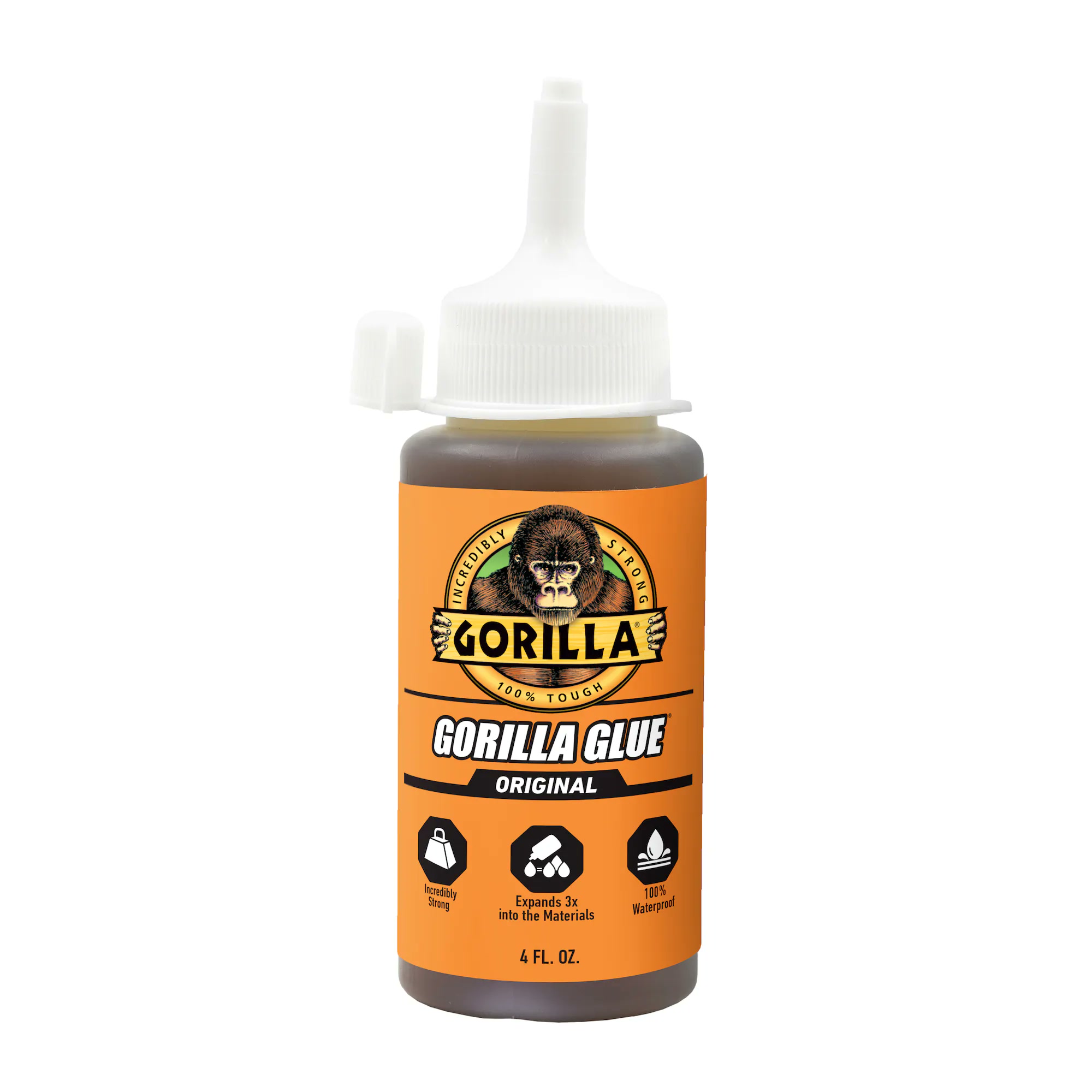
Original Gorilla Glue is a water-activated polyurethane: the cure starts when the adhesive meets moisture, so the routine is to dampen one surface, spread a thin layer on the dry mate, clamp, and wait. The 4 oz bottle carries maker item 5000408, bonds wood, stone, metal, ceramic, foam, glass and concrete, and holds a 100% waterproof ANSI/HPVA Type I rating with service from -40 to 200 degrees Fahrenheit. Amazon's listing showed $6.48, In Stock, with Amazon itself the seller, in a U.S.-delivery render on 2026-09-19; a day later the same listing carried no featured offer, and its buying-options list opened at $8.68 from a third-party vendor shipping through Amazon.
Clamp time runs one to two hours, full cure 24, and the cure expands the bead up to three times — three numbers that govern whether this bottle suits a repair or a cyanoacrylate does. A joint that can be dampened, held and left overnight gets a waterproof bond across more materials than a drawer of single-purpose adhesives; a joint that cannot gets a foam problem instead.
Our verdict
The $6.48 4 oz bottle for waterproof repairs on wood, stone, metal, ceramic, foam, glass and concrete — provided one surface is dampened, the joint clamped for an hour or two, and the foam planned for.
- A good fit for
- Anyone re-bonding outdoor or water-exposed parts in wood, stone, metal, ceramic, foam, glass or concrete who can clamp an hour or two and wait a day for full cure.
- We would skip it if
- Instant fixes that need a cyanoacrylate's seconds, paper and craft gluing, polypropylene, polyethylene and oily rubbers, or any visible joint that must stay foam-free and clean-lined.
Reasons to consider it
- 100% waterproof to ANSI/HPVA Type I, rated for continuous outdoor service from -40 to 200 degrees Fahrenheit
- One formula grips wood, stone, metal, ceramic, foam, glass and concrete, and cured squeeze-out sands, scrapes or chisels off without damaging tools
- Paintable and stainable once sanded, with a working guide of half an ounce per square foot because the cure expands the bead
The compromises
- The same expansion the bond depends on pushes tan foam out of the joint line, and cured foam comes off by sanding, scraping or picking, not wiping
- The spec table answers Gap Filling with No and the directions demand tight-fitting surfaces, so the three-times expansion cannot stand in for missing material
- The formula is a skin sensitizer in the maker's words; bonded skin or a swallowed mouthful means the 1-800-420-7186 line, and polypropylene, polyethylene and oily rubbers stay out of range
What we have not verified: The $6.48 price is pinned to one U.S.-delivery reader render of the Amazon listing on 2026-09-19 (In Stock, an Amazon first-party offer); on 2026-09-20 three fresh reader sessions delivered to non-U.S. addresses suppressed the price entirely, and the direct curl page rendered with no buybox block at all — the $9.01, $6.96 and $5.98 spans on that page belong to substitute-carousel items for other products, not this bottle. A U.S. browser render on 2026-09-20 showed no featured offer at all: the buying-options list opened at $8.68 from Express Brands, a marketplace vendor shipping through Amazon, then $9.99 from a seller shipping itself, with eighteen more behind them — so the $6.48 first-party offer is a dated snapshot, not a standing price. The one-year shelf life is the maker's rule of thumb for unopened stock, with no published date-code scheme to check a specific bottle against.
The things in this guide
A closer look at the products, who they may suit, and what to check before buying.
Original Glue (4 oz)
$6.48 bought the 4 oz bottle on 2026-09-19, In Stock, Amazon first-party: a moisture-cured polyurethane that grips seven material families, carries ANSI/HPVA Type I waterproofing, and serves outdoors from -40 to 200 degrees Fahrenheit.
Before you buy: The cure expands up to three times and the spec itself says no gap filling; polypropylene, polyethylene and oily rubbers are out of range, and bonded skin goes to 1-800-420-7186.
Price checked September 19, 2026. Retailer prices can change.Dampen, clamp, wait: how the bond forms
The chemistry sets the routine. This is a moisture-cured polyurethane, so the cure starts when the adhesive meets water: dampen one surface with a wet cloth or a spray, short of saturation, and for dense hardwoods dampen both. The glue itself goes onto the dry mating surface, thin, because the bead expands up to three times during cure and over-application is where the mess begins. Gorilla's working guide is half an ounce per square foot. Clamp under even pressure for one to two hours, with the full 24 hours before the joint carries real load; heavy objects, tape, or rubber bands substitute for light work. Application temperature stays above 40 degrees Fahrenheit.
Squeeze-out has a protocol. Uncured glue wipes up with a dry cloth or paint thinner, gloves on; once cured, removal turns mechanical — sanding, chiseling, scraping, picking — though dried glue leaves tools undamaged. The finished joint serves from -40 to 200 degrees Fahrenheit, indoors or out, under a 100% waterproof rating certified to ANSI/HPVA Type I.
Expands three times — and still gap filling: no
The expansion claim pulls against the printed spec table. Gorilla's FAQ puts expansion at up to three times, and the Amazon bullets repeat the same three-times line as the strength story, foaming into the materials it penetrates. The same spec table answers gap filling with a bare no, and the directions require tight-fitting surfaces. Expansion drives penetration; it does not conjure missing material. A joint with a gap in it cures into a joint that still has a gap, now lined with foam.
The cured color is tan, so wherever squeeze-out shows, a tan foam line shows with it. Finishing tolerates that: oil-based and spray paints go over cured glue directly, and acrylics, latex and stains take after sanding. Clean-line work — visible furniture seams, models, anything where the glue line should disappear — is the wrong assignment for a foaming adhesive, and the trim-and-sand step it forces is the price of the waterproof bond.
Seven material families in, three plastics out
Seven families are in range: wood, stone, metal, ceramic, foam, glass and concrete, the same list on the maker page and the listing. Preparation carries conditions — surfaces clean, dust-free and tight-fitting, and the shiny faces of metals, glass and some plastics roughened first so the adhesive has something to grip. A first pass at an unfamiliar material earns a test piece.
The exclusions are specific. Polypropylene and polyethylene are out — Gorilla says so flatly — along with rubbers carrying high oil or plasticizer content. Plenty of cheap storage bins, cutting boards and car trim are PP or PE, which makes the recycling code the opening move to read before blaming the bottle.
The skin warnings and the 1-800 line
Gorilla labels the formula a skin sensitizer in some instances and tells anyone predisposed to skin reactions to take the extra precaution; gloves and a disposable brush are the working answer. Unwanted skin contact follows the removal page: lift what a dry cloth can while the glue is tacky, then gritty soap and warm water or a gritty exfoliator, then moisturize. Cured glue can stain skin and take several days to wear off. Alcohol, acetone and other solvents are explicitly off the list.
Bonded skin and any swallowing go to the same number, 1-800-420-7186, which reaches a medical professional for skin and the product safety team for emergencies, anytime per the first-aid page. The swallowing risk is not hypothetical: a 2021 veterinary review covered 22 dogs that ingested polyurethane glue between 2005 and 2019, stomach moisture foaming it into a hard mass. Storage answers that — the bottle away from children and animals, cool and dry, with this 4 oz size squeezed airless before the cap goes back, and the maker's one-year rule for unopened stock in mind.
Which Gorilla for which job
Gorilla's line-up frames the choice. Original is the water-activated polyurethane here: it foams, clamps one to two hours, cures in 24, and carries the Type I waterproof rating for outdoor service. Gorilla Super Glue is a cyanoacrylate — one drop per square inch of surface, ten to 45 seconds of press, no clamp, no foaming, a clear cured bead for indoor fixes, not paintable, cleaned up uncured with acetone or isopropyl alcohol. Gorilla Wood Glue is a PVA: wood only, clamped 20 to 30 minutes above 55 degrees Fahrenheit, cured in 24, water-resistant to Type II rather than waterproof, with no expansion at all.
Match the chemistry to the clock and the weather. Seconds-scale fixes on paper, leather, rubber, ceramic or metal belong to the cyanoacrylate, which bonds paper outright; fine woodworking joints with a glue line that must disappear belong to the PVA; mixed materials, water exposure and outdoor service belong here. Of the three, only Original carries the Type I rating.
$1.62 an ounce, and the 8 oz bottle beats it
Prices are snapshots: $6.48 for this bottle in a U.S.-delivery read on 2026-09-19 — gone by the next day, when no featured offer was showing and marketplace copies started at $8.68 — and the size ladder as the listing displayed it on 2026-09-20. Four ounces at $6.48 runs $1.62 an ounce. The 2 oz bottle showed $5.98 with Amazon's own $2.99-per-fluid-ounce display; the two-pack of 4 oz bottles showed $22.75 at $2.84 an ounce, which asks $9.79 more than two single bottles; the 8 oz bottle showed $9.98 at $1.25 a fluid ounce against a struck $12.99, the lowest per-ounce price on the ladder.
Shelf life governs how far up that ladder to climb. The storage rules — squeeze the air out of this 4 oz bottle before capping it, keep it cool and dry, skip humid spots like laundry rooms and under-sink cabinets — exist because the same moisture that cures the joint can cure the bottle. The one-year rule for unopened stock makes the 8 oz the sensible ceiling unless glue work is a weekly habit.
Who should skip it
Instant-fix buyers should hold a cyanoacrylate, not this: ten to 45 seconds against a two-hour clamp and a 24-hour cure is not a contest. Paper and craft gluing sits on the Super Glue page's bond list with that fast set; routing it through a foaming tan polyurethane buys nothing but wait.
The same goes for polypropylene, polyethylene and oily rubbers, which the formula will not hold, and for any visible seam expected to stay clean-lined — the tan foam sees to that. A repair that cannot be clamped, or a bottle that would live in a humid cabinet, is out of contention before the cap comes off.
How we put this together
Built from the product pages and listings below, without test scores or results we have not measured. Specifications and prices change, so check the original page for the exact model, current price, delivery, and returns.
- Gorilla Glue: Original Gorilla Glue product page (opens in a new tab)
- Gorilla Glue: Removing Gorilla Adhesive From Skin (opens in a new tab)
- Amazon: Gorilla Original Glue 4 oz listing (ASIN B0001GAYRC) (opens in a new tab)
- Gorilla Glue: First Aid & SDS page (opens in a new tab)
- Gorilla Glue: Gorilla Super Glue product page (opens in a new tab)
- Gorilla Glue: Gorilla Wood Glue product page (opens in a new tab)
- PubMed: Gorilla Glue ingestion in dogs: 22 cases (2005-2019) (opens in a new tab)