Product image supplied by the brand
In this guide
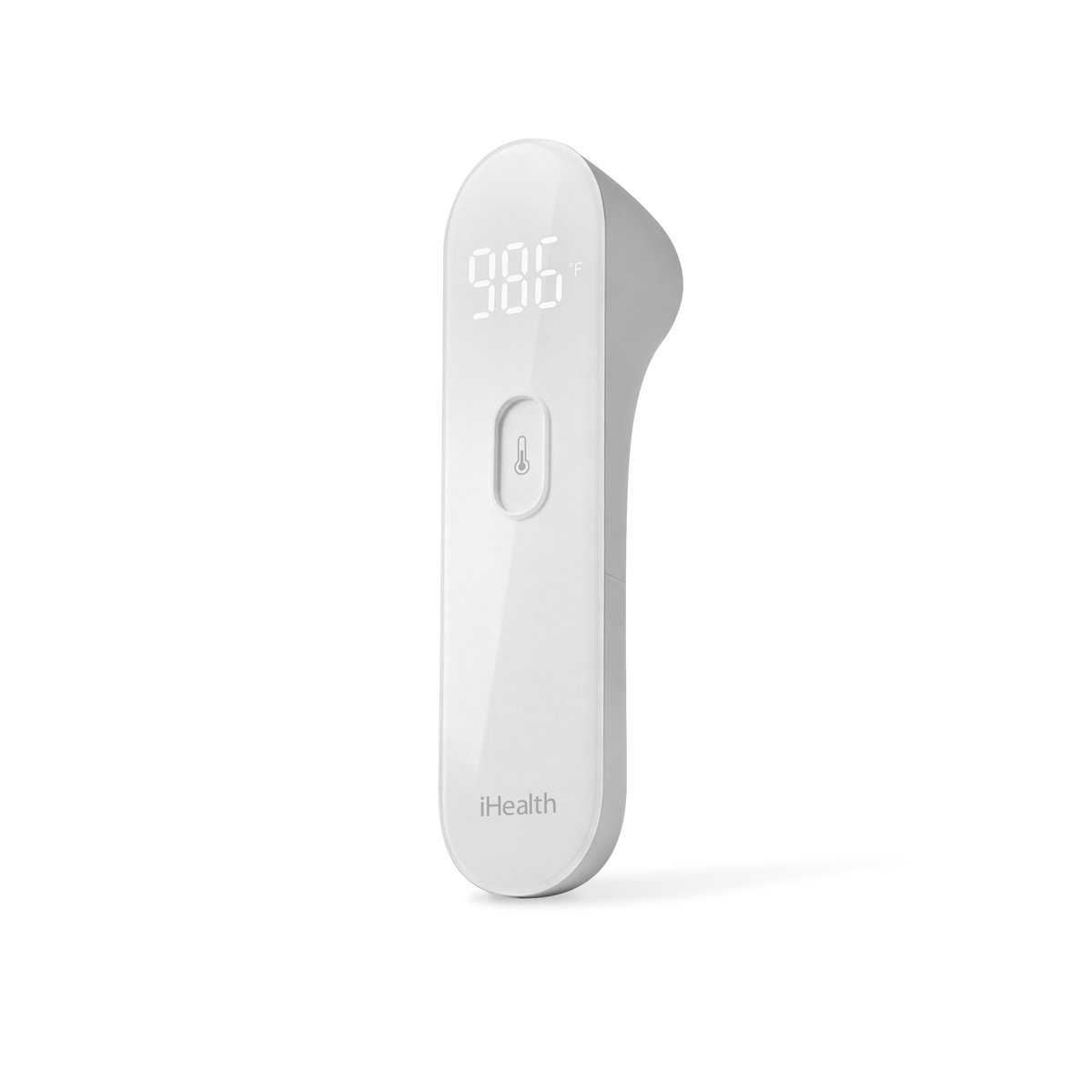
The PT3 is the plain one in iHealth's thermometer line. It has one button, one job and no radio: aim it at the center of the forehead from about a finger's width away, press, and about a second later the temperature appears on a backlit LED panel while the handle vibrates once. iHealth listed it at $30.95, marked down from $32.98, in white or black, and mentions an iF Design Award in the store description.
What separates it from a $13 stick thermometer is the sensor stack. An infrared thermopile samples the forehead a hundred times in that second, a distance sensor refuses to fire if the probe is farther than 1.18 inches away, and an ambient-temperature sensor corrects for the room. What separates it from iHealth's own PT9S, which costs $34.99, is everything the PT3 leaves out: no reading memory, no color fever alert, no object mode and no phone app. The choice is between a cheaper device that answers and a slightly dearer one that also remembers.
Our verdict
A fully specified, quiet forehead thermometer for households that check temperatures often and write nothing down; the missing memory and app pairing are the only reasons to spend $4 more on iHealth's PT9S.
- A good fit for
- Parents checking a sleeping child, or a household that prefers a single-button reading with a vibration instead of a beep.
- We would skip it if
- You need a log of readings for a doctor, want an ear or oral reading, or expect the device to sync with a phone.
Reasons to consider it
- Reading in about one second from 1.18 inches, with distance and ambient sensors that block out-of-range attempts
- Stated precision of ±0.4 °F across the fever range and a clinical reproducibility of ±0.28 °C
- Vibration confirmation and a dim backlit LED that iHealth says will not wake a sleeping baby
The compromises
- No reading memory and no pairing with the iHealth MyVitals app
- Forehead readings typically run 0.5 to 1 °F below oral, and sweat, hair or a cold room skews them
- The maker gives the device an expected life of five years, printing an expiration date on the box
What we have not verified: No temperatures were taken here; how consistent readings are on a squirming toddler, actual AAA life, and how often the device returns dashes in a cool room were not assessed.
The things in this guide
A closer look at the products, who they may suit, and what to check before buying.
PT3 Infrared No-Touch Forehead Thermometer
Three sensors, a one-second read at 1.18 inches, ±0.4 °F stated precision in the fever range, vibration instead of a beep, and two ordinary AAA cells, all for $30.95 from the maker.
Before you buy: It stores nothing and syncs with nothing; iHealth's PT9S adds a 40-reading memory for $4 more.
Price checked September 11, 2026. Retailer prices can change.Three sensors, one second, one vibration
iHealth's support pages describe the measurement more precisely than the store does. The probe is held at the center of the forehead 1.18 inches, or 3 centimeters, away, roughly the width of an adult index finger, and a press of the single button starts a burst of 100 infrared samples that an algorithm reduces to one number within a second. A distance sensor gates every reading: if the probe is farther than 1.18 inches from the skin the device will not take a reading at all and shows three dashes instead, which is iHealth's way of preventing a bad number.
The third sensor tracks ambient temperature and compensates for it, which is why iHealth specifies an operating window of 59 to 104 °F and 15 to 85 percent humidity. A successful reading is confirmed by a vibration in the handle, not a beep, and appears on an LED panel iHealth sizes at 1.01 by 0.75 inches with a backlight described as dim enough not to disturb a sleeping child. The device shuts itself off after 8 seconds without a button press. Units default to Celsius; switching to Fahrenheit means holding the button for 8 seconds with the device off, pressing once, and holding for 8 seconds again.
The stated precision, and what a forehead number means
The specification article gives a measurement range of 89.6 to 109.2 °F, a resolution of 0.1 °C, and a precision of ±0.2 °C between 35 and 42 °C with ±0.3 °C outside that band; the accuracy FAQ restates the same figures as ±0.4 °F between 95 and 107.6 °F and ±0.5 °F elsewhere. iHealth also lists a clinical reproducibility of ±0.28 °C, the figure that describes how closely repeated readings on the same person agree, and that number is the one to keep in mind when a child reads 99.1 and then 99.6 a minute later.
iHealth is unusually direct about what a forehead reading is not. Its accuracy page says a forehead scanner usually reads 0.5 to 1 °F lower than an oral thermometer, that ear readings run higher and armpit readings lower, and that sweat, hair, air temperature and a recently covered head all shift the result. The troubleshooting advice adds that the device and the person should sit in the same room for 30 minutes before a reading, that the lens should be cleaned with a cotton swab lightly moistened with rubbing alcohol followed by a 30-minute wait, and that fresh non-rechargeable cells should be used when readings look stuck.
Two AAA cells, a five-year lifetime and no phone
The PT3 runs on two 1.5 V AAA cells, and a pair is supplied along with a manual and a quick-start card. iHealth asks owners to pull the batteries if the thermometer will sit unused for more than a month, to store it back in its packaging, and to keep liquids, dust and fingers off the probe, since a dirty or scratched lens reads wrong. The materials that touch the patient are ABS, TPU and metal, tested to ISO 10993 for irritation and toxicity, and iHealth says anyone with a plastic or rubber allergy should not use it.
Two facts on the support site will surprise buyers. First, iHealth states an expected lifetime of five years counted from first use and explains that the expiration date printed on the box comes from the shelf life of the bundled batteries and from Chinese export rules for protective equipment. Second, the PT3 is on iHealth's list of devices that do not pair with its MyVitals app, alongside the PT2L, PT1 and the ear thermometer, and it has no on-device memory either. For a log of readings, iHealth's PT9S at $34.99 stores 40 of them and adds infant, child, adult and object modes plus color-coded fever alerts.
$30.95 on sale, contiguous-US shipping, and a 365-day warranty
On the day of the check iHealth showed the PT3 at $30.95 against an original price of $32.98 in both white and black. The store ships thermometer orders in one to two business days by UPS Mail Innovations or USPS, quotes four to seven days in transit, offers no expedited option, and ships only to the contiguous US; Alaska, Hawaii, territories and military addresses are excluded, with iHealth directing those buyers to Amazon. Shipping is charged by weight and destination at checkout.
Returns require an RMA from customer service, requested before 30 days from shipment have elapsed, with the unopened product back in iHealth's hands within 10 days of the RMA and return postage paid by the buyer; shipping charges and taxes are not refunded. The hardware warranty runs 365 days from purchase and lets iHealth repair with new or reconditioned parts or swap the unit for a new or reconditioned one, with the replacement covered for the longer of the remaining term or a fresh 365 days. Batteries are excluded as consumables, the device must go back freight prepaid in its original packaging with a receipt, and support asks for the lot or serial number, which starts with KA, plus a short video of the fault.
Skip it if the reading has to be written down for someone
If a pediatrician or an employer wants a temperature history, the PT3 is the wrong iHealth thermometer. It stores nothing, shows nothing after the 8-second auto-off, and cannot send a reading to a phone, so every number has to be copied by hand the moment it appears. The PT9S costs $4 more and keeps 40 readings; that is the model for a household tracking a fever over days.
Pass on it, too, if the number you trust is an oral or ear temperature. iHealth itself says forehead readings sit half a degree to a degree below oral and move with sweat, hair and room temperature, so a forehead device is a screening tool, not the reading a nurse will ask for. And buy it with the five-year lifetime in mind: at $30.95 the cost works out near $6 a year, which is fine, as long as nobody expects it to outlast the child it was bought for.
How we put this together
Built from the product pages and listings below, without test scores or results we have not measured. Specifications and prices change, so check the original page for the exact model, current price, delivery, and returns.
- iHealth: PT3 Infrared No-Touch Forehead Thermometer product page (opens in a new tab)
- iHealth: Shipping and Returns Policy (opens in a new tab)
- iHealth Support: Technical specifications for the PT3 (opens in a new tab)
- iHealth Support: Getting started with the PT3 (opens in a new tab)
- iHealth Support: How accurate is the thermometer? (opens in a new tab)
- iHealth Support: Why do temperature measurements not change or vary dramatically? (opens in a new tab)
- iHealth Support: Why is there an expiration date on the PT3? (opens in a new tab)
- iHealth Support: Which iHealth devices pair with the MyVitals app (opens in a new tab)
- iHealth: PT9S Infrared No-Touch Forehead Thermometer product page (opens in a new tab)