Product image supplied by the brand
In this guide
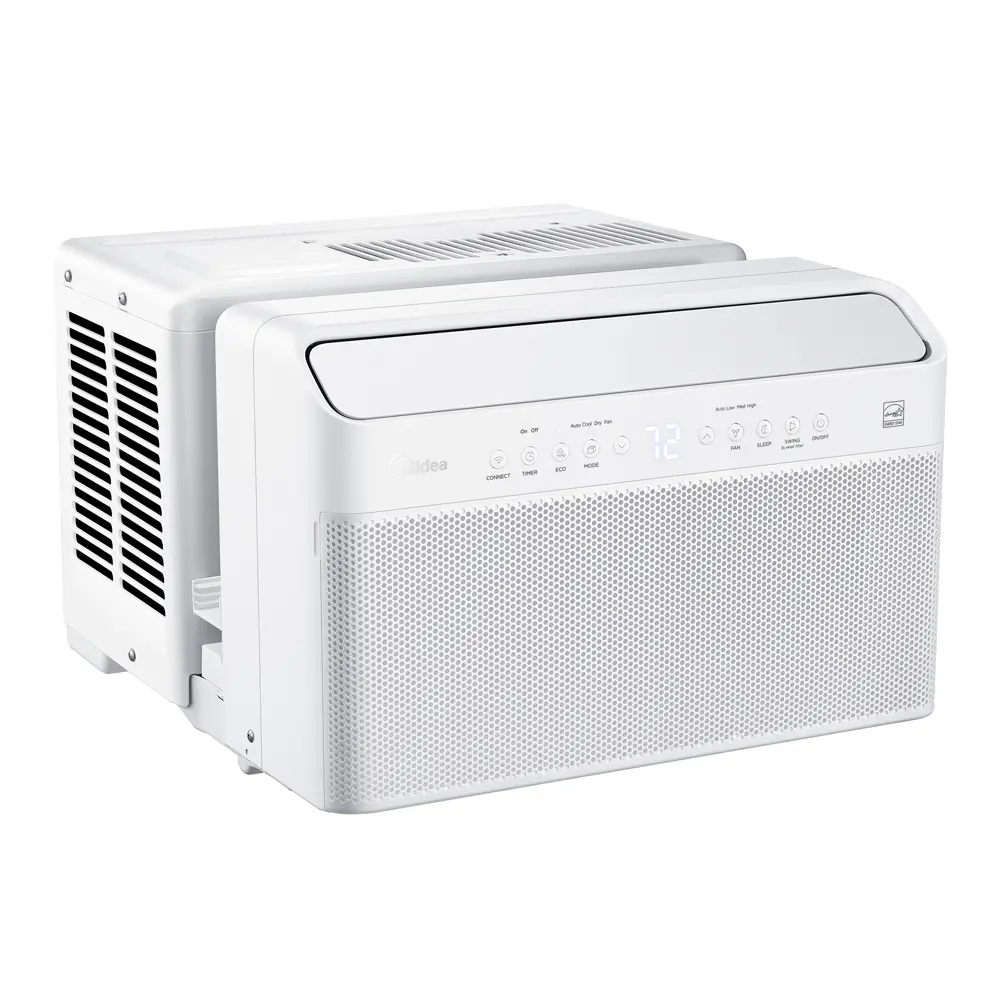
Midea's U-shaped window air conditioner is built so the window can close over it. The 8,000 BTU model, MAW08V1QWT, is $399.99 on Midea's US store, which Midea's page data lists InStock, sold in white, with a channel across the top that the lower sash drops into, so the frame seals over the unit instead of leaving an open gap above a flat panel. The shape also puts the compressor in the outdoor half, and that is the reason it fits some windows and refuses others.
The decision most renters face is between this, a portable air conditioner and more fans, and the three do different jobs. A fan moves air across your skin, which helps only while the air is cooler than you are; a box fan or circulator is $40 to $80. A portable unit rolls between rooms but needs a hose out a window and a floor footprint. A window unit cools harder per dollar and stays put. Midea's own capacity math for this model is narrow: the page title gives up to 350 sq ft, and the FAQ below it gives an 8,000 BTU unit rooms between 300 and 350 sq ft.
Our verdict
A $399.99 8,000 BTU window unit that can seal a double-hung sash over its body, sized for 300 to 350 sq ft. Casement, awning and sliding windows are out; there is no sash to drop over the U.
- A good fit for
- A renter or small-home owner with a double-hung bedroom window and 300 to 350 sq ft to cool, who wants the sash to close against street noise and against a unit someone could push in.
- We would skip it if
- Your window is casement, awning or a horizontal slider, or its opening is under 22 or over 36 inches wide, or the sill is above the first floor and the building forbids an outdoor bracket.
Reasons to consider it
- The U-shaped cabinet leaves a slot across the top for the lower sash to close into, so the frame seals over the unit instead of sitting open above a flat panel, and Midea ships the quick-snap bracket and adjustable window panels in the box
- Midea sizes the MAW08V1QWT at 8,000 BTU for 300 to 350 sq ft, and the DOE EnergyGuide label lists a Combined Energy Efficiency Ratio of 15.0 at an estimated $43 a year on 13-cent power
- Cool, Dry and Fan modes with app, smartwatch and voice control, a timer in half-hour steps to 10 hours and then hourly to 24, a four-speed fan and a washable filter the manual says to check at least once every two weeks
The compromises
- The manual's Sound Performance table lists 42 dB(A) sound power per ISO 3744 at low fan speed for this model, while the product page claims 'as low as 32 dBA' with no stated method; the two readings are different measures and are not interchangeable
- It installs only in a double-hung window with a 22 to 36 inch opening and a 13.5 inch clear vertical opening, the manual requires the supplied parts to be used and warns that misusing the bracket voids the warranty, and the rear has to hang outdoors
- Warranty service puts diagnostics, removal, transportation and reinstallation on the owner, the manual excludes units put to 'commercial, business, rental, or other use', and Midea publishes no wattage or amp draw for this model
What we have not verified: No wattage or amp figure for the MAW08V1QWT appears in any Midea document, so the peak draw is unknown — and with it whether an older 15 A bedroom circuit holds the unit alongside other loads, and what it really adds to a bill; the manual points only to the serial plate on the cabinet, and the label's $43 a year is a standardized estimate, not a measured draw. If the draw is high, a cheaper 5,000 BTU unit or a fan becomes the better argument.
The things in this guide
A closer look at the products, who they may suit, and what to check before buying.
U-Shaped Smart Window Air Conditioner · 8,000 BTU
The U-shaped cabinet gives the lower sash a slot to close into, Midea sizes the 8,000 BTU unit at 300 to 350 sq ft, the DOE label rates it CEER 15.0 at an estimated $43 a year, and the carton includes the quick-snap bracket and window panels for a double-hung opening 22 to 36 inches wide.
Before you buy: It installs only in a double-hung window with a 22 to 36 inch opening and a 13.5 inch clear vertical opening, the manual requires the supplied parts to be used and warns that misusing the bracket voids the warranty, it excludes commercial and rental use, and Midea publishes no wattage or amp figure.
Price checked October 7, 2026. Retailer prices can change.The window it needs, and the ones it turns down
Midea builds this unit for one window. Midea specifies a standard double-hung with an opening 22 to 36 inches wide (558 to 914 mm) and a window height of 13.75 inches. The lower sash has to lift clear to a vertical opening of 13.5 inches, and the rear must hang outdoors, not into a garage or a hallway. A casement, awning or horizontal sliding window has no sash to drop onto the top of the U, so it is not a candidate.
The install is not a drop-in. The manual walks through a support bracket that spans the sill and screws into it, two extension arms whose gap you measure and fill with cut foam, anti-tip brackets pushed down into the window track, and a sash lock; the brackets want 1/8-inch pilot holes drilled first. Tools on the list are a Phillips screwdriver, a level, a flathead screwdriver, a pencil, a tape measure, scissors or a knife, and a drill. A triple-track window with a screen needs the screen out.
Two lines matter to anyone renting. Midea's instructions say the bracket is only for its intended purpose and that misusing it voids the warranty, and the mounting drives screws into the sill and frame, work a lease may not allow. A storm window over the opening has to come off, or, if it stays, sit behind a wood spacer at least 1-1/2 inches (38 mm) thick that the bracket is then fastened to.
What 8,000 BTU covers, and what a bill looks like
Midea puts 8,000 BTU against 350 sq ft in the page title and the specification list, then narrows it in the FAQ: an 8,000 BTU unit is 'ideal for rooms between 300 and 350 square feet'. Take the tighter band. Across 350 sq ft it is about 23 BTU per square foot and across 300 sq ft about 27. A room near the ceiling of that range leans on the unit, and a smaller one just chills faster.
The DOE EnergyGuide for this model lists a Combined Energy Efficiency Ratio of 15.0 and an estimated yearly cost of $43, figured on a national average of 13 cents per kWh, eight hours a day for three months. That is the label's standard room, not a bill for a south-facing bedroom; the same label prints $49 to $121 as the range for similar-capacity units. The buying guide sends room sizing to an interactive calculator rather than a printed BTU chart.
Fans are a different purchase, not a cheaper version of this one. A circulator like the Vornado 630, $79.99, publishes 823 to 1,122 CFM at 47 to 54 dBA, and a box fan like the Lasko Power Plus, $39.99, draws 73 to 102 W. Both cool you by moving air over your skin, which works while the air is cooler than you; on a 95 F afternoon neither lowers the room temperature, and the Midea does.
What the closing sash does for noise, and what the number means
Midea's product page claims the unit minimizes compressor noise 'as low as 32 dBA' and is '10X Quieter than traditional air conditioning units', neither figure tied to a method or a baseline. The manual publishes its own number, and it is larger: its Sound Performance table lists 42 dB(A) sound power for the MAW08V1QWT, per ISO 3744 at low fan speed, for all three capacity variants. Sound power and a bare dBA reading are different measures, so the two do not line up directly, but the manual's has the stated method and the page's does not.
What the shape does is structural. The compressor sits in the outdoor half, and the window closes onto the slot at the top, so the frame blocks some street noise instead of leaving an open panel above the unit. That is Midea's noise-isolation argument, and it concerns what gets in, not the fan's own output. The fan runs Auto, Low, Med or High, and the inverter ramps the compressor rather than switching it on and off, which is where the cycling drone of a cheap window unit comes from.
What the $399.99 does not include
Not much, which is the point. The maker ships the quick-snap bracket and the adjustable window panels, and the manual's parts list covers the screws, sash lock, foam strips and support pins, so there is no second kit to buy. What the install needs instead is a grounded three-prong outlet the cord can reach: the manual bans extension cords and adapters and says a receptacle without a time-delay fuse or breaker needs an electrician.
The warranty runs as three clocks, all starting the day you buy it. One year limited on the unit, five years on the sealed system that holds the refrigerant, three years on the compressor, while the store's spec block prints only 'Warranty 1 Year'. Owner costs are named too, and they are the logistics: diagnostics, removal, transportation and reinstallation. The manual also excludes units put to 'commercial, business, rental, or other use', a line a landlord could read against a tenant. A free three-month extension needs you to text a picture of the receipt.
Upkeep is a washable filter the manual says to check at least once every two weeks, rinsed in water no hotter than 104 F (40 C) and never run removed, plus a cabinet the manufacturer says to wipe down. The unit uses R32 refrigerant, which the manual flags as flammable and says must go to a qualified disposal agency rather than household trash.
When a fan or another window unit is the better buy
Skip this model if the window does not slide up and down. A casement, awning or horizontal slider has no sash to close over the body, and that seal is the reason the U-shape exists; the bracket and the 22-to-36-inch span assume a vertical track. The opening rules it out the same way: narrower than 22 inches or wider than 36 is out, and so is a sill above the first floor where a lease or a building rule forbids a bracket outside.
Skip it if the room runs past 350 sq ft, or if the cooling has to move between rooms. Midea builds the same U-shaped design in 10,000 and 12,000 BTU on the same manual for larger spaces, and a portable unit is the answer when the only window is a slider, at the cost of a hose, a floor footprint and more noise. And if the room is small with under $80 to spend, a fan moves air for a fraction, just not through an August heat wave.
How we put this together
Built from the product pages and listings below, without test scores or results we have not measured. Specifications and prices change, so check the original page for the exact model, current price, delivery, and returns.
- Midea: 8,000 BTU DOE U-Shaped Smart Window Air Conditioner product page (US store) (opens in a new tab)
- Midea: U Air Conditioner Owner's Manual, MAW 8000-12000 BTU (PDF) (opens in a new tab)
- Midea: MAW08V1QWT EnergyGuide label (PDF) (opens in a new tab)
- Midea: Air conditioner buying guide (opens in a new tab)
- Vornado: 630 Medium Air Circulator (opens in a new tab)
- Lasko: Power Plus 20" Box Fan, B20801 (opens in a new tab)