Product image supplied by the brand
In this guide
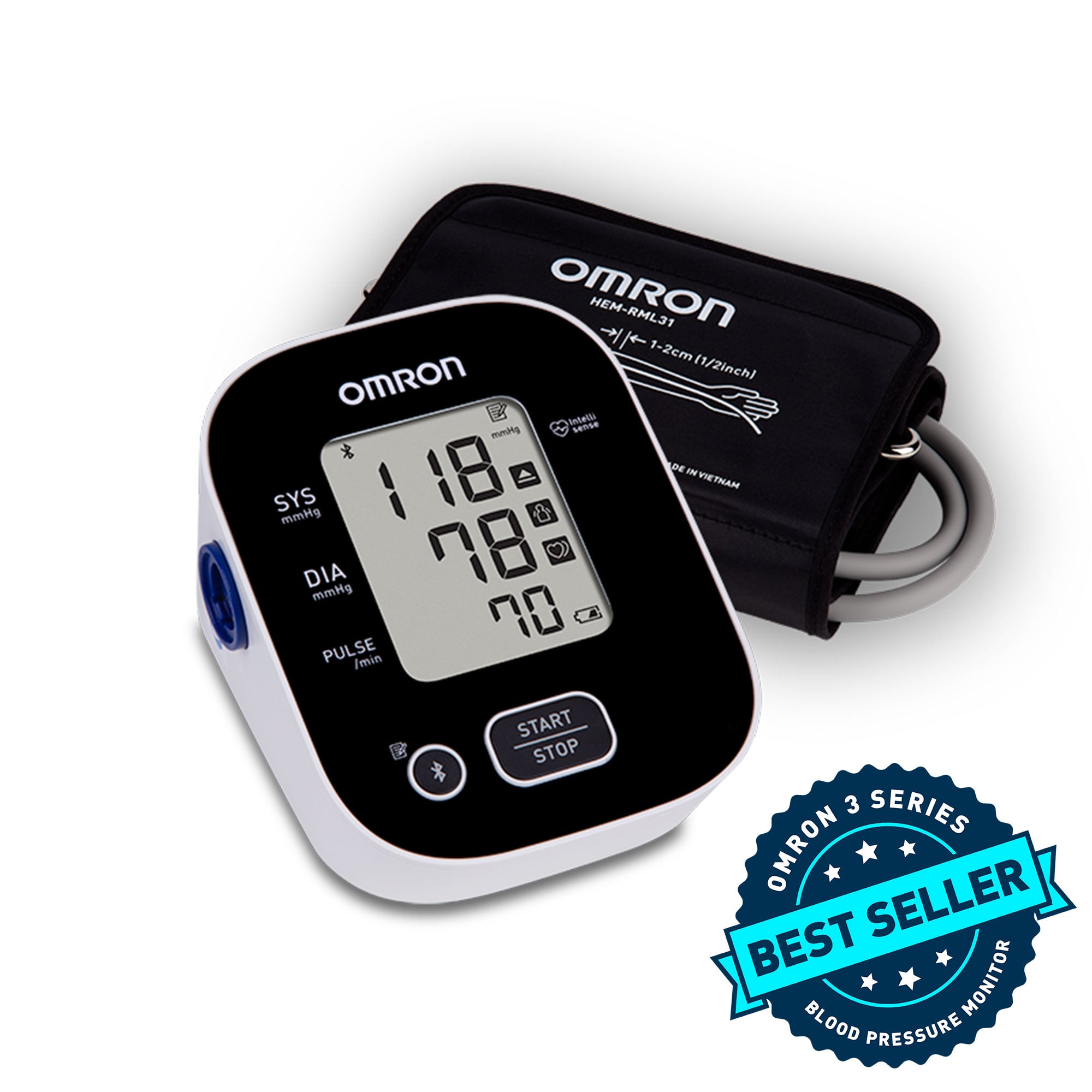
The OMRON 3 Series Upper Arm Blood Pressure Monitor, model BP7150, is the Bluetooth version of Omron's entry-level arm cuff monitor, listed at a $59.99 MSRP on omronhealthcare.com. It measures systolic and diastolic pressure and pulse by the oscillometric method, flags irregular heartbeats and body movement during a reading, and pushes results to the free OMRON connect app. Omron calls it the best-selling blood pressure monitor in the US, citing 2025 NielsenIQ data, and that claim is about volume, not about accuracy.
This review is built from Omron's product listing, Omron's clinical validation page, the BP7150 instruction manual, and the validatebp.org device entry. Nothing here is drawn from using the monitor. A home blood pressure monitor is a regulated medical device; readings taken at home are for tracking and for discussion with a clinician, nothing in this article is medical advice, and a clinician decides what any reading means. Omron's manual says the same thing in capital letters.
Our verdict
Buy the BP7150 when you need a basic upper arm monitor whose clinical validation is documented in public: Omron cites ESH-IP and ISO 81060-2 testing for this exact model, and validatebp.org lists it. The 14-reading memory and the single-user design are the constraints, and the OMRON connect app is how Omron expects you to get around them.
- A good fit for
- One adult who wants a validated cuff monitor for tracking readings at home, is willing to run the OMRON connect app on a phone for history and sharing, and has an upper arm between 9 and 17 inches around.
- We would skip it if
- Two people will share the monitor, you want the date and time stored on the device itself, or you need a monitor that averages several readings on its own. Omron's spec table marks all three as No for this model.
Reasons to consider it
- Omron cites ESH-IP and ISO 81060-2 testing for the BP7150 on its clinical validation page, and the AMA-backed validatebp.org listing names the model directly.
- The included cuff covers 9 to 17 inches of upper arm, which Omron describes as fitting standard and large-sized adult arms, and Omron sells a 7-to-9-inch cuff separately.
- Two-year limited warranty on the monitor body, with replacement as the remedy, for buyers who purchase from an authorized seller.
The compromises
- Memory holds 14 readings for one user, and the date and time stamp exists only in the app, so the device alone is a poor log.
- Four AA batteries and the AC adapter are both sold separately, and the manual rates a fresh set of alkalines at roughly 500 measurements.
- No two-user mode, no averaging, no backlight, no storage case, and no AFib screening, each marked No in Omron's spec table for this model.
What we have not verified: Every accuracy and validation statement here is Omron's or the VDL committee's, not a measurement of a unit in hand. Omron's listing describes the product as registered with the FDA as a medical device; no clearance number appears on the pages fetched, so the regulatory status is reported in Omron's words only. Retail prices vary and the $59.99 figure is Omron's MSRP on the day checked.
The things in this guide
A closer look at the products, who they may suit, and what to check before buying.
OMRON 3 Series Upper Arm Blood Pressure Monitor (BP7150)
The validation trail is public and specific to this model number, the cuff range is wide, and the monitor warranty runs two years. For basic home tracking with a phone alongside it, the spec sheet covers what the task needs.
Before you buy: Fourteen readings, one user, no on-device date and time, and no batteries or adapter in the box. Households with two users, or a buyer who needs a device-only log, should look further up Omron's range.
Price checked September 11, 2026. Retailer prices can change.What the BP7150 does and what $59.99 covers
Omron's manual defines the intended use plainly: a digital monitor for measuring blood pressure and pulse rate in adults, at home, that also detects irregular heartbeats during a measurement and warns with the reading. The BP7150 inflates the cuff with an electric pump, deflates through an automatic valve, and shows systolic, diastolic, and pulse on an LCD. The stated measurement range is 60 to 260 mmHg systolic and 40 to 215 mmHg diastolic, with pulse from 40 to 180 beats per minute.
The box holds the monitor, the wide-range D-ring cuff, an instruction manual, and a quick start guide. Batteries are not in it: the monitor runs on four AA alkaline or manganese cells, and the AC adapter is an optional accessory sold separately. On Omron's spec table the model number is BP7150, the UPC is 073796271503, the monitor weighs 0.55 lb, and the footprint is 5.5 by 4.1 by 3.2 inches. The $59.99 figure is Omron's MSRP; Omron routes purchases through a Where to buy page, so the checkout price depends on the retailer.
What Omron says about accuracy, and who checked it
The listing labels it the BP7150 as clinically validated for accuracy and says it meets the US Validated Device Listing criteria for clinical accuracy. Omron's clinical validation page explains that the American Medical Association convened experts to write the VDL criteria and that NORC at the University of Chicago manages an independent physician committee that reviews the evidence. On that page, the BP7150 row shows checks under ESH-IP and ISO 81060-2 and leaves the AAMI and BHS columns blank. The manual adds the specifics: the monitor was clinically investigated to ISO 81060-2:2013, complies with ISO 81060-2:2013 and ISO 81060-2:2018+A1:2020, and the study used K5 on 85 subjects for diastolic pressure. It also states that the monitor has not been validated for use on pregnant patients.
The manual's specification table gives a pressure accuracy of plus or minus 3 mmHg and a pulse accuracy of plus or minus 5 percent of the displayed reading. Omron's marketing adds a line about Advanced Accuracy technology measuring five times more data points than previous Omron models; that comparison is Omron's and is not tied to a published figure on the pages fetched. The validatebp.org entry, hosted by the AMA, lists the BP7150 with a 22 to 42 cm cuff range under the ANSI/AAMI/ISO 81060-2:2013 protocol, and the AMA disclaimer on that page says the listing implies no recommendation or endorsement. On regulatory status, Omron's wording is that the product is registered with the FDA as a medical device; the pages fetched give no clearance number, so that phrase is quoted as written.
Cuff range, batteries, and the 14-reading memory
The included cuff is Omron's wide-range D-ring cuff, part number HEM-RML31-B, sized for adult upper arms from 9 to 17 inches around (22 to 42 cm). Arms from 7 to 9 inches need the optional HEM-CS24-B small cuff, sold separately. The manual lists the cuff at roughly 6 oz with a 29.5-inch air tube, and the cuff carries its own one-year warranty, shorter than the monitor's two years. Measure the arm before ordering; Omron's manual states that only the approved cuff should be used and that other cuffs may produce incorrect readings.
Power comes from four AA batteries, which Omron rates at approximately 500 measurements on new alkalines with the included cuff, or from the optional AC adapter. Neither is in the box. Memory is the tightest spec on the sheet: the monitor stores 14 readings for a single user, and the date and time stamp exists in the app only. Omron's table marks Two-user mode, Guest mode, Advanced averaging, Morning average, TruRead, backlit digits, and a storage case all as No. Omron's stated service life is five years or 10,000 uses for both the monitor and the cuff.
The OMRON connect app, the indicator icons, and the warranty
Bluetooth Low Energy is on by default and pairs the monitor with the free OMRON connect app on select iOS and Android devices, where Omron says storage is unlimited, readings appear as trend graphs, and results can be shared with family, caregivers, and doctors. With 14 on-device slots and no on-device timestamp, the app is where the actual record lives; without it, the BP7150 is a monitor with a short scrollback. The manual notes that the radio runs in the unlicensed 2.4 GHz band, that Bluetooth can be disabled with a long press, and that batteries should not be swapped while a transfer is running.
Two icons show up alongside readings. The irregular heartbeat symbol appears when the rhythm during a measurement is uneven, and the manual's advice if it keeps appearing is to consult a physician. The hypertension indicator lights when a systolic reading reaches 130 mmHg or a diastolic reading reaches 80 mmHg; those cutoffs are fixed in the device, and what a flagged reading means for a given person is for a clinician to decide, which Omron's manual states in its own warnings. The limited warranty covers the monitor for two years and the cuff for one year from purchase, for the original retail purchaser, only when bought from an OMRON-authorized seller, and the remedy is replacement.
When to skip the BP7150
Skip it if two adults in the household will use one monitor. The BP7150 has one memory bank of 14 readings and no guest mode, so a second person's readings either overwrite the first person's or have to be sorted out in the app on one phone. Skip it if you want a device that keeps a dated log on its own; the date and time stamp is app-only, and a paper notebook next to the monitor becomes part of the setup. Two-user memory and larger stores are exactly the rows Omron's spec table marks as No here; they belong to other models in Omron's range that this review did not check.
Skip it if your upper arm is under 9 inches or over 17 inches around, since the included cuff will be out of range and only the 7-to-9-inch small cuff is offered as an option. Skip it if you expect the box to be complete: four AA batteries and the AC adapter are extra purchases, which moves the real starting cost above $59.99. And if you want a monitor validated for use during pregnancy, Omron's manual states that this one has not been.
How we put this together
Built from the product pages and listings below, without test scores or results we have not measured. Specifications and prices change, so check the original page for the exact model, current price, delivery, and returns.
- OMRON Healthcare: 3 Series Upper Arm Blood Pressure Monitor (BP7150) (opens in a new tab)
- OMRON Healthcare: Clinical validation (opens in a new tab)
- OMRON BP7150 instruction manual (PDF) (opens in a new tab)
- US Blood Pressure Validated Device Listing: 3 Series Upper Arm Blood Pressure (BP7150) (opens in a new tab)