Product image supplied by the brand
In this guide
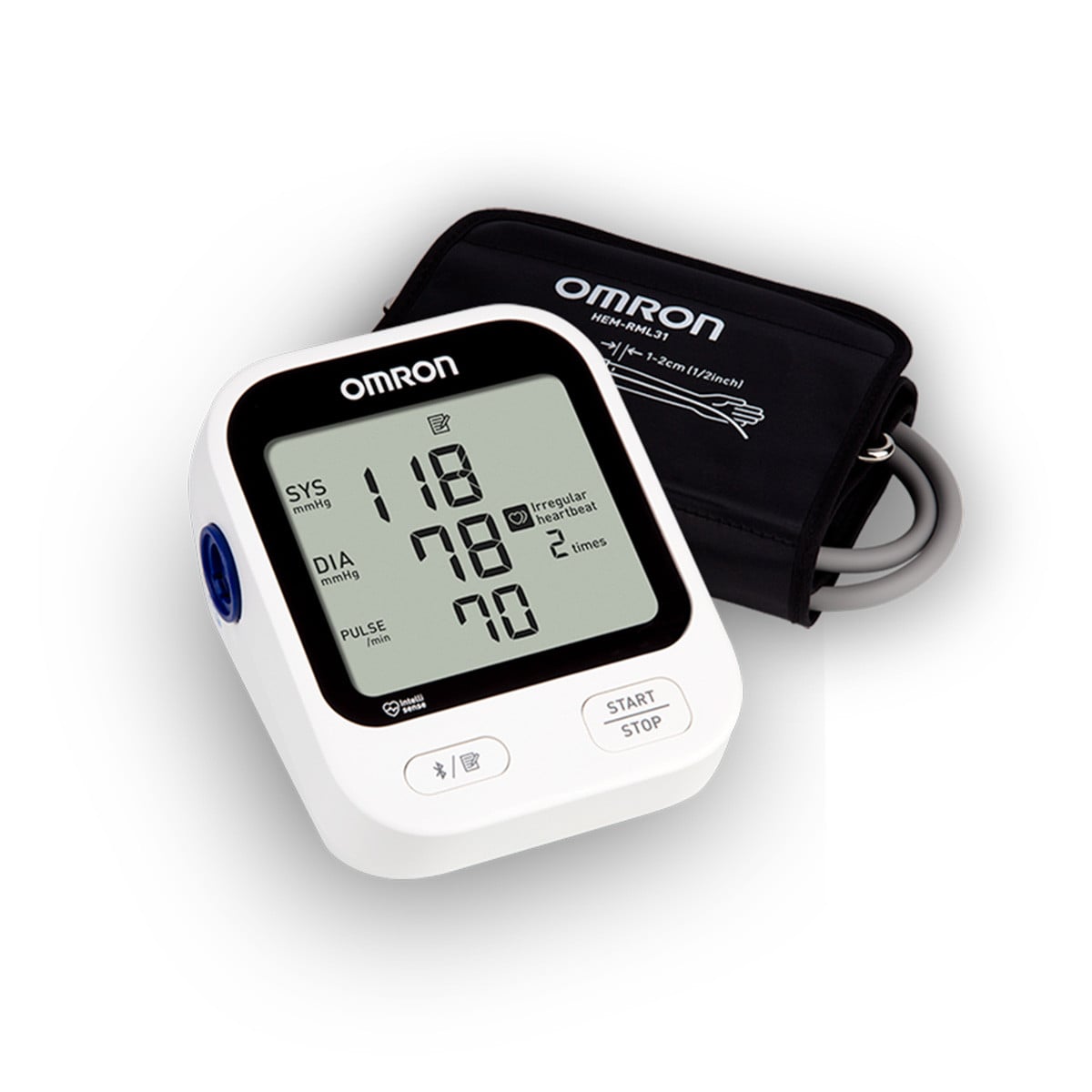
OMRON's 5 Series Upper Arm Blood Pressure Monitor carries an MSRP of $83.99 on omronhealthcare.com under model number BP7255. It sits one step above the 3 Series (BP7150, $59.99) in OMRON's numbered line, and the added cost goes into three concrete items OMRON lists: a 30-reading memory instead of 14, an irregular heartbeat counter where the 3 Series has only an indicator, a larger screen with icon descriptions, and four AA batteries in the box. The cuff, the Bluetooth radio, the body movement detector, the OMRON connect app, and the two-year monitor warranty are shared with the cheaper model.
Everything below comes from OMRON's own product page, the BP7255 instruction manual PDF, OMRON's clinical validation page, and the validatebp.org entry for this model. We did not take readings with it. A home blood pressure monitor produces numbers, and OMRON's manual is blunt about what to do with them: "NEVER diagnose or treat yourself based on your readings. ALWAYS consult with your physician." This article describes the device; it does not tell you what any reading means.
Our verdict
Buy the 5 Series if you take readings at home for a doctor who has asked for them and you want the monitor itself to count irregular beats and hold a month of results between syncs. OMRON puts this model on the US Validated Device Listing and prints a pressure accuracy of plus or minus 3 mmHg in the manual, but the numbers on the screen are data for a clinician to interpret, not a diagnosis.
- A good fit for
- One adult with an upper arm between 9 and 17 inches around who wants a validated cuff monitor, on-device storage for 30 readings, and Bluetooth transfer into the free OMRON connect app.
- We would skip it if
- Two people will share the monitor (there is no two-user mode), you need an AC adapter in the box, or your arm falls outside the 9-to-17-inch cuff range and you are not prepared to buy the 7-to-9-inch cuff separately.
Reasons to consider it
- OMRON lists the monitor on the US Validated Device Listing (VDL) and cites ISO 81060-2:2013 in the manual, with a stated pressure accuracy of plus or minus 3 mmHg and pulse accuracy of plus or minus 5 percent.
- The device stores 30 readings for one user, detects body movement during a measurement, and counts up to three irregular heartbeats per reading, all on the monitor without the app.
- Four AA batteries ship in the box, and OMRON rates a set at roughly 500 measurements with the included cuff.
The compromises
- Single-user only: no guest mode, no two-user mode, and no morning average or weekly averaging on the device.
- Date and time stamps live only in the OMRON connect app, so the 30 on-device readings have no timestamp until you sync them.
- The AC adapter (HEM-ADPTW5) is optional and not included, and the small 7-to-9-inch cuff is sold on its own.
What we have not verified: We have not used this monitor. Accuracy, battery life, and validation statements are OMRON's, drawn from its product page, instruction manual, and clinical validation page, plus the AMA-run validatebp.org listing. OMRON's US site lists the 5 Series as model BP7255; the earlier BP7250 appears only on OMRON's clinical validation page and has no live product page we could read.
The things in this guide
A closer look at the products, who they may suit, and what to check before buying.
OMRON 5 Series Upper Arm Blood Pressure Monitor (BP7255)
A VDL-listed upper arm monitor with a wide-range cuff, 30 stored readings, an irregular heartbeat counter, a labeled large screen, Bluetooth sync, and batteries included, for $24 more than OMRON's 3 Series.
Before you buy: Built for one user with no on-device averaging or timestamps; a second person, a small arm, or wall power each adds a purchase or a compromise.
Price checked September 11, 2026. Retailer prices can change.What $83.99 puts on the table
OMRON's specifications table for the BP7255 lists a 0.75 lb monitor measuring 5.3 by 4.3 by 3.3 inches, an LCD with large icons and on-screen descriptions, Bluetooth, and a memory of 30 readings for a single user. The carton holds the monitor, the wide-range D-ring cuff for adult upper arms of 9 to 17 inches (22 to 42 cm), four AA batteries, an instruction manual, and a quick start guide. The manual adds a weight of roughly 12 oz for the monitor without batteries and about 6 oz for the cuff.
The feature checklist OMRON publishes is as useful for what it marks No as for what it marks Yes. Yes: advanced accuracy, body movement detection, a hypertension indicator, an irregular heartbeat count up to three, and OMRON connect compatibility. No: one-touch use, AFib screening, advanced averaging, guest mode, two-user mode, a morning hypertension indicator, a weekly morning average, TruRead, a backlit extra-large display, a 1-lead EKG, and a storage case. Date and time stamps are marked as available in the app only.
The three flags the monitor raises, in OMRON's words
OMRON describes the hypertension indicator as an alert that appears if the systolic (upper) measurement reaches 130 mmHg or above, and/or if the diastolic (lower) measurement reaches 80 mmHg or above. The manual ties those thresholds to the ACC/AHA 2017 categories for adults and prints a warning in capitals next to the table: never diagnose or treat yourself based on your readings, and always consult with your physician. The indicator is a threshold comparison on the device, not an assessment of you.
The irregular heartbeat counter, per OMRON, alerts you to the number of irregular heartbeats detected during a measurement, up to three; the manual says the symbol appears when an irregular rhythm is detected two or more times in one reading. The body movement detector, which OMRON marks Yes on the 3 Series as well, warns when motion or other errors were detected so you can sit still and repeat the measurement. OMRON's checklist marks AFib screening as No for this model, so the counter is a count, not a screening tool, and any pattern in those counts is something for a clinician to read.
What clinically validated means here
OMRON's product page uses the phrase "Clinically validated for accuracy" with a footnote to its own clinical validation page, and separately states that the monitor "meets the U.S. Validated Device Listing (VDL) criteria for clinical accuracy" and "is registered with the FDA as a medical device." The validation page explains that the VDL is a list maintained through an AMA-convened process, with an independent physician committee managed by NORC at the University of Chicago reviewing clinical evidence. The validatebp.org entry for the BP7255 records the ANSI/AAMI/ISO 81060-2:2013 protocol and a 22-42 cm cuff range.
The manual gives the engineering numbers behind that language: a cuff pressure range of 0 to 299 mmHg, a systolic measurement range of 60 to 260 mmHg, a diastolic range of 40 to 215 mmHg, a pulse range of 40 to 180 beats per minute, and a stated accuracy of plus or minus 3 mmHg for pressure and plus or minus 5 percent of the displayed pulse reading. The same page notes that the monitor was clinically investigated to ISO 81060-2:2013, that K5 was used on 85 subjects for diastolic determination, and that the device "has not been validated for use on pregnant patients." The intended-use statement limits it to adults at home.
Bluetooth, the OMRON connect app, and four AA cells
The 5 Series syncs over Bluetooth to the free OMRON connect app, which OMRON says stores unlimited readings, shows trends on graphs, and lets you share results with family, caregivers, and doctors. Two details matter for anyone who plans to skip the app: the device itself holds 30 readings, the manual says the oldest reading is deleted once memory is full, and date and time stamps exist only in the app. Without a phone you get 30 untimed numbers in order. OMRON keeps a compatible-device list at OmronHealthcare.com/connect.
Power is four AA batteries, included, with the manual estimating approximately 500 measurements per set of new alkaline cells using the included cuff. The AC adapter jack is on the monitor, but the adapter (HEM-ADPTW5) is optional and not in the box. The manual also lists two contraindications: use in ambulatory environments and use on aircraft, and it asks you to disable Bluetooth or pull the batteries in RF-restricted areas. Service life is stated as five years or 10,000 uses for both monitor and cuff.
Against the $59.99 3 Series
OMRON prices the 3 Series (BP7150) at $59.99 MSRP, so the 5 Series costs $24 more. Both share the 9-to-17-inch D-ring cuff, Bluetooth, the OMRON connect app, the hypertension indicator, body movement detection, single-user operation, and the two-year monitor and one-year cuff warranty structure. Where the 5 Series pulls ahead on OMRON's checklist is memory (30 readings versus 14), the irregular heartbeat count up to three (the 3 Series shows an indicator with no count), the large screen with icon descriptions, and the four AA batteries in the box; the 3 Series page lists batteries as not included. Body movement detection and advanced accuracy are marked Yes on both.
What the 5 Series gives up is one-touch use, which OMRON marks Yes on the 3 Series and No here, an odd inversion at the higher price. Neither model offers two-user mode, averaging, or a backlight; those features start at OMRON's 7 Series and above. If the point of the purchase is a validated cuff that syncs to a phone, the 3 Series covers it. If you want a count of irregular beats, a labeled screen, and a month of readings held before you sync, the $24 buys exactly that.
Two years on the monitor, one on the cuff, replacement only
OMRON's warranty statement for the BP7255 covers the monitor, excluding the arm cuff and batteries, for two years, and the arm cuff for one year, in each case for defects appearing within that period when the monitor is used according to the instructions. Coverage runs to the original retail purchaser and only for units bought from an OMRON-authorized seller who follows OMRON's quality control standards. OMRON's remedy is replacement without charge of the monitor or cuff; it describes replacement as its only responsibility.
The site pairs that statement with a banner about counterfeit units sold online and asks buyers to purchase only from reputable, authorized resellers, which is also the condition for coverage. The manual carries the full terms. If you buy through a marketplace, the seller's status under OMRON's rules is the first thing to confirm, because an unauthorized source voids the two years before the monitor comes out of the box.
When to skip the 5 Series
Skip it if two adults in the house will take readings. There is no two-user mode and no guest mode, and the 30-reading memory has no name attached, so a second person's numbers land in the same untimed list; OMRON's checklist marks both features as No. Skip it if your upper arm is under 9 inches or over 17 inches around, because the included cuff will not fit and the 7-to-9-inch cuff is an extra purchase. Skip it when you expect the monitor to average readings or show a morning trend on its own screen; none of that exists below the 7 Series.
Also pass if you never intend to install the OMRON connect app, since the timestamps and unlimited history live there and the device shows only the last 30 values. And step back from the whole category if what you want is a diagnosis: OMRON's manual says never to diagnose or treat yourself based on readings, the device is contraindicated on aircraft and in ambulatory use, and it has not been validated on pregnant patients. If the $24 premium over the 3 Series does not buy anything you will use, the cheaper model shares the validation listing.
How we put this together
Built from the product pages and listings below, without test scores or results we have not measured. Specifications and prices change, so check the original page for the exact model, current price, delivery, and returns.
- OMRON Healthcare: 5 Series Upper Arm Blood Pressure Monitor (BP7255) (opens in a new tab)
- OMRON Healthcare: BP7255 instruction manual (PDF) (opens in a new tab)
- OMRON Healthcare: Clinical validation (opens in a new tab)
- validatebp.org: Omron 5 Series Upper Arm Blood Pressure Monitor (BP7255) (opens in a new tab)
- OMRON Healthcare: 3 Series Upper Arm Blood Pressure Monitor (BP7150) (opens in a new tab)