Product image supplied by the brand
In this guide
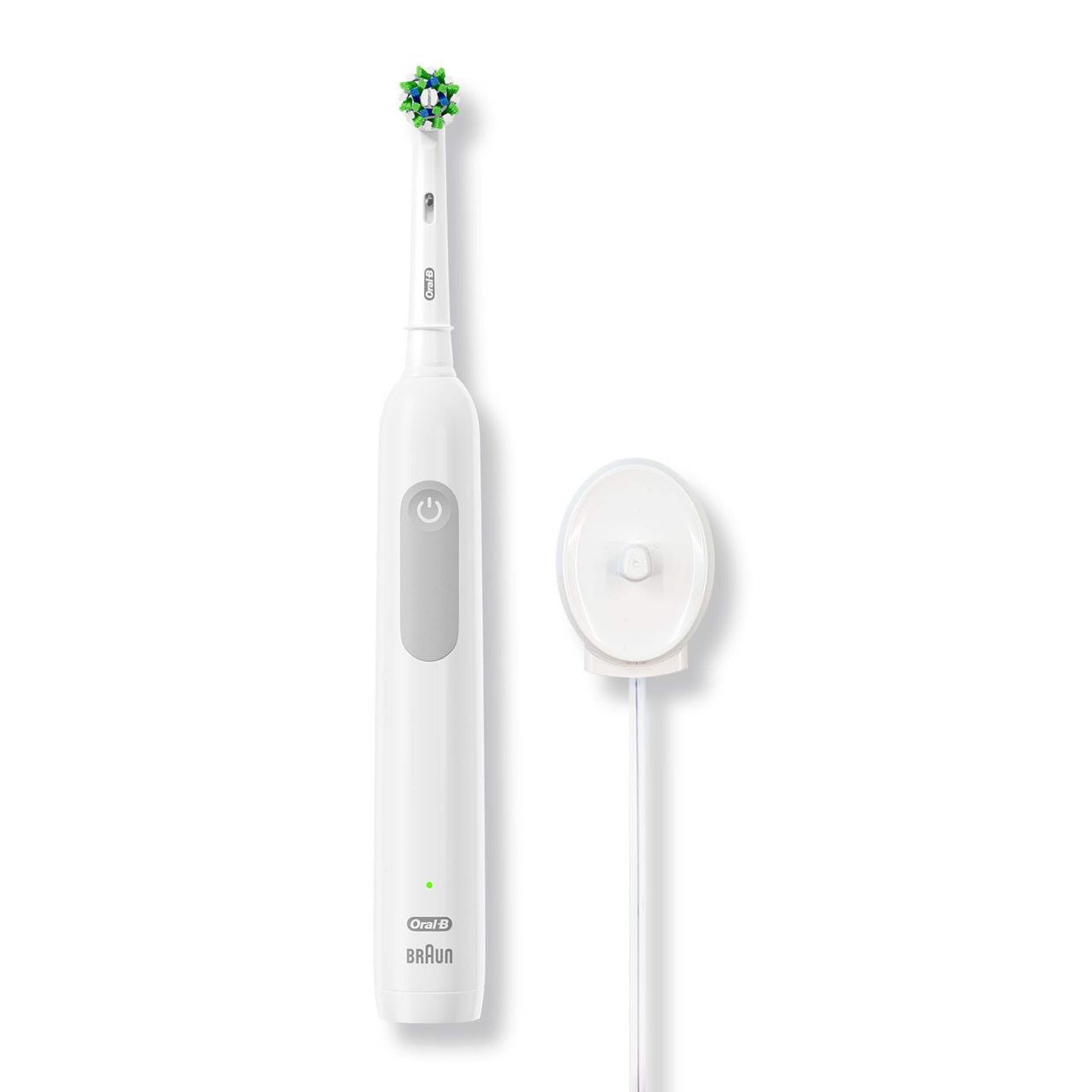
The Oral-B Pro 1000 opens the oscillating-rotating side of the electric-brush aisle: a Braun handle, type 3756, that oscillates a small head back and forth and pulses it against the tooth, shipped with one CrossAction head and a charging stand. Amazon's own offer sat at $49.94 on 2026-09-21, ready to ship from Amazon itself. Oral-B's direct store listed a gum-care variant of the same handle at $49.99 the same day, bundled with two ultra-thin-bristle heads in place of the CrossAction.
The pressure sensor is the clearest reason to spend more than on the Sonicare 1100: both provide timed pacing, while the Oral-B also changes its pulsation under excessive pressure. Refills deserve equal attention. Oral-B's store listed CrossAction X-Filament packs at $24.99 for two, $34.99 for three, and $64.99 for ten on 2026-09-21. At three-month changes, four heads represent about $26 to $50 of annual consumption. The supplied head covers the first interval, so that is an ongoing allowance, not the first year's extra bill.
Our verdict
Consider the $49.94 Pro 1000 for pressure feedback and timed brushing. Budget for replacement heads, and confirm the exact package before buying if a Sensitive mode is essential.
- A good fit for
- A first electric-brush buyer with a $50 budget who scrubs too hard or rushes, and who will swap the CrossAction head every three months without treating the extra cost as an afterthought.
- We would skip it if
- Choose the cheaper Sonicare 1100 if you only want timed pacing. For a Sensitive mode, travel case, or app coaching, verify those features on the exact package before paying.
Reasons to consider it
- The pressure sensor changes the brush's behavior instead of blinking at you: in the manual's description, the head keeps moving but the pulsation stops and the sound changes, so you hear and feel the correction
- The in-handle timer stutters at 30-second intervals and again at two minutes, remembers elapsed time through a brief switch-off, and resets only after a pause longer than 30 seconds
- The Pro 1000 is named on the ADA Seal of Acceptance record for Oral-B oscillating-rotating-pulsating brushes, and the manual lists eight Oral-B head types for the handle, with iO the one range Oral-B's page rules out, so two people in one bathroom can share a refill supply
The compromises
- The Ni-MH battery needs up to 22 hours on the charger for up to seven days of twice-daily brushing, against the up-to-14 days Philips lists for the Sonicare 1100
- Heads are the real cost: at Oral-B's direct prices a CrossAction X-Filament head runs $12.50 in a two-pack, $11.66 in a three-pack, and $6.50 in a ten-pack, so four heads a year cost between $26 and $50
- Oral-B's own pages disagree on the mode count — the single-unit listing filters it as one brushing mode while the twin-pack copy and the Amazon bullets promise three — and the manual only describes modes as depending on model
What we have not verified: The mode count is unresolved across Oral-B's own materials: the oralb.com single-unit listing tags the Pro 1000 with one brushing mode, the twin-pack page and Amazon's bullets list Daily Clean, Whitening, and Sensitive, and the shared manual describes modes only as depending on model. A buyer who finds three modes on the handle loses nothing; a buyer counting on a Sensitive mode should not assume it. The plaque-removal figure also varies by page — 300 percent more along the gumline on oralb.com, up to 100 percent more on Amazon — and both are manufacturer claims against a manual brush with no independent test consulted. Oral-B's voltage is printed only on the charger base, so dual-voltage travel use is unconfirmed. Head prices above are Oral-B direct on 2026-09-21; retailer packs may run lower.
The things in this guide
A closer look at the products, who they may suit, and what to check before buying.
Pro 1000 CrossAction Rechargeable Toothbrush (White)
$49.94 on Amazon, sold from Amazon's own inventory on 2026-09-21, buys the type 3756 handle with a pulsation-stopping pressure sensor, a 30-second quadrant pacer, a two-year limited warranty, an ADA Seal listing, and a handle that takes the eight Oral-B head types the manual lists but not iO heads.
Before you buy: Allow about $26 to $50 annually for CrossAction refills after the included head, using Oral-B store pricing. The published manual lists up to seven days per charge; mode counts differ between listings.
Price checked September 21, 2026. Retailer prices can change.The two features that justify the handle
Oral-B's manual for the type 3756 handle describes the pressure sensor as a behavior change, not a light: 'the movement of the brush head will continue but the pulsation will stop. In addition you will also hear a different sound while brushing.' For a first-time electric user who has had no feedback on how hard they scrub, that feedback is the feature to pay for. It is built into the handle and needs no app. Oral-B's twin-pack copy puts the same claim in marketing form — the sensor 'stops pulsations if you brush too hard' — and the single-unit listing tags the handle with Pressure Sensor and a 2-Minute Timer.
The timer is the second reason. A short stutter every 30 seconds tells you to move to the next quadrant; a long stutter marks two minutes. The manual supplies two details: elapsed time survives a brief switch-off, and the count resets only after a pause longer than 30 seconds, so rinsing mid-brush does not restart the clock. Philips' own store listed the Sonicare 1100 at $19.96 on 2026-09-21; its spec table carries the same pairing — a two-minute SmarTimer and 30-second QuadPacer — plus one cleaning mode and a two-year limited warranty, and no pressure sensor. The roughly $30 premium buys pressure feedback; Philips advertises the longer battery interval. Neither specification establishes which cleans better for an individual user.
One mode or three: Oral-B's pages disagree
Read the mode count as unsettled. The single-unit Pro 1000 gum-care listing on oralb.com — the $49.99 bundle with two ultra-thin-bristle heads — carries the site's own attribute '1 Brushing Mode'. The twin-pack page for the CrossAction configuration says 'Rechargeable battery toothbrush with 3 modes - Daily Clean, Whitening, and Sensitive', and Amazon's bullets repeat '3 EASY-TO-USE CLEANING MODES'. The manual, shared across the whole Pro line, hedges with 'Brushing modes (depending on model)' and notes the handle 'automatically starts in the Daily Clean mode'.
Treat Daily Clean as the minimum to expect, and verify the package if you need more. The manual recommends Sensitive mode for sensitive teeth and gums, optionally paired with a Sensitive Gum Care head; it does not say a softer head duplicates a gentler motor setting. It also tells people undergoing treatment for an oral condition to consult their dental professional before use. Oral-B's $49.99 gum-care bundle includes two ultra-thin-bristle heads, but its page does not name them. That bundle is an option for buyers seeking those bristles, not proof of additional modes.
Four heads a year, priced three ways
Oral-B specifies head replacement every three months, or sooner when worn. Its 2026-09-21 CrossAction prices were $24.99 for two, $34.99 for three, and $64.99 for ten, equivalent to roughly $12.50, $11.66, and $6.50 per head. Four per year therefore consume $49.98 at two-pack pricing or about $26 at ten-pack pricing. Buying ten means paying $64.99 upfront for 30 months of replacements at that interval. A cheaper listed option was Daily Clean at $39.99 for eight, roughly $20 of annual consumption.
The included CrossAction head changes the initial budget: three replacement heads cover the remaining nine months of the first year. One three-pack costs $34.99, bringing the handle plus that pack to $84.93 at the recorded prices. Two two-packs cost $49.98 and leave one spare; a ten-pack lowers the unit cost but ties up more money upfront. Philips' C1 head price was absent from the cited store page on 2026-09-21, so these figures do not establish which brand is cheaper to maintain.
For households already using compatible Oral-B handles, a shared refill supply can simplify ordering. The manual names CrossAction, Precision Clean, FlossAction, 3D White, Sensitive Gum Care, Ortho, Power Tip, and Deep Sweep; iO heads do not fit. Each user still needs a separate head.
Charging at home and taking the brush abroad
The published Pro 1000 manual specifies a Ni-MH cell, charging of up to 22 hours, and up to seven days between charges with two two-minute sessions daily. It permits storage on the powered stand and calls for discharge through normal use at least every six months. Philips advertises up to 14 days for the Sonicare 1100. Its longer stated interval leaves more margin on a week away, but neither maximum guarantees a particular trip without charging. For the Pro 1000, pack its charger when traveling near or beyond that seven-day limit.
The manual describes a waterproof handle but prohibits use while bathing and immersion or dishwasher cleaning of the charger. For travel abroad, read the voltage marked under the stand. Oral-B's travel support page says chargers vary by region and a plug adapter does not change voltage. If the rating does not cover the destination's mains supply, use a suitable voltage converter or a manufacturer-compatible charger rated for that supply. The exact rating of the Amazon package's stand remains unconfirmed.
Warranty, refund window, the ADA record, and who should pass
The US manual provides two years of limited coverage for manufacturing defects, with repair or replacement at Oral-B's discretion. It excludes wear, cosmetic finish and misuse-related damage or inadequate maintenance. For third-party heads, the exclusion concerns handle damage attributed to that head; simply fitting one is not the stated trigger. The manual also describes a 60-day satisfaction offer paid by prepaid card, requiring original packaging, your original purchase receipt and a return postmarked within the deadline. Return postage is the buyer's expense. Confirm the current offer terms before relying on that older manual's refund program.
The ADA acceptance record expressly includes the Pro 1000 and supports plaque removal and helping prevent and reduce gingivitis when used as directed. It does not establish the product's changing percentage claims or superiority over the Sonicare 1100. For buying, the useful distinction is pressure feedback: pay the premium when that feature matters to you. If pacing is enough, the cheaper Sonicare remains the stronger budget choice. When additional modes are essential, resolve the exact package's specification before ordering.
How we put this together
Built from the product pages and listings below, without test scores or results we have not measured. Specifications and prices change, so check the original page for the exact model, current price, delivery, and returns.
- Oral-B: Pro 1000 Gum Care Rechargeable Electric Toothbrush (opens in a new tab)
- Oral-B: Pro 1000 Rechargeable Electric Toothbrush Twin Pack, Black and White (opens in a new tab)
- Braun / Oral-B service: PRO 1000 and Triaction 1000 user manual (USA, Canada), 91200965/XII-19 (opens in a new tab)
- Oral-B: CrossAction X-Filament Replacement Brush Heads, 3 Count (opens in a new tab)
- Oral-B: CrossAction X-Filament Replacement Brush Heads, 10 Count (opens in a new tab)
- American Dental Association: ADA Seal of Acceptance, Oral-B Oscillating-Rotating-Pulsating (opens in a new tab)
- Amazon: Oral-B Pro 1000 CrossAction Electric Toothbrush, White (ASIN B003UKM9CO) (opens in a new tab)
- Philips: Sonicare 1100 Series sonic electric toothbrush HX3641/02 (opens in a new tab)
- Oral-B: Using an electric toothbrush charger abroad (opens in a new tab)