Product image supplied by the brand
In this guide
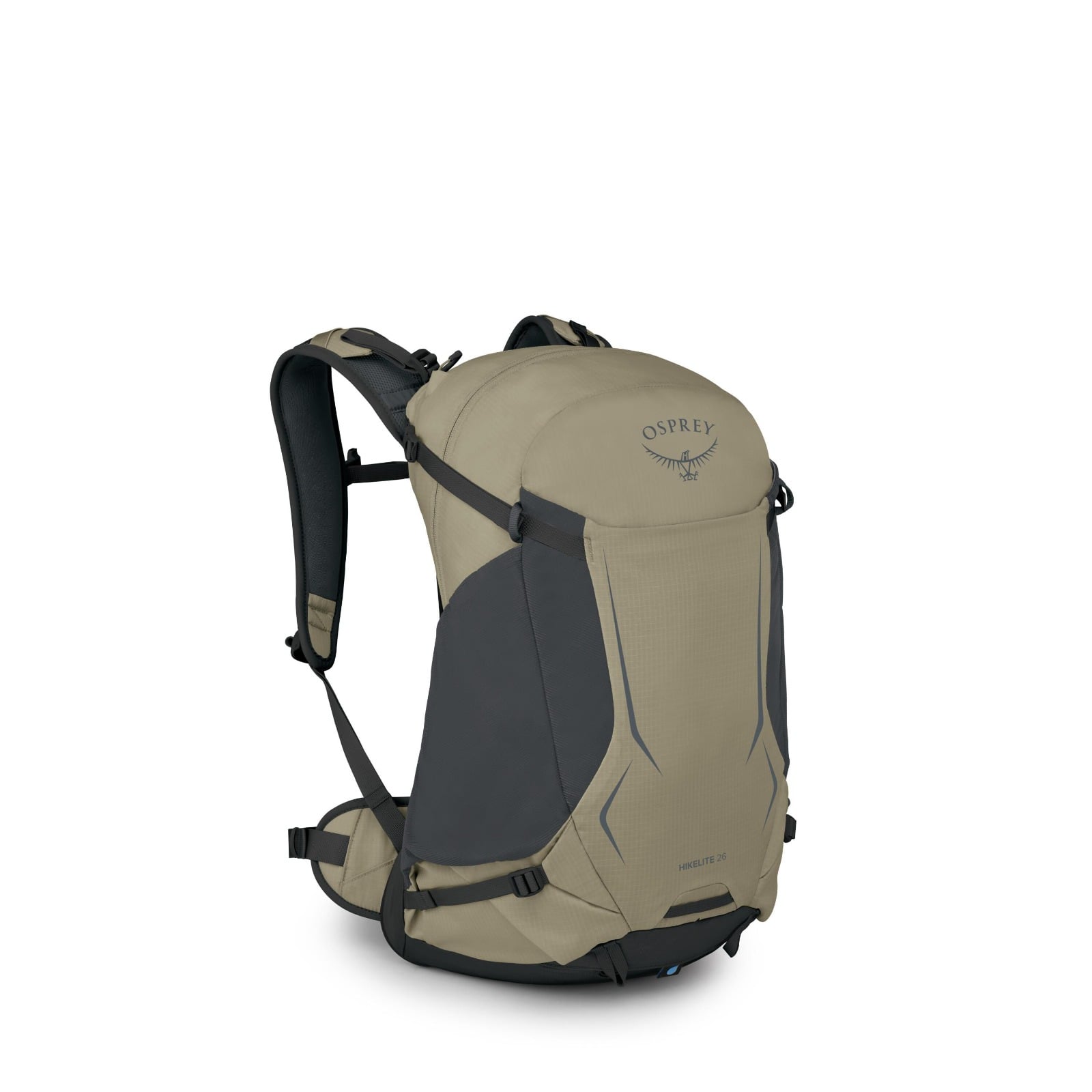
Osprey sells two families of small packs that look alike in photos and behave very differently on a trail. The Daylite line, which this site has already covered at $70 for 13 liters and $80 for 20 liters, is frameless: a foam panel against your back and a webbing belt. The Hikelite 26 is the next idea up. It puts a LightWire perimeter frame in the pack and stretches a mesh panel across it, so the bag rides on a taut screen with a channel of air between you and the load. Osprey lists it at $135 in a single O/S size.
Everything else on the Hikelite follows from that frame. It is a panel loader with a wide dual-zip opening, a front shove-it pocket, stretch side pockets for bottles, upper and lower compression straps, trekking-pole loops, a hydration sleeve with a hose port, and a raincover stowed in a pocket at the base. At 1.8 lb it weighs about half a pound more than a Daylite Plus. The decision to buy one is a decision about how much you carry and for how long, because the frame only pays for itself when there is weight to hold away from your back.
Our verdict
A properly suspended day-hiking pack at $135 that is worth the step up from a frameless daypack only if you carry ten pounds or more for hours at a time.
- A good fit for
- Full-day hikers who carry two liters of water, a layer, food and poles, and who sweat through the back of a foam-panel pack.
- We would skip it if
- Your walks are under two hours with a bottle and a jacket, or you need a pack that also behaves as a laptop bag on a commute.
Reasons to consider it
- LightWire frame plus AirSpeed tensioned mesh keeps the load off your back and lets air move behind it
- Raincover included and stored in its own base pocket, with pole loops, a whistle and a light loop already fitted
- 1.8 lb for 26 liters, in recycled 210D ripstop nylon with a PFAS-free water repellent
The compromises
- The frame and curved mesh back eat interior volume and make the pack awkward as a briefcase or under an airline seat
- Osprey rates it for 5 to 20 lb, so overnight loads or a heavy camera kit push past the design
- The hipbelt is plain webbing with small padded wings, not a load-bearing belt
What we have not verified: The pack was not carried for this piece; whether the trampoline back is comfortable on a long climb, whether the panel zip snags, and the real-world fit of the O/S torso length were not assessed.
The things in this guide
A closer look at the products, who they may suit, and what to check before buying.
Hikelite 26 · HIKELITE26S26
A wire frame and tensioned mesh backpanel, load lifters, a stowed raincover, pole loops and 26 liters of panel-loading space, all at 1.8 lb and $135 with Osprey's repair-or-replace guarantee behind it.
Before you buy: It is a hiking pack first: the frame steals interior room, the 20-lb load ceiling is real, and the webbing hipbelt does not carry weight.
Price checked September 11, 2026. Retailer prices can change.A wire frame and a mesh trampoline, and what they cost you
Osprey calls the system AirSpeed. A LightWire peripheral frame runs around the back of the pack and tensions a mesh panel, so the load sits behind a suspended screen instead of against foam. The harness is the brand's BioStretch design, spacer mesh over die-cut foam, with load lifters at the top of the shoulder straps and an adjustable sternum strap with a safety whistle. Osprey publishes a load range of 5 to 20 lb, which is the useful number: below five pounds the frame is dead weight, above twenty the webbing hipbelt runs out of things to do.
The price of that airflow is shape. A tensioned back curves inward, so part of the 26-liter figure is space that is awkward for flat or boxy items such as a laptop or a lunch container. The dimensions are 19.7 by 11.8 by 10.6 inches at 1.8 lb. Compared with the frameless Daylite Plus, which Osprey lists at 20 liters and 1.29 lb, you are paying about half a pound for the frame, the mesh, the raincover and six more liters. On a hot climb with two liters of water that trade is easy to defend; on a museum day it is not.
Panel access, a raincover in the base, and recycled ripstop
The main compartment opens through a wide dual-zip panel, which is friendlier than a top-loader when you are digging for a mid-layer at a rest stop. A top zippered pocket with a key clip holds small items, the front shove-it pocket takes a shell or a wet layer, and the stretch side pockets are sized for bottles. Inside is a hydration sleeve with a hose port and Osprey's Hydraclip hanger; no reservoir is included. Upper side compression straps double as pole-handle catches, lower front loops take the tips, and a blinker light loop sits on the back. The raincover comes in the box and lives in a dedicated pocket at the base of the pack.
Fabric is where Osprey has moved since the Daylite generation. The main body is bluesign-approved 100% recycled 210D high-tenacity ocean-sourced nylon with a ripstop grid, the lining is recycled 210D nylon and the bottom is recycled 420D nylon, all with a durable water repellent made without PFAS. Backpanel, harness and hipbelt mesh are recycled polyester, and the whole pack carries the bluesign product mark. A California Proposition 65 notice about dimethylformamide appears on the page; Osprey does not say which component it refers to.
$135 sits in the middle of a seven-pack range
The Hikelite 26 is one of seven packs in the line. Osprey's collection page lists the Hikelite 18 at $125, the 28 at $165 and the 32 at $175, and a lighter LT series at $95 for 16 liters, $110 for 22 and $120 for 30. The 26 costs $10 more than the 18 for eight more liters and the same suspension, which makes the 18 hard to recommend unless you are small or pack very light. Against the LT 22 at $110, the $25 premium buys the full frame and the larger opening; the LT packs are a different, lighter build.
The contrast with the Daylite family is the one most people will draw. The Daylite is $70 for 13 liters at 1.23 lb, and the Daylite Plus is $80 for 20 liters at 1.29 lb; both are frameless, both clip onto larger Osprey travel bags, and both live comfortably as everyday bags. The Hikelite 26 does none of the attaching and all of the carrying. Nearly doubling the price of a Daylite Plus buys a frame, a mesh back, a raincover and pole hardware, and nothing that helps on a commute. Five colors are offered at the same $135, with Raven Black out of stock at the time of research.
Osprey's guarantee covers damage, not scuffs
Osprey backs the Hikelite with its All Mighty Guarantee, which the brand states as a promise to repair any damage or defect free of charge whatever the pack's age, and to replace it if a repair is not possible. Cosmetic damage is excluded, and a handful of technical packs sit under a limited version of the program; the Hikelite is not one of them. Current turnaround is quoted at six to ten weeks, and Osprey suggests requesting parts for a faster self-repair when the fault is a buckle or a strap.
The practical conditions matter more than the headline. You pay to ship the pack to Osprey and the brand covers the repair and the return leg, so a traceable service is worth the cost. Dirty or odorous bags are sent back unrepaired, and moldy items are destroyed without replacement, which means a pack that has spent a wet season in a car trunk needs a wash before it goes anywhere. If Osprey decides a pack cannot be repaired it is recycled and replaced unless you tick the form to have it returned as is.
Skip it if your hikes fit in a Daylite
The frame is the entire case for this pack, and a frame is only useful under load over time. If a typical outing for you is a two-hour loop with a bottle, a snack and a windbreaker, the Hikelite 26 will feel like an empty shell on your back and the mesh panel will do nothing a foam pad would not. A Daylite or Daylite Plus at roughly half the cost covers that use, sits flat under a seat, and turns into a work bag on Monday. The Hikelite's curved back and hiking hardware make it a poor commuter.
Also pass if you tend to overload. Osprey's 20-lb ceiling is a design limit, not a suggestion; a camera body with two lenses, a full three-liter reservoir and a picnic for two will exceed it, and the webbing hipbelt has no structure to take the strain. In that case the Hikelite 32 at $175 or a pack with a real padded belt is the better spend. Buy the 26 for long, warm, ordinary day hikes with ordinary loads, which is what it was drawn for.
How we put this together
Built from the product pages and listings below, without test scores or results we have not measured. Specifications and prices change, so check the original page for the exact model, current price, delivery, and returns.
- Osprey: Hikelite 26 Hiking Backpack (opens in a new tab)
- Osprey: Hikelite collection (opens in a new tab)
- Osprey: All Mighty Guarantee (opens in a new tab)
- Osprey: Daylite (opens in a new tab)
- Osprey: Daylite Plus (opens in a new tab)