Product image supplied by the brand
In this guide
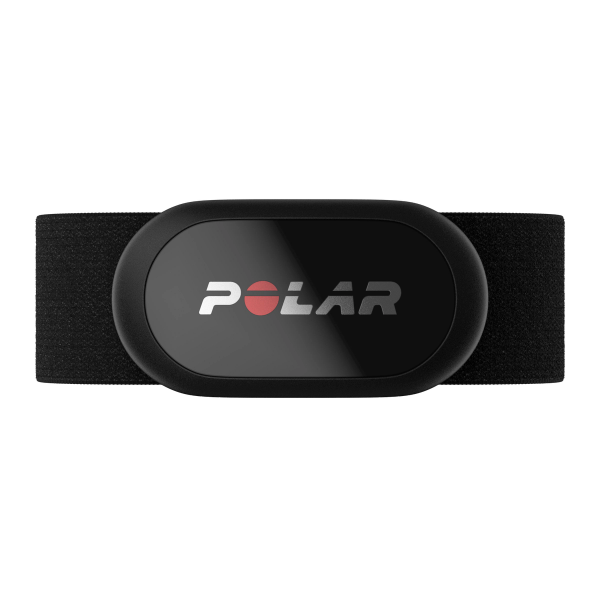
Polar sells the H10 for $104.95 in the US, a chest strap in Black, Red Beat or Black Crush with the sensor pod snapped onto it, and lists all four size-and-color variants in stock at that price. The $104.95 buys the Polar Pro Strap and the sensor, and nothing else. A Garmin, Fitbit or Apple watch already reads heart rate from the wrist, so the question is not whether the H10 can measure a pulse. It is where on the body that measurement happens, and what the watch's own sensor cannot reach.
The wrist sensor reads blood-volume changes with light; the H10 reads the heart's electrical signal from two electrodes pressed against the chest. Polar's own pages set out when each is the better tool, and the answer is narrow: the strap is aimed at fast, hard and motion-heavy sessions, and it asks you to put it on, moisten it, wash it and feed it coin cells. The six wearables already reviewed here each answer which device to wear; the H10 answers whether to add a sensor at all.
Our verdict
Buy the $104.95 H10 when hard intervals, sprints or racket sports are where you train, and accept washing a chest strap and buying its CR2025 cells. If your watch's readings never bother you, skip it.
- A good fit for
- A runner, cyclist or gym user whose watch already reads heart rate but whose hard intervals, sprints or racket sports are where that reading slips.
- We would skip it if
- Skip it if your watch's heart-rate readings have never given you a reason to doubt them, if you will not wash a chest strap weekly, or if you want a rechargeable sensor.
Reasons to consider it
- Two chest electrodes read the heart's electrical signal directly, the method Polar contrasts with the LEDs and photodiode a watch uses on the wrist, and each method comes with a different list of conditions that disturb it.
- The sensor sends over Bluetooth LE and ANT+ 2.1 at the same time, keeps Polar's older GymLink 5 kHz signal on by default, and lists a broadcast range of 295 ft.
- A 30-hour onboard memory records one session with no watch or phone alongside you once started from the Polar Beat app, then transfers when the sensor is back in Bluetooth range.
The compromises
- The strap is a second thing to wash: Polar asks for a rinse after every session and a 40 °C machine wash after every five workouts or at least weekly, with the connector detached each time.
- The battery is a user-replaced CR2025 coin cell rated at about 400 hours; it is not rechargeable, no cable is supplied, and Polar states a CR2032 cannot be used and may damage the sensor.
- The two-year guarantee covers the sensor but explicitly excludes the elastic chest strap and battery wear, so a worn strap is a $49.99 replacement.
What we have not verified: Polar publishes no head-to-head accuracy numbers for the H10 against a wrist optical sensor, so no size for any accuracy difference can be stated; the difference in measurement method, and Polar's own list of conditions that affect each, is what the evidence supports. Polar also gives no replacement interval for the strap beyond saying it wears out with use.
The things in this guide
A closer look at the products, who they may suit, and what to check before buying.
Polar H10 Heart Rate Sensor
A chest strap that reads the heart's electrical signal and sends it over Bluetooth LE, ANT+ and GymLink at a listed 295 ft, with about 400 hours from a CR2025 coin cell, a 30-hour single-session memory and a strap that goes in a 40 °C wash.
Before you buy: The strap is not covered by the two-year guarantee and wears out like clothing ($49.99 to replace), the coin cell is user-replaced and not rechargeable, and the memory holds only one session at a time.
Price checked October 15, 2026. Retailer prices can change.The measurement moves from the wrist to the chest
A wrist heart-rate sensor shines light into the skin and watches how much comes back; the volume of blood under the skin changes with each beat, and the sensor turns that into a pulse. The H10 works in a different way. Its two electrodes press against the chest, where the electrical signal that triggers each contraction reaches the skin, and the sensor reads that signal directly. Polar puts the distinction plainly: electrical sensing needs continuous skin contact at the chest, while the optical method is the one designed for a watch on the wrist. Neither is a failed version of the other; they measure different things at different distances from the heart.
The practical difference starts with placement. A wrist sensor can slide, sit on a bony wrist or lose contact as the arm bends; the chest strap is pulled snug by a buckle, and Polar asks the wearer to moisten the electrode area before starting. That preparation is the trade: the H10 offers a cleaner signal path in exchange for a device you have to put on deliberately, wet, and then clean. A watch already on your arm needs none of that.
The connector measures 2.6 by 1.3 by 0.4 in, and the strap and connector together weigh 2.1 oz; the pod alone is 0.7 oz, and that is the part held against the sternum. Water resistance is rated WR30, which Polar's own table places in the 20/30/50 m class suitable for swimming under ISO 22810. The pod is small enough to wear under a shirt, and because it detaches, the strap can go in the wash.
Where each method is likely to struggle
Polar's comparison says an optical sensor can be affected by movement and by ambient light, which is why a reading taken while the arm is swinging or a sleeve is shifting is the one most likely to look wrong. Polar lists the cases it built the chest strap for: high-intensity work and sports that throw the arms around, such as racket sports, plus intervals and sprints where the pulse climbs fast and the reading has to keep up. It also claims the electrical signal is not affected by temperature, water, sweat or skin pigmentation — a manufacturer's claim, stated as such, and one its own water-resistance page qualifies for swimming.
The chest method has its own failure modes, and Polar documents them. The strap has to be moistened and sit firmly, and a strap that shifts can lose the signal. Polar's water-resistance page is blunt about swimming: pool chlorine and seawater conduct, so the electrodes can short-circuit, and jumping in or hard strokes can move the strap off the spot where the signal is picked up. Polar says problems occur more frequently in water. The strap does not turn every session into a clean trace; it moves the weak point from the wrist to the electrode contact.
What the H10 sends, and how far
The H10 broadcasts over Bluetooth LE and ANT+ 2.1 at the same time, and by default it also carries Polar's older GymLink 5 kHz signal, which many gym machines and older Polar watches expect. The manual says two Bluetooth connections can run at once, so a phone and a watch can follow the same session, and unneeded connections can be switched off later to save battery. Polar lists the broadcast range at 295 ft; the manual's more useful guidance is to keep the receiving device in front of you, at the chest or on a belt, rather than on your back.
Compatibility follows from those radios. Anything that supports the standard Bluetooth heart-rate service or the ANT+ heart-rate profile can pair, which covers Polar's own watches, many other brands, phones and the gym equipment that takes the ANT+ or 5 kHz signal. Polar recommends pairing through its own app first so the sensor gets firmware updates, and it works with Polar Flow or Polar Beat as well as third-party apps. The strap is not locked to one ecosystem, which is the part a watch buyer should notice.
The 30-hour memory, and what it cannot do
The H10 carries a small memory of its own, rated at one training session of up to about 30 hours and recorded at one sample per second. It exists so a session can be logged with no watch or phone beside you: start the recording, leave the phone behind, and the strap holds the heart-rate file on board. On return, the data transfers once the sensor is back in Bluetooth range. For a gym session with the phone in a locker, or a ride where nothing should be on the wrist, the strap carries that session on board.
The limits are as specific as the feature. Only one session fits at a time — the next recording cannot start until the current one is uploaded — and the session has to be started in Polar's Beat app, so the phone is needed at the beginning and at the end, not in the middle. Polar's support page notes that only the start time is visible on the sensor side. The memory is a convenience for a single session, not a log that keeps weeks of history.
The second strap, the coin cell and the $49.99 replacement
The $104.95 buys the sensor and one Polar Pro Strap. Keeping the strap working is a routine: Polar asks for a rinse under running water after every session, and a machine wash at 40 °C after every five workouts or at least once a week, with the connector detached, no bleach or fabric softener, and no dryer. A washing bag is recommended. The strap is a second piece of laundry that has to be kept apart from the sensor, and it is not covered by the two-year guarantee — Polar's warranty explicitly excludes the elastic chest strap.
The battery is the other recurring cost. It is a CR2025 coin cell rated at about 400 hours, replaceable by the user but not rechargeable, and no cable is bundled. Polar states that a CR2032 cannot be used and may damage the sensor, so the replacement has to be the thinner cell. The strap wears out too: Polar says it wears out like any garment and that worn electrodes can produce unreliable readings. A replacement Pro Strap is $49.99, roughly half the price of the whole kit.
The wearables already reviewed answer a different question
Six wearables have been reviewed here: the Garmin Forerunner 165 and vívosmart 5, the Fitbit Charge 6 and Inspire 3, the Apple Watch SE 3 and the Oura Ring 5. Each starts from a different job — GPS on the wrist, payments, a subscription-free routine, sleep on a finger — and each reaches a buying decision about which device to wear. The H10 sits alongside those devices rather than replacing one: it takes over a single measurement they were not built to make from the chest.
Put the two questions next to each other. A watch review decides which device to wear all day, with the sensor living on the wrist and the trade-offs in screens, batteries, apps and subscriptions. The H10 assumes that device already exists and asks whether the measurement itself is good enough for the sessions that matter. The two can be worn together: the watch keeps the day's steps, sleep and notifications, and the strap takes over for the hard interval, the sprint or the racket game where the wrist reading is the part in doubt.
When the strap is not worth adding
Skip the H10 if the watch's heart-rate numbers have never given you a reason to doubt them. The case for it is the sessions where the wrist reading is the part you question — fast intervals, sprints, sports that swing the arms — and if your training is steady-state and indoors, the watch is already measuring what you need. And pass if a chest strap around the ribs is something you will not wear, because an unworn strap measures nothing.
Two more clean skips. If you will not rinse the strap after every session and machine-wash it weekly, the electrodes degrade and the readings get less reliable; Polar says the strap wears out regardless, and the guarantee will not cover it. If a rechargeable sensor is the requirement, the H10 is the wrong product, because it runs on a coin cell you buy and change yourself. Buy it when the session, not the day, is what you want measured well, and when you will accept the upkeep that comes with that.
How we put this together
Built from the product pages and listings below, without test scores or results we have not measured. Specifications and prices change, so check the original page for the exact model, current price, delivery, and returns.
- Polar: H10 Heart Rate Sensor product page (US) (opens in a new tab)
- Polar: H10 user manual, technical specifications (opens in a new tab)
- Polar: H10 user manual, caring for your heart rate sensor (opens in a new tab)
- Polar: H10 user manual, getting started and introduction (opens in a new tab)
- Polar support: How long a training session can I record with H10? (opens in a new tab)
- Polar support: Can I record my heart rate without a training device or a training app? (opens in a new tab)
- Polar: Water resistance of Polar products (opens in a new tab)
- Polar: Warranty (US) (opens in a new tab)
- Polar: Polar Pro Strap product page (US) (opens in a new tab)