Product image supplied by the brand
In this guide
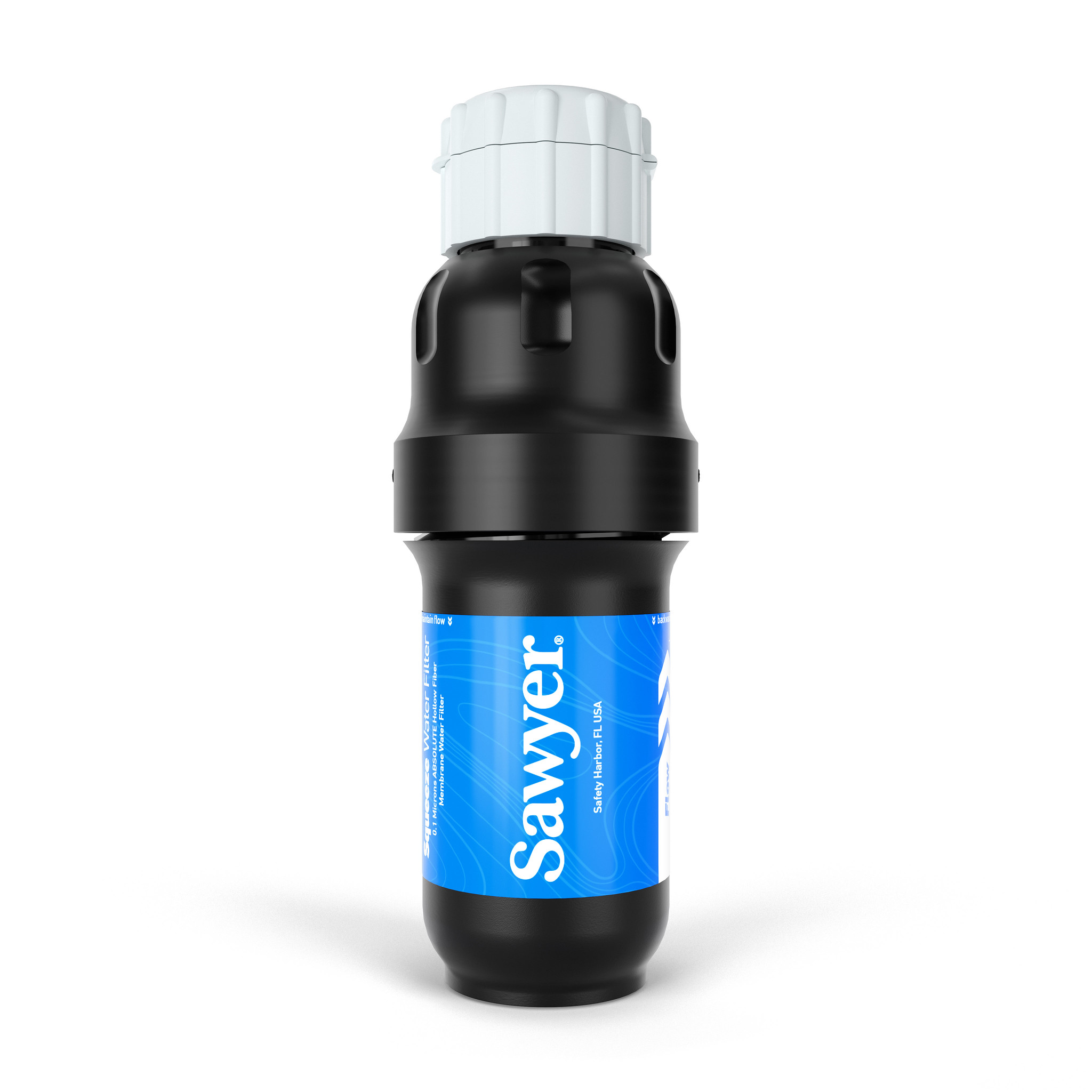
The Sawyer Squeeze is a small black cylinder of hollow-fiber membrane — 3 ounces on Sawyer's spec line, rated 0.1 micron absolute — that screws onto a squeeze pouch, a standard 28 mm bottle, or a hydration-pack hose. For about $46 it asks to be the only water treatment an overnight trip carries: drinking at the source, refilling bottles, and filling the cook pot.
Two questions decide it, and both have documented answers. The first is scope: Sawyer publishes removal claims for bacteria, protozoa, and microplastics, and makes none for viruses, chemicals, or heavy metals. The second is upkeep: flow comes back with a backflush rather than a replacement cartridge, and a filter that freezes after wetting is both ruined and unwarrantied — Sawyer says so in capital letters.
Our verdict
Buy the SP129 at $45.95 from Amazon's own listing when one filter must cover drinking, bottle refills, and camp cooking water; skip it for occasional day-hike sips, where the $17.95 LifeStraw Personal does the same microbial job for less.
- A good fit for
- Backpackers on overnight and longer trips who want one 3-ounce filter to cover drinking, bottle refills, and camp cooking water, with backwashing instead of replacement cartridges.
- We would skip it if
- Day hikers sipping occasionally at the source (the $17.95 LifeStraw Personal is lighter and cheaper), buyers worried about viruses or dissolved chemicals, and winter travelers who cannot keep the filter from freezing.
Reasons to consider it
- 0.1 micron absolute hollow-fiber membrane; Sawyer publishes 99.99999% bacteria, 99.9999% protozoa, and 100% microplastics removal
- Backwashing restores flow instead of replacement cartridges; Sawyer says no clogged filter has ever come back unrestorable
- Lifetime warranty on the filter; screws onto 28 mm bottles, Sawyer pouches, or a hydration hose
The compromises
- No published claims for viruses, chemicals, or heavy metals; dissolved tastes and odors pass through
- A wetted filter that freezes is both ruined and outside the warranty
- sawyer.com does not sell it; the buyable channel was Amazon's listing, and kit contents differ by seller
What we have not verified: No published figure covers flow rate in silty water or clogging over seasons, and the removal percentages rest on Sawyer's own lab citation. Amazon's listing calls the filter 2 ounces against Sawyer's 3; the figures are unreconciled. Sawyer's own page spells the independent lab two ways (Hydration, LLC. and Hydreion, LLC.) for the same report S05-03, so the citation could not be matched to a lab of record.
The things in this guide
A closer look at the products, who they may suit, and what to check before buying.
Squeeze Water Filtration System
$45.95 (2026-09-26, SP129, from Amazon's own inventory) buys a 3-ounce, 0.1 micron absolute filter that screws onto pouches, standard bottles, or a hydration hose, backwashes clean instead of taking cartridges, and carries a lifetime warranty on the filter itself — against $28.99–33.99 for Sawyer's slower MINI and Micro Squeeze.
Before you buy: Nothing published covers viruses, chemicals, or heavy metals; a wetted filter that freezes is ruined and unwarrantied; and sawyer.com itself is out of stock, so the kit contents follow whichever listing you buy.
Price checked September 26, 2026. Retailer prices can change.A 3-ounce filter head with four ways to connect
The Squeeze is a filter element, not a bottle: a black cylinder about the size of a fist with a 0.1 micron absolute hollow-fiber membrane inside. Sawyer publishes removal of 99.99999% of bacteria such as salmonella, cholera, and E. coli, 99.9999% of protozoa such as Giardia and Cryptosporidium, and 100% of microplastics, citing an independent lab report numbered S05-03. These are the manufacturer's figures, describing a mechanical barrier: whatever is larger than the pore stays outside the fibers.
Connection is the format's real feature. The filter is dual-threaded to the 28 mm standard, so it screws onto Sawyer's pouches and most disposable water bottles; a flip-top sports cap lets you drink straight from it; and adapters put it in line with a hydration bladder or a gravity hose. Sawyer's own FAQ places it in a family: the Micro Squeeze is half its length, the MINI about half its width, both around 2 ounces, and the Squeeze is the fastest-flowing of the three.
The claims stop at bacteria, protozoa, and particles
The published percentages cover organisms and particles, and Sawyer makes no virus, chemical, or heavy-metal claim for this filter anywhere on its product page. Its FAQ adds that dissolved solids — tastes, colors, and odors — pass through any of its filters, and the warranty page answers a flat no on salt. If the water that worries you sits downstream of farms, industry, or a city with viral risk, none of the Squeeze's published claims address it.
This matters because the percentages read impressively without their boundary. A 0.1 micron absolute membrane is a fine sieve for bacteria and protozoa; viruses run smaller than the pore, and dissolved contamination is not a size problem at all. Buying the Squeeze means accepting Sawyer's own scope: clear backcountry sources where the realistic concern is microbial, with source selection still doing part of the work.
What comes with it depends on where you buy
Sawyer's product page lists the kit as the filter, two reusable BPA-free collapsible pouches, a cleaning plunger, a cleaning coupling, gravity tubing, inline hydration-pack adapters, and a mesh storage bag. Amazon's SP129 listing — the channel that had stock — describes its box as two 32-ounce pouches, a drinking straw, and a hydration-pack adapter set, with a mesh bag added in the bullet points. Buy against the listing you are actually reading; the accessories differ by seller.
Upkeep is backwashing rather than replacement: push clean water backward through the fibers with the plunger before the initial use, when flow drops, and before prolonged storage. Sawyer says it has never received a clogged filter it failed to talk a customer through restoring, and it rates the system for up to 20 psi of pressure, with stress cracks developing around 30. The only recurring purchase is the pouch itself: a set of three 32-ounce replacement pouches lists at $10.49 on Sawyer's site.
Lifetime coverage with one fatal exception
The warranty runs for the filter's lifetime against manufacturing defects, but it covers the filter itself, not the pouches, caps, or adapters that come with the system. Note also where the gallon figure lives: Sawyer's warranty page rates the MINI and Micro Squeeze up to 100,000 gallons, while the Squeeze's own US page offers no gallon number at all, only the lifetime warranty. Treat any six-figure lifespan attached to this model as borrowed from its siblings.
The exception is cold. Once a filter has been wetted it never fully dries, and freezing voids the warranty — the warranty page states, in capitals, that there is no warranty for a frozen filter, and since testing frozen fibers costs more than the filter, Sawyer recommends replacing a suspect one. Its advice for freezing trips is to carry the filter in a pocket against your body and to sleep with it. A never-wetted filter, by contrast, can freeze safely.
Where $45.95 sits
sawyer.com lists the Squeeze at $45.99 but does not sell it: the page is out of stock and points to stores. The buyable channel was Amazon's listing for SP129 at $45.95, marked In Stock, the seller Amazon.com itself, checked 2026-09-26 with delivery to New York 10001.
Inside the family, the MINI lists at $28.99 and the Micro Squeeze at $33.99 on Sawyer's pages, and the FAQ is direct about what the extra dollars buy: the Squeeze flows faster than the Micro, which flows faster than the MINI, while backwashing frequency runs in the opposite direction. Saving $12 to $17 and an ounce suits solo hikers who drink straight from the source; filling bottles and pots for two people is where the Squeeze's flow earns the difference.
When a straw or a different tool makes more sense
If the need is occasional sips at a source on day hikes, the LifeStraw Personal covers the same microbial class for $17.95 at 1.6 ounces — well under half the money, rated to 1,000 gallons, with nothing to backwash. At $44.95 the LifeStraw Go bottle treats one person's drinking and adds a carbon stage that wants replacing about every two months. Neither fills a cooking pot; that is the capability the extra spend here buys.
Pass on the Squeeze when viruses or dissolved chemicals are the concern, because no published claim covers them; when a trip will freeze the filter and pocket carry is not realistic; and when sources run silty enough that constant backflushing would sour the trip — Sawyer puts the interval at every 10 gallons in turbid water against 1,000 in clear. Buy it when one filter must serve bottle, pouch, and camp kitchen on trips measured in nights, not hours.
How we put this together
Built from the product pages and listings below, without test scores or results we have not measured. Specifications and prices change, so check the original page for the exact model, current price, delivery, and returns.
- Sawyer: Squeeze Water Filtration System product page (SP129CL) (opens in a new tab)
- Sawyer: Lifetime Warranty (opens in a new tab)
- Sawyer: Water Filtration FAQs (opens in a new tab)
- Amazon: Sawyer Products SP129 Squeeze Water Filtration System listing (ASIN B00B1OSU4W) (opens in a new tab)
- Sawyer: 32 oz Squeezable Pouch, set of 3 (SP113) (opens in a new tab)
- Sawyer: MINI Water Filtration System product page (SP128FC) (opens in a new tab)
- Sawyer: Micro Squeeze Water Filtration System product page (SP2129) (opens in a new tab)
- LifeStraw: Personal Water Filter Straw product listing (opens in a new tab)
- LifeStraw: Go Series 22 oz product listing (opens in a new tab)