Product image supplied by the brand
In this guide
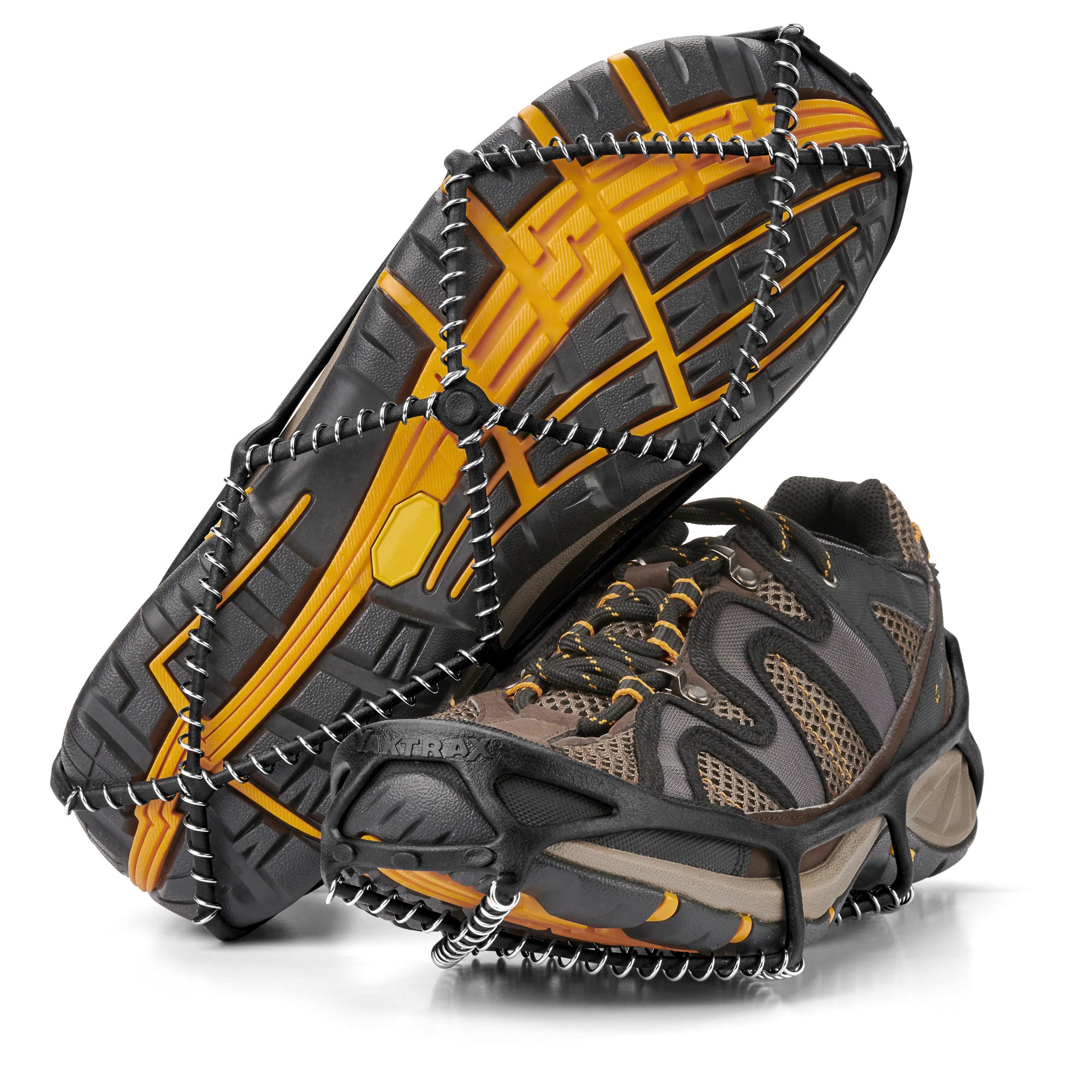
Coil cleats are the simplest traction device sold: a stretch band that pulls over a shoe, with steel wire wound around the parts that touch the ground. Yaktrax's Walk is the entry model in that line, priced at $22.49 on the company store, and its listing describes 1.2 mm abrasion-resistant steel coils in a patented layout that Yaktrax says grips in every direction on cold surfaces.
The word cold is doing work in that sentence. Yaktrax rates the Walk for packed snow, slush and mixed conditions, and it warns in plain language against gravel, concrete, sanded roads and any indoor floor. This review takes that warning as the starting point, because a cleat that must come off at every doorway suits some routes and ruins others.
Our verdict
For sidewalks and driveways that stay covered in packed snow, the Walk is a $22.49 answer with a clear spec: 1.2 mm steel coils, a stretch polyelastomer band, four sizes and a 90-day warranty against defects. Its usefulness ends where the snow does, and Yaktrax says so in writing.
- A good fit for
- A pedestrian, dog walker or older adult who crosses packed snow or ice on foot, can take the cleats off before stepping onto cleared pavement or indoor floors, and weighs enough to press the coils in.
- We would skip it if
- Your route alternates between snow and bare concrete, you want to leave traction on all day, you weigh under roughly 70 pounds, or you need shipping outside the 48 contiguous states.
Reasons to consider it
- Terrain and best-use lines on the listing are specific: packed snow, slush and mixed conditions, in town and dog walking
- Materials are named with recycled content: 1.2 mm high-strength steel coils at 70% recycled and a polyelastomer band at 20%
- Sizing guidance covers boots, with Yaktrax advising one size up for work or hiking boots and two sizes up for insulated snow boots
The compromises
- Yaktrax states the coils are damaged by gravel, concrete and sanded roads cleared of snow, so mixed routes mean stopping to remove them
- The warranty runs 90 days, covers defective parts only, and requires prepaid postage and proof of purchase
- Coils need periodic pinching back into shape according to the FAQ, and the 1.2 mm wire is a wear item with no stated service life
What we have not verified: No pair was worn or tested for this review. Yaktrax publishes no temperature rating for the band, no expected coil lifespan in miles or hours, and no fitted weight per size beyond the store's shipping figures. The listing gives item dimensions as 7.5 x 5.91 x 2.0 without units. Nothing on the fetched pages addresses driving with the cleats on. The 70-75 pound minimum is described by Yaktrax as approximate.
The things in this guide
A closer look at the products, who they may suit, and what to check before buying.
Walk Traction Device
At $22.49 with named materials, four sizes and a documented terrain rating, it covers the packed-snow sidewalk case with minimal cost and a heel tab for taking it off at the door.
Before you buy: Every stretch of cleared pavement or store floor is off-limits under Yaktrax's guidance, so the coils spend part of a mixed-surface trip in your pocket.
Price checked September 11, 2026. Retailer prices can change.What Yaktrax rates the Walk for
The listing reduces the question to three lines. Activity: hiking, running, errands and commuting, outside chores, and walking. Terrain: packed snow, slush, and mixed conditions. Best use: in town and dog walking. The description adds that the 1.2 mm steel coils give 360 degrees of traction on cold surfaces, and the FAQ explains the mechanism: each coil presses down and embeds in ice as weight transfers onto the foot, so grip comes from the wire biting rather than from spikes.
The phrase cold surfaces is the boundary. Coils grip by deforming against ice and compacted snow; on a hard bare surface they cannot compress, and the FAQ says that is what damages them. Mixed conditions in Yaktrax's terrain line means snow with patches of ice, not snow with patches of pavement. The device is aimed at a person crossing a snow-covered lot, path or sidewalk, and the listing's own examples, work, school, the mailbox, describe short trips over one kind of ground.
The warning, quoted as written
Yaktrax publishes a proper-use paragraph in its FAQ, and the operative sentences are worth reading verbatim: "Yaktrax® are not for use on gravel, concrete, or sanded roads cleared of snow. Avoid surfaces such as marble floors, or any non-icy, non-snowy surfaces when wearing Yaktrax®. Yaktrax® are not for indoor use. The improper use or installation of Yaktrax® could result in injury." The same paragraph states that the devices will not eliminate the inherent risks of walking, running or working on ice and packed snow.
Two consequences follow. First, the cleats have to come off before a store, an office lobby or a bus, which is why the heel tab on the listing matters more than it looks. Second, a sanded or salted road that has been plowed to bare asphalt counts as a prohibited surface even in winter. Driving is not mentioned anywhere on the fetched pages, so treat that as unaddressed. A route that is mostly cleared pavement with occasional ice is the wrong job for this design; a route that stays white is the right one.
Four sizes, a boot rule and a minimum weight
The Walk comes in four sizes, each keyed to a shoe-size range: women's 2.5-6 with men's 1-4.5, women's 6.5-10 with men's 5-8.5, women's 10.5-12.5 with men's 9-11, and women's 13-15 with men's 11.5-13.5. All four cost $22.49. Yaktrax says there is no design difference between men's and women's devices, only the size mapping. For work or hiking boots it recommends going up one size, and for insulated snow boots two sizes, which puts a boot wearer near the top of the chart quickly.
The FAQ also sets a floor: there is no upper weight limit, but a wearer must weigh roughly 70 to 75 pounds to press the coils into ice and get the grip the design depends on. Yaktrax makes no children's sizes for that reason. A lightly built adult is fine; a child is not the intended user. Buying by shoe size alone, without accounting for the boot rule, is the most likely way to end up with a band that will not stretch over winter footwear.
Steel and polyelastomer, with recycled content and a pinch test
The materials line is more specific than most cleat listings. The coils are 1.2 mm high-strength steel containing 70% recycled content; the webbing that forms the band is polyelastomer with 20% recycled content. Cleaning instructions are one sentence: hand wipe with a damp cloth and air dry. There is no stated temperature limit for the band, no coating named on the steel, and no claim about corrosion resistance beyond the abrasion-resistant wording in the description.
Upkeep is a manual task. The FAQ tells owners to periodically pinch the coils at points marked on the included insert to restore their original shape and angle, and repeats that gravel, concrete and sanded roads flatten them. Wire of 1.2 mm is thin enough to be a wear item, and Yaktrax gives no expected life in miles, seasons or hours. A user who walks daily on packed snow should expect to reshape the coils and eventually replace the pair; at $22.49 the pair sits at consumable-grade cost, and the multi-buy discount of 10% on two pairs is priced accordingly.
Ninety days on defects, thirty on returns, 48 states only
The listing prints the warranty in full: Implus LLC will replace defective parts within 90 days of purchase if the product is returned postage prepaid with proof of purchase, with no liability for incidental or consequential damages, and with merchantability and fitness limited to use as a traction augmentation device on outdoor ice and packed snow. The refund policy restates it as a 90-day warranty against manufacturer's defects, replacement only, with a receipt.
Returns are separate and narrower. Unused products bought from the website can go back inside 30 days of purchase, and Yaktrax asks for the order confirmation, a note with contact details and an email with the tracking number; worn or damaged items may be discarded or donated. Shipping is limited to the 48 contiguous states, with no Alaska, Hawaii, territory, P.O. box or international orders, from a warehouse in Durham, North Carolina. A buyer in Anchorage has to find these cleats somewhere other than the company store.
When to skip the Yaktrax Walk
Skip the Walk if your winter surface is plowed and salted pavement with intermittent ice. Under Yaktrax's guidance the coils must come off for the bare stretches, and a device that spends half a trip in a pocket is one you will stop carrying. Skip it if you want cleats that stay on for an indoor errand; marble and other hard floors are named as surfaces to avoid. Skip it for a child, since the company sets a weight threshold and makes no junior size.
Skip it if you expect coverage beyond a season: the 90-day defect warranty and the 30-day unused-return policy are the whole safety net, and coil wear on hard ground is excluded by definition. Where it fits is narrow and well described: a walker on packed snow and ice, in the contiguous United States, willing to take the cleats off at the door and pinch the coils back into shape. For that person $22.49 buys a device whose maker has been unusually clear about its limits.
How we put this together
Built from the product pages and listings below, without test scores or results we have not measured. Specifications and prices change, so check the original page for the exact model, current price, delivery, and returns.
- Yaktrax: Walk Traction Device (US store listing) (opens in a new tab)
- Yaktrax: Frequently Asked Questions (opens in a new tab)
- Yaktrax: Refund policy (opens in a new tab)