Product image supplied by the brand
In this guide
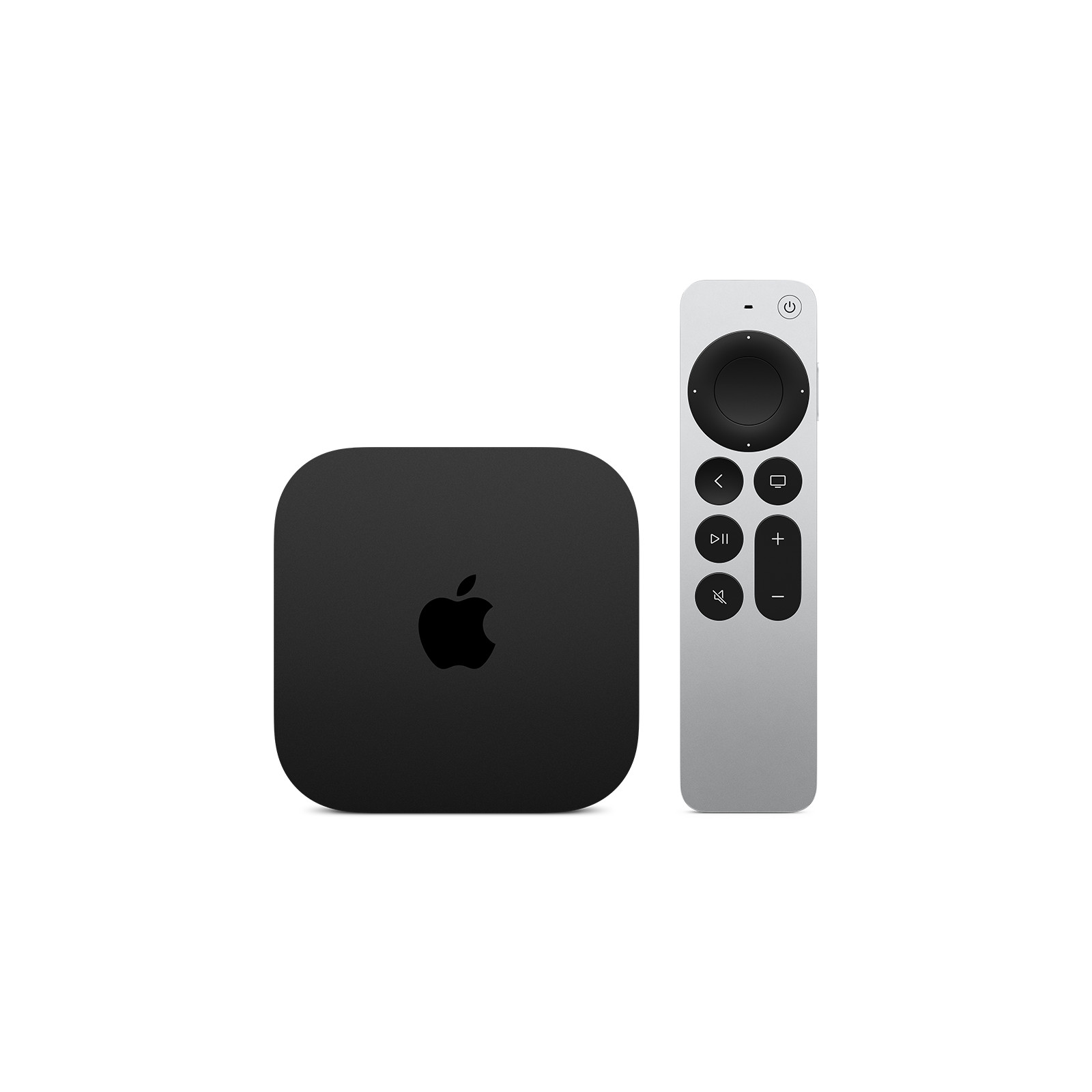
Apple's fourth-generation Apple TV 4K comes in one configuration, $299 (MLFF4LL/A): 128GB, the A19 chip, Wi-Fi 7, Gigabit Ethernet, a Thread radio and three far-field microphones. On 2026-10-24 Apple's US store was taking pre-orders for availability from November 13, Best Buy listed it as a pre-order with the same release date, and Amazon showed a new unit at $289.99 marked for later release. Inside the carton come the player with its power lead and the Siri Remote (4th generation); Apple leaves out both the HDMI cable and the USB-C lead that charges the remote.
For a home that streams through the TV's built-in apps, a cheap stick or an aging Apple TV HD, the headline 4K HDR formats do not separate the options. Roku's $79.99 4K stick and Amazon's Fire TV Stick 4K Plus also output 4K with Dolby Vision and HDR10+. The $299 pays for a wired network port, an Apple Home hub, microphones in the box, surround from HomePods and tvOS's ties to the iPhone, and every item on that list carries a catch. A third-generation box already plays 4K Dolby Vision and, by Apple's footnotes, gets Siri AI as well, so its owners face a different upgrade decision.
Our verdict
Buy it at $299 for an iPhone household that needs a first Apple Home hub with Thread or a wired Ethernet port; for streaming alone, Roku's $79.99 Streaming Stick 4K lists the same headline 4K HDR formats.
- A good fit for
- iPhone households leaving an Apple TV HD or slow TV software, Thread or Matter homes without a suitable Apple hub, and anyone planning four HomePod mini 2 or HomePod (2nd generation) speakers in matched pairs.
- We would skip it if
- Your TV's apps or a stick already carry everything you watch, you need only a HomeKit or Matter hub and own a HomePod, HomePod mini or Apple TV HD, or the household uses Android phones.
Reasons to consider it
- Gigabit Ethernet, Wi-Fi 7 and a Thread radio come standard on the single 128GB model, so a TV cabinet with a network jack needs no adapter.
- Three far-field microphones take Siri requests without the remote in nine supported tvOS languages, English among them, with support varying by region; microphone data is processed in Secure Exclaves on the A19, walled off from tvOS and apps.
- It serves as an Apple Home hub for HomeKit and Matter accessories, and it is the only Apple TV Apple lists for surround from four HomePod mini 2 or HomePod (2nd generation) speakers.
The compromises
- There is one $299 configuration, and Apple packs neither an HDMI cable nor the USB-C cable that charges the remote; its store asks for a Dolby Vision-compatible HDMI cable for 4K HDR.
- Hands-free Siri needs a primary tvOS language from Apple's list of nine, and Siri AI is a beta in tvOS 27.2 that requires the home owner's Apple Intelligence-enabled iPhone or iPad.
- HomePod surround needs four HomePod mini 2 or HomePod (2nd generation) speakers in matching front and rear pairs; four minis at Apple's $149 each add $596 to the $299 box.
What we have not verified: Nothing ships until November 13, so every speed figure is Apple's own, from September 2026 tests on preproduction units with prerelease software. Siri AI is a beta with daily limits on server features and a fee promised for expanded access; how it works at launch could move the verdict.
The things in this guide
A closer look at the products, who they may suit, and what to check before buying.
Apple TV 4K (4th generation)
For $299 the single 128GB model adds Gigabit Ethernet, Wi-Fi 7, a Thread radio, three far-field microphones and four-HomePod surround support to the headline 4K HDR formats (Dolby Vision, HDR10, HDR10+ and HLG at 2160p60) that Roku's $79.99 4K stick also lists.
Before you buy: Hands-free Siri works only in the nine tvOS languages Apple lists, Siri AI is a beta that needs the home owner's Apple Intelligence-enabled iPhone or iPad, surround needs four HomePod mini 2 or HomePod (2nd generation) speakers in matched front and rear pairs, and the HDMI and USB-C cables cost extra.
Price checked October 24, 2026. Retailer prices can change.The headline 4K HDR formats a $299 box shares with an $80 stick
Apple's technical specifications give 2160p at 60 fps in Dolby Vision, HDR10, HDR10+ and HLG, with Dolby Atmos. Roku's Streaming Stick 4K, $79.99 on Roku's store on 2026-10-24, lists the same four HDR formats at 2160p60 and passes Dolby-encoded audio through to the TV or receiver. Amazon's Fire TV Stick 4K Plus, $39.99 on its listing that day, prints the four formats and Dolby Atmos in its comparison table. Apple's sheet goes further, naming Dolby Vision Profiles 8.1 and 5 and AV1, VP9 and HEVC decoding; Roku's page mentions no profile and no codec, so the match holds only for headline formats. Those four formats by themselves do not justify the $299 box.
Speed is the other claim. By Apple's account the A19 delivers up to 50 percent faster CPU and up to twice the GPU performance of the previous Apple TV 4K, figures from Apple's own September 2026 tests on preproduction units running prerelease software, and it adds a dedicated AV1 decoder meant to stream at lower bandwidth. No production unit has shipped yet. A sluggish smart-TV interface is a reason to add an external player, but Apple's figures compare the A19 with its own older box, not with a stick, so a stick never enters those comparisons.
A wired port, a Thread radio and an Apple Home hub
The one configuration has Gigabit Ethernet next to Wi-Fi 7, so a TV cabinet with a network jack takes a cable straight into the box. Roku's 4K stick answers weak signals another way: it lists 802.11ac Wi-Fi on both 2.4 and 5 GHz, with a long-range receiver built into its USB power cable, and no wired port. Amazon's comparison table lists Wi-Fi 6 for the 4K Plus and an Ethernet port only for the Fire TV Cube; Amazon also sells a $14.99 micro-USB Ethernet adapter for Fire TV devices, though nothing on the 4K Plus listing confirms the adapter fits this stick. Roku's own Ultra page lists 10/100 Ethernet on that $149.99 player.
The box also runs an Apple Home, handling automations and remote access for HomeKit and Matter accessories, and its Thread radio serves Thread accessories that support either standard. Roku's page says its stick works with Apple AirPlay and HomeKit but does not call it a hub. Apple's footnote names Apple TV HD, Apple TV 4K, HomePod and HomePod mini as examples of the hub Matter accessories require, so a home with any of them already has one. Thread is narrower: Apple's specs list a Thread radio on the HomePod mini 2 and HomePod (2nd generation) but not on the Apple TV HD. For the hub alone, $299 buys little in a home that already has a suitable one.
Talking to the TV: microphones in the box, and Siri AI with conditions
Three far-field microphones with voice isolation let you wake Siri by saying "Siri" or "Hey Siri" without touching the remote, and the press release credits echo cancellation with keeping recognition working while audio plays. Support varies by region and needs a primary tvOS language of Chinese, Dutch, English, Finnish, French, German, Hebrew, Norwegian or Swedish. Microphone data, per the same release, is processed in Secure Exclaves on the A19, kept apart from tvOS and apps. On the sticks, the remote handles voice: Amazon's 4K Plus page says to press the voice remote button and marks hands-free Alexa only for the Cube, and Roku's page describes voice search from its remote and lists no hands-free mode.
Siri AI comes with its own conditions. It is a beta in tvOS 27.2, launching in English in the US and seven other countries, and the person listed as the home's owner in the Home app needs an Apple Intelligence-enabled iPhone or iPad. Server-side features carry daily usage limits, and expanded access is due to cost a fee later. Apple lists Siri AI for the Apple TV 4K (2nd generation) and later, so the assistant is not exclusive to this box; the hands-free microphones are. Amazon's 4K Plus includes a focused Alexa+ experience, with full access tied to Prime or an Alexa+ Standard plan.
HomePod surround, and what four speakers add to the bill
The fourth generation is the only Apple TV that can drive four HomePods as a surround system. Apple's footnote requires four HomePod mini 2 or HomePod (2nd generation) speakers in matching front and rear pairs, with the box on current software; the original HomePod mini is not on that list. The speakers are meant to recognize their positions and calibrate timing and levels to the room, and its Whole Room Audio mode spreads sound evenly across all four. Both descriptions come from Apple ahead of the November 13 release.
On 2026-10-24 Apple's store priced HomePod mini 2 at $149, as a pre-order available from October 30, and HomePod (2nd generation) at $349. Four minis come to $596, so an all-Apple surround setup starts at $895 with the box, and four full-size HomePods take it to $1,695. A household without speakers can instead connect a soundbar or receiver, which the HDMI port supports through ARC and eARC. Amazon's 4K Plus listing pitches its own version, Alexa Home Theater with compatible Echo speakers. HomePod surround pays off mainly where the four speakers will also play music and answer Siri around the house.
What an iPhone adds, and where an Apple TV HD home stands
Most tvOS extras assume an iPhone. FaceTime on the TV turns a nearby iPhone or iPad into the camera through Continuity Camera; the iPhone's Lock Screen and Control Center act as a remote, and Face ID approves purchases and app sign-ins. Two sets of AirPods can listen at once with separate volume. Apple Fitness+, Apple Arcade, Apple Music and the Apple TV service each need a subscription. The Siri Remote (4th generation) can play a sound when it goes missing, and Precision Finding works only with an iPhone 17 or later (not the 17e), iPhone Air or iPhone Duo.
Apple's tvOS 27 guide lists only the Apple TV 4K (2nd generation) and (3rd generation) as supported and states that "Previous models of Apple TV are no longer software-supported." The press release offers Siri AI on the Apple TV 4K (2nd generation) or later. For a household on an Apple TV HD, the Matter hub case does not apply, since Apple's footnote still counts the HD as a hub, but the Thread case can: Apple's model list gives the HD no Thread radio. Beyond Thread, software support is the argument for moving. A home with Android phones gets little from the list above, because FaceTime, iPhone remote control, Precision Finding and Siri AI's setup all run through Apple devices.
The full bill, and the homes that should buy a stick instead
The bill starts at $299 and adds an HDMI cable, which Apple's store says should be Dolby Vision-compatible for 4K HDR, plus, if the house has neither, a USB-C lead and a wall charger for the remote. On 2026-10-24 Apple's US store charged nothing for delivery and accepted returns within 14 days, free by mail. Best Buy listed the box as a pre-order for November 13, and Amazon showed a new unit at $289.99 ahead of release; that gap can change before launch day.
Buy a stick when the TV's apps or a $39.99 to $79.99 Roku or Fire TV stick already carry every service you watch, and nobody needs a wired port, a first hub or HomePod surround. Skip the Apple box as well if the household runs on Android phones or Alexa, or if the primary tvOS language would be one the far-field microphones do not support. The bar for buying it is an editorial threshold, not an Apple one: two or more of its extras should apply, such as a Thread or Matter home with no hub yet, a TV that needs Ethernet, an Apple TV HD missing from the tvOS 27 list, or four HomePods already planned.
How we put this together
Built from the product pages and listings below, without test scores or results we have not measured. Specifications and prices change, so check the original page for the exact model, current price, delivery, and returns.
- Apple: Buy Apple TV 4K (US store) (opens in a new tab)
- Apple: Apple TV 4K technical specifications (opens in a new tab)
- Apple: Apple TV 4K overview (opens in a new tab)
- Apple Newsroom: Apple unveils the new Apple TV 4K (October 13, 2026) (opens in a new tab)
- Apple: Which Apple TV 4K model do I have? (tvOS 27 user guide) (opens in a new tab)
- Roku: Streaming Stick 4K product page (opens in a new tab)
- Amazon: Fire TV Stick 4K Plus product page (US) (opens in a new tab)
- Apple: Buy HomePod mini 2 (US store) (opens in a new tab)
- Apple: Buy HomePod (2nd generation) (US store) (opens in a new tab)
- Best Buy: search results for Apple TV 4K (opens in a new tab)
- Amazon: search results for Apple TV 4K (opens in a new tab)
- Roku: Ultra product page (opens in a new tab)
- Apple Support: Identify your Apple TV model (opens in a new tab)
- Apple: HomePod mini 2 technical specifications (opens in a new tab)
- Apple Support: HomePod (2nd generation) - Tech Specs (opens in a new tab)
- Apple Support: Apple TV 4K (3rd generation) - Tech Specs (opens in a new tab)