Product image supplied by the brand
In this guide
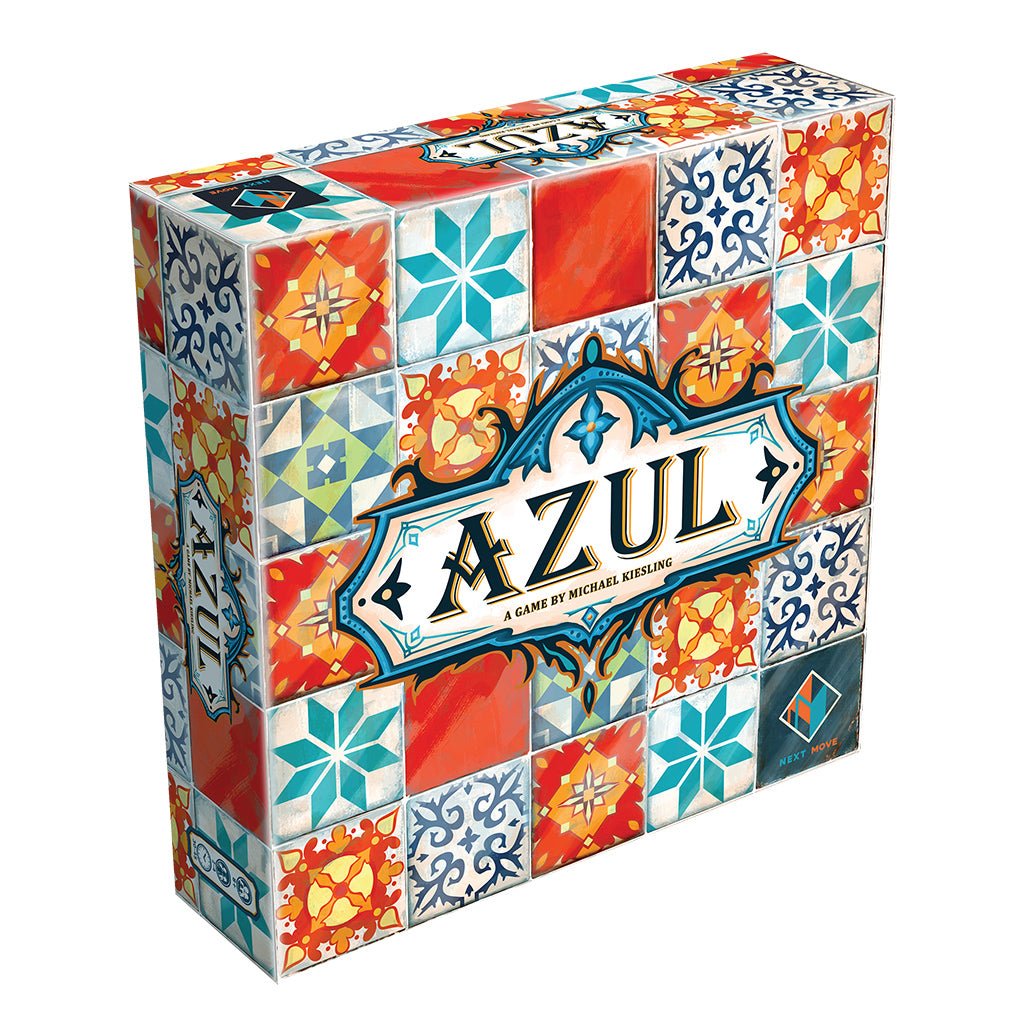
Azul is Michael Kiesling's 2018 tile-drafting game about building the azulejo walls of a Portuguese royal palace, published by Next Move Games and sold in the US through Asmodee's own web store as SKU NM6010. The store lists $39.99 and currently sells it at $31.99, an undated markdown (both checked 2026-10-14), specified for 2-4 players, age 8 and up, averaging 45 minutes; the publisher's game page gives the window as 30 to 45.
A second box has a hard job on a family shelf: it has to work when only two people are free, teach fast enough that guests do not stall, and end before bedtime. Azul's answer is a drafting fight where everyone pulls from the same shared factory displays, and every pull changes what the others can take. Asmodee's own description says it straight: you have to 'make choices that help you without helping them too much.'
Our verdict
At the $39.99 list price (checked 2026-10-14 at Asmodee's US store), Azul is the easiest second box to recommend for a household that needs one competitive game to cover two-player nights and four-player game nights in about 45 minutes.
- A good fit for
- Couples and families from age 8 up who want a competitive game that runs on one-decision turns, finishes inside 45 minutes, and stays sharp when only two people show up.
- We would skip it if
- Your table wants cooperation, a story, five or more seats, or a solo mode: Azul offers none of it, and its floor-line penalties sting players who hate going backwards on the score track.
Reasons to consider it
- Seats two through four from one box: the rules scale factory displays from nine down to five at two players, so a couple gets the full game without an expansion
- A turn is one decision — take every tile of one color from a factory display or the center — and the whole rulebook runs six pages
- The 100 resin tiles and linen bag keep setup to dealing four tiles per display, and the boards' gray side carries a printed variant for a second way to play
The compromises
- Four is the hard ceiling: neither the base game nor anything on the Asmodee store's Azul shelf seats a fifth
- Tiles you cannot place land on the floor line and subtract points — the rulebook's own example costs 8 — which can sour early games with an eight-year-old
- There is no solo mode and nothing to negotiate: the interaction is taking the tiles somebody else was counting on
What we have not verified: The floor-line penalty values themselves are printed on the player boards, not in the rulebook text, so the exact per-slot numbers rest on the rulebook's worked example of minus 8 for four tiles plus the starting player marker. Component counts come from the publisher's listings and the rulebook, not a physical count, and Asmodee's shipping-policy page carried no delivery terms when checked, so delivery times are unverified.
The things in this guide
A closer look at the products, who they may suit, and what to check before buying.
Azul
The $39.99 box is complete for 2-4 players with a six-page rulebook, Asmodee's US store ships free over $49 and gives buyers 30 days to send unopened boxes back, and the $31.99 price as of 2026-10-14 carries no stated end date.
Before you buy: Four seats is the ceiling, there is no solo mode, and the Crystal Mosaic overlays that tidy the tiles are a separate $16.99.
Price checked October 14, 2026. Retailer prices can change.How the drafting fight works
Each player runs a board with five pattern lines and a five-by-five wall. Nine factory displays ring the table at four players, seven at three, and five at two, each dealt exactly four tiles from a bag of 100 — 20 in each of five colors. On your turn you take every tile of one color from a single display, and whatever is left spills to the center of the table.
The center is where the shoving happens. Taking from it is otherwise free — except the first player to do so in a round also takes the starting player marker and parks it on their floor line, which is where penalties live. Everything you claim must fit: one color per pattern line, no color your wall row already holds, and any tiles that do not fit drop to the floor.
When the displays and the center run dry, each completed pattern line sends its rightmost tile to the wall and scores on arrival: a tile with no neighbors pays 1, and every horizontal and vertical run it joins pays its full length. Then the starting player refills the displays and the round begins again — and the publisher puts a full game at 30 to 45 minutes.
What costs points, and when it ends
Azul prices greed on a visible strip. Tiles you cannot or will not place go onto the floor line, and each one subtracts the value printed above its space during the wall-tiling phase; the rulebook's worked example has four tiles plus the starting player marker costing 8 points in a single pass. The score can never drop below zero, so the worst round leaves a player at nothing rather than in the red.
The end has a tripwire: the game finishes after the wall-tiling phase in which someone completes one horizontal row of five, then pays 2 points per finished row, 7 per finished column and 10 for placing all five tiles of a single color. The trigger sits in plain view on every player board, so every player can track how close the game is to ending.
Two players, and an eight-year-old
Two players is a first-class count here, not a tolerated one. The rulebook's two-player setup uses five factory displays of four tiles each, against nine displays at four — fewer tiles in play means the person across the table knows exactly who the two reds on a display are for. A couple gets the complete game from this one box: no dummy player and no expansion.
Both the store and the publisher print an age floor of 8, and a turn is a single choice of color and source. The likelier friction is the floor line. A child who grabs four tiles that will not fit watches points disappear at the end of the round, with no die to blame, and the fastest lesson in drafting is counting your wall before counting your haul.
Some tables should walk away by category. There is no solo mode — the rules and the store both start at two, where a box like Wingspan plays one to five. There is no cooperation and no story to sink into; the azulejo history is cover art, and the interaction is taking what someone else wanted. Four is the ceiling, and nothing on the Asmodee store's Azul shelf adds a fifth chair.
What is in the box
The publisher's component list: 100 resin tiles, 4 player boards, 9 factory displays, 4 scoring markers, 1 starting player marker, 1 linen bag and a rulebook. The rulebook's setup adds the split behind that tile count — 20 tiles in each of five colors — and shows the player boards are double-sided: a colored wall for the standard game and a gray side whose printed variant lets each tile go anywhere in its wall row, subject to no color repeating in any row or column.
The bag does the storage work: pour the tiles in, deal four onto each display, and the table is set — there is no board to align and no deck to sort before the opening turn. The rulebook's credits name Michael Kiesling as game designer and carry the 2018 Plan B Games imprint; Asmodee's store today lists the publisher of record as Next Move Games, and the publisher's page hangs the 2018 Spiel des Jahres, As d'Or and Origins awards beside the rules download.
Buying from Asmodee, and the rest of the Azul shelf
The Asmodee US store is the publisher-side channel for SKU NM6010: $39.99 list, $31.99 as of 2026-10-14, the markdown undated, and a working add-to-cart. The store-wide banner promises US orders free shipping past $49; one copy at the checked price does not reach it, two copies clear it.
Boxes still sealed can come back within 30 days of arriving, with the return shipping billed to the buyer and refunds processed within five business days of arrival at the warehouse. Missing or damaged parts go through email, order number plus photographs attached, and copies bought elsewhere are referred back to the original retailer. The store's shipping page makes no delivery-time promises — the free-over-$49 banner is the only shipping commitment on record.
The rest of the shelf is short. Crystal Mosaic (SKU NM6012, $16.99) is the tidiness purchase: two alternate player boards and four overlays that keep the tiles from roaming — an upgrade, not new rules. Summer Pavilion (SKU NM6050, $44.99) is the standalone follow-up box, carrying the same 2-4 player, age-8, 45-minute specification as the base game.
How we put this together
Built from the product pages and listings below, without test scores or results we have not measured. Specifications and prices change, so check the original page for the exact model, current price, delivery, and returns.
- Asmodee: Azul product page (opens in a new tab)
- Next Move Games: Azul game page (opens in a new tab)
- Next Move Games: Azul rulebook (English, PDF) (opens in a new tab)
- Asmodee: Refund policy (opens in a new tab)
- Asmodee: Shipping policy (opens in a new tab)
- Asmodee: Azul Summer Pavilion product page (opens in a new tab)
- Asmodee: Azul Crystal Mosaic product page (opens in a new tab)
- Stonemaier Games webstore: Wingspan product page JSON (opens in a new tab)