Product image supplied by the brand
In this guide
The P-145BT is Yamaha's 88-key entry in its US portable piano line, listed at $529.99 and in stock on Yamaha's own US web store on 2026-09-27, and Amazon.com charged the same $529.99 as the seller of record. Yamaha's marketing page lists no price and routes buyers to dealers, so the figures here come from the store listing, the spec sheet and the owner's manual that ships with the instrument.
What that money buys is a keyboard rather than a piece of furniture. The Graded Hammer Compact action, the CFIIIS grand sample and the 64-note polyphony are what the $529.99 pays for; the stand, a proper half-damper pedal and any app connection are separate line items, and one of them, the three-pedal unit, is currently marked discontinued.
Our verdict
Buy the P-145BT at $529.99 when a learner needs 88 weighted keys and has a desk wide enough for one. Skip it if the plan is a three-pedal furniture build: Yamaha's US page marks the matching LP-5A discontinued.
- A good fit for
- Adult beginners and returning players who need the full 88-key range with graded weight and will run app control over a cable
- We would skip it if
- You want a stand-and-three-pedal setup now, need two headphone jacks or a line output, or move the instrument to a different room every week
Reasons to consider it
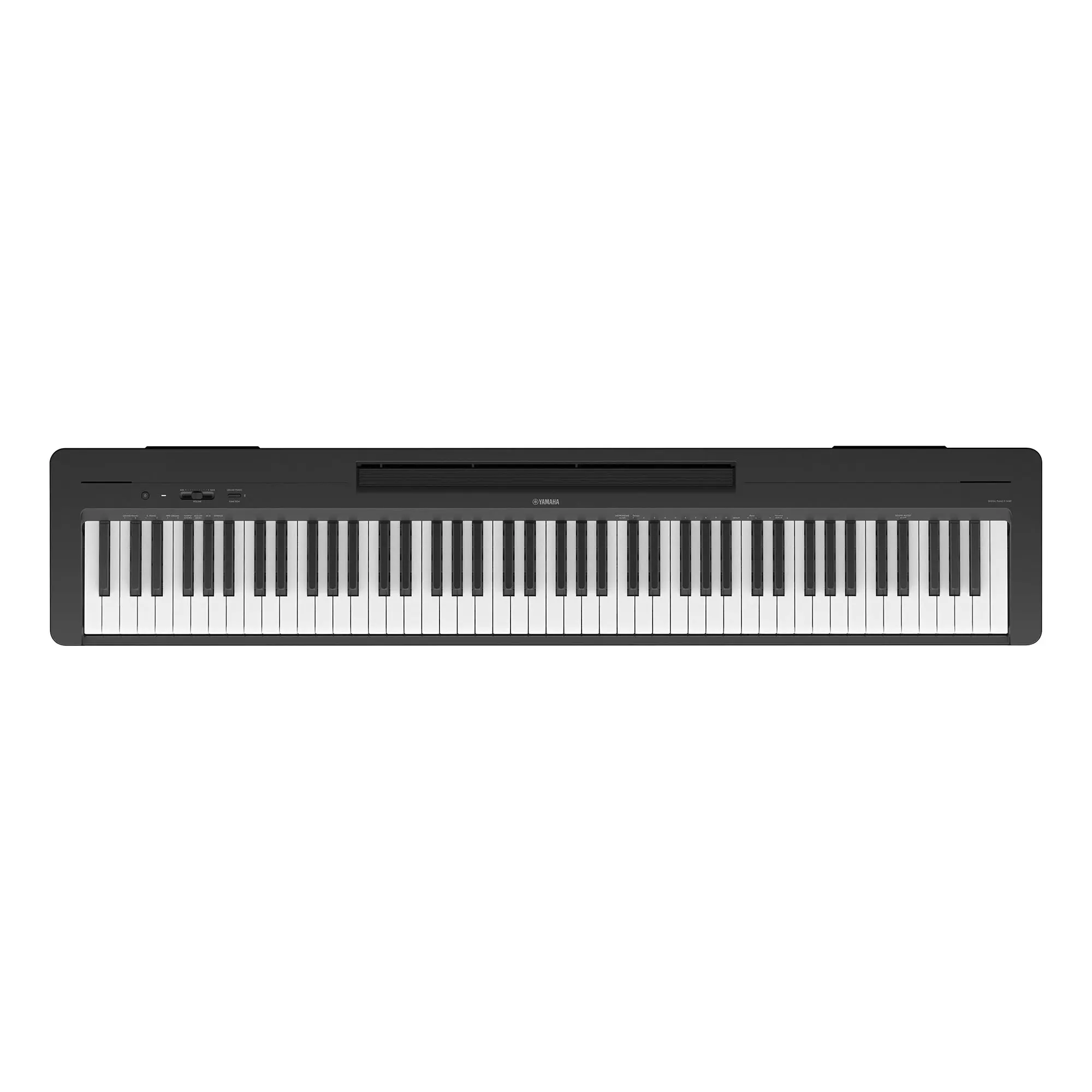
- GHC (Graded Hammer Compact) 88-key action with matte black keytops and four touch curves, in a case 129 mm tall and 11.1 kg
- CFIIIS concert grand sample with a damper resonance effect and Duo mode, which splits the keyboard into two identical ranges, each with its own middle C
- Music rest, sustain footswitch and AC adapter arrive packed with the piano, behind a three-year limited US warranty on P-series digital pianos
The compromises
- The built-in radio is Bluetooth audio in only; the manual states Smart Pianist cannot be used over it, so app control needs a USB cable or the $59.99 UD-BT01
- Ten voices, one headphone jack and no line output, against 24 voices, two jacks and an AUX output on the P-225 in the same Yamaha spec table
- The LP-5A three-pedal unit this model's manual specifies carries a Discontinued label on Yamaha's US site, and the FC3A half-damper pedal was out of stock in the brand's own store on 2026-09-27
What we have not verified: Amazon and Yamaha's store both showed $529.99 on 2026-09-27; other dealers were not checked, while Yamaha's marketing page leaves the price out. Whether an LP-5A can still be ordered through a dealer is also unresolved. Both answers move the recommendation for anyone set on a built-in three-pedal setup.
The things in this guide
A closer look at the products, who they may suit, and what to check before buying.
P-145BT 88-Key Portable Digital Piano, Black
GHC hammer action, a CFIIIS grand sample with damper resonance and 64-note polyphony at $529.99 direct, with music rest, footswitch and AC adapter packed with it and a three-year US warranty behind it.
Before you buy: Stand and bench are extra, half-pedaling needs the optional FC3A rather than anything in the carton, and the LP-5A three-pedal unit that the manual names for this board is marked discontinued in the US.
Price checked September 27, 2026. Retailer prices can change.Eighty-eight keys, and what the action actually is
Yamaha's spec sheet calls the keyboard a GHC, short for Graded Hammer Compact, with matte black keytops; the brand's European product page describes it as the shorter, thinner successor to the GHS action used in earlier P Series models, offering the same weighted piano-like feel. Four touch settings (Hard, Medium, Soft, Fixed) decide how much the player, not the piano, shapes a note. The case is 1,326 mm wide, 129 mm tall and 268 mm deep at 11.1 kg; with the music rest fitted it stands 307 mm tall and 320 mm deep. The carton measures 1,424 x 223 x 362 mm, which is the number to check before a narrow staircase.
The sound side is deliberately narrow. A CFIIIS concert grand sample, a damper resonance effect, 64-note polyphony and ten voices: two acoustic grands, two electric pianos, two pipe organs, harpsichord, accordion, a di zi flute and a strings layer. Key-off samples and virtual resonance modeling are both absent from Yamaha's own column for this model. Dual mode stacks two voices; Duo mode divides the board into two identical ranges with their own middle C, so a teacher and a student can each play the same passage in a range of their own.
When 61 unweighted keys is the better buy
Yamaha's PSR-E483 draws the comparison sharply: $429.99 in the same store, 61 keys on an organ-style action with adjustable touch response, 860 voices, 345 accompaniment styles, 992 mm across and 7.0 kg. It has the same 64-note polyphony and far more sounds. What it does not offer is a hammer-weighted action or the 27 keys beyond its 61.
So the choice is which constraint to accept. An instrument that has to leave for a band room or a shared desk every week is the 7.0 kg keyboard, $100 cheaper and carrying 860 voices against 10. A student working toward piano repertoire written for the full 88 keys, on keys weighted heavier toward the bass, is buying the 1,326 mm board, and the extra $100 pays for that action and those 27 keys.
The P-45 below it and the P-225 above it
Yamaha still sells the P-45 at $449.99, and it is 88 weighted keys for $80 less. Its spec sheet names the older GHS (Graded Hammer Standard) action, AMW Stereo Sampling rather than the CFIIIS voice, 6 W x 2 amplification rather than 7 W x 2, a case 154 mm tall, and a pedal unit input listed as No. The $80 buys the newer compact action in a thinner case, the grand sample with damper resonance, Bluetooth audio in, and a jack that accepts a pedal unit at all.
The P-225 at $769.99 is the other boundary, and Yamaha sets the differences out in the same table: a CFX sample with key-off data and VRM Lite, 192-note polyphony, 24 voices, split mode, two headphone jacks rather than one, a line output, 24-bit USB audio rather than 16-bit, and an extra 5 cm driver in each speaker. Both boards run the same GHC action, so the $240 goes to how the instrument sounds and where it can be plugged in, not to how the keys feel.
The accessory situation is the part that changes the recommendation. The P-225's own store page points to the LP-1 three-pedal unit at $99.99, in stock, on the L-200 stand at $119.99. The P-145BT's designated unit is the LP-5A, whose US product page carries a Discontinued label, and the store's pedal category lists FC35, FC3A, FC4A, FC5, FC7 and LP-1 with no LP-5A. The matching stands cost the same $119.99 for both models, so the $240 gap stands as priced, and only the P-225 can still be finished with an in-stock three-pedal unit.
The BT in the name is an audio input, not app control
The manual heads its radio block Bluetooth (Audio only): version 5.0, A2DP profile, SBC codec, Class 2, roughly 10 meters. That is one direction. It plays a phone or tablet through the piano's rear speakers so a student can follow a recording, and the same page states that the instrument cannot send audio out, that Bluetooth headphones cannot be connected, and that Smart device apps such as Smart Pianist cannot be used over this function. One device connects at a time, with pairing memory for eight.
App control runs over USB TO HOST instead, which carries both MIDI and audio at 44.1 kHz/16 bit, with a Type A-B cable under three meters (USB 3.0 cables are excluded) plus the adapter for the tablet's own port. Going wireless means the $59.99 UD-BT01, a Bluetooth Low Energy MIDI adapter whose store page lists iPhone, iPad, iPod touch and Mac and no Android. Both apps are free downloads, and Yamaha says Smart Pianist brings 303 classical practice pieces with it; the app's own listing marks backing-band accompaniment and the Audio To Score function CSP Series only, so those are not part of what this piano buys.
In the box, and what it takes to reach playing height
Included: the music rest, a sustain footswitch, the AC adapter (PA-150B on the web spec sheet, PA-150 in the manual, both 12 V at 1.5 A), the owner's manual and the product registration paperwork. Power draw is 6 W playing and 0.3 W on standby, and auto power off trips after about 15 idle minutes unless the lowest key is held at switch-on. The footswitch in that carton is not what Yamaha means by expressive pedaling: Yamaha's pages point to the separately sold FC3A for half-pedaling, and that pedal showed $54.99 and out of stock in Yamaha's web store when this page was checked. The $23.00 FC5 that is in stock is described on its page as on/off sustain only.
The line items that make it a practice station are the L-100 stand at $119.99, which lifts the keys to 744 mm with the raised music rest reaching 922 mm, and a bench, for which Yamaha's BB1 is $99.99. That is $529.99 + $119.99 + $99.99 = $749.97 before any pedal upgrade. The SC-KB851 soft case is $189.99 if the piano travels. Amazon sells the P-143, with the same GHC action, CFIIIS sample and 64-note polyphony but no Bluetooth audio and no pedal-unit jack, as a bundle with stand, bench, music rest and footswitch for $679.99, $70 under that pieced-together P-145BT. With the LP-5A discontinued, the Bluetooth audio input is most of what the extra $70 buys. Store orders ship free within the continental US in 3-8 business days and can be returned within 30 days with a Return Authorization number and the original packing, and the three-year limited warranty on P-series digital pianos applies only to instruments bought from a US authorized dealer.
Skip it in these four situations
Skip it if the goal is a three-pedal console. The LP-5A is the only pedal unit the manual names for this board, it is marked discontinued on Yamaha's US site, and the in-stock LP-1 and FC35 belong to other models. Anyone set on damper, sostenuto and soft under one furniture stand is better served completing that build on a P-225, where the LP-1 at $99.99 is a live purchase.
Also skip it if two people need to listen on headphones at once, because there is one headphone jack and no line output. If the instrument has to move weekly, 11.1 kg over 1,326 mm is a lot to carry, and the 7.0 kg, 992 mm PSR-E483 is the better tool for that round trip. And if the plan is a tablet on the music rest running Smart Pianist with no cable crossing the desk, price the $59.99 UD-BT01 first rather than assuming the wireless in the model name already covers it.
How we put this together
Built from the product pages and listings below, without test scores or results we have not measured. Specifications and prices change, so check the original page for the exact model, current price, delivery, and returns.
- Yamaha: P-145BT product overview (opens in a new tab)
- Yamaha: P-145BT specifications (comparison table with P-225 and P-143) (opens in a new tab)
- Yamaha: P-145BT more-features page (opens in a new tab)
- Yamaha: P-145BT/P-143BT Owner's Manual (PDF, published 01/2025) (opens in a new tab)
- Yamaha Shop: P-145BT 88-Key Portable Digital Piano (opens in a new tab)
- Yamaha: LP-5A pedal unit product page (opens in a new tab)
- Yamaha Shop: keyboard pedals category (opens in a new tab)
- Yamaha Shop: FC3A Half-Damper Sustain Pedal (opens in a new tab)
- Yamaha Shop: FC5 Compact Sustain Footswitch (opens in a new tab)
- Yamaha Shop: L-100 Matching Stand for P-143 & P-145BT (opens in a new tab)
- Yamaha Shop: SC-KB851 Digital Piano Soft Case (opens in a new tab)
- Yamaha Shop: BB1 Padded Wooden Piano Bench (opens in a new tab)
- Yamaha Shop: UD-BT01 Bluetooth Wireless MIDI Adapter (opens in a new tab)
- Yamaha: P Series portable digital pianos lineup (opens in a new tab)
- Yamaha: P-45 specifications (opens in a new tab)
- Yamaha Shop: P-45 88-Key Portable Digital Piano (opens in a new tab)
- Yamaha Shop: P-225 88-Key Portable Digital Piano (opens in a new tab)
- Yamaha Shop: LP-1 Foot Pedal Unit (opens in a new tab)
- Yamaha: PSR-E483 specifications (opens in a new tab)
- Yamaha Shop: PSR-E483 61-Key Portable Keyboard (opens in a new tab)
- Yamaha: warranty information for the US market (opens in a new tab)
- Yamaha: limited 3-year warranty for digital pianos (PDF, effective 2023-07-01) (opens in a new tab)
- Yamaha Shop: shipping and returns (opens in a new tab)
- Yamaha: Smart Pianist app page (opens in a new tab)
- Apple App Store: Smart Pianist - US listing (opens in a new tab)
- Apple App Store: Rec'n'Share listing (opens in a new tab)
- Yamaha: P-145BT product page (Europe) (opens in a new tab)
- Yamaha Shop: keyboard stands category (opens in a new tab)
- Amazon: Yamaha P-145BT (ASIN B0F9H3SHFJ) (opens in a new tab)
- Amazon: Yamaha P-143 Digital Piano Bundle (ASIN B0FMCGPCR4) (opens in a new tab)