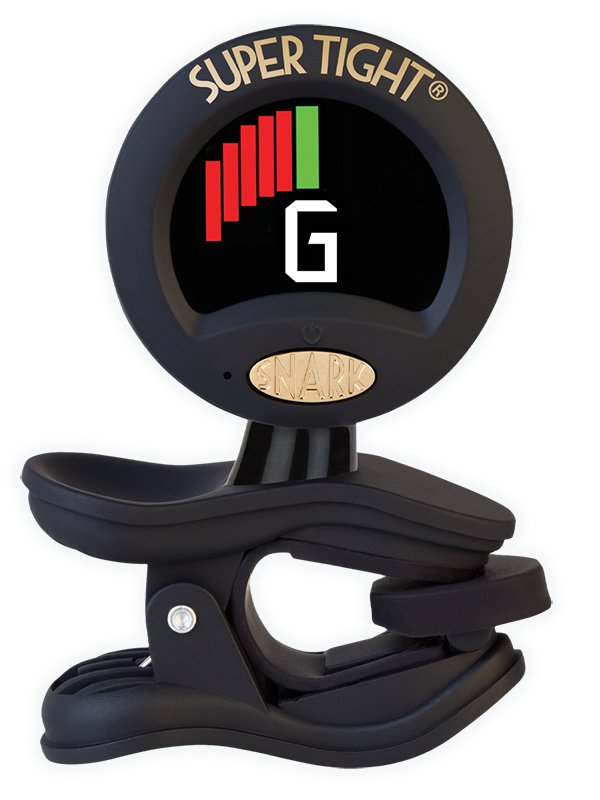
Product image supplied by the brand
In this guide
Snark's Super Tight page is short even by clip-on tuner standards: a photo of the ST-8, a line reading "Chromatic All Instrument Tuner", the words fast, high definition display and superb accuracy, and a side view captioned with a claim that vulcanized rubber joints make the tuner virtually indestructible. There is no price, no spec list and no link to a manual. Everything else about the ST-8 has to come from the instruction sheet packed with the tuner and from the retailers that carry it.
That sheet turns out to be more useful than the site. It describes a chromatic tuner that senses string vibration through its clamp, a pitch reference adjustable from 415 to 466 Hz, a flat-tuning mode for capo players, a visual metronome triggered by a switch on the side, and a warning about instrument finishes that anyone with a lacquered guitar should take seriously. At the roughly $23 retailers ask, the ST-8 is an inexpensive tool with more features than the maker bothers to advertise.
Our verdict
A sensible tuner for anyone who tunes on a noisy stage or a loud living room, with a capo mode and a visual metronome thrown in; the finish warning in the manual is the one line to read before clamping it to a good guitar.
- A good fit for
- A guitar, ukulele or mandolin player who tunes where a microphone tuner struggles and wants a display readable from any angle.
- We would skip it if
- Your instrument has a nitrocellulose, oil or French-polish finish, or you want a maker's page with a price, specs and a warranty form on it.
Reasons to consider it
- Vibration sensing through the clamp ignores room noise by design
- Pitch calibration from 415 to 466 Hz plus a four-flat capo mode and a tap-tempo metronome
- Display rotates 360 degrees on a ball joint; power-save dims the screen after 5 seconds and shuts off after 2 minutes
The compromises
- Snark warns against leaving it on nitrocellulose, polyurethane, oil-finished or French-polished instruments
- No microphone mode, so it cannot tune an instrument it is not clamped to
- Snark's site lists no price, no specs and no warranty page; the manual is dated 2016
What we have not verified: The tuner was not clamped to anything here; tracking speed on low bass strings, how firmly the clamp grips a thin headstock, and real CR2032 life were not assessed.
The things in this guide
A closer look at the products, who they may suit, and what to check before buying.
ST-8 Super Tight Chromatic All Instrument Tuner
The clamp-borne vibration sensor, the 415 to 466 Hz calibration range, a capo mode up to four flats and a 100 bpm default metronome cover most of what a gigging or practicing string player needs from a headstock tuner.
Before you buy: No microphone, a finish warning that rules out nitro and oil-finished instruments for extended clamping, and a maker's site that lists neither price nor specs.
Price checked September 11, 2026. Retailer prices can change.Three sentences on the site, two pages in the box
Snark's site treats the ST-8 as a picture with a caption. The Super Tight page pairs it with the ST-2, which adds a microphone, and gives the ST-8 the line "Chromatic All Instrument Tuner" plus three exclamation-marked claims about speed, display and accuracy. The only other content is a side view of the clamp and a caption about the vulcanized rubber joints. No dimensions, weight, battery, tuning range or price appear anywhere on the site, and the contact page lists a single email address and a reminder that prices and specs can change.
The instruction sheet, dated 2016 and printed on two sides, does the explaining. It says the ST-8 is chromatic and senses the vibration of whatever it is clamped to, describes the clamp, the banana-shaped arm and a body that rotates 360 degrees on a ball joint, and walks through calibration, flat tuning, the metronome and the battery drawer. A 2016 revision date on a product still sold in 2026 suggests the design has not changed much, though Snark does not say so in as many words.
Calibration, capo flats and a metronome on the side
The tuner powers on at A-440 Hz. Pressing the round pitch-calibration button on the back and then the up or down triangle moves the reference anywhere from 415 to 466 Hz, which covers baroque pitch at 415 and the sharper orchestral tunings above 440; pressing the front power switch resets it to 440. The display uses a red needle for flat, a yellow needle for sharp and a green center needle for in tune, and Snark notes that a briefly flashing red or yellow segment beside the green one means the note is only slightly off.
Capo players get a flat-tuning mode: each press of the flat button on the back adds one flat, up to four, so a guitar capoed at the second fret still reads as standard tuning. A switch on the side labeled TAP-MET starts a visual metronome at 100 bpm, shown as a flashing red heart on the display, and the tempo follows either two taps on that switch or the up and down buttons. Power management is simple: the screen dims after about 5 seconds without a detected note and the tuner shuts off after 2 minutes of silence.
The finish warning matters more than the durability claim
Snark's site sells the clamp on toughness, but the manual opens with a caution about what the clamp touches. The company recommends removing the tuner as soon as tuning is done, because any lacquer finish can be marked by the rubber pad if the tuner stays in contact for a while. It goes further and advises against using its clip-on tuners at all on instruments with nitrocellulose lacquer, polyurethane, French polish or oil finishes, and names Gibson guitars with nitro finishes specifically, unless the owner accepts the risk of dents to the headstock; for those instruments Snark points to its own SN-10 pedal tuner.
The rest of the clamp guidance is practical. Attach the clamp to the headstock with the tuner body in front of or behind it, do not attach it if any rubber pad is broken or missing, and adjust the arm and rotate the body until the display sits where you can see it. Snark also asks that the tuner not be left on an instrument sitting in direct sunlight. None of this makes the ST-8 fragile; it makes the finish of the instrument the fragile part of the pairing, which the site's caption about indestructible joints does not mention.
No price from Snark, about $23 from retailers, twelve months of coverage
Snark lists no price for the ST-8. zZounds, the retailer whose page also hosts the manual, listed it at $22.99 as a special-order item shipped from the manufacturer on the day of the check, and gave a packed weight of 0.12 pounds. Treat that as one retailer's number on one day; it is the reason the price field on this page is blank instead of a figure the maker never stated.
The manual's warranty runs twelve months from the day of purchase and covers manufacturing and material faults that affect how the tuner performs, provided the warranty card was mailed within ten days or a receipt is presented with the claim. Evets Corporation, the company behind Snark, may repair, replace with new or reconditioned product, or refund the original price, and postage plus insurance to send it in are on you the tuner to its Irvine, California address. Batteries and casings are excluded, along with accident and misuse, and the warranty is valid only in the US. The card tells buyers to register online by clicking Warranty on snarktuners.com, but the current site has no such link.
Skip it for a nitro guitar or a tuner you can hear
Do not buy the ST-8 for a guitar with a nitrocellulose, oil or French-polish finish unless you plan to clamp it, tune and remove it every time. Snark's own manual says as much, and a $23 tuner is not worth a dented headstock on an instrument that cost a hundred times more. A pedal tuner or a microphone tuner that never touches the instrument is the safer tool for those guitars.
Also pass if you tune instruments you cannot clamp onto, or if you want to check a note from across the room. The ST-8 has no microphone, and Snark's ST-2 on the same page exists precisely because some players want to choose between a mic and the vibration sensor. And if buying blind from a maker that publishes nothing bothers you, that discomfort is fair; the manual is good, but you have to find it on a retailer's site to read it.
How we put this together
Built from the product pages and listings below, without test scores or results we have not measured. Specifications and prices change, so check the original page for the exact model, current price, delivery, and returns.
- Snark: Super Tight product page (opens in a new tab)
- Snark: ST-8 instruction sheet (PDF, rev 7/16, hosted by zZounds) (opens in a new tab)
- zZounds: Snark ST-8 Super Tight Chromatic Clip-on Tuner (opens in a new tab)
- Snark: Contact page (opens in a new tab)