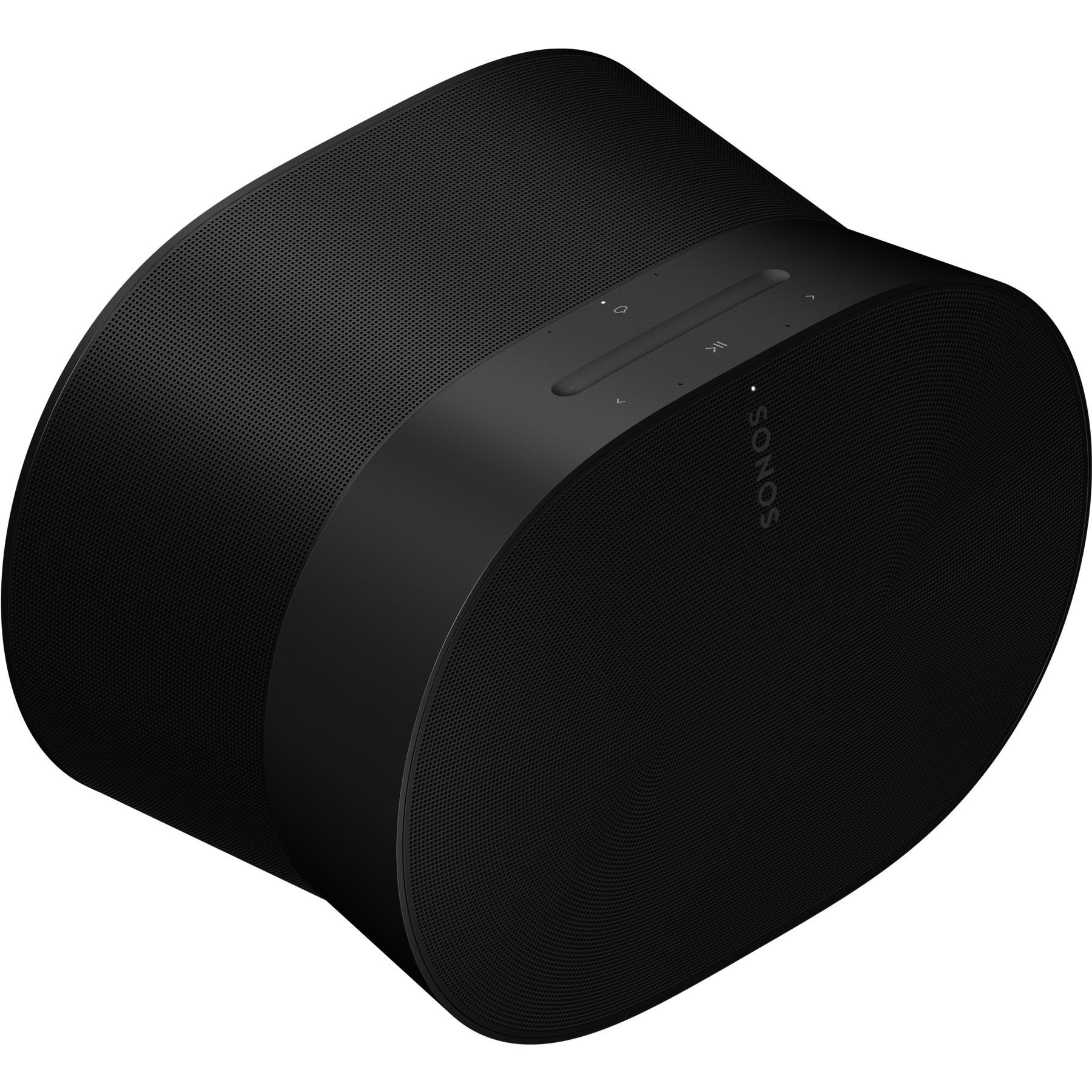
Product image supplied by the brand
In this guide
Sonos lists the Arc Ultra at $1,099 in black or white, both showing stock there on November 8, 2026, where Sonos pays for delivery and refunds a returned bar inside 30 days; Amazon shows the same $1,099, stocked and dispatched there, and Best Buy's listing reads $1,099 as well. The bar is 46.38 in (1,178 mm) wide, 2.95 in tall and weighs 13.01 lb (5.9 kg), and the specifications printed beside it give fifteen Class-D amplifiers, nine silk-dome tweeters with two aimed upward, six midwoofers, and a flat four-motor Sound Motion woofer where a deeper bass cabinet would otherwise sit.
What that budget buys is a single-box answer to the two complaints people actually have about TV audio: dialogue that arrives muffled and effects that never leave the plane of the screen. Both depend on your television before they depend on the bar. Sonos is explicit that any Dolby Atmos content needs the HDMI ARC or eARC input, so the port on the back of your TV settles what the $1,099 buys: a height channel, or a very good stereo image.
Our verdict
Buy the Arc Ultra when one cabinet under a large TV must fix dialogue and still deliver Atmos, and the TV has an HDMI ARC or eARC port. It works alone; surrounds and a sub come later.
- A good fit for
- A home whose TV has an HDMI ARC or eARC input, where dialogue clarity is the complaint, and where one bar under the screen is the whole plan.
- We would skip it if
- A TV with only an optical output, a smaller room the $699 Beam Ultra or $499 Beam covers, or an Arc owner after dialogue alone: the upgrade is drivers, bass loading and Android quick tuning.
Reasons to consider it
- Fifteen Class-D amplifiers behind a spec table of nine silk-dome tweeters, with a pair firing upward for height channels, six midwoofers and a four-motor dual-membrane Sound Motion woofer.
- Advanced Speech Enhancement, described by Sonos as voice detection that clarifies dialogue, with Trueplay tuning measured by the bar's own far-field microphone array — full tuning on iOS or iPadOS, quick tuning on Android.
- One connection does the work: an HDMI cable is in the box, the supply is 100-240V 50/60 Hz, while the wireless side is Wi-Fi 6 with Bluetooth 5.3 for everything the TV is not.
The compromises
- Dolby Atmos arrives only over HDMI ARC or eARC. The optical route needs the $25 adapter and, per Sonos's own Atmos guidance, no Atmos content plays that way.
- No HDMI input, no analog input and no Ethernet port on the bar, and the $39 Combo Ethernet & Aux Line-In Adapter's own page leaves the Arc Ultra off the list of products it hardwires, so plan on Wi-Fi.
- $1,099 sits $400 above the $699 Beam Ultra, which prints the same eARC format list, $600 above the Beam, and $200 above a $899 Arc whose page Sonos itself badged Last Chance and reported unavailable on 2026-11-08.
What we have not verified: No wattage figure and no frequency-response range appear in anything Sonos published for the Arc Ultra, and nothing found on 2026-11-08 measures it against the Beam Ultra or the Beam in the same room. The driver counts on the page are printed in two forms that do not reconcile. Sonos states that a second subwoofer can be paired with the Arc Ultra, but publishes no per-model list on the pages read today of which earlier subwoofers and rear speakers bond with this bar, and the upward-firing channels and the dialogue mode are specified only as conditions — ceiling height and seating depth can move the listening verdict without moving the price.
The things in this guide
A closer look at the products, who they may suit, and what to check before buying.
Sonos Arc Ultra
$1,099 at Sonos and Amazon on 2026-11-08, black and white alike: fifteen Class-D amplifiers behind nine tweeters, with a pair firing upward for Atmos, six midwoofers and the Sound Motion woofer, with Advanced Speech Enhancement, full Trueplay on iOS with quick tuning on Android, and a 100-240 V supply plus Wi-Fi 6 and Bluetooth 5.3.
Before you buy: Atmos needs HDMI ARC or eARC, so optical-only TVs lose it; there is no HDMI input, no analog input and no Ethernet port, the $25 optical adapter is an extra, and the $39 Combo Adapter's page leaves this bar off. Setup, tuning and grouping all happen inside the Sonos app, against an account.
Price checked November 8, 2026. Retailer prices can change.One port decides what the bar is allowed to do
The format list Sonos prints reads Dolby Atmos, Dolby Atmos via Dolby Digital Plus, Stereo PCM, Dolby Digital, Dolby Digital Plus, Dolby TrueHD, Dolby Atmos via Dolby TrueHD, Multichannel PCM, Dolby Multichannel PCM and DTS Digital Surround. Five entries carry a single asterisk that resolves to 'HDMI eARC connection required': Dolby Atmos, Dolby TrueHD, Dolby Atmos via Dolby TrueHD and the two Multichannel PCM lines. DTS Digital Surround alone carries a double asterisk Sonos spells out as not an indication of a licensed decoder, and there is no DTS:X anywhere in the list. The app's Now Playing screen displays whichever format is being decoded.
The support article is blunter than the spec table: a Sonos home theater speaker must be connected to HDMI ARC or HDMI eARC to play any Dolby Atmos content, and lossless Atmos carried by Dolby TrueHD needs eARC specifically. So the first job is not unboxing, it is reading the back of the television. A TV with only an optical out still gets clearer dialogue from this bar, but the height channels stay dark, and the $25 Optical Audio Adapter is what makes the connection possible at all.
The counts Sonos prints, and the two it never publishes
The product page's headline says fourteen drivers. The specifications it prints give fifteen Class-D amplifiers, nine silk-dome tweeters with two firing upward to build the height channels, six midwoofers, and one four-motor, dual-membrane Sound Motion woofer — parts that do not add to fourteen, and Sonos never prints a total beside them. Missing are the two numbers a comparison would need: no wattage figure and no frequency-response range appear for this bar, and the Era 300 page prints neither, though it does give an idle draw of 1.8 watts.
What Sonos does list are the differences from the Arc this bar now heads. The older page gives eleven drivers, an Ethernet 10/100 port, and tells a television with only an optical output to use the included Sonos Optical Audio Adapter; the Arc Ultra has no Ethernet port and sells that adapter separately. Trueplay splits the same way, with a catch: the Arc page states an iOS device is required, the Arc Ultra page says Trueplay is compatible with iOS and Android, and Sonos's own Trueplay article narrows that to full tuning on iOS or iPadOS with quick tuning offered on Android.
Read that comparison as a printed-price reference only: on 2026-11-08 the $899 Arc page carried a Last Chance badge and an out-of-stock value in its own structured data. The in-stock step below is the $699 Beam Ultra: the same format list and eARC footnotes, AI Speech Enhancement and Trueplay for iOS and Android, from nine amplifiers, five tweeters and four woofers in a 750 mm cabinet, with a voice line naming Sonos Voice Control alone, without Alexa. Sonos pitches it at TVs up to 65 inches; the Arc Ultra's extra $400 buys width, the Sound Motion woofer and more drivers.
Dialogue is the part most buyers are actually paying for
Sonos calls the feature Advanced Speech Enhancement and describes it as AI that detects the human voice to clarify dialogue. The tuning that follows is split by phone: Sonos's Trueplay article states full Trueplay runs on fully-supported iOS or iPadOS devices and that Android devices cannot use it, while offering them the quick tuning version — which the same article lists as supported on the Arc Ultra. On the bar itself the measuring hardware is built in, since the spec section credits its far-field microphone array with beamforming and multichannel echo cancellation for voice control and Trueplay tuning, and there is a physical switch on the back that, in Sonos's words, disconnects power to the mics.
The spec page's voice line is short: the bar works with Sonos Voice Control and Amazon Alexa, and availability of those services varies by language and country. Siri is not in that line; it appears inside the AirPlay 2 card, where Sonos says the Apple Home app can use Siri on your device to play Apple Music, and the voice line itself names no third assistant beyond those two. The support article adds a condition people discover too late: using voice commands to switch the TV on and off requires the ARC or eARC input with HDMI-CEC enabled on the television, and those commands stop working if the bar is connected through the optical adapter instead.
Adding a Sub and two rears, priced by Sonos
Sonos names the expansion parts on the bar's own page — a Sonos Sub and Era 300 rear speakers — and prices each in line on 2026-11-08: the bar at $1,099, Sub 4 at $899, Era 300 at $499 apiece. The store sells that four-piece set as the Ultimate Immersive Set with Arc Ultra, listed at $2,996 and priced $2,846 on the day of this check, so the full-chain figure is Sonos's own. The Sub 4 page goes further and says two subwoofers can be paired with the Arc Ultra, a sentence Sonos writes for this bar and not for the older ones.
Two cautions come with the expansion. Speakers bonded as surrounds lose AirPlay, Bluetooth audio playback, line-in and subwoofer output while they hold that role, per Sonos's own limitations list — the rears stop being independent speakers. The Era 300 page, read by itself, still describes pairing two speakers with Arc or Beam (Gen 2) and does not list this bar, so the Arc Ultra and Sub 4 pages are the ones that carry the current pairing statements. And the bar has no HDMI input, analog input or Ethernet port; the $25 adapter handles an optical-only TV, but the $39 Combo Adapter's page leaves the Arc Ultra off its hardwiring list.
Owning it: an app, an account, and a year of cover
Setup is app-first: the support instructions open the Sonos app for iOS or Android, start a new system and require creating or signing in to a Sonos account before the bar joins. Music services then bring terms of their own — Sonos Radio is free with the speaker, while Radio HD is $7.99 a month — and the app is where the tuning, the grouping and the surround bonding all live, so a household that resists a required account should count that against this bar and shop instead for ones with a plain optical input and a remote.
Sonos's terms cover the bar for one year for material and workmanship faults, running from the date of shipment from Sonos or the date of the original retail purchase, and the store refunds the purchase price in full on returns reported inside 30 days; Sonos also ships every order free. Bought at Amazon instead, the return runs on Amazon's rules: on 2026-11-08 its listing gave purchases made November 1 to December 31 until January 31, 2027. CCFL-backlit televisions built between 2004 and 2012 are the one compatibility exclusion the bar's own page prints; anything newer connects over HDMI or, with the adapter, over optical.
When the port behind the television decides the answer
Pass on the Arc Ultra if the television has no ARC or eARC port, because the most expensive part of what you are buying then goes unused; an optical-connected bar is a dialogue upgrade, not an Atmos system, and the $499 Beam covers that job for $600 less, with the $699 Beam Ultra as the in-stock step between. It is also the wrong purchase for a bedroom or a rental where the bar must move between sets, and for anyone whose existing Arc already handles dialogue acceptably — the upgrade Sonos documents is drivers, bass loading, and Trueplay quick tuning on Android rather than an iOS-only calibration.
Buy it when the complaint is specific: dialogue that needs repeating, a television with an eARC port that is currently unused, and a setup that stops at one cabinet under the screen. Sonos's own comparison line puts the Arc Ultra in the bracket for televisions of 50 inches and up, while the Beam it is compared against is listed for sets up to 65 inches. Both colors list at $1,099 with the same in-stock status at Sonos on 2026-11-08, and Amazon matches the price, so black or white is a decor decision and not an availability one.
How we put this together
Built from the product pages and listings below, without test scores or results we have not measured. Specifications and prices change, so check the original page for the exact model, current price, delivery, and returns.
- Sonos: Arc Ultra product page (Black) (opens in a new tab)
- Sonos: Arc Ultra product page (White) (opens in a new tab)
- Sonos: Arc product page (opens in a new tab)
- Sonos: Beam product page (opens in a new tab)
- Sonos: Sub 4 product page (opens in a new tab)
- Sonos: Era 300 product page (opens in a new tab)
- Sonos: Optical Audio Adapter product page (opens in a new tab)
- Sonos: Combo Ethernet & Aux Line-In Adapter product page (opens in a new tab)
- Sonos: Terms of Sale (US) (opens in a new tab)
- Sonos Support: Set up your Sonos Arc Ultra (opens in a new tab)
- Sonos Support: Listen to Dolby Atmos audio from your TV on Sonos (opens in a new tab)
- Sonos Support: Surround sound guidelines and limitations (opens in a new tab)
- Sonos: Sonos Radio (opens in a new tab)
- Amazon: Sonos Arc Ultra (Black) (opens in a new tab)
- Sonos Support: Trueplay-compatible devices and Sonos products (opens in a new tab)
- Sonos: Beam Ultra product page (Black) (opens in a new tab)
- Best Buy: Sonos Arc Ultra search results (opens in a new tab)